Home Blog Page 510

Le Clarence Awarded Two Michelin Stars Under the Direction of Andrea Capasso

PARIS, March 17, 2026 /PRNewswire/ — Le Clarence, an essential address of Parisian haute gastronomy, celebrates its two stars in the Michelin Guide at the 2026 ceremony. This distinction honors the work and vision of Andrea Capasso, Executive Chef since September 2025, who achieves, in his very first year at the helm of the kitchen, a major recognition of his rigor and culinary sensitivity.

To view the Multimedia News Release, please click: 
https://www.multivu.com/domaine-clarence-dillon/9387451-en-le-clarence-awarded-two-michelin-stars-under-direction-andrea-capasso

Located just steps from the Grand Palais, in a setting that is both majestic and intimate, Le Clarence was opened in November 2015 at the initiative of the family-owned group Domaine Clarence Dillon, owner of prestigious wine estates including the legendary Château Haut-Brion. This address embodies a refined and timeless French art de vivre, championed by H.R.H. Prince Robert of Luxembourg, representing the fourth generation of the family and serving as President of the company.

A distinction honoring Andrea Capasso’s cuisine

In his early thirties, with fourteen years of experience already behind him, Andrea Capasso brings to Le Clarence an energy that is both serene and vibrant. Having been part of the restaurant for seven years, he now embodies both its continuity and momentum. His cuisine goes beyond technical mastery, it is something to be felt. Conceived as an enveloping and electrifying score unfolding in sequences, his culinary writing explores the essence of carefully selected ingredients, worked with precision and then elevated to reveal multiple expressions, sometimes unexpected, always clear. A guiding thread of enveloping delicacy and fine acidity extends each bite, while the land-and-sea pairings so dear to Le Clarence take on a new dimension. Andrea Capasso cooks to move and restore through emotion, a sincere approach that leaves guests with a lasting desire to return.

“Receiving two Michelin stars in my first year as Executive Chef is an immense honor,” says Andrea Capasso. “This distinction above all recognizes a collective effort, the daily commitment of those who bring Le Clarence to life, and the trust that has been placed in me. It encourages us to continue cooking from the heart, to seek genuine emotion, and to offer each guest a moment of pleasure that remains in their memory.”

Born from observing the preferences of his guests, Andrea Capasso has introduced, alongside the tasting menus, a weekday lunch menu that evolves with the seasons. Designed for busy schedules, it offers the chance to experience Le Clarence in just one hour, without compromising on taste or standards. A feat in which the precision of the service rivals the creativity on the plate.

An experience elevated by excellence in service

At the heart of this experience, Charles Weyland orchestrates an elegant yet relaxed hospitality. Trained at leading establishments, he brings to Le Clarence a vision of service rooted in attentive listening and an intuitive understanding of each guest. Far from any formality, he creates a warm and almost intimate atmosphere, where kitchen and dining room engage in perfect harmony, enhancing every moment spent within the private mansion.

Le Clarence also draws on one of the most remarkable wine cellars in Paris, bringing together nearly 2,000 references from the finest French terroirs. Each wine service, orchestrated by the sommelier team, becomes a moment of distinction: personalised guidance, decanting and food-and-wine pairings create a unique dialogue between gastronomy and grands crus, enhancing every dish and every moment spent at the restaurant.

With the consecration of its two Michelin stars, Le Clarence affirms the singularity of Andrea Capasso’s cuisine and the excellence of a holistic experience, establishing itself, more than ever, among Paris’s greatest gastronomic destinations.

About Domaine Clarence Dillon

Founded in 1935, the family-owned group Domaine Clarence Dillon brings together some of the most prestigious wine estates in the world: Château Haut-Brion, Château La Mission Haut-Brion, Château Quintus, Clarendelle and Klara. Since 2015, Domaine Clarence Dillon has also established a Parisian residence, a true ambassador of the French art de vivre cherished by Prince Robert of Luxembourg, President of Domaine Clarence Dillon and representative of the fourth generation of the family. It is home to the double Michelin-starred restaurant Le Clarence and La Cave du Château, an exceptional boutique dedicated to the finest wines and spirits of the French terroir, also present in Bordeaux (https://www.lacaveduchateau.com).

Since 2018, Prince Robert of Luxembourg and Domaine Clarence Dillon have been members of Primum Familiae Vini, an international association of 12 families whose châteaux and estates produce some of the world’s greatest wines. Domaine Clarence Dillon also continues the philanthropic tradition dear to its founder by supporting the Grand Palais, located opposite its private mansion. Since 2023, the group’s wines have been official partners of the Academy Museum of Motion Pictures and are exclusively served at the Oscars® ceremony.

Media Contacts:

Klante flore@klante.co

Le Clarence Team ©Marie-Astrid Jamois


 

Nature’s Capital: Why Asia’s Governments Are Turning to Nature-Based Solutions

SINGAPORE, March 17, 2026 /PRNewswire/ — Lester Chan, CEO & Chairman, The GrowHub Limited (Nasdaq: TGHL) explains how forests, mangroves, and peatlands are reshaping climate strategy

The first wave of carbon markets was about avoidance. The second wave is about removal. The third—gathering momentum now—is about nature itself.

Across Asia, governments are recognising a fundamental truth: their most valuable carbon assets are not in industrial parks or power grids, but in mangroves, peatlands, forests, and coastal ecosystems. Nature-based solutions are no longer a niche concern for conservationists. They are becoming central to national climate strategy, economic planning, and international cooperation under Article 6 of the Paris Agreement.

The Asia Advantage

Asia holds an extraordinary concentration of natural capital. Mangroves across the region store up to several times more carbon per hectare than many terrestrial forests. Tropical peatlands lock away carbon accumulated over thousands of years. Mountain and highland ecosystems provide both carbon sinks and water regulation for entire river basins.

Many governments now explicitly frame NbS as core to their climate and development pathways. Sri Lanka’s third NDC, submitted in September 2025, explicitly names nature-based solutions as critical for addressing the interconnected challenges of climate change, biodiversity loss, and land degradation. Bhutan, already carbon-negative, is structuring Article 6 partnerships around its forest estate.

Yet despite this potential, natural capital remains underleveraged. The forest and land-use finance gap is still measured in the hundreds of billions of dollars annually—the shortfall between current investment and what is needed to meet global climate and biodiversity targets by 2030. In Asia, private capital still accounts for only a small fraction of NbS finance.

The problem is not a lack of land or ideas. It is a lack of bankable, high‑integrity projects that governments can endorse and investors can trust.

The Integrity Imperative

The voluntary carbon market’s growing pains have taught a clear lesson: volume without verification is worthless.

For nature‑based credits to command premium pricing—and for host governments to be confident in authorising mitigation outcomes under Article 6—projects must meet exacting standards of durability, additionality, and transparency. This is particularly challenging in complex, dynamic ecosystems.

Measuring biomass in dense tropical forests, tracking carbon accumulation in mangroves, and monitoring leakage across dispersed landscapes have historically been labour‑intensive, expensive, and prone to error. That is no longer acceptable.

The solution lies in digital MRV. Satellite-based remote sensing, AI‑powered biomass and land‑use modelling, and blockchain‑secured data trails are moving from experimental to essential. Countries with large forest and peatland estates are refining emission factors, strengthening greenhouse gas inventories, and tightening land‑use governance. This level of scientific and institutional rigour is what separates projects that deliver real climate impact from those that merely produce paper credits.

The Government Partnership Model

Nature‑based solutions are inherently public goods. They operate across jurisdictional boundaries, involve local communities, and intersect with land rights, conservation policy, and rural development. Only governments can provide the enabling frameworks that make NbS investable at scale.

This is why The GrowHub’s approach has always centred on working with governments, not around them.

Under Article 6 bilateral cooperation, host countries retain sovereignty over their natural assets and mitigation outcomes. Partner countries bring technology, finance, and demand for high‑integrity credits. The private sector then provides the project development, execution, and technology stack that turns policy into reality.

Done well, this is not carbon colonialism; it is carbon partnership. Projects are designed to align with national development priorities—whether that is coastal protection, fire prevention, community forestry, or rural electrification—while meeting stringent requirements for quantification and verification.

In practice, this often means sitting with environment ministries, planning agencies, and local authorities to translate national climate commitments into prioritised NbS portfolios, designing safeguards and benefit‑sharing mechanisms that communities can accept, and embedding digital MRV from day one so that every authorised tonne is traceable and defensible.

Singapore’s Catalytic Role

Singapore, despite its limited land area, is positioning itself as a regional hub for high‑quality nature‑based carbon solutions.

Policy and industry initiatives are increasingly focused on solving the technical bottlenecks that have held back blue carbon and forest projects—issues such as high sapling mortality, weak baselines, and inadequate monitoring. Multi‑year programmes now pair research institutions with project developers to improve mangrove and coastal restoration outcomes, backed by digital monitoring and standardised methodologies. Pilot efforts are also supporting a pipeline of blue carbon and forest projects across multiple Asian countries, linking them to emerging regional carbon markets.

Support for remote‑sensing research, biomass measurement tools, and space‑based monitoring tailored to regional conditions all point in the same direction: if Asia’s natural capital is to be mobilised at scale, the methodologies and technologies must be built, tested, and governed here—not simply imported.

What Is at Stake for Governments

For governments across Asia, the case for investing in nature‑based solutions goes well beyond carbon revenues.

NbS deliver co‑benefits that engineered solutions cannot. Mangrove restoration, for instance, can reduce wave height by up to 66 percent and provide storm protection valued at over $65 billion annually—while sequestering carbon up to four times faster than terrestrial forests. Peatland rewetting reduces catastrophic fires and transboundary haze. Forest conservation safeguards biodiversity hotspots and cultural heritage, while supporting nature‑based tourism and ecosystem services.

NbS also offer a structured pathway to attract international climate finance on terms that respect national sovereignty. Under Article 6.2, bilateral cooperation allows host countries to authorise the transfer of mitigation outcomes in line with their nationally determined contributions, while retaining control over how projects are designed, approved, and monitored.

Finally, the quality premium is real. As corporate buyers become more sophisticated, they are increasingly willing to pay higher prices for credits that offer durability, transparency, and verified co‑benefits, rather than lowest‑cost tonnes with unclear impact. The market is steadily shifting toward integrity.

The GrowHub’s Role

At The GrowHub, we work with governments to translate high‑level climate commitments into concrete NbS project pipelines that attract investment and deliver measurable outcomes.

In one Southeast Asian coastal programme, for example, we combine satellite imagery, ground surveys, and sensor data to track mangrove recovery and link verified ecological performance directly to credit issuance.

Our role typically spans three dimensions:

Policy to pipeline: helping governments move from Article 6 frameworks and national strategies to prioritised portfolios of nature‑based projects aligned with national development plans.

Technology to trust: deploying AI, remote sensing, and blockchain so that data across the project lifecycle—from field measurements and community engagement records to registry entries—is robust, traceable, and audit‑ready.

Projects to markets: connecting verified credits and outcomes to corporate buyers and financiers who understand that price without integrity is a liability, not a discount.

From highland reforestation to mangrove protection and regenerative land‑use, we are seeing the same shift: nature‑based solutions are moving from the margins to the mainstream of climate and development policy.

Looking Ahead

Asia’s natural capital is extraordinary. But potential is not outcome. The next five years will determine whether our mangroves, forests, and peatlands become genuine climate solutions—or remain a missed opportunity.

For governments, the path is clear: prioritise quality over volume, invest in the technology and capacity that make integrity possible, and partner with organisations that respect national priorities while bringing global market access and digital MRV capabilities.

For the private sector, the mandate is equally clear: back projects with strong governance, credible host‑country alignment, and technology‑enabled transparency. The era of buying cheap, low‑integrity credits and hoping for the best is over.

At The GrowHub, our focus remains the same: help governments and corporates turn Asia’s natural capital into real, measurable, and trusted climate impact. The potential is here. The technology is ready. What matters now is execution.


CIQ Solves Vendor Lock-In Challenges for LG Uplus With Long-Term Support for Rocky Linux

Facing escalating licensing fees for its Enterprise Linux stack, the company chose CIQ to manage migration to and stable, long-term support for Rocky Linux from CIQ.

SEOUL, South Korea, March 17, 2026 CIQ, the founding support and services partner of Rocky Linux and a leader in high-performance software infrastructure, has been selected by LG Uplus in South Korea to provide Rocky Linux from CIQ (RLC) with long-term support. Rocky Linux from CIQ is the company’s supported distribution of Rocky Linux.

Facing license renewal subscription price hikes on their Enterprise Linux instances that have risen as much as 3x in the past three years, LG Uplus chose CIQ to help it solve long-term challenges with vendor lock-in and cost escalation.

LG Uplus is a major South Korean telecommunications company, part of the LG Corporation, providing mobile connectivity, high-speed internet, IPTV and other digital services including smart home solutions, data centers and enterprise IT services across mobile, home and corporate sectors in Korea.

“Rocky Linux from CIQ has emerged as the standard for supported Rocky Linux distributions,” said Ally Cho, regional director and country manager at CIQ. “At the same time, Rocky Linux has grown to become the most actively adopted Enterprise Linux offering, according to EPEL data (1). We are honored by the trust LG Uplus has placed in CIQ, and we look forward to showing them how Rocky Linux with support from CIQ can bring cost stability and innovation to its infrastructure stacks.”

“Having visibility into our infrastructure costs is critical to our business,” said Sehoon Ahn, chief architect at LG Uplus. “By selecting Rocky Linux from CIQ and the CIQ engineering team to provide long-term support, our goal is to gain greater certainty into costs while benefitting from the support and innovation that the CIQ team offers.”

Open source Rocky Linux
Since its launch more than four years ago, Rocky Linux has become the trusted open source option for businesses seeking a rock-solid, Enterprise Linux distribution. CIQ is the founding services and support sponsor of the Rocky Linux project and with Rocky Linux from CIQ the company offers secure delivery, reliability and support so customers have the assurances they need to support both dev/test and production workloads. Read more on Rocky Linux from CIQ at:

About CIQ
CIQ delivers secure and performant software infrastructure for the demands of all modern workloads, from the most mundane to the most extreme HPC and AI jobs. We believe infrastructure should drive the future of your business and that both the operating system of a single machine and the orchestration layer to manage a cluster of machines and even hybrid environments needs to be optimized for your requirements. We are an open source company who has started and/or contributed to critical infrastructure projects such as Rocky Linux, Warewulf, Fuzzball, Ascender and Apptainer. For more information, visit ciq.com.

1 Read more about Rocky Linux and EPEL data here: https://ciq.com/blog/why-fedora-epel-statistics-might-be-the-best-indicator-of-enterprise-linux-adoption/

MEDIA CONTACT:
Cristin Connelly
Cathey.co for CIQ
cristin@cathey.co

Logo – https://laotiantimes.com/wp-content/uploads/2026/03/ciq_logo.jpg 

Nature’s Capital: Why Asia’s Governments Are Turning to Nature-Based Solutions

SINGAPORE, March 17, 2026 /PRNewswire/ — Lester Chan, CEO & Chairman, The GrowHub Limited (Nasdaq: TGHL) explains how forests, mangroves, and peatlands are reshaping climate strategy

The first wave of carbon markets was about avoidance. The second wave is about removal. The third—gathering momentum now—is about nature itself.

Across Asia, governments are recognising a fundamental truth: their most valuable carbon assets are not in industrial parks or power grids, but in mangroves, peatlands, forests, and coastal ecosystems. Nature-based solutions are no longer a niche concern for conservationists. They are becoming central to national climate strategy, economic planning, and international cooperation under Article 6 of the Paris Agreement.

The Asia Advantage

Asia holds an extraordinary concentration of natural capital. Mangroves across the region store up to several times more carbon per hectare than many terrestrial forests. Tropical peatlands lock away carbon accumulated over thousands of years. Mountain and highland ecosystems provide both carbon sinks and water regulation for entire river basins.

Many governments now explicitly frame NbS as core to their climate and development pathways. Sri Lanka’s third NDC, submitted in September 2025, explicitly names nature-based solutions as critical for addressing the interconnected challenges of climate change, biodiversity loss, and land degradation. Bhutan, already carbon-negative, is structuring Article 6 partnerships around its forest estate.

Yet despite this potential, natural capital remains underleveraged. The forest and land-use finance gap is still measured in the hundreds of billions of dollars annually—the shortfall between current investment and what is needed to meet global climate and biodiversity targets by 2030. In Asia, private capital still accounts for only a small fraction of NbS finance.

The problem is not a lack of land or ideas. It is a lack of bankable, high‑integrity projects that governments can endorse and investors can trust.

The Integrity Imperative

The voluntary carbon market’s growing pains have taught a clear lesson: volume without verification is worthless.

For nature‑based credits to command premium pricing—and for host governments to be confident in authorising mitigation outcomes under Article 6—projects must meet exacting standards of durability, additionality, and transparency. This is particularly challenging in complex, dynamic ecosystems.

Measuring biomass in dense tropical forests, tracking carbon accumulation in mangroves, and monitoring leakage across dispersed landscapes have historically been labour‑intensive, expensive, and prone to error. That is no longer acceptable.

The solution lies in digital MRV. Satellite-based remote sensing, AI‑powered biomass and land‑use modelling, and blockchain‑secured data trails are moving from experimental to essential. Countries with large forest and peatland estates are refining emission factors, strengthening greenhouse gas inventories, and tightening land‑use governance. This level of scientific and institutional rigour is what separates projects that deliver real climate impact from those that merely produce paper credits.

The Government Partnership Model

Nature‑based solutions are inherently public goods. They operate across jurisdictional boundaries, involve local communities, and intersect with land rights, conservation policy, and rural development. Only governments can provide the enabling frameworks that make NbS investable at scale.

This is why The GrowHub’s approach has always centred on working with governments, not around them.

Under Article 6 bilateral cooperation, host countries retain sovereignty over their natural assets and mitigation outcomes. Partner countries bring technology, finance, and demand for high‑integrity credits. The private sector then provides the project development, execution, and technology stack that turns policy into reality.

Done well, this is not carbon colonialism; it is carbon partnership. Projects are designed to align with national development priorities—whether that is coastal protection, fire prevention, community forestry, or rural electrification—while meeting stringent requirements for quantification and verification.

In practice, this often means sitting with environment ministries, planning agencies, and local authorities to translate national climate commitments into prioritised NbS portfolios, designing safeguards and benefit‑sharing mechanisms that communities can accept, and embedding digital MRV from day one so that every authorised tonne is traceable and defensible.

Singapore’s Catalytic Role

Singapore, despite its limited land area, is positioning itself as a regional hub for high‑quality nature‑based carbon solutions.

Policy and industry initiatives are increasingly focused on solving the technical bottlenecks that have held back blue carbon and forest projects—issues such as high sapling mortality, weak baselines, and inadequate monitoring. Multi‑year programmes now pair research institutions with project developers to improve mangrove and coastal restoration outcomes, backed by digital monitoring and standardised methodologies. Pilot efforts are also supporting a pipeline of blue carbon and forest projects across multiple Asian countries, linking them to emerging regional carbon markets.

Support for remote‑sensing research, biomass measurement tools, and space‑based monitoring tailored to regional conditions all point in the same direction: if Asia’s natural capital is to be mobilised at scale, the methodologies and technologies must be built, tested, and governed here—not simply imported.

What Is at Stake for Governments

For governments across Asia, the case for investing in nature‑based solutions goes well beyond carbon revenues.

NbS deliver co‑benefits that engineered solutions cannot. Mangrove restoration, for instance, can reduce wave height by up to 66 percent and provide storm protection valued at over $65 billion annually—while sequestering carbon up to four times faster than terrestrial forests. Peatland rewetting reduces catastrophic fires and transboundary haze. Forest conservation safeguards biodiversity hotspots and cultural heritage, while supporting nature‑based tourism and ecosystem services.

NbS also offer a structured pathway to attract international climate finance on terms that respect national sovereignty. Under Article 6.2, bilateral cooperation allows host countries to authorise the transfer of mitigation outcomes in line with their nationally determined contributions, while retaining control over how projects are designed, approved, and monitored.

Finally, the quality premium is real. As corporate buyers become more sophisticated, they are increasingly willing to pay higher prices for credits that offer durability, transparency, and verified co‑benefits, rather than lowest‑cost tonnes with unclear impact. The market is steadily shifting toward integrity.

The GrowHub’s Role

At The GrowHub, we work with governments to translate high‑level climate commitments into concrete NbS project pipelines that attract investment and deliver measurable outcomes.

In one Southeast Asian coastal programme, for example, we combine satellite imagery, ground surveys, and sensor data to track mangrove recovery and link verified ecological performance directly to credit issuance.

Our role typically spans three dimensions:

Policy to pipeline: helping governments move from Article 6 frameworks and national strategies to prioritised portfolios of nature‑based projects aligned with national development plans.

Technology to trust: deploying AI, remote sensing, and blockchain so that data across the project lifecycle—from field measurements and community engagement records to registry entries—is robust, traceable, and audit‑ready.

Projects to markets: connecting verified credits and outcomes to corporate buyers and financiers who understand that price without integrity is a liability, not a discount.

From highland reforestation to mangrove protection and regenerative land‑use, we are seeing the same shift: nature‑based solutions are moving from the margins to the mainstream of climate and development policy.

Looking Ahead

Asia’s natural capital is extraordinary. But potential is not outcome. The next five years will determine whether our mangroves, forests, and peatlands become genuine climate solutions—or remain a missed opportunity.

For governments, the path is clear: prioritise quality over volume, invest in the technology and capacity that make integrity possible, and partner with organisations that respect national priorities while bringing global market access and digital MRV capabilities.

For the private sector, the mandate is equally clear: back projects with strong governance, credible host‑country alignment, and technology‑enabled transparency. The era of buying cheap, low‑integrity credits and hoping for the best is over.

At The GrowHub, our focus remains the same: help governments and corporates turn Asia’s natural capital into real, measurable, and trusted climate impact. The potential is here. The technology is ready. What matters now is execution.


CIQ Solves Vendor Lock-In Challenges for LG Uplus With Long-Term Support for Rocky Linux

Facing escalating licensing fees for its Enterprise Linux stack, the company chose CIQ to manage migration to and stable, long-term support for Rocky Linux from CIQ.

SEOUL, South Korea, March 17, 2026 CIQ, the founding support and services partner of Rocky Linux and a leader in high-performance software infrastructure, has been selected by LG Uplus in South Korea to provide Rocky Linux from CIQ (RLC) with long-term support. Rocky Linux from CIQ is the company’s supported distribution of Rocky Linux.

Facing license renewal subscription price hikes on their Enterprise Linux instances that have risen as much as 3x in the past three years, LG Uplus chose CIQ to help it solve long-term challenges with vendor lock-in and cost escalation.

LG Uplus is a major South Korean telecommunications company, part of the LG Corporation, providing mobile connectivity, high-speed internet, IPTV and other digital services including smart home solutions, data centers and enterprise IT services across mobile, home and corporate sectors in Korea.

“Rocky Linux from CIQ has emerged as the standard for supported Rocky Linux distributions,” said Ally Cho, regional director and country manager at CIQ. “At the same time, Rocky Linux has grown to become the most actively adopted Enterprise Linux offering, according to EPEL data (1). We are honored by the trust LG Uplus has placed in CIQ, and we look forward to showing them how Rocky Linux with support from CIQ can bring cost stability and innovation to its infrastructure stacks.”

“Having visibility into our infrastructure costs is critical to our business,” said Sehoon Ahn, chief architect at LG Uplus. “By selecting Rocky Linux from CIQ and the CIQ engineering team to provide long-term support, our goal is to gain greater certainty into costs while benefitting from the support and innovation that the CIQ team offers.”

Open source Rocky Linux
Since its launch more than four years ago, Rocky Linux has become the trusted open source option for businesses seeking a rock-solid, Enterprise Linux distribution. CIQ is the founding services and support sponsor of the Rocky Linux project and with Rocky Linux from CIQ the company offers secure delivery, reliability and support so customers have the assurances they need to support both dev/test and production workloads. Read more on Rocky Linux from CIQ at:

About CIQ
CIQ delivers secure and performant software infrastructure for the demands of all modern workloads, from the most mundane to the most extreme HPC and AI jobs. We believe infrastructure should drive the future of your business and that both the operating system of a single machine and the orchestration layer to manage a cluster of machines and even hybrid environments needs to be optimized for your requirements. We are an open source company who has started and/or contributed to critical infrastructure projects such as Rocky Linux, Warewulf, Fuzzball, Ascender and Apptainer. For more information, visit ciq.com.

1 Read more about Rocky Linux and EPEL data here: https://ciq.com/blog/why-fedora-epel-statistics-might-be-the-best-indicator-of-enterprise-linux-adoption/

MEDIA CONTACT:
Cristin Connelly
Cathey.co for CIQ
cristin@cathey.co

Logo – https://laotiantimes.com/wp-content/uploads/2026/03/ciq_logo-1.jpg 

First Phosphate Signs Agreement for a $16.7 Million Non-Repayable Contribution with the Government of Canada

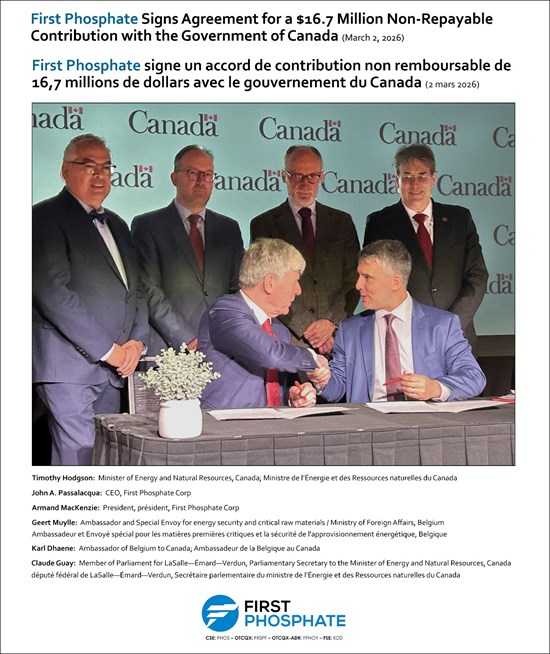
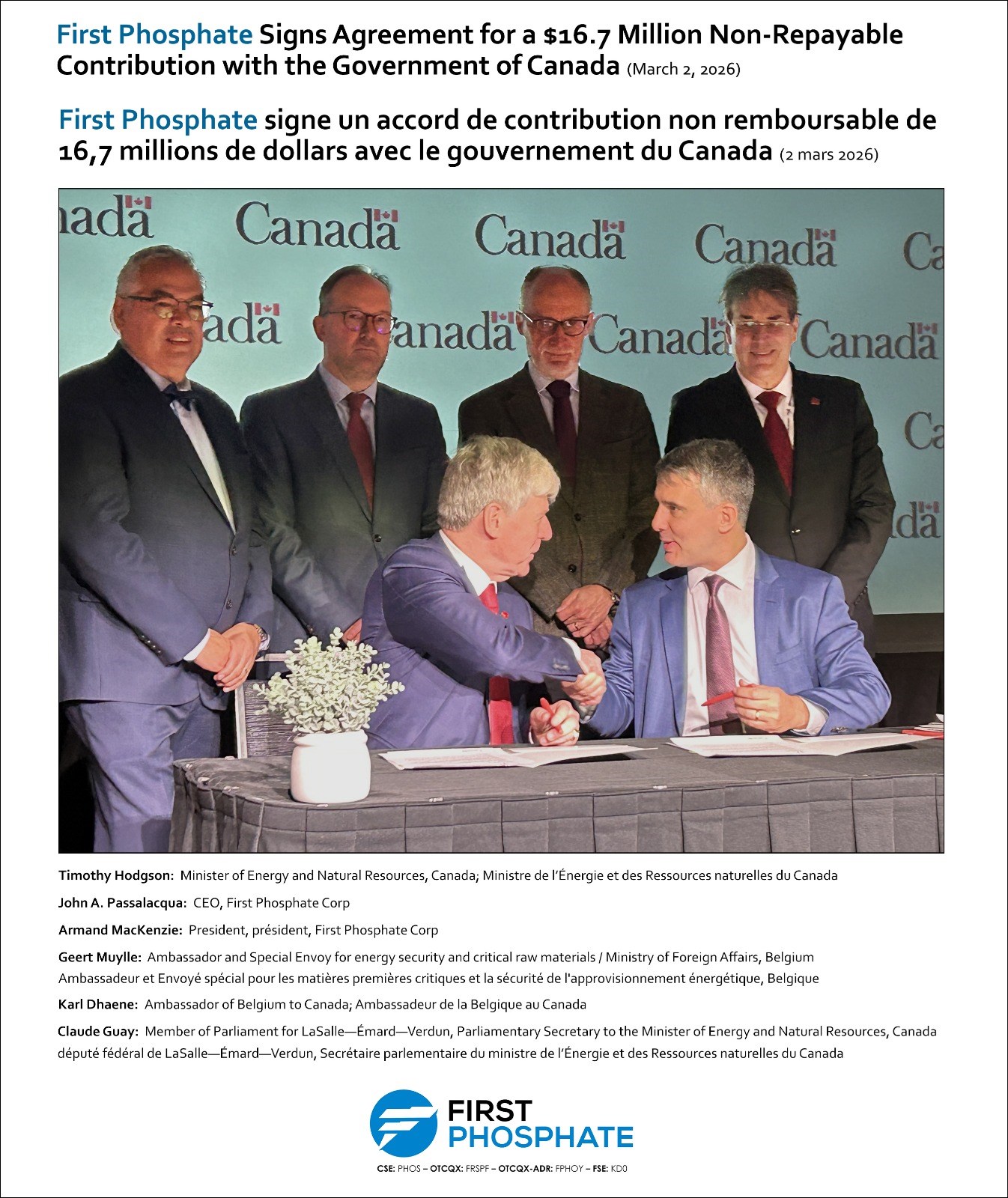
Saguenay, Québec – Newsfile Corp. – March 16, 2026 – First Phosphate Corp. (CSE: PHOS) (OTCQX: FRSPF) (OTCQX ADR: FPHOY) (FSE: KD0) (“First Phosphate” or the “Company“) is pleased to announce that it has finalized an agreement, on March 4, 2026, for a $16.7 million non-repayable contribution from the Government of Canada through Natural Resources Canada (“NRCan”) Global Partnerships Initiative (“GPI”).

This contribution funding will accelerate the development of the phosphate project in Bégin-Lamarche by developing the technical and engineering parameters – including processing circuits and equipment – needed to validate the ability to produce a phosphate concentrate that meets the quality requirements of the lithium iron phosphate (“LFP”) battery market. The work will be conducted based on the parameters established under the contract between First Phosphate and its definitive offtaker.

“Canada and our partners are putting real capital behind the secure and resilient critical mineral supply chains that our economies and defence industries rely on,” said The Honourable Tim Hodgson, Minister of Energy and Natural Resources. “By supporting companies like First Phosphate, we are helping deliver the minerals the world needs and the prosperity and security Canadians deserve.”

“We welcome this investment from the Government of Canada which supports the continued progress of our project and its strategic role in the LFP battery supply chain,” said John Passalacqua, CEO of First Phosphate. “Together, we are taking another step toward establishing an integrated phosphate-based LFP battery supply chain in Canada.”

The Bégin-Lamarche demonstration and feasibility project will help strengthen Canada’s strategic positioning within the LFP battery value chain through the development of domestic capacity to process apatite (phosphate concentrate) into high-purity phosphoric acid (“PPA”) for battery applications.

The project will develop a scalable Canadian process for the production of battery-grade phosphate concentrate, reducing dependence on foreign supply chains.

The project will generate significant economic benefits, including the creation of approximately 277 skilled jobs and the potential establishment of a Canadian phosphoric acid facility supported by local commercial production of phosphate concentrate.

The financial contribution is granted for the completion of a feasibility study of the Company’s integrated Bégin-Lamarche phosphate mine and processing project in Saguenay-Lac-Saint-Jean and covers eligible activities planned through 2028, in accordance with the terms of the agreement.

To view an enhanced version of this graphic, please visit:
https://images.newsfilecorp.com/files/8917/288575_2224e89c6455f8e6_001full.jpg

Qualified Person

The scientific and technical disclosure for First Phosphate included in this news release has been reviewed and approved by Gilles Laverdière, P.Geo. Mr. Laverdière is Chief Geologist of First Phosphate and a Qualified Person under National Instrument 43-101 – Standards of Disclosure of Mineral Projects (“NI 43-101”).

About Natural Resources Canada

Natural Resources Canada (“NRCan”) is the federal department responsible for developing policies and programs to ensure the sustainable and responsible development of Canada’s natural resources. Through its initiatives and funding programs, including the Global Partnerships Initiative, NRCan supports projects that contribute to strengthening supply chains, industrial innovation, and Canada’s competitiveness in the critical and strategic minerals sectors.

About First Phosphate Corp

First Phosphate (CSE: PHOS) (OTCQX: FRSPF) (OTCQX ADR: FPHOY) (FSE: KD0) is a mineral exploration and development and clean technology company dedicated to building and reshoring a vertically integrated mine-to-market supply chain for the production of LFP batteries in North America. Target markets include energy storage, data centers, robotics, mobility, and national security.

First Phosphate’s flagship Bégin-Lamarche property, located in Saguenay-Lac-Saint-Jean, Québec, Canada, represents a rare North American igneous phosphate resource producing high-purity phosphate characterized by very low levels of impurities.

For further information, please contact:
Armand MacKenzie
President
armand@firstphosphate.com
Tel: +1 (514) 618-5289

Investor Relations: investor@firstphosphate.com
Media Relations: media@firstphosphate.com
Website: www.FirstPhosphate.com

Follow First Phosphate:
X: https://x.com/FirstPhosphate
LinkedIn: https://www.linkedin.com/company/first-phosphate

Forward-Looking Information and Cautionary Statements

This release includes certain statements that may be deemed “forward-looking information”. Any statement that discusses predictions, expectations, beliefs, plans, projections, objectives, assumptions, future events or performance (often but not always using phrases such as “expects”, or “does not expect”, “is expected”, “anticipates” or “does not anticipate”, “plans”, “budget”, “scheduled”, “forecasts”, “estimates”, “believes” or “intends” or variations of such words and phrases or stating that certain actions, events or results “may” or “could”, “would”, “might” or “will” be taken to occur or be achieved) are not statements of historical fact and may be forward-looking information. In particular, this press release contains forward-looking information relating to, among other things: the Company’s compliance with the terms of the definitive agreement; the funding amount, anticipated benefits, timing, and potential outcomes of the GPI funding award under the contribution agreement with NRCan and the project funded thereby including, but not limited to, the strengthening of Canada’s strategic positioning within the LFP battery value chain, the development of domestic capacity to process apatite into high-purity PPA for battery applications, the development of a scalable Canadian process for the production of battery-grade phosphate concentrate, the reduction of dependence on foreign supply chains, and the contribution to significant economic benefits, including the creation of skilled jobs and the potential establishment of a Canadian phosphoric acid facility; and the Company’s plans for building and onshoring a vertically integrated mine-to-market LFP battery supply chain for North America. Although the Company believes the expectations expressed in such forward-looking statements are based on reasonable assumptions, such statements are not guarantees of future performance and actual results or developments may differ materially from those forward-looking statements. Factors that could cause actual results to differ materially from those in forward-looking statements include development and exploration successes, continued availability of capital and financing, and general economic, market or business conditions. These statements are based on a number of assumptions including, among other things, assumptions regarding general business and economic conditions; there being no significant disruptions affecting the activities of the Company or inability to access required project inputs; permitting and development of the projects being consistent with the Company’s expectations; the accuracy of the current mineral resource estimates for the Company and results of metallurgical testing; certain price assumptions for P2O5 and Fe2O3; inflation and prices for Company project inputs being approximately consistent with anticipated levels; the Company’s relationship with First Nations and other Indigenous parties remaining consistent with the Company’s expectations; the Company’s relationship with other third party partners and suppliers remaining consistent with the Company’s expectations; and government relations and actions being consistent with Company expectations. Investors are cautioned that any such statements are not guarantees of future performance and actual results or developments may differ materially from those projected in the forward-looking statements. Accordingly, readers should not place undue reliance on the forward-looking information contained in this press release. The Company does not assume any obligation to update or revise its forward-looking statements, whether because of new information, future events or otherwise, except as required by applicable law. All forward-looking information contained in this release is qualified by these cautionary statements.

The issuer is solely responsible for the content of this announcement.

Starlight Investments Announces the Closing of Canadian Multi-family Growth Fund IV

Largest Fund Raised to Date by Starlight, Enabling the Acquisition of over 10,000 Rental Suites

TORONTO, March 17, 2026 /PRNewswire/ — Starlight Investments (“Starlight”), a leading global real estate investment and asset management firm, today announced the successful closing of Starlight Canadian Residential Growth Fund IV (“Growth Fund IV”), the fourth fund in the firm’s flagship Growth Fund series focused on Canadian multi-family real estate.

Starlight Investments

Growth Fund IV received significant equity commitments from a diverse and global investor base, enabling the acquisition of more than 10,000 rental suites across Canada’s major markets. The Fund attracted strong participation from institutional investors across Canada, Asia-Pacific and Europe, the Middle East and Africa (EMEA), including substantial recommitments from existing limited partners, alongside several new global investors in this commingled vehicle.

“The close of Growth Fund IV reflects continued confidence in Starlight’s global experience, proven track record and performance in Canadian multi‑family, as well as the long‑term fundamentals supporting rental housing across the country,” said Raj Mehta, President, Global Markets, Starlight Investments. “We appreciate the trust shown by both long‑standing and new investors, and remain focused on delivering stable, long‑term value through disciplined investment and active asset management.”

Starlight’s Growth Fund platform is centred on the acquisition, management and stewardship of high‑quality, well-located rental properties in major Canadian cities. Backed by operational excellence, the platform delivers professionally managed rental communities that create lasting value for investors while enhancing the resident experience.

For more than three decades, Starlight has been a leading global real estate investment and asset management firm, delivering proven performance and responsible management across its real estate strategies. The company continues to broaden its global footprint, managing and investing on behalf of institutional partners across several continents.

About Starlight Investments

Starlight Investments is a leading global real estate investment and asset management firm headquartered in Toronto, Ontario, Canada. A privately held owner, developer and asset manager of over 70,000 multi-residential suites and over 7 million square feet of commercial property space with CAD $30 billion in AUM, Starlight offers a range of investment vehicles across various real estate strategies. Starlight’s guiding mission is to balance its tenure with visionary curiosity to create positive impact for investors and communities alike. At Starlight, we invest with impact.

Learn more at www.starlightinvest.com or connect with us on LinkedIn.

Contacts: Raj Mehta, President, Global Markets, +1-647-725-0498, rmehta@starlightinvest.com; Talia Schwebel, Vice President, Marketing and Communications, media@starlightinvest.com

Starlight Investments Announces the Closing of Canadian Multi-family Growth Fund IV

Largest Fund Raised to Date by Starlight, Enabling the Acquisition of over 10,000 Rental Suites

TORONTO, March 17, 2026 /PRNewswire/ — Starlight Investments (“Starlight”), a leading global real estate investment and asset management firm, today announced the successful closing of Starlight Canadian Residential Growth Fund IV (“Growth Fund IV”), the fourth fund in the firm’s flagship Growth Fund series focused on Canadian multi-family real estate.

Starlight Investments

Growth Fund IV received significant equity commitments from a diverse and global investor base, enabling the acquisition of more than 10,000 rental suites across Canada’s major markets. The Fund attracted strong participation from institutional investors across Canada, Asia-Pacific and Europe, the Middle East and Africa (EMEA), including substantial recommitments from existing limited partners, alongside several new global investors in this commingled vehicle.

“The close of Growth Fund IV reflects continued confidence in Starlight’s global experience, proven track record and performance in Canadian multi‑family, as well as the long‑term fundamentals supporting rental housing across the country,” said Raj Mehta, President, Global Markets, Starlight Investments. “We appreciate the trust shown by both long‑standing and new investors, and remain focused on delivering stable, long‑term value through disciplined investment and active asset management.”

Starlight’s Growth Fund platform is centred on the acquisition, management and stewardship of high‑quality, well-located rental properties in major Canadian cities. Backed by operational excellence, the platform delivers professionally managed rental communities that create lasting value for investors while enhancing the resident experience.

For more than three decades, Starlight has been a leading global real estate investment and asset management firm, delivering proven performance and responsible management across its real estate strategies. The company continues to broaden its global footprint, managing and investing on behalf of institutional partners across several continents.

About Starlight Investments

Starlight Investments is a leading global real estate investment and asset management firm headquartered in Toronto, Ontario, Canada. A privately held owner, developer and asset manager of over 70,000 multi-residential suites and over 7 million square feet of commercial property space with CAD $30 billion in AUM, Starlight offers a range of investment vehicles across various real estate strategies. Starlight’s guiding mission is to balance its tenure with visionary curiosity to create positive impact for investors and communities alike. At Starlight, we invest with impact.

Learn more at www.starlightinvest.com or connect with us on LinkedIn.

Contacts: Raj Mehta, President, Global Markets, +1-647-725-0498, rmehta@starlightinvest.com; Talia Schwebel, Vice President, Marketing and Communications, media@starlightinvest.com