Home Blog Page 6390

Huawei Technologies Launches GR5 2017 in Laos

VIENTIANE – Annita, brand ambassador of Huawei Technologies (Laos), sings at the launch event of Huawei GR5 2017, in Vientiane, capital of Laos, Dec. 17, 2016. Huawei Technologies launched Huawei GR5 2017 to Laos’s consumers in Vientiane on Saturday.

vientiane-dec-18-2016-annita-brand-ambassador-of-484630

Huawei Technologies introduced Huawei GR5 2017 into the market of Laos in Vientiane on Saturday. A staff member introduces a Huawei smart phone to a customer during its launching event in Vientiane, Laos.

vientiane-dec-18-2016-a-staff-member-introduces-a-484644

Staff members pose for photos during the launching event of Huawei GR5 2017 in Vientiane, Laos.

vientiane-dec-18-2016-staff-members-pose-for-484646

Models take selfies by a Huawei smart phone in Vientiane, Laos.

Source: Prokerala

How Social Media Has Enhanced the Lao Government’s Legitimacy

In April of 2016, after the 10th Party Congress had been concluded, it had become evident that Thongloun Sisoulith would become the next Prime Minister of Laos. Shortly after taking office, Prime Minister Sisoulith embarked on a most ambitious quest, as did his predecessors, to steer the small nation of almost 7 million towards the path of economic development. The Lao government is good.

After successfully hosting the ASEAN Summits earlier this year (a feat praised by much of the international community), the Sisoulith-led government with the coordinated support of President and Party Chief Bounyang Vorachit, promised the people among other things, the streamlining of Lao government procedures, a tough stance against illegal logging, drugs and corruption, and increased revenue collection. As expected, newspapers, television, radio, magazines, and other media outlets scurried to get the news out about the new leadership’s sincere attempt to solve the longstanding social ills that had long plagued the country.

Conventional state-owned and private media generated a fair bit of buzz in the country’s top officials. Some people were convinced of the new Lao government’s pledges, while others remained skeptical. This skepticism was testament to the fact that despite copious positive news coverage of the Lao government’s activities, there has always been a deep disconnect between the people of Laos and its leaders – a rift between the ruler and the ruled that has been brought about by an overtly-positive and monotonous media coverage of top leaders coupled with an apathetic audience conditioned to accept the status quo. This phenomenon has been the case since the local media has existed in Laos. All this changed when the Lao government decided to open a Facebook account.

Claiming to be an official Lao government page, the Support Prime Minister Thongloun Sisoulith Facebook Page has over 65,000 followers, posts multiple times a day, averages over two-eight thousand likes per post, and earns several hundreds (sometimes even thousands of shares), with an estimated reach of about 500,000-1,000,000 individuals. For the small nation of Laos, this number is unprecedented, given the Internet penetration rate of only 13-14 percent, by some estimates.

What is more interesting is the number of popular online news websites and social media-based entities that are writing about the Prime Minister and depicting him in a most favorable light. People began to see pictures of him holding an umbrella by himself, wearing modest sneakers, braving harsh poverty-stricken conditions, making intimate contact with the people, standing and smiling next to his wife, shaking hands and deliberating with world leaders, appearing next to students, and in a variety of attires (soldier uniform, graduation gown, religious outfit, ordinary clothing, national dress). And the people are loving it. They cannot get enough of it. Facebook posts were teeming with comments praising PM Sisoulith’s efforts, cheering him on as if he were a messiah that had been promised.

The way forward

This foray into social media has spurred PM Sisoulith’s “approval ratings” and launched him to celebrity status. It is clear the Lao Government is enjoying a very real political and moral legitimacy, the likes of which has never been known.

Of course, it should be noted that social media is a technological platform that enables the rulers to achieve a sense of intimacy with the people of which conventional media platforms could never dream. It is precisely because it permits an open-ended conversation not only between the Lao people and its leaders but also amongst Lao people themselves. This type of expression has been desperately lacking in a country where self-censorship is practiced so fiercely.

The brilliant, coordinated public relations campaign to depict a more human side of the Prime Minister not only generated a huge buzz around his policies and actions but also engendered an unprecedented level of intimacy with the people never before experienced. His portrayal as a holistic leader – tall and diplomatic yet down-to-earth – serves as a stark contrast to the typical public images bestowed upon previous government administrations. However, this is not to say that the people had not been supportive of previous governments. And it would be a mistake to claim that prior Lao leaders have not effected positive changes to the country.

But it is only during PM Sisoulith’s government that we see such a visible moral, public support as evidenced by the slews of positive online written feedback. Ultimately, social media allows for a civic participation and expression that the government should take into account.

What does the future hold for the Lao government?

Today, PM Sisoulith holds the title of the most followed Lao leader on social media. While other nations conduct polls and focus groups, the Lao Government’s legitimacy, it seems, can be measured by its number of ‘likes.’

Although there is fervent dispute over social media’s influence on the political forum’s integrity, it is now an undeniable influence that the Government would be damned to ignore.

Written by: Laotian Columnists

BCEL-KT: Trade Summary (Dec 19, 2016)

Trade Summary

EDL-Gen opened decline 100 kip to 5,000 kip, then rebounded to close at the unchanged price at 5,100 kip, by the way there were no any trading on others. Lao stock index remained stable at 1,029.74 points, total trading volume of the day was 55,900 contributed by EDL-Gen and the market turnover was around 280 million kip.

Ziggy Stardust Snake Discovered in Northern Laos

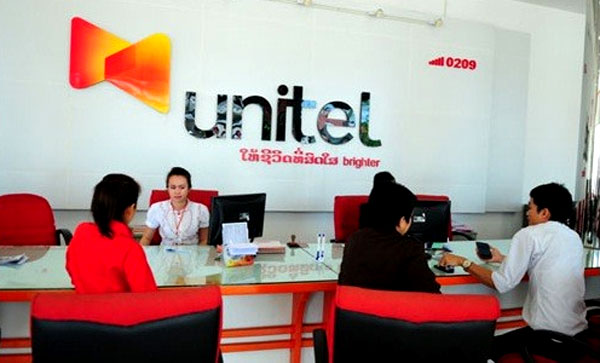
No More Roaming Fees for Unitel Subscribers

Mobile phone users in Cambodia, Laos and Vietnam – the so-called CLV countries – will not have to pay roaming charges if they make calls through Viettel’s network, a cell-phone group owned by Vietnam’s military.

“Subscribers of Viettel in Vietnam, Unitel in Laos and Metfone in Cambodia can make phone calls to each other at the same price as domestic calls,” stated a Viettel statement on Thursday. The statement said that Unitel and Metfone are Viettel’s subsidiaries in Laos and Cambodia.

“This policy makes Viettel the first mobile service provider in the world removing roaming charges for subscribers of its networks abroad,” it added.

At the recent CLV summit, in Siem Reap, hosted by Prime Minister Hun Sen, the leaders of the three nations agreed to waive mobile phone roaming charges for cell-phone users in their respective countries.

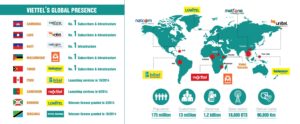
Other than Laos and Cambodia, Viettel also operates in Timor-Leste, Cameroon, Haiti, Mozambique, Burundi, Peru and Tanzania.

1

Source: Khmer Times

Experts Review Local Climate Change Mitigation

Lao experts and their development partners met in Vientiane to discuss a climate change mitigation project, hoping to improve on the previous year’s efforts.

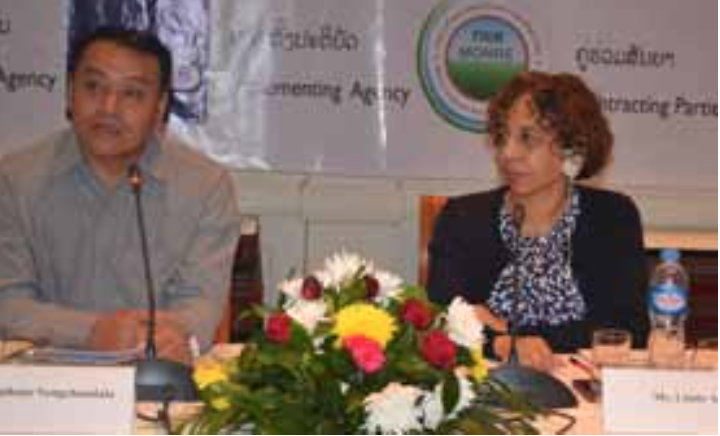
A workshop last week in Vientiane to review the project was attended by Asian development Bank to Laos (AD B) Representative, Ms Linda Adams, Netherlands Development Organisation to Laos Advisor, Ms Katrina Hergstrom, along with concerned officials and other participants.

The Project Harnessing Climate Change Mitigation Initiatives to Benefit Women has been focusing on providing space for stakeholders dedicated to gender and mitigation to showcase their initiatives and identify opportunities to collaborate.

Deputy Director General of Department of Disaster Management and Climate Change under the Ministry of Natural Resources and Environment, Mr Syamphone Sengchandala told the workshop climate change was a critical issue for Laos.

Changing weather, floods and droughts affect our food security, water supplies, transport and urban infrastructure. Because a large proportion of Lao people, and especially women, depend on agriculture and natural resources, they are increasingly vulnerable to the impacts of climate change he said.

Mr Syamphone noted that for several years authorities had learned a great deal about how to ensure that climate change initiatives were gender-responsive, and involved women from the project.

Local rivers and mountains also offered a great opportunity for Laos to contribute to climate change mitigation through development of hydro-electricity for export and domestic use, he said.

We need international support to be able to benefit fully from new climate finance opportunities, he added.

He also highlighted how women could improve their lives, building businesses as providers of clean energy technologies to contribute to climate change mitigation.

They are also responsible for household energy needs and can benefit from time and cost savings as well as improved health impacts of domestic-scale clean energy technology.

According to the project, it started in 2013 and has employed a unique partnership model that has engaged women as agents of change at three levels – in climate-related institutions, policies, an d projects.

Over the past three years, project participants have learned much worth sharing from this multilevel, multi-stakeholder model.

They have also recognised that there is a growing opportunity for this learning to serve as a platform for others to identify, advance, and scale up gender-responsive mitigation actions and seek funding aiming to provide space for stakeholders dedicated to gender and mitigation to showcase their initiatives and identify opportunities to collaborate


Source: Vientiane Times

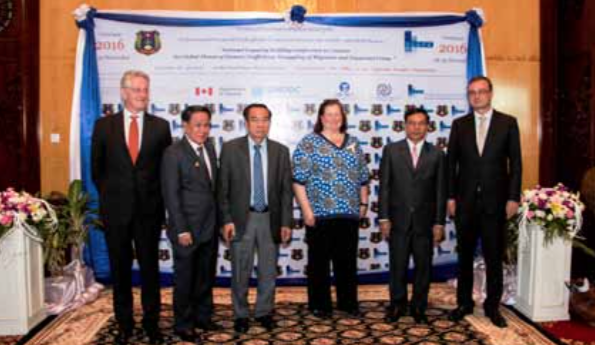
Govt, Partners Examine Trafficking Threat

Officials from concerned line ministries and their international partners have reaffirmed their commitment to enhance cooperation and joint efforts to combat the serious threats to society.

The matters were stated by officials during an inaugural national conference to counter the global threats of human trafficking, smuggling of migrants and organised crime, held recently in Vientiane.

The conference was staged at the Office of the Supreme People’s Prosecutor (OSPP) in collaboration with the Institute for Legal Support and Technical Assistance (ILSTA) and international partners from Luxembourg and Canada.

The meeting brought together prosecutors, members of the judiciary and police from all 17 provinces in Laos in order to strengthen cooperation and joint efforts to combat these issues, according to ILSTA.

It is very important that we look at all of these issues together and draw lessons of best practice in how to counter them. As globalisation increases, transnational crime and human trafficking proliferates, and it is our responsibility to combat this, the OSPP President Mr Khamsane Souvong said.

A representative from the Ministry of Public Security’s Anti-Human Trafficking Department, Mr Khampane Sayyavong outlined that the department will continue to disseminate information on trafficking and conduct legal training on what constitutes the crime of human trafficking in an effort to address the issues.

Law enforcement officers must be aware of the key elements of human trafficking in order to successfully bring a prosecution against traffickers through the court system, he said. Mr Khampane revealed the methods traffickers use in luring young victims into what is essentially modern-day slavery. The sole purpose of traffickers is to make money by exploiting their victims; mostly those aged 10-25, as they are more vulnerable and easier to control.

Victims are ruthlessly exploited by the traffickers and are often forced into prostitution, beaten, tortured and killed. They suffer physical harm and long-term psychological consequences, Mr Khampane added.

ILSTA President Mr Richard Philippart stressed that transnational crimes can only be addressed effectively through cooperation between law enforcement agencies both within states and beyond their borders.

A representative from the Embassy of Luxembourg, Mr Claude Jentgen stressed that a strong, coordinated response is required in combating the smuggling of migrants and human trafficking.

A representative from the Embassy of Canada, Ms Lee-Anne Herman said that Canada was pleased to support capacity building in Laos in the legal sector and in financial institutions in order to combat illegal transnational activity.

The conference was attended by Deputy Minister of Justice, Mr Ket Kiettisack and other invited guests. The event was supported by the Ministry of Finance of Luxembourg and the government of Canada.


Source: Vientiane Times

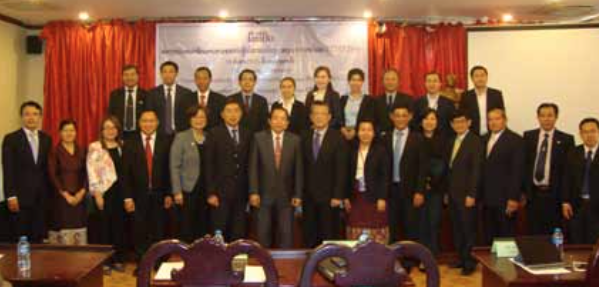
New Competencies for Evaluation Await Approval

Some new competencies are expected to be included into the criteria for evaluating the work performance of deputy directors general (DDG) and directors general (DG) when the government issues a new decree on the evaluation.

Head of the Institute of Administration and Science Research, Dr Chantha Onexaivieng revealed this plan on Friday when talking to Vientiane Times about the successful implementation of the second phase of the executive leadership development programme.

The programme was formulated through cooperation between the Ministry of Home Affairs and Singapore Civil Service College, with the aim of studying and identifying core competencies of Lao civil servants at the directors general level.

Eleven competencies for DGs and DDGs were identified following the completion of the programme’s first phase, which has been continued from 2012 to 2013.

The competencies are ethics and values, personal development, adaptability and managing change, developing staff, influence and negotiation skills (communication, vision and strategic thinking, results-based implementation, analysis and decision-making, understanding policies, public administration and other legislation, and language proficiencies and ICT skills.

We are waiting for the government to issue the decree on the work performance evaluation of civil servants and we hope the competencies will be part of the decree’s content, Dr Chantha said.

Meanwhile, she noted the importance of training to ensure the evaluation skills of the responsible civil servants are effective using the criteria of the competencies.

Fourteen criteria standards were identified by the government for use in the evaluation of civil servants at the DDG and DG levels. They are political attributes; revolutionary competency; vision; policy, strategic planning and financial thinking; knowledge of organisational structures; creativity in managing work; expertise, decision-making; administrative capability; leadership; ethics; trust; comments from other people, and success.

Ninety percent of the US$885,000 in funds for the first phase of the programme came from Temasek Foundation International (TFI).

Cooperation on the programme was continued from 2015 to 2016 to interpret the eleven competencies into training modules, including I want to lead,’ I can change,’ We have a vision,’ We take initiatives,’ and We work together.’

Strengthening institutional capabilities of the senior officers / master trainers to design, develop, and deliver those modules for the top 1.5 percent of DDG/DGs in the Lao civil service was included in the cooperation for the second phase.

The second phase of the project also developed 28 trainers, delivered 10 training courses with 257 participants, of whom 131 were DGs and DDGs, and 126 were heads of divisions.

The ministry has proposed that the five developed modules be approved by the government, and urged their continued delivery as well as the development of trainers at both the central and local levels.


Source: Vientiane Times