Home Blog Page 6509

Japan Supports Gender Education in Bokeo

The Japanese government has provided grant assistance of more than 3.7 billion kip (US$450,381) to build secondary school facilities and support gender education in Bokeo province.

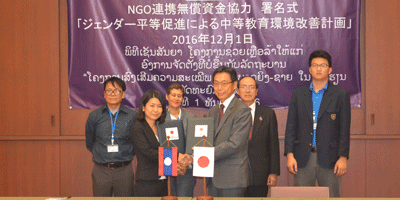
A signing ceremony for a grant contract for the project took place on December 1 between the Ambassador of Japan to Laos, Mr Takeshi Hikihara, and Project Manager of Plan International Japan, Ms Chiya Nagashima.

Plan International Japan is a Japanese non-profit organisation that has been actively engaged in development support for the education and health sectors in Laos since 2007. The grant extended at this time will fund activities in the first year of this three-year project.

The project, Better secondary education for girls through promotion of gender equity, aims to create gender-sensitive school environments and develop the capacity of secondary school teachers, students and local communities to promote gender equality.

The project will target all 10 secondary schools in Pha-oudom district, Bokeo province.

In the first year, the project will provide opportunities to learn basic knowledge about gender issues. Two teachers from each school will be selected as gender focal teachers, who will be expected to lead activities at their respective schools.

The project will also establish a reporting and monitoring system for students who have gender-related issues. It will also help with starting a children’s club to promote children’s initiatives and voices.

Five schools will be targeted during the first year. In the second and third years, the project will further strengthen teachers’ capacity to deal with gender related issues. For the newly targeted five schools, the same training will be conducted as in the first year.

Children’s clubs will have exchange programmes with other children’s clubs outside their schools and their leaders will participate in events on International Women’s Day. They will advocate gender equality, and over three years, the project will build student dormitories with kitchen facilities, separate latrines for boys and girls, and a water supply system in one school each year.

Project Manager Ms Chiya Nagashima said they had selected the schools in Pha-oudom district because they were located in a remote area of Bokeo province.

These schools lack the facilities to support teaching and learning, while some families do not support their children in education, especially girls, so there are fewer girls in schools than boys in this area.

The project aims to upgrade gender equality in education and it is believed the project will lead to more development and sustainable outcomes after it ends, Ms Chiya said.


Source: Vientiane Times

Foreign Diplomats Wish Laos Continued Success in Development

The heads of diplomatic missions in Laos have expressed confidence that the current National Socio-Economic Development Plan (NSEDP) will lead to tangible progress in achieving continuous, inclusive and sustainable growth.

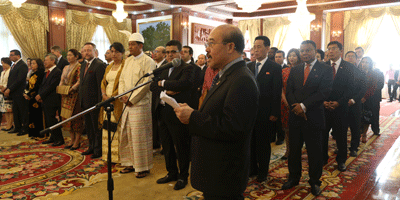
This was the main message delivered by foreign diplomats to the country’s leaders, government and citizens during a ceremony held at the Presidential Palace on Friday to celebrate Laos’ 41st National Day.

Malaysian Ambassador to Laos Dato’ Than Tai Hing, as Dean of the diplomatic corps, led representatives of diplomatic missions in offering good wishes to President Bounnhang Vorachit, his wife, and the government.

Ambassador Hing congratulated Laos on the successful convening of the General Election of the National Assembly in March, saying it paved the way for the smooth transition of the country’s leadership.

The diplomatic corps noted the continuing political stability in Laos over the past 41 years as one of the country’s most remarkable achievements, which they said had enabled the effective and successful implementation of successive five-year NSEDPs, including the current eighth cycle from 2016 to 2020.

We strongly believe that Laos will achieve its objectives and strategies as the 8th NSEDP will be pursued with great vigour and determination under the guidance of the country’s wise and visionary leadership, said the message read by Ambassador Hing.

We are confident that the direction set by the 8th NSEDP will lead to tangible progress in continuous, inclusive and sustainable economic growth, as well as achieving other planned concrete outcomes as outlined in the overall objectives of the plan, the message added.

This year was noted by foreign diplomats as having been eventful, busy and demanding as Laos assumed the chairmanship of ASEAN, and stood out as a year of diplomatic success for the country.

They noted with admiration that under Laos’ chairmanship, ASEAN had taken significant steps in the first year of the establishment of the ASEAN Community towards the realisation of the ASEAN Vision 2025 under the theme Turning Vision into Reality for a Dynamic ASEA N Community.

They also mentioned Laos’ strategic location within the region, which they said made it an attractive add on destination for holiday-makers. People were attracted by its rich blend of nature, culture, traditions and rural lifestyle along with drawcard destinations and historical sites that have fascinated tourists from all over the world.

The diplomatic corps also underlined the spirit of leadership, cooperation and solidarity between Laos and its partners, expressing the hope that this be further developed and strengthened in the years to come.

In greeting guests at the ceremony, President Bounnhang highlighted the achievements made over the past year. He noted that the Party and government had led the nation by bringing together all economic sectors to implement the Resolution adopted by the Tenth Party Congress and realise the eighth NSEDP, whose objectives include fulfilling the United Nations’ Sustainable Development Goals.


Source: Vientiane Times

“They’re so Lao”: Explaining the Thai sense of superiority

theyre-so-lao

A Thai photographer’s Facebook post drew attention to long-standing tensions between the cultures of his nation and neighbouring Lao. But is “you’re so Lao” truly an insult? It apparently is for the fiercely proud Thais.

By Oliver Ward

Thai photographer, Pongsaton Gitprachaya was photographing a motoring expo in Vientiane when he casually commented  “Damn, they´re so Lao” on his Facebook page. The comment was intended to point out the, in his view, inferior nature of the work on display but the comment was picked up by the national media and he had to flee across the border. Despite his apologies Lao netizens exploded with anger and the damage was done.

Behind this story is the strong belief among Thai professionals that their work is far superior to anything produced by their neighbours.  But when you look deeper, the use of the term “Lao” as an insult is offensive not only to Laotians but also to swathes of the northeastern Thai population who share Lao roots.

One people, divided

Divided by the mighty Mekong river, the people in both nations share linguistic and cultural similarities. In fact, the Lao kingdom of Lan Xeng included all of northeastern Thailand as recently as the early 18th century.

As a result, the people of the northeastern Isaan region, in particular, share strong Lao roots. This is because even after the fall of the Lan Xeng kingdom and during the following Ayutthaya and Rattanakosin periods, Isaan was incorporated into the territory of Siam but retained their strong Lao cultural connection. Linguistically they speak Isan, a Lao dialect used by a third of the population of Thailand.

And the connections between the two nations run much deeper than appearances. Shared cuisine, language, fashion and culture transcend the Mekong, meaning any belief in the superiority of “Thainess” fails to grasp the extent to which the two nations were a united Kingdom until fairly recent history. To be fair, the feeling of Thai superiority is not present amongst the whole nation, but certainly, the population of central and southern Thailand look to their northern borders with contempt.

Some of the most public examples of this are cases where the Thai entertainment industry has been responsible for offending Laotians. Several years ago, Thai singer Uthen Prommin caused a stir with public insults while the film Mak Te (Lucky Losers), tells the tale of a football cup where the Thai and Lao national teams face each other in the final. It was widely criticised for depicting Lao’s players as country farmers who were utterly incapable of organising a national team until they hired a Thai as a manager. It was never released.

Where does it come from?

Thamrongsak Petchlertanan, an expert on Thai history at the Rangsit University, believes that the idea of Thai superiority is rooted in almost a century of nationalist education in Thai schools. Anti-communist ideology after the 1950´s bolstered the idea of “Thainess” and the idea of Thai conquest and dominance over the region. As part of this narrative, the destruction of Vientiane by the Siamese army in 1778 has been told with enthusiasm to generations of Thai children.

In the wider picture, Lao has limped behind Thailand economically since the Cold War due in part to the economic restrictions imposed on the country. Much of the economic assistance received by the Lao government since has come from Thai pockets, contributing to increased Thai zealotry. However, this understanding conveniently ignores the fact that Laos’ economy is currently growing faster than that of its Thai neighbour.

The widespread religious belief in karma also plays a role in spawning a sense of Thai superiority. Many Thais feel their neighbouring countries have seen less development as they have procured less karma and goodwill, perpetuating ideas that Laotians or Cambodians are villains that lack moral integrity.

The final plank in the Thai mindset is the history of border skirmishes between the two nations, the most significant of which in December 1987 ignited the Thai-Laotian war. The dispute was over national boundaries and ownership of four small villages. The first blow was landed by the Thai army which moved in and raised their flag,  prompting Lao forces to fight back under cover of darkness and reclaim the village as their own. The fighting went on for some weeks until a ceasefire was declared in February of 1988.

Solving the problem of Thai superiority

Solving the problem between these two brothers in culture and ASEAN will not be a simple task. While politician and educators retain the view of Thai superiority it will never be as easy as changing the syllabus of new diplomatic deals. A complete overhaul of social perceptions would need to occur first. This is especially true for the feeling of superiority over their Cambodian neighbours, as the Thai government has strategically fueled anti-Cambodian sentiment in the past to help strengthen their claim over the disputed land near Preah Vihear.

After joining the ASEAN economic integration agreement, Thai relations with their neighbours are more important than ever as closer economic ties have brought more people from Thailand´s neighbouring countries in to both work and visit the country. Subjecting these people to a bigoted belief of their inferiority will only cause tensions and undermine the modernising process which has made Thailand a good place for foreign nationals to do business.

The Laotians themselves have their own way of fighting back.  On their streets you hear another expression that cuts to the bone, “don’t be Thai to me”. It’s a sense of superiority that has never really been earned.

Source: ASEAN Today

Laos Visas Explained

Laos Visa Explained

By RDK Group
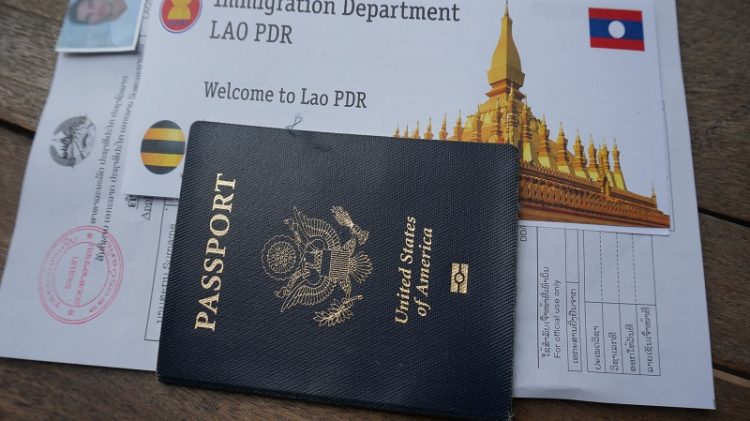
Most foreigners require a visa before entering the territory of Laos. Generally speaking, obtaining a visa to Laos is a relatively simple process, although specific information is not always easy to find. This guide explains each type of visa available, as well as the application process for each:

Tourist Visa (T-B3)

While tourist visas can be obtained at a Lao embassy or consulate abroad, tourists from many countries are offered a tourist visa on arrival in Laos. Obtaining a visa on arrival is a simple process, requiring only filling out a few forms and paying a visa fee at a land border crossing or at airport immigration. The standard fee for a visa is $30 USD, although fees may vary from country to country.

Visas on arrival are available at:

  • Lao international airports in Vientiane, Luang Prabang, Pakse and Savannakhet.
  • Thanaleng Railway Station in Vientiane Capital
  • International land border crossings including Lao-Thai Friendship bridges in Vientiane, Thakhek and Savannakhet, and land borders with other countries.

Citizens of some countries, including Japan, Russia, Switzerland, Republic of Korea, and Luxembourg may enter and remain in Laos without a visa for 15 days. To see a full list of countries with bilateral or unilateral visa exemption agreements, view this list by MOFA.

Citizens of the following countries are not eligible for visas on arrival:

Afghanistan Nauru
Algeria Niger
Bangladesh Nigeria
Burundi Pakistan
Cameroon Senegal
Cote d’Ivoire Sierra Leone
Congo Sri Lanka
Ghana Suriname
Guinea Syria
Guinea Bissau Swaziland
Jordan Tonga
Lesotho Turkey
Liberia Zambia
Libya Zimbabwe
Mozambique


Tourist Visa Fees by Country:

Country          Price (US Dollar)
Australia          30
Canada            42
China               20
India                40
Sweden           31
USA                35
UK                  35
Others             30+-

Tourist Visa Extension:
If you are having a great time in Laos and want to stay longer, your visa can be extended at the Immigration Department, Ministry of Public Security, in Vientiane Capital (off Lane Xang Avenue, here). The extension cost is $2 per day if you apply before your original visa expires, although there is a fine of US $10 per day for each day you overstay your original visa. You’ll need your passport, one passport photo, and the correct amount of money for fees.


Transit Visa (TR-B3)

A Transit Visa is for tourists that will transit through Laos to another destination. This type of visa allows a seven day stay in Laos, and it cannot be extended. When applying for this visa, it may be necessary to provide evidence of an onward trip, such as an air ticket or entry visa for the next destination.


Visitor Visa (B3)

Visitor Visas are for citizens of foreign countries that wish to enter Laos for the purpose of visiting relatives living in Laos. This type of visa can be obtained from Lao embassies or consulates abroad. The visa allows visitors a stay of 30 days in Laos, and it may be extended twice. It may also be necessary to provide a letter from a guarantor in Laos, certified by MOFA, Laos.


Labor Visa (LA-B2)

The LA-B2 Labor Visa is the most common type of visa held by foreigners living and working in Laos. This visa may be for a 3 month, 6 month, or 12 month duration, and is a multiple entry visa, meaning the bearer may exit and re-enter the country as many times as they wish. In order to apply for this visa, the applicant must be legally employed and sponsored by a registered enterprise in Laos which holds a quota for foreign employees. The visa is normally accompanied by a Work Permit, and Stay Permit, and spouse visas are available under this visa.

RDK Group
If you do not have a company to sponsor you, or need assistance in processing a B2 visa, RDK Group can help facilitate this for you. Either visit our website, or complete this form.


Expert Visa (E-B2)

The expert visa is a visa issued to foreign experts, usually working for international organizations or non-government organizations. The conditions and processes are similar to that of the LA-B2 visa. The visa is normally accompanied by a Stay Permit and Work Permit, and spouse visas are available under this visa.


Investor Visa (NI-B2)

The NI-B2 Investor Visa is available to foreign citizens who have invested in an enterprise registered in Laos. This includes foreign investors, stockholders, directors, deputy directors, and technical officers. The visa is normally accompanied by a Stay Permit and Work Permit, and spouse visas are available under this visa.


Media Visa (M-B2)

The Media Visa is a special visa issued to registered foreign journalists who cover events in Laos.


Student Visa (ST-B2)

Student Visas are issued to foreign students that will study in Laos for one to five years. It is a 12 month visa that can be extended every year.


Spouse Visa (SP-B3)

The spouse visa is issued to husbands or wives of other types of visa holders. The spouse visa will normally be for the same duration as that of the original visa holder. A spouse visa holder may not undertake any work while in Laos.


Diplomatic Visa (D-A1)

This type of visa is only available to diplomatic passport holders, including consular officers, heads of international organizations and United Nations agencies, and their families. The visa is a 12 month multiple entry visa, and can be extended every year.


Official Visa (S-A2)

The Official Visa is similar to the A2 visa, and is for the staff members of diplomatic missions, consulates, United Nations agencies, and their families. It can is a 12 month visa which can be extended each year.


Courtesy Visa (C-B1)

The courtesy visa is a visa issued to foreign experts and their families, who perform assignments under bilateral cooperation or grant assistance projects for the government of Laos. The Courtesy Visa is exempt from visa fees and allows multiple entry for 6 months, or until assignment completion.


This article supplied by RDK GROUP.

RDK Group


Lao, Chinese Officials Exchange Views on Socio-economic Development

Confirmation of Laos’ commitment to participate in China’s One Belt, One Road’ initiative will add fresh impetus to and broaden the prospects for the two countries’ future cooperation.

The initiative will further improve the well-being of the Lao people and promote socio-economic development in the country as a whole.

China’s One Belt, One Road initiative is highly compatible with Laos’ national development strategy, said Professor of International Relations from Jinan University in Guangzhou, Dr Zhang Zhenjiang, when he and his delegation met with senior officials from Lao media organisations in Vientiane yesterday.

During the meeting, officials from the two countries exchanged views on topics concerning the One Belt, One Road’ initiative, the economic situation in China and other issues of interest.

Dr Zhenjiang said the planned China-Laos railway would transform Laos from being landlocked to land-link ed.

The China-Laos railway will be the first route to connect Laos with the vast railway system in China, using Chinese technology, equipment and investment.

The project has a total investment of 40 billion Chinese yuan (about US$6 billion), 70 percent of which comes from China, while 30 percent comes from Laos.

The China-Laos railway will cover a distance of 427km and will be completed by 2021. It marks an important milestone in the socio-economic cooperation strategy of the two countries.

The project links to the One Belt, One Road’ initiative of Chinese President Xi Jinping and will contribute to increased friendly relations and cooperation between Laos and China, and between C hina and Asean.

The Lao government has highlighted the significance of the railway in transforming Laos from a landlocked country to a land link and attracting more foreign investment and tourists.

The railway will also serve to boost production in Laos, both for export and to spur economic growth.

With regard to economics, China’s annual GDP growth rate averaged 10 percent for 35 years from 1978 to 2013, but has now slowed to 6-7 percent.

The country’s annual GDP growth rate has fallen to a level unseen since 1978 and a so-called new normal has arisen .

The metric that is most commonly used in the media to gauge China’s macroeconomic movement is year-on-year GDP growth rate — meaning the percent deviation that the economy has grown this year over the same point last year.

While this metric can help to provide a picture of what is happening in China’s economy, its importance has been severely overrated.


Source: Vientiane Times

Vietnam Tops List of Destinations for Lao Students

From 2011-2016 Lao students and officials took more academic courses in Vietnam than any other country, according to figures from the Ministry of Education and Sports.

More than 13,300 Lao students took courses in Vietnam from 2011-2016, while this academic year 3,498 Lao nationals are studying in foreign countries.

Director General of the Student Affairs Department, Associate Prof. Dr Khamleusa Nuansavanh, recently told the Education and Sports newspaper that the 3,498 figure includes 1,688 women studying abroad in academic year 2016-17.

Some 1,680 students received scholarships from the government while others received exchange scholarships arranged between Laos and various countries, and 1,818 students paid for their own studies abroad.

Associate Prof. Dr Khamleusa said more Lao students preferred Vietnam over other countries, with 1,749 people studying in the country in 2016-17. In 2015-16, almost 5,200 Lao nationals studied abroad including 899 on government scholarships, 2,490 through other programmes, and 1,797 being self-financed.

From 2011-2016, more than 13,300 Lao students and officials took courses in Vietnam, along with 3,289 in China, 909 in Thailand, 258 in Japan, and 252 in Australia.

According to the Student Affairs Department, Lao students have studied in 37 countries for bachelor, master’s and PhD degrees in subjects including administration, foreign affairs, law, technology, and agriculture and fisheries.

Associate Prof. Dr Khamleusa invites people wanting to apply for scholarships to study abroad to monitor the Student Affairs Department website: www.dsa.moe.gov.la/lo/.

This website gives the details of foreign scholarships and there are many available for students and officials at several ministries. Many countries provide scholarships for Laos each year, he said.


Source: Vientiane Times

Govt, Japan to Further Develop Human Resources in Legal Sector

To realise the government’s master plan of building the country into a state governed by the rule of law, Laos will continue to work with Japan to enhance their joint efforts to develop institutional and individual capacity in the legal sector.

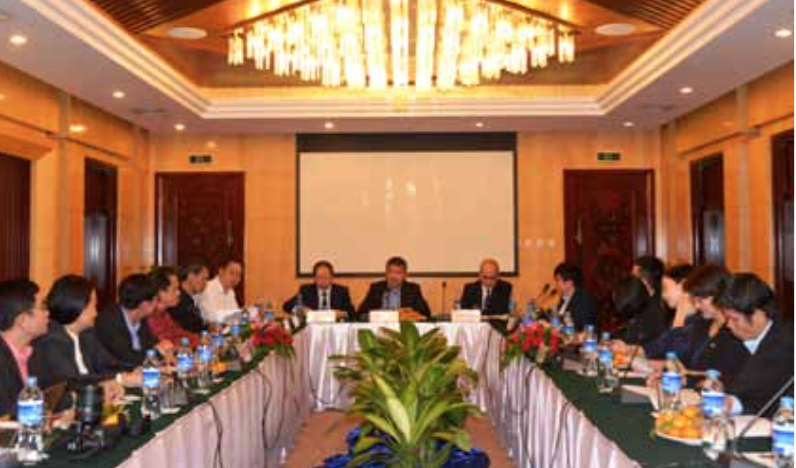
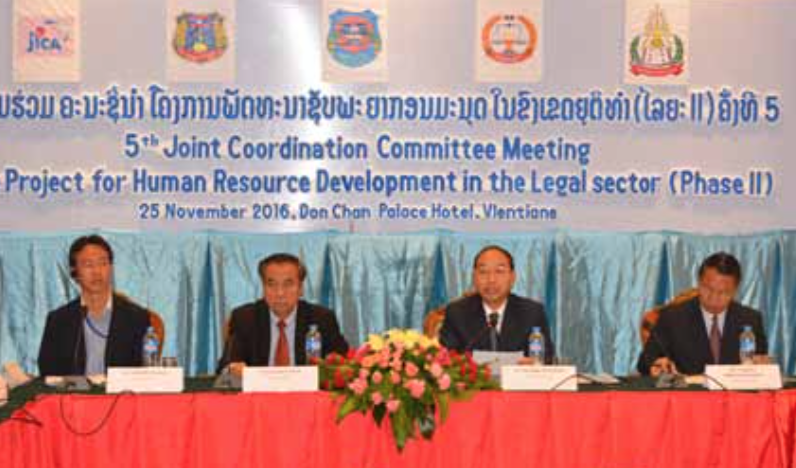
This was the key message delivered by the Vice President of the People’s Supreme Court, Mr Khampha Sengdara, when he addressed the 5th Joint Coordination Committee Meeting of the Project of Human Resource Development in the Legal Sector (phase 2), held in Vientiane on Friday.

Mr Khampha said the project focused on implementing four activities: making civil law, writing handbooks on civil law and economics, writing handbooks on criminal law, and developing an education law institute.

The working group members comprised officials and lecturers from the Ministry of Justice, the People’s Supreme Court, the Supreme People’s Prosecutor Office, and the National University of Laos.

The group has systematically analysed legal theories and practical issues relating to the civil code, civil procedure and criminal procedure, and developing a handbook summarising the result of the analysis.

The group has explained how to use the handbook and its contents to institutions and officials/lecturers in the legal and justice sector.

The project has been implemented through a technical cooperation agreement between the Japan International Cooperation Agency (JICA) and the Ministry of Justice, the People’s Supreme Court, the Supreme People’s Prosecutor Office, and the National University of Laos.

The goal of the project is to enable institutions and officials/lecturers in the legal and justice sectors and legal education to develop their institution/individual capacity to advance legal studies on Lao law on the basis of systematised analysis of theories and practices.

During the meeting, participants discussed the progress and outcomes of the project over its implementation period. According to the terminal evaluation team from JICA, the expected outputs are to be realised as planned in the project design.

Based on the evaluation criteria such as relevance, effectiveness, efficiency, impact and sustainability, the project has been evaluated high or fairly high overall, said Mr Khampha.

The first phase of the project began in 2010 and ended in 2014, focusing on strengthening the capacity of institutions and officials in the Lao legal and justice sectors, as well as legal education.

The meeting was attended by representatives from JICA, the Ministry of Justice, the People’s Supreme Court, the Supreme People’s Prosecutor Office, and the National University of Laos.


Source: Vientiane Times

Four People Killed in UXO-related Accidents over 10 Months

Four people have died and 11people have been injured in UXO-related accidents from January to October 2016, according to a report from the Lao National Unexploded Ordnance Programme (UXO Lao).

The report was disclosed on Friday at UXO Lao’s annual meeting to summarise their work over the past year and plan for the year ahead.

The meeting was attended by Minister of Labour and Social Welfare Dr Khampheng Saysompheng, UXO Lao Director Mr Thipphasone Soukhathammavong, and other officials.

An official from UXO Lao said that from January to October of this year there had been seven UXO-related accidents in which 11 people sustained injuries and four people died.

Three of the accidents occurred in Xieng Khuang province where two people sustained injuries and one was killed.

Another incident in Savannakhet province saw two people sustain injuries.

In Attapeu province, an explosion resulted in five people being injured and one being killed.

An accident in Khammuan province injured one person and killed two, while in Champassak province an explosion injured one person.

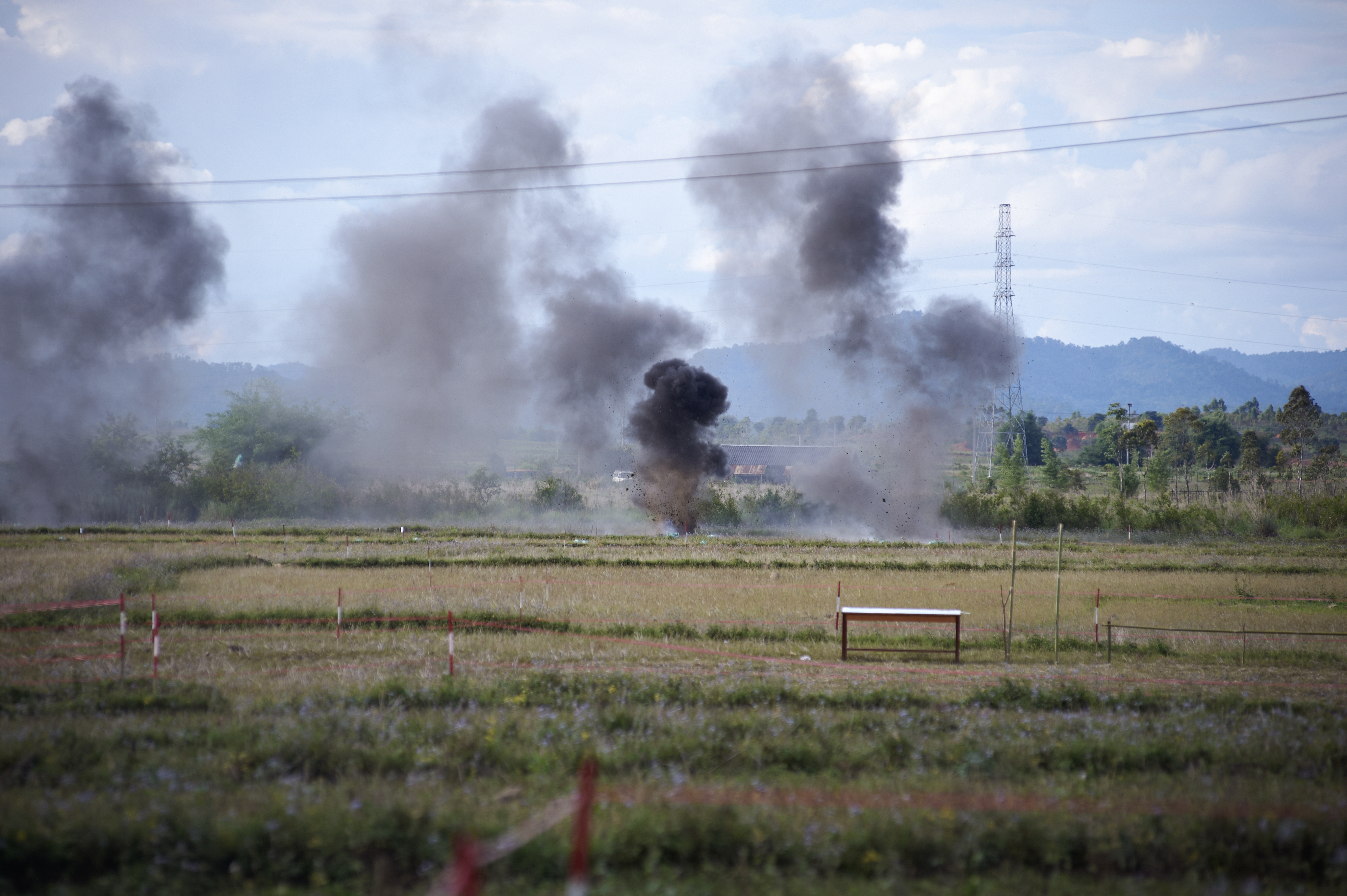
Explosions typically occur during the transport, dismantling or burning of UXO, or while villagers are working in their fields.

U XO Lao has worked with international organisations to clear UXO from 2,147 hectares of land, of which 93 percent is needed for farming and 7 percent for development purposes.

Some 84,402 cluster munitions were cleared, including 68,639 bombies and other items. On average, 21 bombies per hectare have been found.

UXO Lao’s target is to remove UXO from 3,200 hectares of land in the provinces of Huaphan, Luang Prabang, Xieng Khuang, Khammuan, Savannakhet, Saravan, Xekong, Attapeu and Champassak.

Addressing the meeting, Dr Khampheng said UXO Lao’s goal is to reduce the number of casualties and provide assistance to the survivors of UXO-related accidents.

During the Indochina War from 1964-73 some 3 million tonnes of UXO were dropped o n Laos, including about 270 million sub-munitions from cluster bombs and about 4 million aircraft bombs.

Tests in the United States have found that cluster munitions have a failure rate of up to 30 percent, meaning a large amount of unexploded devices still remain in Laos.

A total of 87,000 square kilometres of land are thought to be contaminated with UXO.


Source: Vientiane Times