Home Blog Page 86

Canadian Solar Reports First Quarter 2026 Results and Announces Appointment of Chief Executive Officer

KITCHENER, ON, May 14, 2026 /PRNewswire/ — Canadian Solar Inc. (“Canadian Solar” or the “Company”) (NASDAQ: CSIQ) today announced financial results for the first quarter ended March 31, 2026.

First Quarter Highlights

  • Solar module shipments of 2.5 GW, above guidance of 2.2 GW to 2.4 GW.
  • Energy storage shipments of 2.1 GWh, exceeding guidance of 1.7 GWh to 1.9 GWh.
  • Net revenues of $1.1 billion, at the high end of $900 million to $1.1 billion guidance.
  • Gross margin of 25.1%.
  • Commenced trial production at the flagship HJT solar cell factory in Jeffersonville, Indiana, marking a key milestone in U.S. domestic manufacturing, with commercial operation targeted to begin in July 2026.
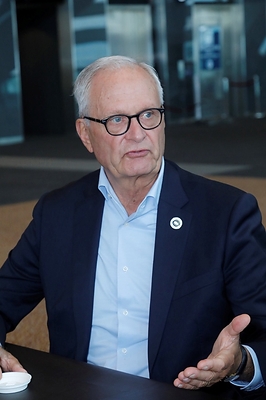
  • Appointment of Mr. Colin Parkin as Chief Executive Officer, effective May 14, 2026. Mr. Parkin previously served as President of Canadian Solar. Dr. Shawn Qu, the Company’s founder, will transition from Chairman and Chief Executive Officer to the roles of Executive Chairman and Chief Technology Officer.

Dr. Shawn Qu, Executive Chairman and CTO, commented, “Canadian Solar’s journey from its founding in Ontario to its current position as a global leader in integrated clean energy is a testament to our enduring resilience. We have consistently evolved, and today we are navigating a pivotal shift from volume-driven expansion to value-driven leadership. This evolution calls for thoughtful leadership succession, and I am incredibly proud to transition the Chief Executive role to Colin Parkin, whose execution and operational leadership have already established our first-mover advantage in the energy storage sector. As I dedicate my focus to advancing our technological roadmap, we are deepening our commitment to our U.S. manufacturing footprint. Our Jeffersonville solar cell facility has entered trial production, and commercial operation is expected to commence in about two months. Coupled with the capacity expansion at our Mesquite module plant, we are helping strengthen the American solar supply chain to ensure long-term, sustainable growth.”

Dr. Shawn Qu founded Canadian Solar Inc. in Mississauga, Ontario 25 years ago. He holds a Ph.D. in Materials Science from the University of Toronto, an M.Sc. in Physics and an honorary doctorate from the University of Manitoba, and a B.Sc. in Physics from Tsinghua University. Dr. Qu has been a Fellow of the Canadian Academy of Engineering since 2019.

Colin Parkin, CEO of Canadian Solar, said, “We began the year with strong execution, exceeding guidance across all metrics. We delivered 2.5 GW of solar modules globally with an optimized mix of U.S. volumes. We maintained a disciplined approach to solar module shipments throughout the quarter, strategically managing volumes in response to elevated feedstock costs—including silver—to protect profitability. Our domestic manufacturing in the U.S. contributed robust margins, as we continue to reshore our supply chain. In our energy storage segment, we recognized revenue on 2.1 GWh of volume, supported by smooth construction progress across multiple customer sites. We will build on this momentum, with storage volumes expected to reach record levels in the second half. The broader solar market remains complex, as incremental price increases have not yet fully absorbed upstream cost pressures. Furthermore, competition in the storage sector is intensifying. In the face of these challenges, we remain committed to a balanced strategy focused on rigorous execution and continuous innovation.”

Ismael Guerrero, CEO of Canadian Solar’s subsidiary Recurrent Energy, said, “The sequential improvement in revenue was primarily driven by the sale of the Fort Duncan project, while the improvement in margin reflected the absence of pipeline impairment charges this quarter. As we continue to monetize other operating and under-construction assets, the impact on our results of operations may be less favorable in the near term. However, this strategy remains necessary to deleverage our balance sheet and recycle capital.”

Xinbo Zhu, Senior VP and CFO, added, “In the first quarter of 2026, we achieved $1.1 billion in revenue and a gross margin of 25.1%, with gross margin increasing both sequentially and year-over-year primarily due to the recognition of tariff refund benefits. Aided by this one-time benefit and continued controls on operating expenses, net loss attributable to shareholders narrowed to $32 million, or $0.71 per share. We closed the period with a cash position of $1.9 billion.”

First Quarter 2026 Results

Total solar module shipments recognized as revenue in Q1 2026 were 2.5 GW, down 42% quarter-over-quarter (“qoq”) and down 64% year-over-year (“yoy”).

Total battery energy storage shipments recognized as revenue in Q1 2026 were 2.1 GWh, up 5% qoq and up 142% yoy.

Net revenues were $1.1 billion in Q1 2026, down 11% sequentially and 10% yoy, mainly due to lower sales of solar modules partially offset by higher sales of battery energy storage systems.

Gross profit was $271 million, inclusive of a $93 million tariff refund benefit, compared to $124 million in Q4 2025 and $140 million in Q1 2025. Gross margin was 25.1%, compared to 10.2% and 11.7% in Q4 2025 and Q1 2025, respectively. The sequential and yoy increase in gross margin was primarily due to the recognition of IEEPA tariff refund benefits.

Operating expenses were $198 million, compared to $188 million in Q4 2025 and up from $195 million in Q1 2025 due to lower logistics costs offset by the absence of one-time gains recorded in the previous quarter. Operating expenses represented 18.4% of revenue, compared to 15.5% in Q4 2025 and 16.3% in Q1 2025.

Net loss attributable to Canadian Solar in accordance with generally accepted accounting principles in the United States of America (“GAAP”) in Q1 2026 was $32 million, or a net loss of $0.71 per share, compared to a net loss of $86 million, or a net loss of $1.66 per share, in Q4 2025, and a net loss of $34 million, or a net loss of $0.69 per share, in Q1 2025. Net income or loss per diluted share includes the dilutive effect of convertible bonds, as applicable, and dividends on the Recurrent Energy redeemable preferred shares.

Net cash flow used in operating activities in Q1 2026 was $209 million, driven by changes in working capital, specifically an increase in inventories, compared to net cash flow used in operating activities of $65 million in Q4 2025 and net cash flow used in operating activities of $264 million in Q1 2025.

Total debt, including financing liabilities, was $6.8 billion as of March 31, 2026, including $3.8 billion, $2.6 billion and $0.4 billion related to Recurrent Energy, Manufacturing, and convertible notes, respectively. Total debt increased from $6.5 billion as of December 31, 2025, mainly due to the issuance of convertible notes. Total non-recourse debt under Recurrent Energy as of March 31, 2026, was $2.3 billion.

Business Segments

On December 1, 2025, Canadian Solar announced a strategic initiative to resume direct oversight of its U.S. operations. The Company has formed a new joint venture with its majority-owned subsidiary, CSI Solar Co., Ltd. (“CSI Solar”), by holding a 75.1% controlling stake in CS PowerTech Inc. (“CS PowerTech”), which operates U.S.-based manufacturing and sales of solar modules, solar cells, and advanced energy storage systems.

Following the consummation of this strategic initiative, Canadian Solar’s business is organized into two segments:

  • Manufacturing, comprising CS PowerTech, which focuses on the manufacturing and sales of solar products, battery energy storage products, and other power technology products for the U.S. market, and CSI Solar, which serves all other global markets; and
  • Recurrent Energy, which focuses on solar power and battery storage project development, asset sales, power services, and electricity revenue from its operating portfolio.

Manufacturing
Solar Modules and Solar System Kits
The Company shipped 2.5 GW of solar modules and solar system kits to more than 60 countries and regions in Q1 2026.

Consistent with the Company’s transition from volume-driven growth to high-value creation, the Company will focus its disclosure on strategic markets rather than aggregate global manufacturing capacity.

In the U.S., the Company operates a 5 GWp solar module factory in Mesquite, Texas, which it expects to expand to nameplate capacity of 10 GWp by the second half of 2026.

The Company is also continuing to advance its flagship, state-of-the-art heterojunction technology (“HJT”) solar cell factory in Jeffersonville, Indiana. In response to strong customer demand, the Company is increasing its production capacity beyond 5 GWp, with additional production lines being installed and commissioned through 2026.

  • Phase I: Trial production began in April 2026. Phase I has a nameplate capacity of 2.1 GWp and is expected to become one of the first commercial-scale HJT solar cell facilities in the U.S. upon commencement of commercial operations.
  • Phase II: The Company expects to begin trial production for Phase II at the beginning of 2027. This expansion will add 4.2 GWp of capacity, bringing the Company’s total solar cell nameplate capacity in the U.S. to 6.3 GWp.

e-STORAGE: Battery Energy Storage Solutions
As of May 8, 2026, e-STORAGE contracted backlog, including contracted long-term service agreements, stood at $3.5 billion. These signed orders represent binding customer commitments and provide significant earnings visibility over a multi-year period.

Recurrent Energy
As of March 31, 2026, the Company had a total global solar project development pipeline of approximately 24 GWp and a battery energy storage project development pipeline of 81 GWh.

The business model consists of three key drivers:

  • Electricity revenue from the operating portfolio to drive stable, diversified cash flows in growth markets with stable currencies;
  • Asset sales, including selective operating assets in stable currency markets and assets in the rest of the world, to manage cash flow, debt levels and to fund growth in the operating portfolio; and
  • Power services (O&M) through long-term operations and maintenance (“O&M”) contracts, currently with 15 GW of contracted projects, to drive stable and long-term recurring earnings and synergies with the project development platform.

Project Development Pipeline – Solar
As of March 31, 2026, the Company’s total solar project development pipeline was 23.7 GWp, including 1.8 GWp under construction, 2.6 GWp of backlog, and 19.3 GWp of projects in advanced and early-stage development, defined as follows:

  • Backlog projects are late-stage projects that have passed their risk cliff date and are expected to start construction within the next one to four years. A project’s risk cliff date is the date on which it passes the last high-risk development stage and varies by country. Typically, this occurs after the project has received all required environmental and regulatory approvals, and entered into interconnection agreements and offtake contracts, including feed-in tariff (“FIT”) arrangements and power purchase agreements (“PPAs”). A significant majority of backlog projects are contracted (i.e., have secured a PPA or FIT), and the remainder have reasonable assurance of securing PPAs.
  • Advanced pipeline projects are mid-stage projects that have secured or are assessed by the Company as having a greater than 90% likelihood of securing an interconnection agreement.
  • Early-stage pipeline projects are early-stage projects controlled by the Company that are in the process of securing interconnection.

While the magnitude of the Company’s project development pipeline is an important indicator of potential increases in power generation and battery energy storage capacity, as well as potential future revenue growth, the development of projects in its pipeline is inherently uncertain. If the Company does not successfully complete the pipeline projects in a timely manner, it may not realize the anticipated benefits of those projects to the extent expected, which could adversely affect its business, results of operations, and financial condition. In addition, the Company’s guidance and estimates of its future operating and financial results assume the completion of certain solar projects and battery energy storage projects in its pipeline. If the Company is unable to execute on its actionable pipeline, it may fail to meet its guidance, which could adversely affect the market price of its common shares and its business, results of operations, and financial condition.

The following table presents the Company’s total solar project development pipeline.

Solar Project Development Pipeline (as of March 31, 2026) – MWp*

Region

Under Construction

Backlog

Advanced Development

Early-Stage Development

Total

North America

606

226

427

4,573

5,832

Europe, the Middle East, and Africa (“EMEA”)

674

1,418**

1,134

4,111

7,337

Latin America

374

352

6,256

6,982

Asia Pacific

492

616**

572

1,887

3,567

Total

1,772

2,634

2,485

16,827

23,718

*All numbers are gross MWp.

**Including 443 MWp in backlog that are owned by or already sold to third parties.

Project Development Pipeline – Battery Energy Storage

As of March 31, 2026, the Company’s total battery energy storage project development pipeline was 80.6 GWh, including 5.0 GWh under construction and in backlog, and 75.6 GWh of projects in advanced and early-stage development.

The table below sets forth the Company’s total battery energy storage project development pipeline.

Battery Energy Storage Project Development Pipeline (as of March 31, 2026) – MWh*

Region

Under Construction

Backlog

Advanced Development

Early-Stage Development

Total

North America

600

200

600

21,640

23,040

EMEA

1,350**

3,925

30,322

35,597

Latin America

1,320

5,005

6,325

Asia Pacific

1,200

1,620

3,281

9,580

15,681

Total

1,800

3,170

9,126

66,547

80,643

 *All numbers are gross MWh. 
**Including 600 MWh in backlog that are owned by third parties.

Business Outlook

The Company’s business outlook is based on management’s current views and estimates, taking into account factors such as existing market conditions, order book, production capacity, input material prices, foreign exchange fluctuations, the anticipated timing of project sales, and the global economic environment. This outlook is subject to uncertainty with respect to, among other things, customer demand, project construction and sale schedules, product sales prices and costs, supply chain constraints, and geopolitical conflicts. Management’s views and estimates are subject to change without notice.

In Q2 2026, the Company expects total revenue to be in the range of $1.0 billion to $1.2 billion. Gross margin is expected to be between 13% and 15%. Total module shipments recognized as revenue are expected to be in the range of 3.1 GW to 3.3 GW. Total battery energy storage shipments in Q2 2026 are expected to be in the range of 2.8 GWh to 3.2 GWh, including approximately 400 MWh to internal and external projects under execution.

The Company is reiterating its guidance of 6.5 to 7.0 GW of solar modules and 4.5 to 5.5 GWh of battery energy storage solutions for the U.S. market in 2026.

Colin Parkin, CEO of Canadian Solar, commented, “The first half of the year reflects prevailing market challenges, with solar margins remaining under pressure. In our energy storage business, margins are normalizing, and we remain partially exposed to fluctuations in lithium carbonate pricing. These factors, combined with a broader backdrop of policy uncertainty and geopolitical volatility, continue to impact both customers’ long-term planning and our own operational execution. We anticipate stronger storage volumes and the benefits from the ramp-up of our U.S. domestic solar cell manufacturing to be weighted toward the second half, while our project development business continues to execute on its rebalancing strategy.”

Recent Developments

Canadian Solar

On May 14, 2026, Canadian Solar announced the appointment of Mr. Colin Parkin as Chief Executive Officer, effective immediately. Mr. Parkin, who previously served as the Company’s President, succeeds founder Dr. Shawn Qu, who has transitioned from Chairman and CEO to the roles of Executive Chairman and Chief Technology Officer. In this new capacity, Dr. Qu will focus on spearheading the Company’s technological innovation and long-term R&D strategy.

On April 17, 2026, Canadian Solar announced that the Patent Trial and Appeal Board (“PTAB”) of the U.S. Patent and Trademark Office (“USPTO”) issued Final Written Decisions invalidating all claims of two TOPCon (Tunnel Oxide Passivated Contact) solar cell patents. These patents were previously asserted by Trina Solar Co., Ltd. (“Trina”) against certain subsidiaries of Canadian Solar. These decisions reflect Canadian Solar’s continued ability to manage international intellectual property disputes.


Manufacturing: CS PowerTech and CSI Solar

On March 31, 2026, Canadian Solar announced that it would deliver a total of 420 MWh AC of battery energy storage systems for Drax Group, a leading UK renewable energy company, across two projects in the United Kingdom. Both projects are being developed by Apatura and have been acquired by Drax. Battery installations are scheduled to commence in the third quarter of 2026 at the Marfleet site, with the Neilston project expected to start installations in early 2027.


Conference Call Information

The Company will hold a conference call on Thursday, May 14, 2026, at 8:00 a.m. U.S. Eastern Time to discuss the Company’s first quarter 2026 results and business outlook. The dial-in phone number for the live audio call is +1-877-704-4453 (toll-free from the U.S.) or +1-201-389-0920 from international locations. The conference ID is 13760199. A live webcast of the conference call will also be available via the webcast link on the investor relations section of Canadian Solar’s website.

A replay of the call will be available after the conclusion of the call until 11:00 p.m. U.S. Eastern Time on Thursday, May 28, 2026, and can be accessed by dialing +1-844-512-2921 (toll-free from the U.S.) or +1-412-317-6671 from international locations. The replay pin number is 13760199. A webcast replay will also be available via the webcast link on the investor relations section of Canadian Solar’s website.

About Canadian Solar Inc.

Canadian Solar is one of the world’s largest solar technology and renewable energy companies. Founded in 2001 and headquartered in Kitchener, Ontario, the Company is a leading manufacturer of solar photovoltaic modules; provider of solar energy and battery energy storage solutions; and developer, owner, and operator of utility-scale solar power and battery energy storage projects. Over the past 25 years, Canadian Solar has successfully delivered nearly 177 GW of premium-quality, solar photovoltaic modules to customers across the world. Through its subsidiary e-STORAGE, Canadian Solar had shipped over 20 GWh of battery energy storage solutions to global markets as of March 31, 2026, and had a $3.5 billion contracted backlog as of May 8, 2026. Since entering the project development business in 2010, Canadian Solar has developed, built, and connected approximately 12.2 GWp of solar power projects and 6.4 GWh of battery energy storage projects globally. Its geographically diversified project development pipeline includes 24 GWp of solar and 81 GWh of battery energy storage capacity in various stages of development. Canadian Solar is one of the most bankable companies in the solar and renewable energy industry, having been publicly listed on the NASDAQ since 2006. For additional information about the Company, follow Canadian Solar on LinkedIn or visit www.canadiansolar.com.

Safe Harbor/Forward-Looking Statements

Certain statements in this press release, including those regarding the Company’s expected future shipment volumes, revenues, gross margins, and project sales are forward-looking statements that involve a number of risks and uncertainties that could cause actual results to differ materially. These statements are made under the “Safe Harbor” provisions of the U.S. Private Securities Litigation Reform Act of 1995. In some cases, you can identify forward-looking statements by such terms as “may”, “will”, “expect”, “anticipate”, “future”, “ongoing”, “continue”, “intend”, “plan”, “potential”, “prospect”, “guidance”, “believe”, “estimate”, “is/are likely to” or similar expressions, the negative of these terms, or other comparable terminology. These forward-looking statements include, among other things, our expectations regarding global electricity demand and the markets for solar power and battery energy storage; our growth strategies, future business performance, and financial condition; our ability to sustain our project development and balance long-term asset ownership with selective project sales; our ability to monetize project portfolios, manage supply chain fluctuations, and respond to economic factors such as inflation and interest rates; our outlook on government incentives, and policy support schemes, trade measures, regulatory developments, and geopolitical risks; our expectations for project timelines, costs, offtake and returns; competitive dynamics in solar and storage markets; our ability to execute supply chain, manufacturing, and operational initiatives; access to capital, debt obligations, and covenant compliance; relationships with key suppliers and customers; technological advancement and product quality; and risks related to intellectual property, litigation, and compliance with environmental and sustainability regulations. Other risks are described in the Company’s filings with the Securities and Exchange Commission, including its latest annual report on Form 20-F filed on April 10, 2026. Although the Company believes that the expectations reflected in the forward-looking statements are reasonable, it cannot guarantee future results, level of activity, performance, or achievements. Investors should not place undue reliance on these forward-looking statements. All information provided in this press release is as of today’s date, unless otherwise stated, and Canadian Solar undertakes no duty to update such information, except as required under applicable law.

Investor Relations Contact:

Wina Huang

Investor Relations

Canadian Solar Inc.

investor@canadiansolar.com

FINANCIAL TABLES FOLLOW

The following tables provide unaudited select financial data for the Company’s Manufacturing and Recurrent Energy businesses.

Select Financial Data – Manufacturing and Recurrent Energy

Three Months Ended and As of March 31, 2026

(In Thousands of U.S. Dollars)

Manufacturing

Recurrent Energy

Elimination and unallocated items

Total

Net revenues

$ 949,662

$ 139,232

$  (11,016)

$  1,077,878

Cost of revenues

673,316

153,749

(20,007)

807,058

Gross profit

276,346

(14,517)

8,991

270,820

Operating expenses

149,529

45,736

2,689

197,954

Income (loss) from operations

126,817

(60,253)

6,302

72,866

Other segment items (1)

(64,181)

Income before income taxes and equity in losses of affiliates

8,685

Supplementary Information:

Interest expense

$  (14,828)

$  (31,664)

$  (5,878)

$  (52,370)

Interest income

6,252

10,202

204

16,658

Depreciation and amortization, included in cost of revenues and operating expenses

114,089

16,632

130,721

Cash and cash equivalents

$ 1,353,014

$ 71,283

$ 16,813

$ 1,441,110

Restricted cash – current and non-current

323,034

119,147

442,181

Non-recourse borrowings

2,284,531

2,284,531

Other short-term and long-term borrowings

2,505,510

1,349,878

3,855,388

Convertible notes – non-current

419,150

419,150

Green bonds – current

151,137

151,137

(1) Includes interest expense, net, gain on change in fair value of derivatives, net, foreign exchange loss, net and investment income, net.

The following table summarizes the revenues generated from each product or service.

Three Months Ended

March 31, 2026

Three Months Ended

December 31, 2025

Three Months Ended

March 31, 2025

(In Thousands of U.S. Dollars)

Manufacturing:

Solar modules

$  455,117

$  718,597

$  797,422

Battery energy storage solutions

382,758

296,848

155,310

Solar system kits

25,437

35,409

85,526

EPC and others

77,152

101,412

35,037

Subtotal

940,464

1,152,266

1,073,295

Recurrent Energy:

Solar power and battery energy storage asset sales

88,541

15,975

72,151

Power services

22,416

20,286

16,499

Revenue from electricity, battery energy storage operations and others

26,457

28,682

34,680

Subtotal

137,414

64,943

123,330

Total net revenues

$  1,077,878

$  1,217,209

$  1,196,625


Canadian Solar Inc.
Unaudited Condensed Consolidated Statements of Operations
(In Thousands of U.S. Dollars, Except Share and Per Share Data)

Three Months Ended

March 31,

December 31,

March 31,

2026

2025

2025

Net revenues

$ 1,077,878

$ 1,217,209

$ 1,196,625

Cost of revenues

807,058

1,092,808

1,056,131

Gross profit

270,820

124,401

140,494

Operating expenses:

Selling and distribution expenses

54,281

81,047

90,767

General and administrative expenses

135,472

106,946

105,651

Research and development expenses

20,718

21,683

24,284

Other operating income, net

(12,517)

(21,214)

(25,403)

Total operating expenses

197,954

188,462

195,299

Income (loss) from operations

72,866

(64,061)

(54,805)

Other income (expenses):

Interest expense

(52,370)

(48,458)

(40,487)

Interest income

16,658

8,960

12,096

Gain (loss) on change in fair value of derivatives, net

4,985

(7,052)

(9,039)

Foreign exchange loss, net

(33,920)

(8,035)

(4,586)

Investment income, net

466

120

1,090

Total other expenses

(64,181)

(54,465)

(40,926)

Income (loss) before income taxes and equity in losses of affiliates

8,685

(118,526)

(95,731)

Income tax benefit (expense)

(16,938)

4,178

23,122

Equity in losses of affiliates

(5,255)

(16,453)

(4,045)

Net loss

(13,508)

(130,801)

(76,654)

Less: net income (loss) attributable to non-controlling interests and redeemable non-controlling interests

18,585

(44,463)

(42,683)

Net loss attributable to Canadian Solar Inc.

$  (32,093)

$  (86,338)

$  (33,971)

Earnings (loss) per share – basic

$  (0.71)

$  (1.66)

$  (0.69)

Shares used in computation – basic

67,817,714

67,712,693

66,962,686

Earnings (loss) per share – diluted

$  (0.71)

$  (1.66)

$  (0.69)

Shares used in computation – diluted

67,817,714

67,712,693

66,962,686


Canadian Solar Inc.
Unaudited Condensed Consolidated Statement of Comprehensive Income (Loss)
(In Thousands of U.S. Dollars)

Three Months Ended

March 31,

December 31,

March 31,

2026

2025

2025

Net loss

$ (13,508)

$  (130,801)

$ (76,654)

Other comprehensive income (loss), net of tax:

Foreign currency translation adjustment

63,355

39,752

2,091

Gain (loss) on changes in fair value of available-for-sale debt securities

1,941

(504)

Gain (loss) on interest rate swap

6,604

7,955

(3,081)

Share of gain (loss) on changes in fair value of interest rate swap of affiliate

22

(443)

(1,232)

Comprehensive income (loss)

56,473

(81,596)

(79,380)

Less: comprehensive income (loss) attributable to non-controlling interests and redeemable non-controlling interests

35,562

(31,664)

(40,768)

Comprehensive income (loss) attributable to Canadian Solar Inc.

$  20,911

$  (49,932)

$ (38,612)


Canadian Solar Inc.
Unaudited Condensed Consolidated Balance Sheets
(In Thousands of U.S. Dollars)

March 31,

December 31,

2026

2025

ASSETS

Current assets:

Cash and cash equivalents

$ 1,441,110

$ 1,370,418

Restricted cash

420,784

541,705

Accounts receivable trade, net

698,978

829,957

Accounts receivable, unbilled

247,858

228,393

Amounts due from related parties

13,903

17,959

Inventories

1,519,211

1,133,539

Value added tax recoverable

263,970

252,251

Advances to suppliers, net

220,530

217,871

Derivative assets

6,852

15,002

Project assets

747,798

549,269

Prepaid expenses and other current assets

881,774

822,502

Total current assets

6,462,768

5,978,866

Restricted cash

21,397

28,312

Property, plant and equipment, net

3,469,541

3,376,035

Solar power and battery energy storage systems, net

2,099,078

2,065,498

Deferred tax assets, net

657,297

634,160

Advances to suppliers, net

101,001

104,518

Investments in affiliates

307,255

289,601

Intangible assets, net

31,282

31,981

Project assets

1,231,954

1,481,486

Right-of-use assets

430,948

441,291

Amounts due from related parties

84,008

76,848

Other non-current assets

638,019

663,133

TOTAL ASSETS

$ 15,534,548

$ 15,171,729


Canadian Solar Inc.
Unaudited Condensed Consolidated Balance Sheets (Continued)
(In Thousands of U.S. Dollars)

March 31,

December 31,

2026

2025

LIABILITIES, REDEEMABLE INTERESTS AND EQUITY

Current liabilities:

Short-term borrowings

$ 2,602,193

$ 2,389,037

Green bonds

151,137

153,152

Accounts payable

1,030,796

878,827

Short-term notes payable

724,908

939,549

Amounts due to related parties

6,286

7,484

Other payables

821,534

779,198

Advances from customers

216,077

162,586

Derivative liabilities

5,789

6,179

Operating lease liabilities

32,601

26,783

Other current liabilities

479,288

507,594

Total current liabilities

6,070,609

5,850,389

Long-term borrowings

3,537,726

3,621,232

Convertible notes

419,150

195,313

Liability for uncertain tax positions

5,642

5,788

Deferred tax liabilities

300,722

296,719

Operating lease liabilities

338,663

354,508

Other non-current liabilities

565,341

578,152

TOTAL LIABILITIES

11,237,853

10,902,101

Redeemable non-controlling interests

295,933

326,559

Equity:

Common shares

835,543

835,543

Additional paid-in capital

569,859

568,921

Retained earnings

1,449,539

1,481,632

Accumulated other comprehensive loss

(25,121)

(78,125)

Total Canadian Solar Inc. shareholders’ equity

2,829,820

2,807,971

Non-controlling interests

1,170,942

1,135,098

TOTAL EQUITY

4,000,762

3,943,069

TOTAL LIABILITIES, REDEEMABLE INTERESTS AND EQUITY

$ 15,534,548

$ 15,171,729


Canadian Solar Inc.
Unaudited Condensed Statements of Cash Flows
(In Thousands of U.S. Dollars)

Three Months Ended

March 31,

December 31,

March 31,

2026

2025

2025

Operating Activities:

Net loss

$  (13,508)

$  (130,801)

$  (76,654)

Adjustments to net loss

152,825

158,944

161,770

Changes in operating assets and liabilities

(347,975)

(93,177)

(349,319)

Net cash used in operating activities

(208,658)

(65,034)

(264,203)

Investing Activities:

Purchase of property, plant and equipment and intangible assets

(173,210)

(266,377)

(256,380)

Purchase of solar power and battery energy storage systems

(20,053)

(53,105)

(128,707)

Other investing activities

60,176

20,946

(83,897)

Net cash used in investing activities

(133,087)

(298,536)

(468,984)

Financing Activities:

Capital contributions from tax equity investors in subsidiaries

750

14,680

Repurchase of shares by subsidiary

(24,510)

(21,404)

Net proceeds from issuance of convertible notes

222,983

43,896

Other financing activities

114,936

45,561

507,066

Net cash provided by financing activities

337,919

21,801

544,238

Effect of exchange rate changes

(53,318)

102,273

(41,153)

Net decrease in cash, cash equivalents and restricted cash

(57,144)

(239,496)

(230,102)

Cash, cash equivalents and restricted cash at the beginning of the period

$ 1,940,435

$ 2,179,931

$ 2,264,021

Cash, cash equivalents and restricted cash at the end of the period

$ 1,883,291

$ 1,940,435

$ 2,033,919

Oudomxay Authorities Detain 50 Foreign Nationals During Immigration Crackdown

A picture of 50 foreign nationals that were arrested by Oudomxay authorities during Immigration Crackdown. (Photo by Lao Security News)

Authorities in Oudomxay province have detained 50 foreign nationals during an inspection operation targeting illegal immigration activities in Xay district on 13 May. 

According to provincial police, officers from the provincial security and police departments conducted inspections at two hotels in Vang Hai village, where they found dozens of foreigners allegedly hiding without proper immigration documents.

Authorities said the group included 46 Chinese nationals and 4 Myanmar nationals. Officials also confiscated 53 mobile phones during the operation.

Preliminary investigations found that many of the detainees did not possess valid passports or clear immigration documents. Authorities said investigations are ongoing and legal proceedings will follow in accordance with Lao law. 

The crackdown comes amid Laos’ broader efforts to combat transnational cybercrime and illegal immigration activities linked to online scam networks operating across the region.

Separately on 13 May, Lao authorities, in coordination with Chinese police through the Lao-China Police Cooperation Center, transferred 485 Chinese nationals from Laos back to China following investigations into cybercrime and illegal migration. 

Authorities said the group was also linked to telecom fraud, online gambling operations, and unauthorized business activities in Laos. 

Police urged hotel owners, landlords, and businesses to report suspicious activities and comply with regulations concerning foreign residents and guests staying in Laos. 

Lao authorities said investigations are continuing as Laos cooperates with neighboring countries and international organizations to address cybercrime and illegal migration. 

Phancy Group Ranked Number One in China’s Machine Learning Platform Market for the 8th Consecutive Year


HONG KONG SAR – Media OutReach Newswire – 14 May 2026 – IDC today released its China AI Software Market Semi-Annual Tracker, 2025H2 report. According to the report, Phancy Group (Stock Code: 6682.HK) achieved a 30.4% market share, securing the No.1 position in China’s private deployment machine learning platform market for the eighth consecutive year, further strengthening its industry leadership.

Dr. Dai Wenyuan, Founder of Phancy Group, said: “Being ranked No.1 for eight consecutive years in IDC’s China private deployment machine learning platform market is a powerful recognition from our customers and the market of our technological strength, product maturity, and proven large-scale implementation capabilities. This milestone reflects eight years of persistent innovation and dedication. Moving forward, we will continue to deepen our domestic computing ecosystem, while delivering standardized, full-stack AI products and solutions to help more enterprises achieve truly scalable AI adoption.”

Since launching the Sage AIOS platform in 2016, Phancy has leveraged core technologies such as AutoML to significantly lower the barrier to AI development. This has enabled enterprises across finance, retail, manufacturing, and other industries to rapidly build high-performance, high-efficiency AI models, markedly improving business outcomes and laying a solid foundation for long-term market leadership. Recently, the company introduced PhanthyModel, an AI-powered intelligent modeling tool that elevates machine learning model development to a new level. Users simply describe the problem in natural language, and PhanthyModel automatically handles data analysis, model construction, and result iteration. Early tests show it reduces what previously took 5 to 6 hours of manual work to approximately 10 minutes, while continuously learning from expert feedback to achieve self-evolution.

In the era of generative AI, Phancy continues to expand its technological edge. Through its standardized AI development platform, the company has built an end-to-end closed loop from model development to deployment and operations, greatly improving enterprises’ large-scale AI implementation efficiency. In December 2024, Phancy completed a strategic upgrade and outlined its technology roadmap of “AI Agent + World Models”, offering more scenario-adapted and decision-intelligent solutions for industry transformation.

On the ecosystem front, Phancy continues to bridge domestic computing power, large models, and enterprise scenarios. Its ModelHub XC has completed compatibility certification for over 70,000 models, effectively solving compatibility issues between models and domestic chips. It now supports mainstream domestic computing platforms including Huawei Ascend, Cambricon, TianShu, Kunlun Core, Moore Threads, Hygon, Biren, Enflame, and others, further advancing China’s indigenous AI ecosystem.

IDC forecasts that China’s AI software private deployment market will maintain strong growth in 2026, with the mid-market segment becoming a key growth driver. Competition is shifting toward the ability to convert industry Know-how into scalable product capabilities. Leveraging its long-term technological depth, industry expertise, and ecosystem advantages, Phancy is well positioned to continue leading China’s private deployment machine learning platform market.

Hashtag: #Phancygroup

The issuer is solely responsible for the content of this announcement.

About Phancy Group

Phancy Group (6682.HK) is a leading full-stack AI cloud services platform, providing comprehensive solutions for the AI 2.0 era. Our offerings include SageAIOS, HAMi vGPU and ModelHub XC, delivering efficient and scalable AI infrastructure with end-to-end capabilities. We provide a complete solution from heterogeneous compute resource management and optimization to the deployment of intelligent agent models. These solutions empower digital transformation across a wide range of industries, supporting our vision of building a large-scale and efficient “Token Factory.”

Guided by the mission of “AI for Everyone” and positioned as the “Navigator of AI,” Phancy Group is committed to becoming a global leader in general-purpose artificial intelligence.

Thailand to End 60-Day Visa-Free Stay, Revert to 30 Days

This photo is used for representational purpose only.

Thailand is ending its 60-day visa-free entry scheme for nationals of 93 countries, with a Cabinet vote expected within days. 

Thailand launched the 60-day exemption in July 2024 to revive its post-pandemic economy, expanding visa-free access from 57 to 93 countries. The original 57-nation list covered established tourist-sending markets including Western Europe, the Gulf states, the US, Canada, Australia, Japan, and South Korea.

The 36 countries added in 2024 came largely from South America, Central Asia, and parts of Asia.

The expanded scheme drew concern. 

Authorities found foreigners using the extended stay to work illegally, run businesses through Thai nominees, and operate criminal networks on Thai territory. The Thai Hotels Association reported a surge in illegal short-term apartment rentals, while officials warned the scheme was being exploited to undermine national security.

Earlier in February 2026, the Cabinet acknowledged a Foreign Affairs Ministry report on the abuses and established a dedicated committee to assess the policy. Three months later, both ministries backed a rollback.

The data supported the move. 

Tourism Minister Surasak Phancharoenworakun said more than 90 percent of foreign visitors leave within 30 days, with only 10 percent using the full allowance. Foreign Minister Sihasak Phuangketkaew stated that “sixty days is probably too long for a tourist visa” and that a tourist stay “should not exceed 30 days.”

Under the proposed change, the default reverts to 30 days. The 36 countries added in 2024 face individual review, and those with poor compliance records could be cut to just 15 days, with longer stays requiring a formal visa application, including financial and background checks.

For most ASEAN neighbors, little will change. Malaysia, Singapore, Indonesia, the Philippines, and Brunei were already on the original 57-nation list. Cambodia, Laos, Myanmar, and Vietnam operate under separate bilateral agreements unaffected by this shift. Intra-ASEAN travel to Thailand continues largely as normal.

The Cabinet is expected to vote within the coming week, after which an official start date will be announced.

Fuutura launches non-custodial multi-asset trading protocol with identity attestation at the protocol layer


PANAMA CITY, PANAMA – Media OutReach Newswire – 14 May 2026 – Fuutura has introduced a unified trading protocol that combines self-custody, on-chain identity, and access to multiple asset classes within one connected architecture. At the centre of the design sits a single rule: each user verifies once, holds their own keys throughout, and operates independently across every product the platform offers.

press release image 06f

Where much of the crypto industry has pursued visibility through disconnected tools running on competing chains, Fuutura has worked outside the spotlight for years. The team has been engineering the foundational infrastructure required to deliver financial access to the billions whose participation has been blocked by the legacy system.

The launch brings three products to market under the Fuutura name. Fuutura Identity, Fuutura Wallet, and Fuutura Trade have each been designed to stand alone while reinforcing the capabilities of the others.

Fuutura Trade has been described by the team as the trading layer crypto has spent fifteen years trying to build. The protocol is non-custodial and multi-chain, engineered for traders unwilling to compromise on architecture. On-chain execution. Cross-chain liquidity. A revolutionary single environment for the full range of on-chain digital assets: cryptocurrencies, stablecoins, governance and utility tokens, liquid staking tokens, wrapped assets, LP tokens, and other digital and tokenised assets. The protocol already knows the trader is verified, recognises the keys they hold, and trusts them to act on their own behalf.

No platform-managed orderbook. No off-chain matching. No third party with the keys.

The protocol works for the trader. Not the venue. Not the custodian. Not the intermediary.

That’s the difference.

“We didn’t set out to build another exchange. We set out to build the trading layer that’s missing from crypto. Non-custodial, on-chain, multi-chain, with identity attestation handled at the protocol layer rather than at every product. Once you build that architecture, the rest of the ecosystem becomes possible. Wallet, Identity, Trade. They all run on the same foundation, and that’s why the protocol can recognise the user and trust them to act on their own behalf without intermediaries getting in the way,” said Ellis McGrath, Co-founder and Chief Technology Officer of Fuutura.

The Fuutura Identity product sits beneath the wider ecosystem as its trust layer. Verification runs through biometric authentication and liveness detection, paired with document recognition and AML screening, before producing an on-chain attestation linked directly to the user’s wallet. That attestation is then recognised across every product Fuutura operates. A single verification covers all subsequent interactions, with compliance happening within the protocol rather than at the entry to each individual product.

This is what gives Trade the ability to identify its user without running KYC a second time. It is also what allows Wallet to function with no intermediary involvement. Identity becomes the architecture itself.

Fuutura Wallet sits at the centre of the ecosystem as its custody and control layer. The wallet is non-custodial and multi-chain. Users retain their keys, direct the movement of their assets, and authorise their own transactions. It operates across blockchains and serves as the entry point to every Fuutura product, without surrendering custody to a third party at any stage.

The principle is simple: ownership is not delegated.

“The promise of crypto has always been that users could participate in finance without giving up custody, identity, or access. The reason that promise hasn’t delivered is that the architecture wasn’t there. Identity, custody, and execution have lived in separate places, and the user has paid the cost. Fuutura is being built so they live in one place, at the protocol layer, where they belong,” said Oliver Cook, Co-founder of Fuutura.

Three products are ready for launch. Additional products are under active development, each engineered to broaden identity usage, deepen wallet integration, and expand the reach of the ecosystem as Fuutura scales.

This is the broader vision Fuutura is working toward: a compliance-first financial ecosystem designed to deliver inclusion at a global scale, with the user positioned at its centre.

Digital asset risk.

Digital assets are high-risk and their value may fall as well as rise. Trading digital assets involves significant risk and may not be suitable for all investors. Past performance is not a reliable indicator of future results.

Forward-looking statements.

This document contains forward-looking statements regarding Fuutura, its technology, products, business plans and future conduct, including statements relating to the phased rollout of the ecosystem, regulatory engagement and licensing outcomes, geographic expansion, and market ambitions. Forward-looking statements are identifiable by words such as “building,” “plans,” “intends,” “expects,” “designed to,” “anticipates” and similar expressions, as well as by statements regarding future outcomes, ambitions or strategic direction.

Forward-looking statements are not guarantees of future performance and are subject to risks, uncertainties and assumptions that could cause actual outcomes to differ materially from those expressed. These include, without limitation, changes in the regulatory environment across jurisdictions; the availability and timing of licensing or authorisation; developments in digital asset markets; technological and cybersecurity risks; operational risks; counterparty and third-party risks; the pace of product development; and other factors beyond Fuutura’s control.

No offer or advice.

Nothing in this document constitutes an offer to sell, a solicitation to purchase, investment advice, or a recommendation in respect of any digital asset, crypto-asset, token, security, or financial product or instrument. Fuutura’s products and services may not be available in all jurisdictions and may be subject to regulatory restrictions. Access to Fuutura’s platform is restricted to residents of jurisdictions where its services are permitted.

No duty to update.

Fuutura undertakes no obligation to update or revise any forward-looking statement, whether as a result of new information, future events or otherwise, except as required by applicable law.

Restricted Jurisdictions.

NOT FOR DISTRIBUTION TO, OR USE BY, PERSONS IN RESTRICTED JURISDICTIONS.

This communication is directed exclusively at persons outside, and must not be acted upon by any person in or resident of, the United Kingdom, the European Union or European Economic Area (including Iceland, Liechtenstein and Norway), Switzerland, the United States of America, Canada, Australia, Japan, any FATF-listed high-risk or monitored jurisdiction, or any jurisdiction subject to comprehensive United Nations, European Union, United Kingdom or United States sanctions (the “Restricted Jurisdictions”). It is not an offer, solicitation, inducement or recommendation in respect of any digital asset, token, security or financial product. Fuutura holds no regulatory authorisation in any Restricted Jurisdiction; its products and services are not available to persons in or resident of any Restricted Jurisdiction; and access to Fuutura’s platform is restricted at the onboarding and protocol level.

Hashtag: #Fuutura

The issuer is solely responsible for the content of this announcement.

ABOUT FUUTURA

Fuutura is a blockchain infrastructure company building a compliance-first, accessible financial ecosystem for global financial inclusion. The platform brings together a reusable digital identity layer, a non-custodial multi-chain wallet, and a digital asset exchange spanning cryptocurrencies, stablecoins, and tokenised real-world assets. Identity verification and compliance attestation are built into the base architecture. Fuutura is designed to be open to regulatory oversight from the protocol layer up.

Vietnam Invests USD 50 Million in Major Coffee Project in Southern Laos

A newly roasted coffee beans from coffee roaster at a coffee plantation in Champasak Province, Laos, on 17 December 2025. (Photo by Lancang-Mekong Cooperation China Secretariat)

A new Vietnamese investment in southern Laos will bring a large-scale coffee plantation and processing project to Champasak province, further expanding foreign agricultural investment on the Bolaven Plateau.

The USD 50 million project, agreed on 10 May, will cover 5,000 hectares in one of Laos’ main coffee-growing regions, known for its fertile volcanic soil and favorable climate for  coffee production. 

Vietnamese agribusiness firm Hoang Anh Gia Lai signed the agreement with Champasak provincial authorities during an investment meeting held in Pakse.

The project will focus on developing high-quality coffee plantations alongside processing facilities aimed at producing export-grade coffee beans for international markets.

The company said the investment will introduce modern agricultural practices and expand value-added processing in Laos’ coffee sector, which remains one of the country’s leading agricultural export industries.

Champasak authorities believe the project could help create jobs, improve agricultural productivity, and support local economic growth, particularly in rural communities linked to coffee farming and processing.

Speaking during Coffee Festival 2026 in Vientiane, officials from the Ministry of Industry and Commerce said coffee generates more than USD 200 million annually for Laos and supports around 25,000 households nationwide.

While the Bolaven Plateau remains the country’s primary coffee-producing area, cultivation has also expanded into northern provinces including Phongsaly, Houaphanh, and Xieng Khouang.

Hoang Anh Gia Lai also plans to expand plantation operations to more than 20,000 hectares across Laos, Cambodia, and Vietnam as part of its long-term regional agricultural strategy.

Hydrogen-Roasted Coffee and Laos’ Export Ambitions

The investment comes as Laos continues expanding coffee production and improving quality standards to strengthen its position in international markets. 

At the same time, Laos is exploring hydrogen-roasted coffee technology as part of broader efforts to modernize the sector and reduce emissions. A hydrogen-powered coffee roasting plant is currently under development in Champasak province through cooperation between Lao and Japanese partners.

Unlike traditional roasting methods, hydrogen roasting produces only water as a by-product, while developers say the technology could improve flavor stability and shelf life. 

This helps Lao coffee meet growing sustainability standards in international markets such as Japan, Europe, and North America.

Artmarket.com: The Artprice Manifesto: 22 Rules for a Regulated and Transparent Art Market in the Age of AI

Artificial intelligence is redistributing the value of information at an unprecedented pace

PARIS, May 14, 2026 /PRNewswire/ — We are living through one of those defining periods. Artificial intelligence is redistributing the value of information at an unprecedented pace. Synthetic data now makes up the majority of the Internet, having surpassed Peak Data in 2024 (a phenomenon reflecting a saturation of the high-quality data available to train AI LLMs), reaching a point where AI slop (AI-generated video or photo content) now blurs the line between documented fact and algorithmic reconstruction. In an information-saturated world under extreme strain—facing the greatest energy shock the global economy has ever encountered, a risk of an extreme food crisis according to the UN, structural geopolitical uncertainties, and market tensions redefining asset allocation behaviors—the quality of the source has never mattered more.

The Art Market in 2025

For 27 years, Artprice has patiently built what can be likened to the Library of Alexandria of the Art Market: a physical and documentary memory tracing back to the manuscripts mapping the birth of the market in Europe and the United States from 1700, all the way to the millions of artworks exchanged every year in auction houses worldwide. This represents over 210 million paper or parchment pages meticulously preserved as physical manuscripts and catalogs. It is a living, irreplaceable archive that exists nowhere else in the world in both physical and digital formats with such exhaustiveness:

907,100 artists, 30 million indices and auction prices since 1987, and 1.39 million lots referenced over the past 12 months across 180 databases.

It is within this logic of the Art Market’s exponential acceleration—driven by public online auctions and expansion across all seven continents—that Artprice News was born in September 2025. As Artprice by Artmarket’s real-time news agency, it has partially absorbed the columnists, editors, and the prestigious 25-year documentary archive of leading contributors from ArtMarket Insight, a specialized global news agency founded in 2001 in a weekly format. Artprice News boasts 24/7 global coverage across 122 countries and in 11 languages.

This strategic rollout represents a major paradigm shift: Artprice is transitioning from a weekly schedule with its ArtMarket Insight® news agency—which will continue to operate—to a continuous, daily global news feed with Artprice News in 122 countries and 11 languages, alongside its longstanding partners Cision PR Newswire and X.

Today, Artprice by Artmarket is speaking out to clarify its moral duty and the core values of its parent company, Server Group—a pioneer in the Internet, databases, and Artificial Intelligence since 1987—which also define the alignment of Artprice’s proprietary and vertical AIs.

Continuously listed on the Euronext regulated market, Artprice by Artmarket fully embraces the obligations that come with access to regulated financial markets: transparency, rigor, and consistency between commitments and actions. Following the delisting via public buyout offers (OPR) of two Art Market-related companies—most notably Sotheby’s—Artprice by Artmarket is now the only continuously listed company on a regulated market worldwide dedicated to global Art Market information. This effectively establishes it as the foundational benchmark for this entire ecosystem.

As the global leader in Art Market information and the publisher of authoritative benchmark reports on the global Art Market for nearly 30 years, connected to 7,200 partner Auction Houses via its dedicated and secure Intranet, Artprice does not merely provide data: it produces a framework of understanding and trust that influences market players, valuations, and international capital flows, driven notably by its two proprietary, vertical AIs, Intuitive Artmarket® and Blind Spot®.

In our current environment of accelerated globalization, digitized transactions, and the rise of AI applied to cultural data, failing to take a stand would leave the field wide open to opacity, rumors, and biased practices. This would be a dereliction of duty toward the market, institutions, collectors, and shareholders.

This 22-rule manifesto is Artprice by Artmarket’s answer to this responsibility, to its moral duty, and to the intangible values of its AI alignment.

Through it, we are publicly formalizing a clear and resolute stance: to champion documentary memory, the traceability of artworks, the transparency of Art Market data, and the rigorous integration of art history, art economics, and the sociology of the Art Market, as the prerequisites for a more legible, fair, and responsible market.

This manifesto is the benchmark document that details its mission, the stakes of data sovereignty, and its responsibility toward the world’s artistic heritage.

The Artprice Manifesto: 22 Rules for a Regulated and Transparent Art Market

  1. The Art Market needs memory. Without exhaustive archives, traceability, and a public historical record, there can be no lasting trust, fair pricing, or collective intelligence.
  2. Qualified Art data is not a luxury. It is the minimal infrastructure for a global market that has grown too vast, too fast, and too opaque to continue operating on intuition alone. The Art Market is no longer the exclusive preserve of the West; it is experiencing rapid growth in the Global South.
  3. An image is not enough. An artwork also lives through its provenance, exhibition history, bibliography, public auction results, circulation, and critical reception.
  4. Cultural capital deserves the same analytical rigor as other asset classes. Measuring the market does not desecrate Art; it gives it a common language.
  5. Opacity is not a mark of elegance. Too often, it is merely a class privilege, an insider’s advantage, or a way to maintain information asymmetry.
  6. The primary duty of an Art Market infrastructure is to reduce this asymmetry. To make visible what was scattered, connect what was fragmented, and contextualize what was raw.
  7. Transparency does not destroy desire. On the contrary, it allows trust, comparison, and conviction to be built upon much more solid foundations.
  8. Art history and Art economics must no longer be separated. The former provides meaning; the latter provides measurement; together, they make the market intelligible.
  9. Digital technology is not meant to replace the human eye. It must extend expertise, document rarity, inform decision-making, and preserve memory.
  10. Every economic market eventually comes to resemble its information system. A poorly documented market breeds rumors; a well-documented market fosters accountability and transparency.
  11. The Art world can no longer claim universality while remaining illegible to the vast majority. Access to information is a prerequisite for its true openness, notably to the countries of the Global South.
  12. Artists need documented visibility, not just media visibility. A career is also built within databases, biographies, indices, archives, and comparables.
  13. Collectors do not merely buy Artworks; they arbitrate between history, rarity, quality, liquidity, prestige, and long-term value. They have a legitimate right to structured information.
  14. Auction Houses, Galleries, Collectors, Experts, Institutions, Insurers, Museums, Customs Officials, Banks, and Financial Institutions all belong to the same informational ecosystem. When data flows better, the entire market gains in maturity.
  15. The globalization of the Art Market demands continuous mapping. Capitals shift, scenes emerge, hierarchies change, and narratives are rewritten.
  16. France, Europe, and their cultural institutions must not surrender control over their artistic data. Cultural sovereignty is also achieved through databases, indices, and platforms.
  17. Artificial intelligence is only as valuable as the quality of the datasets it queries. In Art, as elsewhere, an AI algorithm without robust archives produces nothing but an illusion of knowledge.
  18. True technological progress in the Art Market is not about noise. It is the ability to transform millions of scattered signals into understandable and actionable benchmarks.
  19. Prices do not tell the whole story, but they do tell a story. To ignore them on principle is to allow commentary to replace analysis and posturing to replace observation.
  20. Trust in the 21st-century Art Market rests on proof, documentary depth, and high-speed access to relevant information at a low cost.
  21. An artwork is not a mere commodity, but refusing to acknowledge that it circulates within a global market does not elevate the debate; it only makes it less honest.
  22. Artprice champions a simple conviction: in a world saturated with images, value will belong to those who know how to connect the artwork, history, data, the human element, proprietary AI—retaining full copyright ownership and bearing full responsibility for its data—and the Art Market.

Copyright 1987-2026 thierry Ehrmann www.artprice.com – www.artmarket.com

Artprice’s econometrics department can answer all your questions relating to personalized statistics and analyses: econometrics@artprice.com

Find out more about our services with the artist in a free demonstration: https://artprice.com/demo

Our services: https://artprice.com/subscription

About Artmarket.com:

Artmarket.com is listed on Eurolist by Euronext Paris. The latest TPI analysis includes more than 18,000 individual shareholders excluding foreign shareholders, companies, banks, FCPs, UCITS: Euroclear: 7478 – Bloomberg: PRC – Reuters: ARTF.

Watch a video about Artmarket.com and its Artprice department: https://artprice.com/video

Artmarket and its Artprice department were founded in 1997 by thierry Ehrmann, the company’s CEO. They are controlled by Groupe Serveur (created in 1987). cf. the certified biography from Who’s Who In France©:

https://imgpublic.artprice.com/img/wp/sites/11/2025/11/2026_Biographie_de_Thierry_Ehrmann_WhosWhoInFrance.pdf

Artmarket is a global player in the Art Market with, among other structures, its Artprice department, world leader in the accumulation, management and exploitation of historical and current art market information (the original documentary archives, codex manuscripts, annotated books and auction catalogs acquired over the years) in databanks containing over 30 million indices and auction results, covering more than 901,000 artists.

Artprice Images® allows unlimited access to the largest art market image bank in the world with no less than 181 million digital images of photographs or engraved reproductions of artworks from 1700 to the present day, commented by our art historians.

Artmarket, with its Artprice department, constantly enriches its databases from 7,200 auction houses and continuously publishes art market trends for the main agencies and press titles in the world in 121 countries and 11 languages.

https://www.prnewswire.com/news-releases/artmarketcom-artprice-and-cision-extend-their-alliance-to-119-countries-to-become-the-worlds-leading-press-agency-dedicated-to-the-art-market-nfts-and-the-metaverse-301431845.html

Artmarket.com makes available to its 9.3 million members (members log in) the advertisements posted by its Members, who now constitute the first global Standardized Marketplace® for buying and selling artworks at fixed prices.

There is now a future for the Art Market with Artprice’s Intuitive Artmarket® AI.

Artmarket, with its Artprice department, has twice been awarded the State label “Innovative Company” by the French Public Investment Bank (BPI), which has supported the company in its project to consolidate its position as a global player in the art market.

Contact Artmarket.com and its Artprice department – Thierry Ehrmann, ir@artmarket.com 

South Korea Suspends Seasonal Worker Recruitment from Four Thai Provinces

This photo is used for representational purpose only.

South Korea has suspended recruitment of seasonal agricultural and fisheries workers from four northeastern Thai provinces for the entirety of 2026, after workers holding the visa abandoned their designated employers in agriculture and fisheries. 

The ban, effective 1 January to 31 December, covers Khon Kaen, Udon Thani, Chaiyaphum, and Maha Sarakham, all in Thailand’s Isaan region, one of the country’s primary sources of overseas labour.

South Korean authorities responded with two measures: individually blacklisting workers who absconded, and suspending all new E-8 recruitment from those provinces. The E-8 is a government-facilitated seasonal visa under bilateral agreements, covering up to five months in agriculture and fisheries.

Thailand’s Ministry of Labor confirmed on 12 May that the overall quota for Thai workers remains unchanged and that residents of the four provinces may still enter South Korea through other visa channels. Thai authorities acknowledged, however, that employer desertions continue despite ongoing legal training and monitoring.

Monthly wages in South Korea range from approximately USD 1,600 to USD 2,000, figures that make the informal labor market attractive to workers willing to risk their status. Any worker who leaves a designated employer is immediately classified as undocumented, regardless of how few make that choice.

The restriction carries a warning beyond Thailand. 

From 2021 to August 2025, more than 350,000 Lao nationals sought work overseas, primarily in Thailand, South Korea, and Japan, according to the Ministry of Labour and Social Welfare. Over 17,000 are currently employed in South Korea alone, most in agriculture, manufacturing, and construction under the Employment Permit System and seasonal programmes. Lao workers remitted more than USD 29 million in the first half of 2025.

As South Korean authorities tighten compliance monitoring across the region, Lao workers and recruiters might face a comparable risk of program-level suspensions should similar case of workers leaving their employers without permission emerge.