

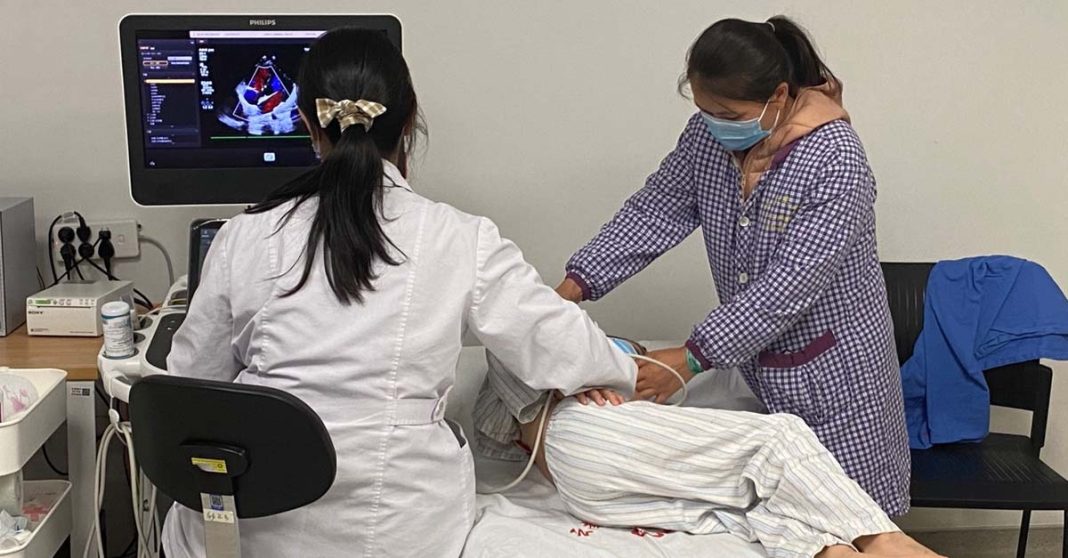
The Mekong Children’s Heart Care Project has treated its first children with congenital heart disease at Mahosot Hospital in Vientiane, marking a major step forward for pediatric cardiac care in Laos.
On 7 February, a visiting medical team treated three children during a one-day mission at the hospital. Health workers identified one child through a school-based heart screening program in Luang Prabang in December 2025, while Mahosot Hospital referred the other two cases.
Health officials said the cases clearly show how early screening can lead directly to life-saving treatment.
The Mekong Institute, the Lao Ministry of Health, Fuwai Hospital, and the Chinese Academy of Medical Sciences jointly run the project, with funding support from the Chinese government through the Global Development and South–South Cooperation Fund.
Fuwai Hospital sent a multidisciplinary team of cardiologists, an ultrasound specialist, and a specialist nurse to work alongside Lao doctors.
The team applied the PAN method, a non-invasive heart procedure that avoids radiation, reduces physical trauma, and allows children to recover quickly, making it well suited for hospitals with limited resources.
Doctors and nurses at Mahosot Hospital participated directly in every stage of diagnosis and treatment, gaining hands-on experience in pediatric cardiac care. Officials said this practical cooperation helps build long-term national medical capacity rather than relying solely on overseas treatment.
Part of a Broader National Heart Care Effort
The successful procedures also support Laos’ wider national effort to address congenital heart disease.
In December 2025, authorities launched the Mekong Children’s Heart Care Project (2025–2027) as a nationwide program to improve early detection, treatment, and follow-up care for children with heart conditions. The Ministry of Health leads the program in partnership with the Mekong Institute and Fuwai Hospital.
Over the next two years, health teams plan to screen at least 10,000 children across the country, including in remote and rural areas. The program aims to provide full-cycle treatment to diagnosed children, with a minimum target of 30 treated cases during the project period.
The initiative also prioritizes capacity building. More than 110 Lao healthcare workers will receive specialized training, while selected doctors and nurses will undertake fellowships at Fuwai Hospital.
Authorities have begun distributing diagnostic equipment, including ultrasound machines, to strengthen services at provincial hospitals.
