

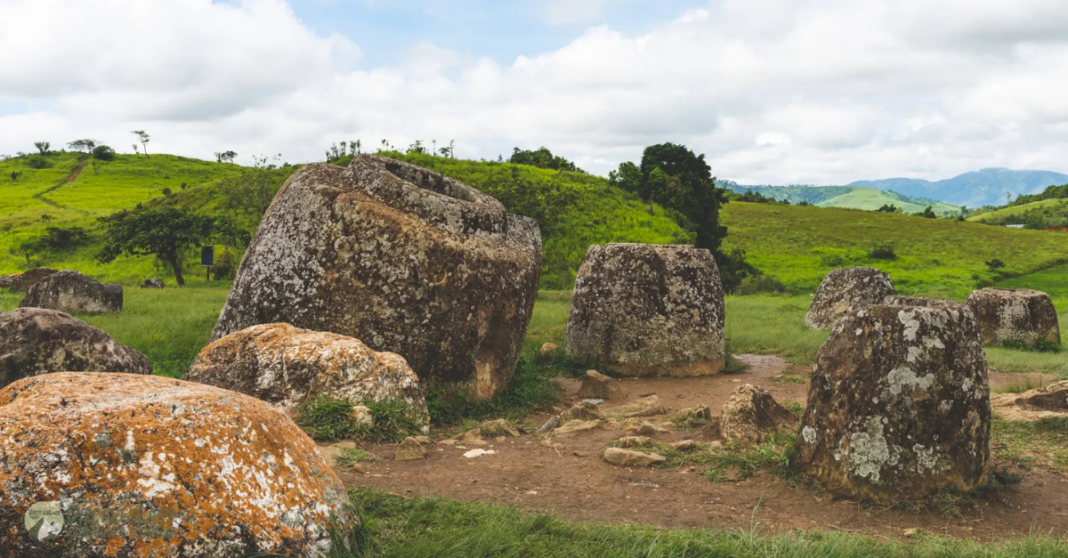
Scientists may soon solve one of Laos’ biggest mysteries: who buried their dead inside the giant stone jars at the Plain of Jars, and where did these people come from?
The Plain of Jars, called Thong Hai Hin in Lao, sits in Xieng Khouang Province in northern Laos. It became a UNESCO World Heritage Site in July 2019. National Geographic published new research at the site on 31 July.
Between 2022 and 2024, archaeologists dug into “Jar 1” on the Xieng Khouang Plateau and found the bones of at least 37 people, showing that ancient people had careful, complex burial customs. Findings from May confirmed who these people were and suggested that families used the jars again and again, over generations, to bury their dead.
Workers found the bones placed with care, not scattered around, with large bones and skulls arranged along the jar’s edges.
Scientists used radiocarbon dating, a method that measures natural carbon in old bones to work out their age, to learn that people used the jar between about AD 890 and 1160. This means many generations may have used it as a burial place over hundreds of years.
Many questions still remain.
Scientists now want to take DNA (genetic material found in every living thing) from the bones to see how the buried people were related, and to learn more about their ancestry and origins.
Recovering DNA is hard in hot, wet places like Laos, since heat and moisture destroy genetic material over time. But if the test works, it could give the clearest answer yet to one of Laos’ most famous mysteries.
Beyond that, the team also recovered an iron knife, a small copper bell, pottery fragments, and glass beads from inside the jar. Chemical analysis of the beads points to trade connections with South Asia and the Middle East, suggesting communities on the Xieng Khouang Plateau participated in wider regional exchange networks.
