

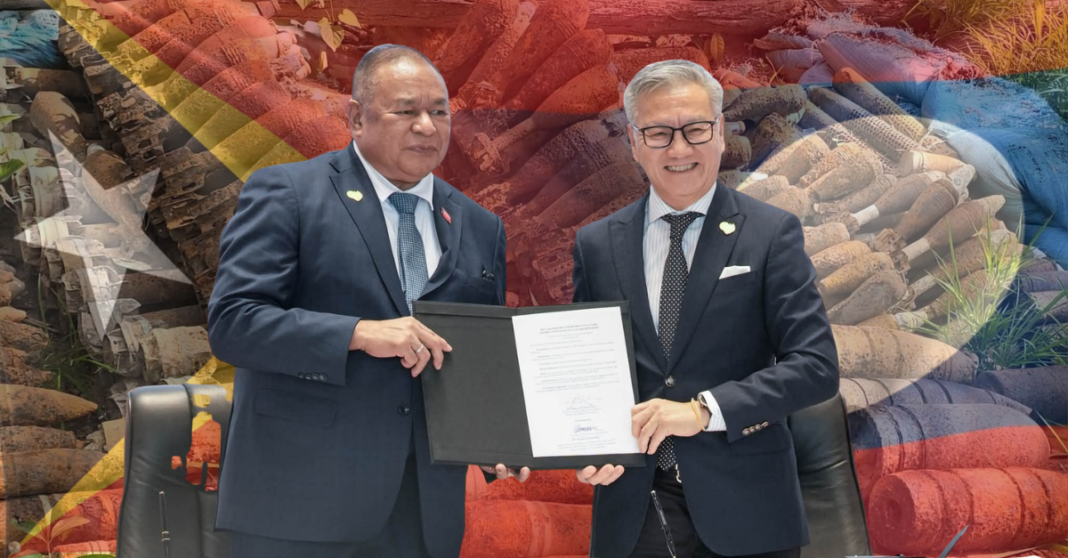
Timor-Leste has taken a formal step toward joining the Convention on Cluster Munitions, signing a declaration of accession in Vientiane on 15 September during the treaty’s Third Review Conference.
Foreign Minister Bendito dos Santos Freitas signed the Declaration of Accession, and handed to Lao Deputy Prime Minister and Foreign Minister Thongsavanh Phomvihane.
The move comes as representatives from nearly 100 countries gather in Laos, which remains one of the world’s most heavily contaminated countries with unexploded ordnance from the Vietnam War era in the 70s.
Signing the declaration does not yet make Timor-Leste a member of the Convention. The country will become a full member after depositing an instrument of accession with the UN Secretary-General.
The Convention bans the use, production, stockpiling and transfer of cluster munitions. It also requires member states to destroy stockpiles, clear contaminated areas, educate communities about the risks and assist people affected by the weapons.
Timor-Leste’s UXO Legacy
Timor-Leste supported the development of the Convention in 2008 but did not sign it. The country remained outside the treaty for years despite supporting its goals. Landmine and Cluster Munition Monitor cited limited resources and other priorities as reasons for the delay.
The Monitor reported nine casualties from explosive remnants of war in Timor-Leste between 1999 and 2011.
In the last reported incident, in 2011, two civilian men were killed and another was critically injured while handling unexploded ordnance.
For people living in countries affected by explosive remnants of war, the danger can continue long after fighting ends. Unexploded weapons can remain in the ground for decades, posing risks to people farming, working or traveling through contaminated areas.
