

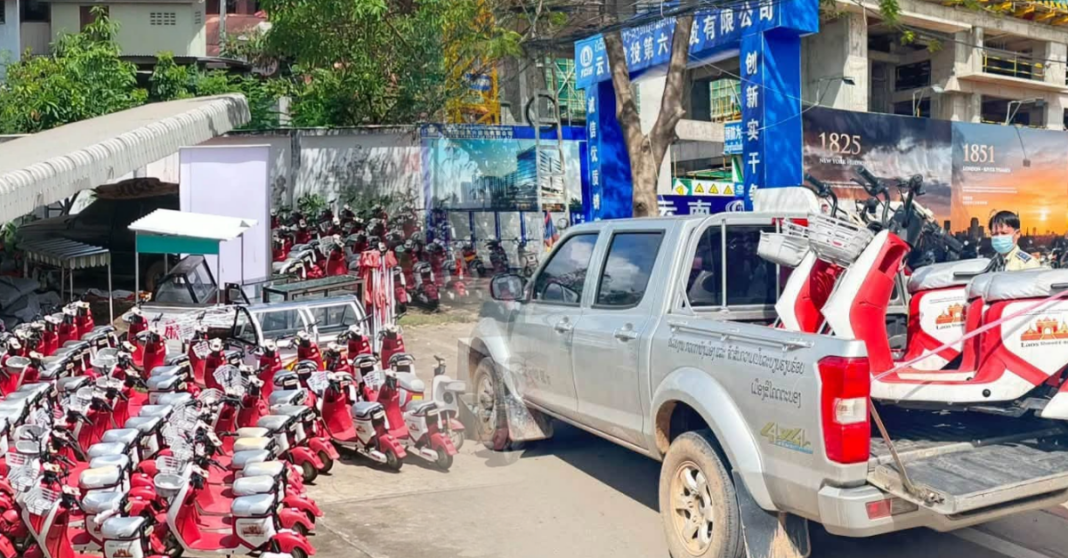
Red electric bikes bearing the “Laos Shared E-Bike” logo have reappeared across Vientiane, raising questions about who operates the service, whether it has official approval, and how the bikes will be parked.
The bikes can be unlocked through Zuimei’s LAOS-Ebike app and appear to revive an red e-bike service that authorities ordered removed in February over licensing concerns, unsafe riding, and improper parking. The operator of the newly appeared red bikes has not been publicly identified, and it remains unclear whether they have official approval to operate.
The app charges LAK 9,300 (USD 0.43) for the first five minutes, followed by LAK 900 (USD 0.04) for each additional minute. Users can park in designated green zones without an extra fee, while parking in red zones incurs a LAK 48,000 (USD 2.20) charge. However, unclear markings may leave users uncertain about where they can leave the bikes.
Licensing Concerns
On 28 and 29 September, Sikhottabong District authorities collected 150 unauthorised electric scooters parked along major roads and pedestrian walkways, saying they obstructed traffic and public access. Officials did not identify the operator or confirm whether the scooters belonged to the LAOS-Ebike service.
The collection followed an order issued on 5 February by the Vientiane Capital Department of Public Works and Transport, which said the red e-bike service operated by Zuimei Laos had not received official approval to operate in the capital. District offices were instructed to collect the bikes and report them to the department.
At the time, The Laotian Times contacted Zuimei for comment, but a company representative declined to respond. Wuhan Huakexunce Technology, a Chinese developer of e-bike applications, confirmed it had business operations in Laos but did not clarify whether it was involved in managing the service.
The app’s terms and conditions set a minimum user age of 16, but it does not appear to have a reliable system for verifying users’ ages. Residents previously reported that improperly parked bikes blocked pavements and business entrances, while limited oversight raised concerns about rider safety.
Similar parking problems have affected green e-bikes in Luang Prabang, where authorities removed bikes parked illegally near the night market in August 2025. The recurring complaints have prompted calls for clearer regulations, stronger enforcement, and greater accountability from shared e-bike operators.
Electric Transport Push in Laos
Laos has introduced several measures to encourage electric-vehicle use in recent months. In March, the government reduced EV fees and service charges by 30 percent while increasing charges for fuel-powered vehicles by the same amount. It also required transport companies to ensure that EVs account for at least 10 percent of their fleets by the end of 2026.
From 1 June, Laos suspended imports of most petrol- and diesel-powered vehicles until the end of 2026, with exemptions for passenger transport, machinery, project-related trucks, and specialized vehicles. Fully electric vehicles priced below USD 50,000 are exempt from excise tax.
The government has also offered land and technical support to private investors in charging infrastructure and introduced rules for home and public charging stations.
Vietnam’s Financial Incentives for EV
Vietnam is pursuing similar transport goals through financial incentives and public e-bike services. Hanoi has proposed subsidies covering up to 20 percent of a new electric motorbike’s cost, capped at VND 5 million (USD 190). In December 2025, the city launched a public e-bike service with 500 bikes at 130 stations and plans to expand the fleet to 5,000 by the end of 2026.
