

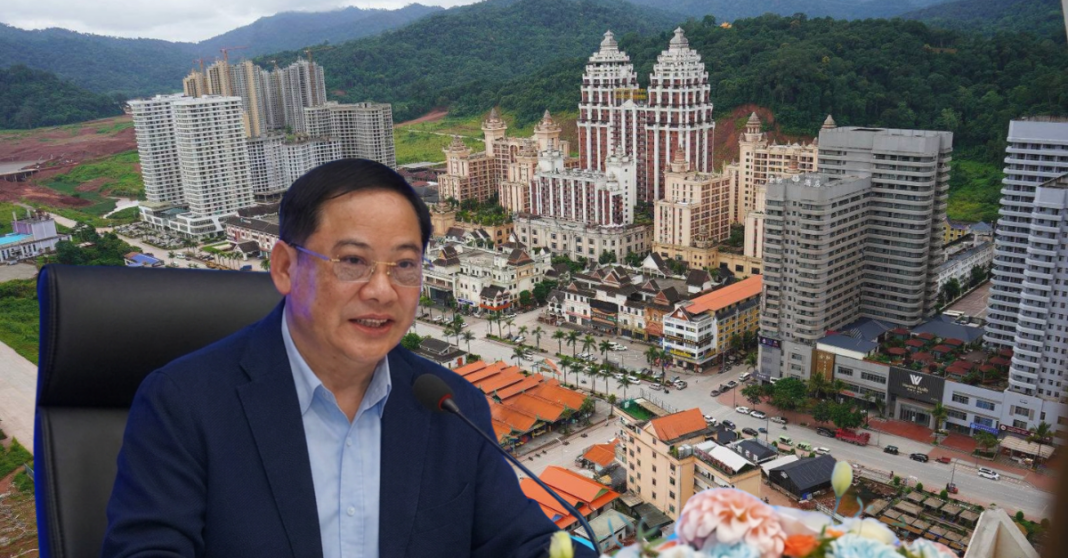
Prime Minister Sonexay Siphandone has called for stronger management of the Boten Special Economic Zone (SEZ) in Luang Namtha as Laos seeks to expand the border area as a trade and investment hub.
Laos began developing the Boten SEZ in 2012 to attract investment in finance, trade, industry, transport and tourism. More than a decade later, the zone has completed most of its basic infrastructure, including roads and water supply systems.
During a visit from 17 August, authorities said they were preparing to build a data centre in the zone, adding digital infrastructure and technology investment to its traditional focus on trade and logistics.
Sonexay instructed authorities to review land allocations to ensure investors use land efficiently and projects receive proper oversight.
He also called for closer coordination between Electricité du Laos (EDL) and the SEZ developer to ensure a stable power supply. He tasked the Ministry of Labour with securing enough local workers to meet legal employment quotas.
The prime minister also ordered road repairs and told the Ministry of Foreign Affairs and local border officials to work with Chinese authorities to streamline procedures for people and goods crossing the border.
The push comes as trade and transport links through Boten continue to grow.
Boten Railway Station began its first major expansion in June since opening in 2021. The upgrade aims to increase capacity and improve cross-border freight handling as trade between Laos and China continues to rise.
Ongoing challenges
The development push comes as authorities tackle security and environmental concerns in Luang Namtha.
On 30 June, police in the province raided a building inside the Boten SEZ that authorities said organised scam groups used to run fake investment schemes, fraudulent online platforms and social media scams. During the raid, police detained 135 suspects
On 12 August, local authorities formed a committee to tackle drug trafficking and online scams as part of regional cooperation between China, Laos, Myanmar and Vietnam.
Wildlife trafficking has also emerged as a major concern in the Boten area.
A 2022 study found protected wildlife products, including pangolin and bear parts, for sale in outlets in the Boten SEZ.
Despite these challenges, Luang Namtha collected more than LAK 2.21 trillion (USD 98 million) in revenue during the first half of 2026, reaching 58.4 percent of its annual target, according to officials.
The province spent LAK 220 billion (USD 9.8 million), or 26.24 percent of its annual budget target, suggesting that project implementation and government spending remain slow.
