

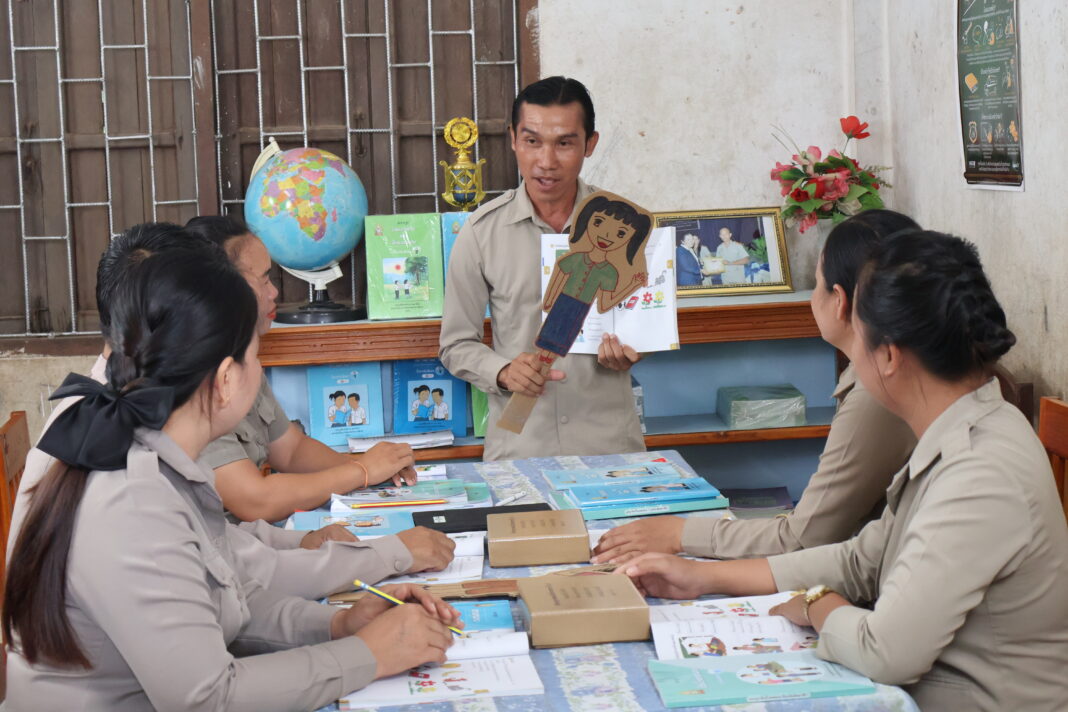
The Ministry of Education and Sports of Laos, in partnership with the Australian Government, presented the achievements of the “Spoken Lao teaching and learning materials” at the What Works Hub for Global Education Conference 2026, held at the University of Oxford, United Kingdom, from 15–16 September.
The presentation shared Laos’ important lessons and experience in using evidence and findings from classroom-based research to develop an education innovation and scale it up nationally. The initiative began with a pilot in seven districts between 2019 and 2021, before expanding to 21 districts during the 2023–2024 school year. Based on the results of the pilot, evaluation and continuous improvement, Spoken Lao was formally incorporated into supplementary teaching and learning for the Lao language subject within the national curriculum.
The teaching and learning materials focus on developing Lao listening and speaking skills among Grade 1 primary students. They are particularly intended for students whose mother tongue, or first language, is not Lao, as well as students who experience difficulties or are progressing slowly in Lao language learning. The package includes a teacher guide, student books, educational games, paper puppets and vocabulary cards. It uses student-centred teaching and learning approaches.
Vongphet Oudomlith, Director General of the Research Institute for Educational Sciences, Ministry of Education and Sports, said: “This work is an excellent example of how real problems from the classroom can be developed into a solution at national level through the use of scientific evidence. This was achieved through close cooperation with the Australian Government, through the Basic Education Quality and Access in Lao PDR program, or BEQUAL. The initiative was implemented and improved systematically, in line with the principles of education science.”
Keomany Thongpaseuth, Vice Head of the Lao Language Research Center, Research Institute for Educational Sciences, further emphasised: “The presentation at the University of Oxford was not only an opportunity to showcase the Spoken Lao initiative. It was also an opportunity to share Lao PDR’s experience with the international education community. It demonstrated that evidence-informed pilots, supported by collaboration, evaluation and continuous improvement, can progress towards policy development and practical implementation at national level.”
Meanwhile, Michael Currie, First Secretary at the Australian Embassy in Laos and the Embassy’s representative overseeing BEQUAL, said: “The Australian Embassy is very proud to have supported the Ministry of Education and Sports in developing the Spoken Lao teaching and learning materials. This achievement demonstrates the value of cooperation in creating sustainable work that can be applied in practice. These materials will help establish a strong foundation in language and literacy for children from the beginning of their schooling. This is an important foundation for learning in every subject. It is also a lesson that can be shared internationally, and an investment that lays an important foundation for human resource development and the long-term development of Lao PDR.”
Participation in this international conference also provided an important opportunity for the Lao delegation to exchange knowledge and learn about research findings, pilots and experiences in education reform from many countries. These lessons will provide important information and ideas for adaptation in research, curriculum development, innovation pilots and efforts to improve the quality of learning in Lao PDR.
In particular, the lessons will support the ongoing reform of the general education curriculum structure, from 5+4+3 to 6+3+3, led by the Ministry of Education and Sports. The participation also helped expand cooperation and academic exchange networks with researchers and experts from different countries, so that appropriate lessons can be adapted to the Lao context in the future.
Editor’s Note: This article was contributed by BEQUAL Laos. Views and information presented are those of the author.
