Home Blog Page 151

Thongmang Sinkhole Victims Set for LAK 147.93 Billion Compensation

A picture of Thanongxay Khoutphaythoune, Vice Chairperson of the People's Council of Vientiane Capital during the meeting, and the sinkhole led to 4 people missing in Thongmang village, Xaythany district, Vientiane Province on 2 January. (Photo by VientianeMai)

Vientiane authorities have set a compensation package worth LAK 147.93 billion (USD 6.5 million) for residents affected by sinkholes and ground subsidence linked to potash mining activities in Thongmang village, Xaythany district.

According to state media, the compensation was calculated by a special force to help residents affected by ground collapses restore damaged land, crops, buildings, irrigation systems, and roads.

The compensation package includes LAK 97 billion (USD 4.3 million) for damaged land, LAK 29.34 billion (USD 1.3 million) for crops and agricultural production, and LAK 13.82 billion (USD 615,888) for damaged buildings and other structures.

Another LAK 7.67 billion (USD 341,750) will be used to repair and restore irrigation systems and roads affected by the ground subsidence.

The official announcement did not specify how many residents or households are eligible for compensation, whether the package includes the families of the four villagers who have been missing since January, or when payments are expected to be approved and distributed.

The proposed compensation follows a series of sinkhole incidents in Thongmang, where authorities have recorded at least five major ground collapses since May 2025.

The most serious incident occurred on 2 January, when a large sinkhole opened just outside the village, leaving four people missing and prompting authorities to evacuate 38 households. Officials linked the collapses to underground potash mining, which was halted in July 2025 as stabilization work continued.

In June, Vientiane authorities began developing a compensation framework for residents affected by the sinkholes, covering damage to land, crops, agricultural assets and structures.

This latest calculation puts a total value on those losses, but authorities have yet to say when affected residents will receive compensation.

ATFX World Trading Cup Gains Momentum as Traders Worldwide Compete for USD 210,000

Registration extended to 14 September 2026 following strong global response, giving more traders the opportunity to compete


HONG KONG SAR – Media OutReach Newswire – 27 August 2026 – ATFX World Trading Cup is under way, bringing together new and existing ATFX clients from around the world to compete for a USD 210,000 cash prize pool. Eligible traders can register through the Client Portal until 14 September 2026, giving them time to join the competition as it progresses through its regional stages towards the World Finals.

ATFX World Trading Cup offers traders worldwide the opportunity to compete for a USD 210,000 prize pool

Under the theme, “Fight for Your Region. Trade for the Crown.”, ATFX World Trading Cup puts trading performance at the centre of the trading competition. Traders compete across multiple stages, with rankings determined by Profit % Return. This approach rewards strategic growth rather than the size of a trader’s starting capital, helping to create a more level basis for competition.

To take part, traders must open a live trading account, complete verification, and register through the Client Portal with the required minimum deposit. Tournament is open to eligible new and existing ATFX clients who want to test their skills against traders from their regions and beyond.

ATFX World Trading Cup runs across three stages: Regional Qualifiers from 17 August to 2 October, Regional Finals from 14 October to 13 November, and World Finals in December 2026. Each stage raises the stakes as participants compete for progression to the World Finals.

The journey culminates in a live finale in Hong Kong, where the elite Top 3 from each region will win an all-expenses-paid trip to compete against the best of the best. The ultimate World Champion will claim a USD 100,000 grand prize, with an additional USD 60,000 distributed among the finalists.

Eligible traders can register for ATFX World Trading Cup until 14 September 2026. Full terms and conditions, including eligibility criteria, are available at https://www.atfx.com/en/promotions/world-trading-cup.
Hashtag: #ATFX #ATFXWorldTradingCup #WorldTradingCup #TradingCompetition


YouTube:

The issuer is solely responsible for the content of this announcement.

About ATFX

is a leading global fintech broker with a local presence in 24 locations and holds 10 regulatory licences and authorisations, including UK’s FCA, Australia’s ASIC, Cyprus’ CySEC, the UAE’s CMA, Hong Kong’s SFC, South Africa’s FSCA. With a strong commitment to customer satisfaction, innovative technology, and strict regulatory compliance, ATFX delivers exceptional trading experiences to clients worldwide.

For further information, please visit ATFX website .

Dusit brings ASAI Hotels to Malaysia with the opening of ASAI Gamuda Cove – the brand’s largest property to date

Opening in September within one of Selangor’s most ambitious developments, ASAI Gamuda Cove brings together 280 rooms, locally inspired dining, and easy access to wetlands and waterpark attractions in a well-connected destination near Kuala Lumpur International Airport and Sepang International Circuit


BANGKOK, THAILAND – Media OutReach Newswire – 27 August 2026 – Dusit Hotels and Resorts, the hotel arm of Dusit International, one of Thailand’s leading hotel and property development companies, is set to introduce its locally focused, affordable lifestyle brand, ASAI Hotels, to Malaysia, with the opening of ASAI Gamuda Cove.

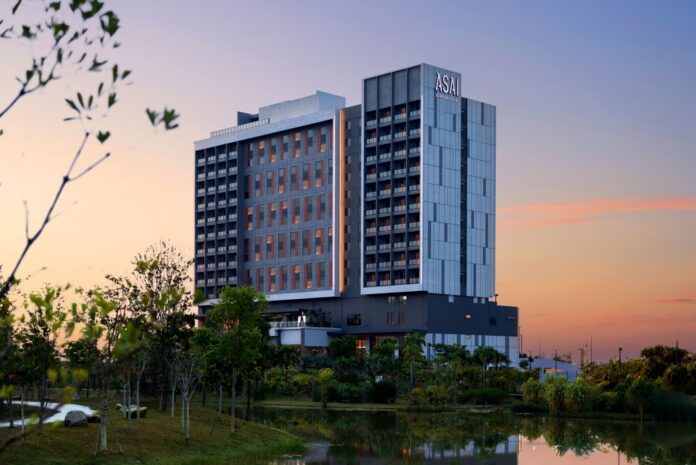
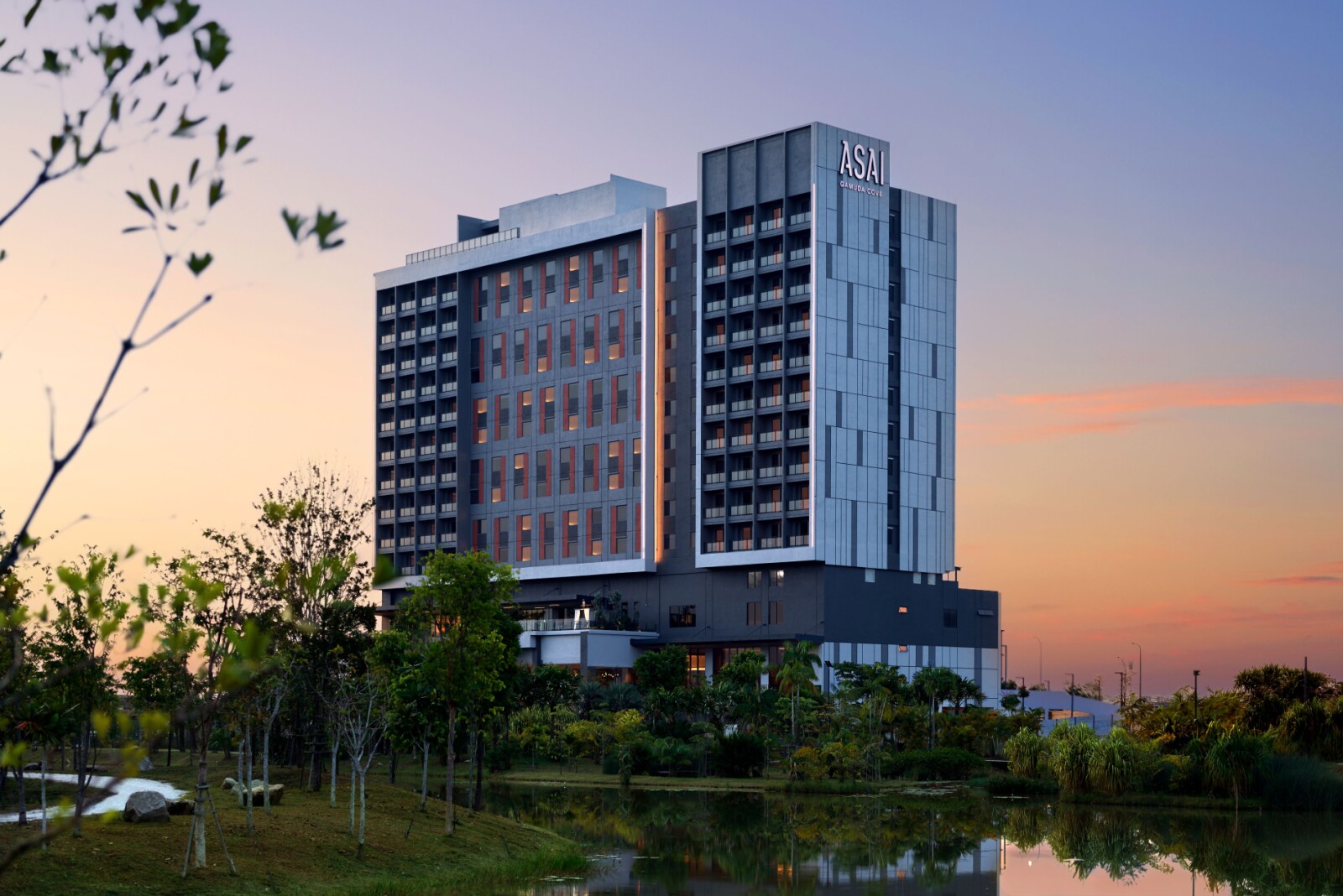
ASAI Gamuda Cove in Selangor, Malaysia, will welcome its first guests on 15 September 2026.

Scheduled to welcome its first guests on 15 September 2026, the 13-storey hotel is located within the 1,530-acre Gamuda Cove township, approximately 20 minutes by car from Kuala Lumpur International Airport. The largest ASAI property to date, it is also Dusit’s second hotel in Malaysia, following Dusit Princess Melaka, and the first ASAI hotel to open outside a city neighbourhood. It joins the brand’s three established properties in Bangkok and Kyoto.

Embodying the ASAI Hotels slogan, Live Local, the hotel places some of Selangor’s most distinctive nature experiences right on guests’ doorstep. It sits beside the 1,111-acre Paya Indah Discovery Wetlands, a nature reserve and wildlife sanctuary where visitors can observe native wildlife and explore a rare freshwater wetland landscape. Alongside it, the 90-acre Wetlands Arboretum serves as a living tree museum, with walking routes, birdwatching, and environmental learning activities offering further opportunities to experience the area’s biodiversity at close range.

Also nearby is the family-friendly SplashMania Waterpark, home to 39 slides and attractions, as well as Discovery Park, an outdoor recreation and entertainment hub offering activities for families and adventure seekers. An electric tram network connects key destinations across the township, allowing guests to move easily between its nature, recreation, and commercial areas without relying on private vehicles.

Across 280 thoughtfully planned rooms, ASAI Gamuda Cove’s design focuses on comfort, efficient use of space, and flexibility. Options range from compact rooms for solo travellers and couples to balcony rooms, bunk-bed configurations, and a two-room family category sleeping up to six guests. Selected rooms look towards the wetlands, while all include fast Wi-Fi, smart televisions, walk-in showers, and practical storage.

Beyond the guest rooms, the hotel features an infinity pool overlooking the wetlands, a gym, co-working areas, flexible meeting and event spaces accommodating up to 100 people, and three dining venues centred on Malaysian flavours, complemented by Thai and international dishes.

The all-day dining restaurant Nasi & Khao draws on the comfort-food traditions shared by Malaysia and Thailand, bringing Malaysian classics, vibrant Thai flavours, and familiar Western dishes together in a relaxed setting. Tea Shop provides a warm, community-focused space for curated teas and light bites from morning until late, while the Pool Bar pairs handcrafted cocktails, refreshments, and snacks with views across the infinity pool and Paya Indah Discovery Wetlands.

The hotel will also place guests approximately 20 minutes by car from Sepang International Circuit, where Formula 1 will return for the first time since 2017 with the Formula 1 Gulf Air Bahrain Grand Prix in Malaysia, taking place from 2–4 October 2026.

“ASAI Gamuda Cove shows how our Live Local approach can work in a setting where nature, recreation, and a growing community come together,” said Mr Chanin Donavanik, Group CEO, Dusit International. “It will give travellers a comfortable and practical base, provide local residents with new places to meet and dine, and put the wetlands and the wider township within easy reach. Opening just ahead of Formula 1’s return gives us an excellent opportunity to demonstrate what ASAI offers to visitors from Malaysia and around the world. And the hotel’s role will extend well beyond the race weekend: we want every stay to help guests experience more of the area and connect with the people who call it home.”

ASAI Hotels was created for travellers who value well-designed essentials, accessible rates, and a closer connection to the places they visit. Each property combines compact, functional rooms with social, dining, and co-working spaces shaped by its location. ASAI Gamuda Cove will become the brand’s fourth operating hotel, joining ASAI Bangkok Chinatown and ASAI Bangkok Sathorn in Thailand, and ASAI Kyoto Shijo in Japan.

ASAI’s Malaysian debut will also mark the latest step in Dusit’s expansion in the country, following the opening of Dusit Princess Melaka in December 2024. The company’s presence in Malaysia is set to grow further in October 2026 with the opening of Dusit Princess Ipoh, details of which will be announced soon.

For more information, please visit dusit.com/asai-gamuda-cove.

Hashtag: #Dusit

The issuer is solely responsible for the content of this announcement.

About Dusit Hotels and Resorts

is the hotel arm of Dusit International. With a heartfelt belief and commitment to introducing Thai-inspired gracious hospitality to the world, Dusit Hotels and Resorts offers guests a uniquely special stay in high-style surroundings and a personalised approach to service. The group’s portfolio of hotels, resorts and luxury villas includes close to 300 properties operating under a total of nine brands (Devarana – Dusit Retreats, Dusit Thani, Dusit Suites, Dusit Collection, Dusit Hotels, dusitD2, Dusit Princess, ASAI Hotels, and Elite Havens) across 19 countries worldwide.

For more information, please visit

About Dusit International

Established in 1949, is a leading hospitality group listed on the Stock Exchange of Thailand. Its operations comprise five distinct yet complementary business units: Dusit Hotels and Resorts, Dusit Hospitality Education, Dusit Foods, Real Estate Development, and Hospitality-Related Services.

Dusit’s diversified investments in real estate development, hospitality-related services, and the food sector are part of its long-term strategy for sustainable growth, which focuses on three key areas: balance, expansion, and diversification.

For more information, please visit

Turning AI Innovation into Sustainable Profitability: Deepexi Technology (1384.HK) Delivers Surging Revenue, Quarterly Profitability, and a Differentiated Enterprise AI Platform

HONG KONG SAR – Media OutReach Newswire – 27 August 2026 – In an era when enterprise software valuations are being fundamentally repriced by the rise of agentic AI, Deepexi Technology Co., Ltd. (1384.HK) has emerged as a rare counterexample: a pure-play enterprise AI platform that is delivering both technology leadership and bottom-line profitability. According to the company’s first interim results following its public listing, Deepexi recorded a 115% year-over-year surge in revenue for the first half of the year, powered by a 209% leap in core AI revenue and a decisive turnaround to quarterly GAAP profitability in the second quarter of 2026. This performance has earned the company “Buy” and “Overweight” ratings from multiple brokerages within its first year of listing.

Quarterly Profitability: A Rare Milestone in Hong Kong’s AI Sector

In capital markets, ambitious visions must ultimately be backed by real financial performance—and Deepexi’s interim results provide clear proof of execution.

For the first half of 2026, the company generated RMB 284.0 million in total revenue, marking a 115.0% year-over-year increase. Its AI business served as the primary growth engine, contributing RMB 226.0 million—an impressive 209.2% year-over-year surge—bringing AI revenue to 79.6% of total corporate turnover.

Even more noteworthy is the marked improvement in profitability. First-half gross profit reached RMB 160.0 million, up 120.5% year-over-year, with gross profit margin expanding to 56.5%. Crucially, during the second quarter of 2026, Deepexi posted a standalone quarterly net profit of approximately RMB 30.1 million, officially crossing the breakeven threshold.

In Hong Kong’s technology sector, pure-play enterprise AI companies capable of achieving quarterly net profitability while sustaining high R&D investment remain exceptionally rare. This milestone underscores Deepexi’s operational efficiency, scalable software delivery, and self-sustaining monetization engine.

This scarcity value is equally evident in the company’s revenue composition and vertical reach. Industrial manufacturing accounted for more than 50% of total revenue, while retail and consumer goods contributed 30%, alongside expanding footholds in healthcare and smart transportation. In manufacturing, for example, equipment troubleshooting and predictive maintenance involve dense engineering schematics, real-time IoT sensor telemetry, and extensive historical maintenance logs—all of which Deepexi translates into structured logic that AI models can readily interpret. This deep vertical expertise and proprietary data accumulation create a formidable competitive barrier that general-purpose AI vendors cannot easily match.

Beyond the “SaaSpocalypse”: Deepexi’s AI-Native Platform Defies the Software Valuation Reset

The first quarter of 2026 witnessed what market observers have dubbed the “SaaSpocalypse”—a tectonic shift in which approximately $2 trillion in market capitalization was erased from B2B software equities, driven by a fundamental fear that agentic AI would cannibalize the traditional per-seat licensing model. The iShares Expanded Tech-Software ETF (IGV) plunged nearly 21% year-to-date, and enterprise software multiples (EV/Sales) cratered from a 5.6x average at the end of 2025 to 4.2x by mid-March.

Investors have pivoted decisively toward AI-native infrastructure—companies that manage the data and underlying plumbing of autonomous systems—while penalizing traditional application-layer SaaS vendors reliant on human-centric interfaces. As a recent Windsor Drake analysis notes, “AI-native agentic platforms clear 14x to 22x revenue, with private rounds at 20x to 30x,” while legacy standalone RPA trades at just 2.5x to 5x. The market is now rewarding AI-native architecture and measurable workflow ownership.

Deepexi sits squarely on the winning side of this divergence. Unlike traditional SaaS vendors whose revenues are tied to human seat counts—and thus vulnerable to agentic displacement—Deepexi’s token-based, consumption-driven model aligns directly with the agentic AI future. The company’s DeepWorks enterprise Agent platform does not sell per-seat licenses; it sells AI productivity, enabling enterprises to deploy autonomous agents that replace repetitive administrative work, not software seats. As the market shifts from “AI as a feature” to “AI as a replacement,” Deepexi’s business model is structurally insulated from the seat-compression forces that have punished legacy software vendors.

Focus on Enterprise AI Applications and Proprietary Domain Data

To ensure AI truly meets real-world enterprise demands, generic foundational models are insufficient on their own. Deepexi’s core competitive edge lies in its specialized “Data + AI” dual-engine architecture, anchored by the FastData enterprise data intelligence platform, the FastAGI agentic AI suite, and the Deepexi Enterprise Large Model Platform, supported by its proprietary Deepology ontology dataset containing over 2,000 vertical industry skills.

At the foundational layer, the FastData platform—powered by the FastData Foil fusion engine—acts as an intelligent lakehouse that tokenizes structured, semi-structured, and complex unstructured enterprise data into standardized formats ready for large model training and inference. Building upon this data foundation, the FastAGI platform and DeepWorks Enterprise Agent Platform provide organizations with a flexible, modular AI operating system.

Featuring a pluggable architecture, the platform connects seamlessly to leading open-source foundation models such as DeepSeek and Zhipu AI, giving enterprise clients complete autonomy while eliminating vendor lock-in. This “model-agnostic” approach is a key differentiator in an environment where enterprises increasingly demand flexibility to choose the best model for each use case, rather than being locked into a single provider.

Through native Model Context Protocol (MCP) frameworks and specialized agents—ranging from operational decision-making agents to productivity and autonomous workflow execution agents—Deepexi embeds intelligence directly into core business operations. DeepWorks is fully integrated with mainstream workplace collaboration suites such as DingTalk, Feishu, and Tencent Meeting, allowing employees to summon AI copilots directly for automated weekly reporting, data synthesis, and cross-departmental coordination—effectively turning AI into an indispensable daily productivity tool.

In an enterprise AI market where 42% of organizations already have AI agents in production and 72% are deploying across production and pilots combined, Deepexi’s proven, governed agentic workflows are no longer an experiment—they are core infrastructure.

Strategic Partnership with Huawei Cloud: Tackling Compute and Data Bottlenecks

In the commercialization of enterprise AI, computing costs and access to high-quality domain data represent two of the industry’s most critical bottlenecks. On August 12, Deepexi announced a strategic alliance with Huawei Cloud to jointly launch enterprise data intelligence solutions, providing strong operational backing for the company’s long-term expansion.

The partnership combines the complementary strengths of both technology leaders. Huawei Cloud provides underlying Ascend AI computing clusters and distributed cloud infrastructure, while Deepexi brings its deep expertise in enterprise data governance, data tokenization, and vertical AI agent deployments. By integrating with Huawei’s domestic Ascend compute clusters, Deepexi not only secures stable, long-term computing power but also significantly drives down token processing costs. This cost efficiency establishes ideal conditions for exploring usage-based, token-metered commercial billing models—precisely the kind of consumption-based pricing that aligns with the agentic AI future.

Crucially, falling AI costs are widely expected to accelerate enterprise adoption of autonomous agents. Deepexi’s partnership with Huawei Cloud positions the company to capture this demand wave with a cost structure that improves as token volumes scale—a powerful margin-expansion dynamic that stands in stark contrast to the fixed-cost burden of traditional SaaS.

Strong Institutional Backing Highlights Long-Term Investment Value

Reflecting strong capital market confidence, Deepexi announced on August 17 the successful placement of 14,286,000 new H-shares at HK$35.00 per share, raising net proceeds of approximately HK$488.0 million. Successfully closing a sizeable placement amid broader market volatility demonstrates strong institutional recognition of Deepexi’s proven business model, robust unit economics, and profitability trajectory.

The company’s strategic shareholder structure provides a solid foundation for long-term growth. It is supported by prominent independent investors, including Hillhouse, 5Y Capital, and BAI, as well as industry-focused investors such as Shanghai AI. These partnerships enhance Deepexi’s industry reputation, drive technological innovation, and strengthen its market competitiveness.

The newly raised funds are earmarked primarily for continuous R&D in next-generation enterprise agent systems and token productivity platforms—positioning the company to capture the $206.5 billion AI agent software market projected for 2026, which Gartner expects to grow to $376.3 billion in 2027.

Investment Thesis: Why Deepexi Stands Apart

1. AI-Native Architecture in an Agentic World. Unlike legacy SaaS vendors facing seat compression, Deepexi’s token-based model is structurally aligned with the agentic AI future. The company doesn’t sell software seats—it sells AI productivity.

2. Rare Profitability in Enterprise AI. Quarterly GAAP profitability at a 56.5% gross margin, with projected revenue CAGR of 95.5% through 2027, places Deepexi among the most financially disciplined enterprise AI companies globally.

3. Model-Agnostic, Vendor-Neutral Platform. In an environment where enterprises demand flexibility, Deepexi’s pluggable architecture—supporting DeepSeek, Zhipu, and other open-source models—eliminates lock-in and captures value regardless of which foundation model wins.

4. Proprietary Data Moat. With over 2,000 vertical industry skills and deep expertise in manufacturing, retail, healthcare, and transportation, Deepexi’s domain-specific data capabilities create barriers that general-purpose AI vendors cannot replicate.

5. Strategic Compute Partnership with Huawei Cloud. Long-term, cost-effective compute access, combined with token-metered pricing models, positions Deepexi for sustained margin expansion as token volumes scale.

6. Institutional Validation. Backing from top-tier investors and a successful HK$488 million placement amid market volatility signal strong institutional confidence in Deepexi’s business model and growth trajectory.

The enterprise AI market has decisively shifted from early conceptual exploration into a new era of commercial execution and tangible financial delivery. Backed by mature product suites across FastData and FastAGI, proprietary vertical ontologies, strategic cloud partnerships, and an official transition to net profitability, Deepexi Technology has proven that enterprise AI can deliver both transformative technology and sustainable profits.

Hashtag: #DeepexiTechnology

The issuer is solely responsible for the content of this announcement.

About Deepexi Technology

Deepexi Technology is China’s leading provider of enterprise large model AI application solutions. Through its FastData enterprise data intelligence solution and FastAGI enterprise AI solution, it empowers enterprises to integrate their data, decisions and operations efficiently at scale. Deepexi ranked fifth in China’s enterprise large model AI application solution market in terms of revenue in 2024. Its solutions have achieved large-scale commercialization across multiple verticals, including consumer goods, manufacturing, healthcare and transportation. As of June 30, 2025, Deepexi Technology served a cumulative total of 283 enterprise customers across various industries.

This press release contains forward-looking statements that involve risks and uncertainties. Actual results may differ materially from those projected. The company undertakes no obligation to update any forward-looking statements.


Vientiane Water Enterprise Reports USD 4.2 Million Profit, 103 Villages Still Without Water

Hydrology work in Laos has helped develop groundwater for agriculture, improving the climate resilience of the country’s food production systems. Photo: International Water Management Institute

Vientiane’s state water supplier reported a profit of more than LAK 91.6 billion (USD 4.2 million) in the first half of 2026, even as it struggles to keep up with growing demand and extend services to all parts of the capital.

At a meeting on 26 August, the Vientiane Capital People’s Council called on the enterprise to speed up efforts to expand water supplies and improve services for residents.

Daily demand for water in the capital has reached about 504,000 cubic meters, driven by population growth and economic development. 

The enterprise currently produces an average of around 400,000 cubic meters a day, leaving a gap of roughly 104,000 cubic meters, with demands continuing to outpace supply.

Future Projects

The enterprise is working on three projects that are expected to add 80,000 cubic meters of daily capacity by the end of 2028. 

The projects include two new water treatment plants and an expansion of the existing Chi Nai Mo plant, with the first project expected to be completed in April 2027.

For now, water coverage remains uneven across the capital.

The enterprise currently supplies 378 of Vientiane’s 481 villages, covering about 79 percent of the capital. The remaining 103 villages are mainly in Pak Ngum, Santhong and parts of Xaythany districts.

Officials said water services continue to face challenges from seasonal changes in raw-water levels, ageing pipelines, water losses, power outages and limited budgets. 

Rising demand is putting further pressure on existing infrastructure.

Revenue and Service Upgrades

The enterprise reported collecting 53 percent of its annual revenue target during the first six months of 2026. It has introduced real-time meter reading, mobile billing, and bank payment options to improve service efficiency. 

The People’s Council has urged the water supplier to expand coverage, reduce water losses from its pipelines, recover unpaid bills and ensure its planned treatment plants stay on schedule.

Officials also said broader regulatory issues, including management rules, technical standards and differences in water tariffs, need to be addressed.

Finance, Transport Ministries Meet to Streamline Cargo Fee Collection

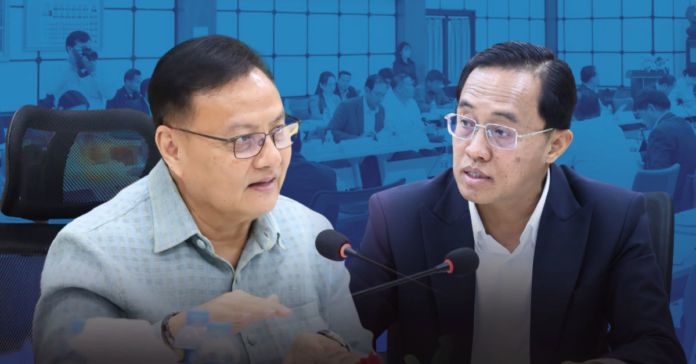
Lao Finance Minister Santipab Phomvihane (left) and Transport Minister Leklai Sivilay (right). Viantiane, Laos. 26 August 2026. (Photo: Ministry of Finance).

Laos is working to unify fee collection procedures on transit cargo and cross-border tolls across the country’s key trade corridors, officials report.

The push comes as Laos’ Ministry of Finance and Ministry of Public Works and Transport held a joint meeting on 26 August, to address inconsistencies in the collection of transit cargo transport fees at the Thanaleng Dry Port development zone, alongside toll collection issues at the Lao-Thai Friendship Bridge checkpoint.

Thanaleng Dry Port, located near the 1st Lao-Thai Friendship Bridge in Vientiane, forms part of the broader Vientiane Logistics Park area. The facility links Southeast Asia and China rail networks to markets beyond Asia, with around 2,000 vehicles passing through daily. 

In late June 2026, Laos and Cambodia opened a new agricultural transit route through Thanaleng, cutting the journey for Cambodian produce bound for China from nearly 20 days to about one week.

The meeting placed fee collection inconsistencies at the facility at the center of its agenda, alongside broader efforts to unify revenue management across transit and toll systems. 

Officials described the discussions as an important step toward organizing revenue collection and strengthening the finance sector’s specialized work, aiming to ensure consistency, transparency, and legal compliance.

Authorities also discussed the toll collection system for the bridges crossing the Mekong River between Laos and Thailand, which currently number five, located in Vientiane, Savannakhet, Khammouane, Bokeo, and Bolikhamxay. 

The participants also reviewed the open bidding process for procuring a company to develop and install systems for managing tolls on National Road No. 9 in Savannakhet Province, which connects Thailand in the west to Vietnam in the east. 

That project combines a LAK 3.23 trillion (USD 148.7 million) highway rehabilitation contract with electronic toll collection targeting trucks of 12 tons or more.

Laos Tightens Foreign Borrowing Rules as Debt Risks Persist

Laos tightens foreign borrowing rules amid concerns over debt and foreign currency reserves
A picture used for demonstration purpose only.

Laos has tightened controls on foreign borrowing as the government seeks to limit debt risks and reduce pressure on foreign-currency reserves and the Lao kip.

Under a new Bank of Laos decision issued in August, individuals and companies must obtain central bank approval before taking certain loans, guarantees, trade credits and other forms of financing from foreign lenders.

The central bank can reject a loan if the borrower does not have enough foreign-currency income to repay it or if the borrowing could put pressure on the monetary system or exchange rate.

Companies that earn mainly in foreign currency can borrow up to 75 percent of their registered capital, while companies that earn mainly in kip face a 50 percent limit.

Borrowers seeking to exceed those limits must submit a plan to manage foreign-exchange risks. Loans must also be issued and repaid in the same currency, reducing the risk that exchange-rate changes will increase repayment costs.

The rules impose additional scrutiny on large borrowers. Companies with n outstanding balance combined with a new drawdown reaches USD 100 million or more must submit financial statements audited by an internationally recognized firm.

Commercial banks must verify approval documents, monitor foreign loans and repayments, and report relevant transactions to the central bank. Unauthorized foreign borrowing or guarantees can result in fines, including a penalty equivalent to 10 percent of the loan agreement.

The government aims to reduce public debt to below 70 percent of GDP, strengthen foreign-currency reserves and ensure that foreign borrowing matches borrowers’ ability to earn foreign currency and repay their debts.

Debt Pressure

The new rules come as Laos continues efforts to reduce its high debt burden and strengthen domestic sources of financing.

The Asian Development Bank estimated in May that Laos had limited fiscal space and public debt of about 85 percent of GDP. The bank has said Laos will need stronger domestic revenue collection, debt management and private investment as it prepares to graduate from Least Developed Country status.

The International Monetary Fund has also said Laos’ economy is stabilizing, with lower inflation, easing pressure on the kip and improved macroeconomic management. However, it continues to flag high debt, limited foreign-currency reserves and weaknesses in the financial sector as key risks.

The IMF projects that public debt could fall to 75.7 percent of GDP in 2026 and decline further to 57.4 percent by 2030 if current economic policies continue.

Part of Wider Economic Reforms

The tighter borrowing rules are part of broader efforts to stabilize Laos’ economy and strengthen its financial system.

The economy grew 5 percent in the first half of 2026, according to Ministry of Finance figures, although growth slowed from 5.5 percent in the first quarter to 4.6 percent in the second.

Inflation fell to 7.4 percent in June before rising slightly to 7.6 percent in July. In August, the Bank of Laos cut its seven-day base interest rate from 8 percent to 7 percent as it adjusted monetary policy.

The government has also continued to pursue reforms aimed at strengthening economic management.

In August, the Cabinet approved 12 draft laws and proposals covering areas including public procurement, health insurance, social security, cybersecurity and mineral development.

Together, the measures reflect Laos’ broader effort to manage debt and foreign-currency risks while maintaining economic growth and financial stability.

Voyager of the Seas to Return to Hong Kong as Homeport in 2028, Launching Chinese New Year Itineraries

Two-Ship Deployment with Spectrum of the Seas, Strengthening Hong Kong’s Position as a Cruise Hub

SHANGHAI, Aug. 27, 2026 /PRNewswire/ — Following the announcement of the extended Singapore season for Navigator of the Seas, Royal Caribbean is further expanding its presence in Asia with the return of Voyager of the Seas. Beloved by Chinese vacationers, Voyager of the Seas will be seasonally homeported in Hong Kong from January to February 2028, offering a new lineup of itineraries tailored to the Chinese New Year holiday and the peak winter school holiday travel season. The deployment will bring Voyager of the Seas and Spectrum of the Seas together in Hong Kong for a two-ship deployment, giving vacationers from China and across Asia more opportunities to set sail from this regional cruise hub and explore a diverse range of destinations. Related sailings are now open for bookings in China.

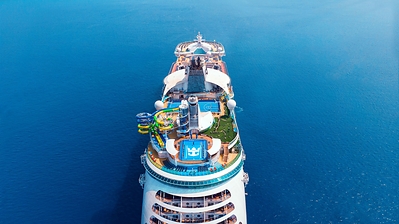
Voyager of the Seas will be seasonally homeported in Hong Kong from January to February 2028

 “Asia is home to remarkable destinations, flavours and cultures the world over wants to experience,” said Benjamin Bouldin, President of Greater China and Managing Director Asia, Royal Caribbean. “We have long believed in Hong Kong as an ideal international cruise hub for Asia. With the return of Voyager of the Seas joining Spectrum of the Seas — already homeporting here — our two-ship deployment offers vacationers a broader range of Hong Kong homeport itineraries than ever before. Whether it’s a quick weekend getaway with family and friends or a longer journey discovering new destinations, or festive sailings timed for Chinese New Year, the two ships complement each other to give vacationers even more flexibility to explore the best of Asia.”

Anthony Lau, Executive Director of the Hong Kong Tourism Board (HKTB), said, “I am delighted to welcome Royal Caribbean’s further expansion of its homeport deployment in Hong Kong. In addition to the arrival of the Spectrum of the Seas next winter, the Voyager of the Seas is also set to be deployed in the city during the Chinese New Year period in 2028. This not only emphasizes Hong Kong’s appeal as a regional cruise hub and reflects the industry’s confidence in the city, but also offers visitors the opportunity to experience vibrant festive atmosphere that is ‘Only in Hong Kong’, alongside a rich array of spectacular events and attractions. HKTB will continue to drive more ship calls and deployment to Hong Kong and work with industry partners to step up promotional efforts, attract more visitors, thereby sustaining the growth momentum of Hong Kong’s tourism industry.”

Voyager of the Seas has a deep connection with the China market. In 2012, she first arrived in Shanghai, becoming one of the largest cruise ships operating from an Asian homeport at the time and witnessing and helping usher China’s cruise market into the era of mega-ships. Starting from 2014, she began homeporting at Kai Tak Cruise Terminal in Hong Kong, bringing new energy to the market and deepening Royal Caribbean’s local presence. Now, this iconic ship — which carries the cruise memories of a generation of Chinese travelers — returns to Asia with a comprehensive upgrade and a new season from Hong Kong, further demonstrating Royal Caribbean’s long-term commitment to deepening its presence in the China market and supporting Hong Kong’s development as a cruise hub.

Diverse Itineraries Covering Asia’s Bucket-list Destinations

Timed around key travel periods including Chinese New Year and winter vacation, Voyager of the Seas will offer a diverse lineup of 4- to 10-night sailings. During the Chinese New Year period, vacationers can choose 4- or 5-night getaways departing from Hong Kong, China, to Ishigaki and Okinawa, Japan, with select sailings featuring overnight stays in Okinawa, for more time to experience the destinations’ natural beauty and unique cultures. Sailings from Hong Kong, China, will also visit Taipei, China (Keelung) and Hue/Danang, Vietnam (Chan May). Vacationers can experience Taipei’s vibrant city life and local cuisine, explore the timeless charm of the ancient city of Hue, and take in the coastal scenery of central Vietnam. For those seeking deeper exploration, select sailings of up to 10 nights will connect multiple distinctive ports across Asia, bringing vibrant cities, historic landmarks, coastal landscapes and mountain scenery together in one unforgettable vacation.

Diverse Onboard Experiences for the Whole Family

Beyond the destinations, Voyager of the Seas offers a wide range of onboard experiences for vacationers of all ages. Thrill-seekers can make waves on the FlowRider surf simulator, race down The Perfect Storm waterslides, take on the rock-climbing wall and go ice-skating at Studio B, the ship’s onboard ice-skating rink. Friends and families can test their putting skills at Voyager Dunes, the ship’s nine-hole mini-golf course, or face off in a glow-in-the-dark battle with Laser Tag: Battle for Planet Z. Younger vacationers have dedicated spaces and activities at Adventure Ocean, while teens can make their own memories at the teen-focused Living Room.

For dining, vacationers can gather over Italian family-style dishes at Giovanni’s Table, savour hand-cut steaks at Chops Grille, explore sushi and Japanese-inspired flavours at Izumi, or opt for casual favourites at Windjammer and Café Promenade. Across every day at sea, Voyager gives different generations the ability to spend their holiday in their own way from high-energy thrills and family activities to dining, entertainment and time to unwind.

Two Ships Deepen Royal Caribbean’s Asia Presence

In the 2027-28 season, Spectrum of the Seas will continue to homeport in Shanghai and Hong Kong, offering 56 curated itineraries ranging from 3 to 11 nights and visiting 22 popular destinations across Asia. Among them are three warm-winter holiday sailings from Hong Kong — Thanksgiving, Christmas and New Year itineraries — giving vacationers more ways to celebrate the festive season at sea. Vacationers can take in the vibrant autumn scenery on Thanksgiving sailings, immerse themselves in the festive spirit on Christmas sailings, and enjoy seasonal highlights such as winter whale watching on New Year sailings, making every journey a memorable experience. With the two ships working together from their Hong Kong homeport, vacationers can choose from short weekend getaways to longer holiday journeys, creating a more comprehensive network of cruise options.

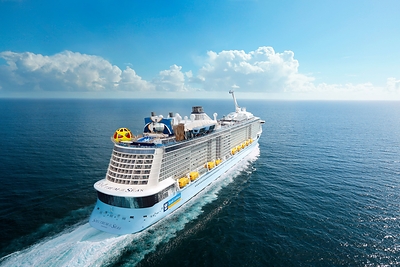
In 2027-28 season, Spectrum of the Seas will continue to homeport in Shanghai and Hong Kong year-round

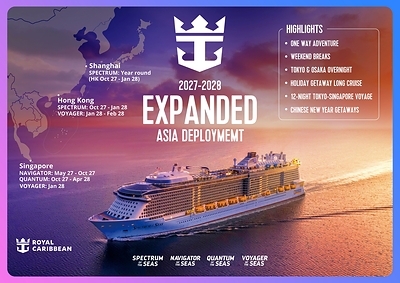
With Navigator of the Seas extending its Singapore season, Voyager of the Seas further expanding its Hong Kong deployment, and Spectrum of the Seas continuing to homeport in both Shanghai and Hong Kong year-round, Royal Caribbean will deploy four ships across the Asian market in the 2027-28 season. Together, they strengthen Royal Caribbean’s presence across three key Asian homeports — Shanghai, Hong Kong and Singapore — and further solidify brand’s leading position.

Royal Caribbean will deploy four ships across the Asian market in the 2027-28 season

Building on its continually expanding network across Asia, Royal Caribbean will continue to bring more high-quality, immersive overseas vacation experiences to Chinese consumers, turning every journey at sea into a memorable opportunity to connect with loved ones and create lasting memories. At the same time, Royal Caribbean will continue to enrich its portfolio of overseas vacation products for the China market, bringing travel agency partners more quality itineraries and product choices and working together to seize new opportunities across the Asia Pacific travel market.

Starting today, bookings for Voyager and Spectrum 2027–28 season sailings are open across the China market. Vacationers can learn more and make reservations through Royal Caribbean’s official website, official WeChat mini program, Fliggy flagship store, Douyin flagship store, authorized Royal Caribbean travel agency partners, or by calling 400-885-0277.