Home Blog Page 6600

Japanese Project Furthers Wood Processing in Laos

A project for developing human resources in the wood processing industry has achieved success, helping to improve the quality of wood products and provide new marketing tools for Laos.

The Ministry of Industry and Commerce’s Industry and Handicrafts Department and the Okawa Chamber of Commerce and Industry yesterday organised a final workshop to summarise the project, which ran over a period of two years.

The cooperation project was funded by Okawa City in Japan through the Okawa Chamber of Commerce and Industry at a cost of US$600,000.

The project began in 2015 and will end next year, aiming to develop human resources in the wood processing industry.

Human resource development was important in all areas of work as it was key to development, and especially this project, officials noted, which was enabling the efficient use of raw materials and improved production standards. The government considers human resource development as an important issue especially in the wood processing industry and forest management.

It is in line with Prime Ministerial Order No. 15, which aims to ensure the effective management and use of timber through the processing and adding of value to products before their export.

The project has provided wood processing training on eight occasions and furniture processing training on seven occasions.

Those to undergo the training included Lao carpenters and teachers from different furniture manufacturers, sawmills and vocational schools, under the supervision of Japanese carpenters, according to the press release.

The project also held wood and furniture processing training in Japan, especially in Okawa City, and selected two carpenters to participate in the ASEAN labour contest in Malaysia.

The course helped improve participants’ skills and increased their labour knowledge in the wood and furniture processing industry to add more value to the projects produced.

Participants also increased their understanding about how to maintain and use wood machines, wood and furniture processing techniques, colour painting, transportation and exhibitions.

Despite the project period being short, it still helped develop Lao skills in the furniture and wood processing industry according to Industry and Handicrafts Department Director General, Mr Manohak Rasachack .

The workshop was co-chaired by the Director of the Okawa Chamber of Commerce and Industry, Mr Yuichiro Tsumura.


Source: Vientiane Times

Vientiane to Increase Water Charges by Four Percent

Vientiane Water Supply Enterprise (Nampapa Nakhon Luang) has announced it will increase water supply charges by four percent across all categories coming into effect this January.

The enterprise issued an announcement recently that requires households to pay in line with four rates – the more water is consumed the higher the rate households are required to pay.

Under the new rate, those households using not more than 10 cubic metres of water per month will have to pay 1,434 kip per cubic metre, an increase from the current 1,379 kip per cubic metre. Households consuming 11-30 cubic metres per month are required to pay 1,989 kip per cubic metre, an increase from 1,910 kip per cubic metre.

The consumption of between 31-50 cubic metres of water a month will require the payment of 2,538 kip per cubic metre, while those households using 51 cubic metres or more per month will pay 3,089 kip per cubic metre.

State organisations, foreign embassies and international organisations in Laos are required to pay only one rate regardless of the amount used. They are required to pay 2,538 kip per cubic metre, an increase from the current 2,440 kip.

Commercial use by businesses, such as hotels and restaurants, is also under one rate, which is the highest among all categories at 3,089 kip per cubic metre.

A technical official of Vientiane Water Supply Enterprise told Vientiane Times yesterday the increase in water charges was not implemented every year. She added that for many years before 2016 the fee had not been adjusted .

An official of the Water Supply Department under the Ministry of Public Works and Transport said adjustments to water supply fees in different provinces would be considered and approved on a case-by-case basis following proposals from water supply enterprises in a province via the provincial authorities.

He explained the enterprise was required to submit a proposal to provincial authorities to consider before forwarding the proposal to his department to make recommendations if the proposed increase was appropriate and reasonable.

“If the proposed increase is too high, we will recommend lowering it [the proposed increase fee] to avoid adverse impacts on people’s living conditions,” the official said.

He added that the water supply is on the list of 48 controlled products whose fee adjustments needed to be approved by the relevant state sector before it could be increased to avoid a severe impact on people’s cost of living.

While water charges are on the increase, Electricite Du Lao (EDL), recently lowered its power fees for households.


Source: Vientiane Times

China Proposes Weight Limit Increase for Heavy Vehicles

Oudomxay province: — China has asked Laos to consider increasing the allowable weight limit for heavy trucks on the nation’s rods, with large numbers of Chinese trucks operating, especially in the northern provinces.

Currently, a weight limit of 11 tonnes per axle is imposed throughout the country and Chinese goods transporters would like to see this increased to allow larger trucks to operate in Laos.

Director of Oudomxay provincial and Industry and Commerce Department, Mr Khamphao Sylisouk, told the press on Saturday that representatives from China raised this matter at a meeting of the northern provincial industry and commerce sectors on December 8, which was hosted by Luang Namtha province.

In that meeting, a representative of the northern provincial industry and commerce department answered that the roads in Laos could not withstand loads of more than 11 tonnes per axle, Mr Khamphao said.

The roads in Laos are quite small in the northern parts of the country, so if the trucks carrying loads of more than 11 tonnes per axle are allowed to operate, it is expected the roads will quickly start to deteriorate.

Despite the ban, some larger trucks are operating anyway. Some 12-wheeled trucks are known to be carrying loads of up to 20 or 30 tonnes per axle between Laos and China.

“We did not allow them but goods truck operators take it upon themselves to exceed the 11 tonnes per axle,” Mr Khamphao said.

Nowadays, there are about 26 weigh stations across the country, but previously there were many more.

Right now about 400 cars and heavy trucks from Laos, China and other countries are crossing at the Boten International Checkpoint in Luang Namtha province. Weigh stations are important for controlling overloaded trucks, but not all national roads around the country have them, with only some operational.

The government closed some of the weigh stations in 2011, and since then many roads have been damaged due to the proliferation of heavy vehicles.

In order to protect the nation’s roads, repairs should begin as soon as the first cracks in the surface appear because they rapidly deteriorate in the rainy season, especially in areas that are heavily used by trucks.

The capital Vientiane has four weigh stations located around the city at Chaengsavang village on Road No. 13 North, Khoksa-aath village on Road No. 13 South, Dongphosy village at the Lao-Thai Friendship Bridge and at Nongda village on National Road No. 11.


Source: Vientiane Times

UN Agencies Continue to Boost Development in Laos

All three respective United Nations agencies are starting their new cycle of five-year programming next year in an effort to boost the development of Laos after reaching an agreement on the path forward.

Together, the UNICEF, UNDP and UNFPA estimate they shall deliver close to US$200 million over the five-year programme period from 2017-2021 – that is an estimated US$40 million a year, according to the UNDP.

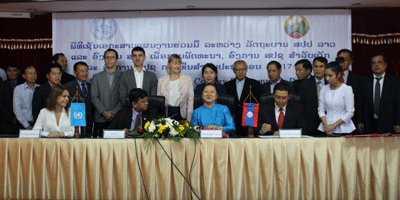
The Letter of Agreement was co-signed yesterday by Deputy Minister of Planning and Investment, Dr Kikeo Chanthaboury and the UNDP Deputy Resident Representative, Mr Balasubramaniam Murali.

The related documents were also signed by UNFPA Deputy Representative, Ms Ulrika Rehnström Loi and UNICEF Laos Representative, Ms Hongwei Gao.

Three UN agencies – the UNDP, UNFPA and UNICEF implement the new Laos-United Nations Partnership Framework, reflecting the collective contributions of the United Nations to support the country in achieving the development goals set by the government.

“Yesterday’s signing marks another milestone in the government’s partnership with the United Nations, as the period 2017-2021 coincides with the last push for the country to graduate from least developed country status to develop into a modern upper middle income country by 2020,” Dr Kikeo said.

While the specific programmes differ in line with their respective mandates, the three agencies share common goals and strategies, as all will collaborate with other United Nations agencies and development partners to support the achievement of the 8th National Socio-Economic Development Plan and the Sustainable Development Goals, including the additional local Goal 18 on UXO and other key national development objectives.

Under the new agreement, the UNDP, UNFPA and UNICEF will also support policy and legislative reform, capacity building of government institutions and work on south-south cooperation.

Another common theme among the three agencies is the work done for and with young people; an essential component in a country with some 60 percent of its population below the age of 25.

UNDP Laos’ new country programme concentrates on key target groups: poor people and those most at risk of falling back into poverty, especially rural agricultural workers and communities in or near protected areas.

This focus includes youth, particularly young women, for skills development and increased awareness of their rights to access justice and public services. The UNDP will also expand efforts to facilitate south and triangular cooperation, especially among ASEAN countries.

The UNFPA Laos’ new country programme will focus on marginalised populations, in particular rural and ethnic women, adolescents and young people.

It aims to ensure that adolescent girls are empowered to delay their first pregnancy and can realise their full potential while contributing to a sustainable future in Laos.

The overall goal of UNICEF Laos’ new country programme is to ensure that children, especially the most disadvantaged, fully enjoy their rights to survival, development and protection.


Source: Vientiane Times

Railway Access Road Construction Begins for Tunnel Drilling Site

A Chinese contractor has recently begun surveying the construction area of an access road to the drilling site for the Laos-China Railway tunnel in Nga district, Oudomxay Province, said a member of the technical staff.

Deputy Head of the Oudomxay Provincial Public Works and Construction Department, Mr Sinouan Khamdy told a KPL News reporter last Friday that the railway will pass through the three districts of Namor, Xay and Nga (40 villages) with a total length of 126.6 km, representing one third of the total length of the rail line. Three main stations and six small stations are to be built in Oudomxay.

This project will be the biggest one ever to be implemented in the province, he said, adding that the majority of the railway construction activities in Oudomxay will be tunnels (40% of the total length of the rail line) and bridges.  The longest tunnel will be 9.3 km in length and will be drilled in Nga District.

The Oudomxay Coordinating Committee for the Management of the Lao-China Railway Construction Project is now conducting a public campaign in affected areas to increase the understand of local people and also to encourage their participation in making the construction project a success, Mr Sinouan said.

The Coordinating Office for the Laos-China Railway Construction Project and seven coordinating committees responsible for the project have also been set up, said Oudomxay Deputy Governor Mr Somchit Phanyasack.

The compensation allowance for families affected by the project in Oudomxay and Luang Namtha has yet to be determined.

The railway is expected to significantly boost transport, both at the provincial and national level.

The cargo transport cost by the Laos-China Railway will be about 100,000 kip per tonne, said Mr Somchit.

More than 5,000 Chinese workers are expected to work on the project.


Source: KPL

BCEL-KT: Trade Summary (Dec 9, 2016)

Trade Summary

Lao stock market was a little quiet on the last trading day of this week, even if the index was stable at 1,014.05 points. However, EDL-Gen, BCEL, LWPC, PTL and SVN closed at prices unchanged at 5,000 kip, 5,100 kip, 5,900 kip, 2,500 kip and 3,000 kip respectively. EDL-Gen played an important role in the market by generating the trading volume of just 4,700 shares, worth 23,500,000 kip.

Vientiane Library Visitors Decline in Numbers

Visitor numbers to the Vientiane Library have declined because a majority of people are obtaining information from other sources like the internet, officials claim.

Even though increasing numbers of students consistently visit the library each year between September and November, the overall number of visitors continues to decline.

Director of the Vientiane Library, Mr Keovilaisak Seansakda, says the Vientiane Library plays an important role in preserving and collecting both Lao and foreign materials about Laos, and therefore remains an important source of information for students and researchers alike.

He said from 2013 to 2016, the visitor numbers dramatically declined because more people are looking for information online.

The library had 42,000 visitors in 2014, 31,000 visitors in 2015, and only 13,000 in 2016. Some 80 percent of the visitors are students in Vientiane, he said.

He explained the library now has over 20,000 books and the library is currently running programmes to entice more visitors to come and utilise the facilities; the programmes include Lao Stories for Children and Lao History.

The library used to consistently receive a steady stream of new books, but in recent years the number of books has also declined. However, NGOs continue to be an important source of book donations.

We welcome any support from interested sponsors who would like to provide books relating to the ASEAN region, the social sciences or Laos, because we want to broaden people’s knowledge of the country and the regional bloc, he added.

Indicative of the crisis that currently afflicts the library, a student from a secondary school who attended the event, Ms Monta, said, I think the library lacks sufficient information on ASEAN nations and other important historical and sociological topics overall. Instead of coming here to conduct research, my friends and I agree we can find all of the information we require on the internet and from television.


Source: Vientiane Times

Construction Material Quality Control Centre Slated

Laos and China have agreed to cooperate in the construction sector, aiming to guarantee and improve of quality of construction materials in Laos.

An agreement to build the new laboratory and quality control centre for construction materials was signed recently in Vientiane between acting Director General of the Department of Standardisation and Metrology under the Ministry of Sciences and Technology, Mr Viengthong Vongthavilay and the President of Lao Chengjian Quality and Technology Services Co., Ltd, Mr Zhang Qiao Quan

The quality of construction is of paramount importance for the safety of the public and for the proper stewardship of the revenue expended for infrastructure construction and maintenance, officials said

The cooperation agreement ceremony was attended by Minister of Science and Technology, Prof. Dr Boviengkham Vongdara.

The new laboratory will open in 2017 monitoring construction materials coming into the country at the immigration and customs stations at borders in the north, central and southern parts of Laos.

Mr Viengthong said several years ago, the ministry had placed a priority on developing its human resources in the field of standards so they could conduct more quality inspections and present standards certificates to businesses nationwide that had met the required benchmarks.

Another goal is to seek cooperation with regional and international bodies for assistance with funding and personnel exchanges on standards to guarantee and improve the quality of all sectors because we lack good quality employees compared with neighbouring countries including China, Mr Viengthong said.

The centre will serve as a hub for resource development and facilitate cooperation between Lao and Chinese technicians in regards to laboratory services and field research, he added .

I think that the laboratory will play an important role in assurance quality in the construction materials sector, Mr Viengthong said.

The construction materials laboratory will have modern laboratory equipment and highly qualified staff, who can ensure consistently high product quality, he said.

The new laboratory will be able to monitor all construction materials imported from neighbouring countries, he stressed. This will include new products and applications as well as concrete formulas.

According to the ministry, standards certificates have now been presented to over 100 businesses in food and construction including table salt, cassava powder and other foods plus timber used in the construction sector and a Savannakhet cement manufacturer Oulayphanith Company Ltd which had complied with ISO 9001 certification.


Source: Vientiane Times