Home Blog Page 6601

Laos, China Cooperate in Agricultural Science

Laos and China have agreed to cooperate in the areas of crop science, plant protection and animal science after reaching an agreement.

The two parties also agreed to work together in the fields of food quality and safety, and agricultural machinery.

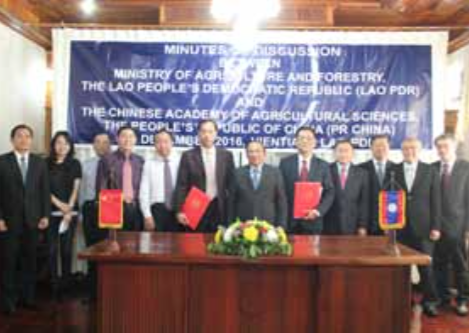
The agreement was signed on Friday by Deputy Minister of Agriculture and Forestry Dr Phouangparisak Pravongviengkham and Secretary of the Leading Party Group Chinese Academy of Agricultural Sciences (CAAS) China, Prof. Chen Mengshan.

Under the agreement, the two parties will implement the agreed areas of cooperation by joint participation in research projects, establishment of a joint laboratory and arrangement of symposia, workshops, seminars, meetings and conferences of mutual interest.

The parties will cooperate to exchange scientists and experts, scientific-technical information and literature, while other forms of cooperation can be proposed and implemented by mutual written consent from both parties. Both delegations agreed to follow up with respective authorities to report the results of discussions and areas of collaboration in order to obtain support and approval for future cooperation.

They also agreed to have further discussions in detail and have a Memorandum of Understanding for each agreed area of cooperation.

Both delegations agreed the focal point to facilitate communication for cooperation between the ministry and CAAS China.

Cooperation between the ministry and CAAS China began in 2012 and the two parties worked together to use Trichogramma wasps to biologically control key pests in rice in areas of Xayaboury province. The parasitic wasps are tiny parasites that attack the eggs of over 200 species of moths and caterpillars.

The wasps seek out eggs, but do not feed on or harm vegetation. It is a particularly effective biological control agent because it kills its host before a plant can be damaged.

Tests conducted in Laos so far indicate that the tiny wasps are able to control pests that destroy rice.

Regarding agricultural machinery cooperation, the government of China last year supplied 80 machines and insecticide to local authorities but these have proved to be ineffective so far against the onslaught during grasshopper outbreaks in Luang Prabang province. Due to the outbreak, thousands of hectares of crops were sprayed and authorities in three districts plan to continue until they can drive out the grasshoppers.

The army of grasshoppers began to ravage crops in the region in February being first spotted in Viengkham district before quickly spreading to fields in Phonthong and Ngoy districts.

The signing ceremony was attended by Minister of Agriculture and Forestry Dr Lien Thikeo, representatives from CAAS China and other invited guests.


Source: Vientiane Times

Authorities Mark International Anti-Corruption Day

The State Inspection and Anti-Corruption Authority in cooperation with National University of Laos and the United Nations Office on Drugs and Crime marked the13th Anniversary of International Anti-Corruption Day last Friday.

The ceremony took place at the National University of Laos and was attended by Vice President of the Government Inspection Authority and the Anti-Corruption Organisation Mr Xaykham Ounmixay, Vice President of the State Inspection and Anti-Corruption Authority Mr Vilayvanh Boutdakham, Acting President of National University of Laos, Prof. Dr Somsy Gnophanxay, and representative of the United Nations Office on Drugs and Crime (UNODC) in Laos Mr Erlend Falch, along with officials, lecturers and students.

During the meeting participants listened to a review of anti-corruption operations of agencies over the past year and their work for the year ahead. Attendees were also given an explanation about the anti-corruption law.

According to a report presented at the 3rd Congress of the Inspection Committee of the Party Central Committee held in Vientiane recently, more than 4,807 billion kip has been lost to corruption over the past five years and 734 targets were found involved, a top anti-corruption body reported.

Vice Chairman of the Inspection Committee, Sinai Mienglavanh told the congress that more than 887 billion kip of the money lost to corruption has been recovered.

More than 303.1 million cubic metres of timber were found logged and sold illegally over the past five years, Mr Sinai told the participants as he delivered the report.

Over the same period, some 1,806 cadres of the Lao People’s Revolutionary Party have been disciplined as they violated the Party’s statutes and state laws in various cases. Of those, a total of 1,007 cadres were expelled from Party membership.

In addition, the committee has received 3,640 petitions including 2,719 petitions that have been resolved. Most of the petitions were related to land disputes, business disputes, and dissatisfaction over court verdicts.

Meanwhile, Mr Erlend Falch said the seminar aimed to bring together people from all walks of life in the fight against corruption, serving as a global call for action and raising awareness about the importance of countries ratifying the UN Convention against Corruption, which Lao PDR ratified in 2009.

Fighting corruption is a global concern because corruption is found in both rich and poor countries, and evidence shows that it hurts poor people disproportionately, he said.

Corruption is the single greatest obstacle to economic and social development around the word. Every year US$1 trillion is paid in bribes while an estimated US$2.6 trillion is stolen annually through corruption, a sum equivalent to more than five percent of the global GDP. In developing countries, according to the UNDP, funds lost to corruption are estimated at 10 times the amount of official development assistance he said.

But corruption does not just steal money from where it is needed the most, it leads to weak governance, which in turn can fuel organised criminal networks and promote crimes such as human trafficking, arms and migrant smuggling, counterfeiting and the trade in endangered species he noted.


Source: Vientiane Times

Ministry Reviews UNFPA Country Programme

The Ministry of Planning and Investment and the United Nations Fund for Population Activities (UNFPA) organised the final review of the 5th Country Programme and the first planning meeting for the 6th Country Programme for Laos.

The meeting highlighted key achievements in the areas of sexual and reproductive health, including the increased capacity of midwives and midwifery institutions, the expansion of family planning choices and other related commitments by the government.

The achievements have increased information and services on sexual and reproductive health for young people and increased the aggregation of data through surveys and research. Some of the research achievements from the programme include the Lao Social Indicator Survey, the Population and Housing Census 2015 and the National Study on Violence against Women.

The meeting took place in Vientiane on Friday with support from the UNFPA. Director General of the ministry’s International Cooperation Department, Ms Sisomboun Ounavong, and a representative of the UNFPA in Laos, Ms Ulrika Rehnstrom, chaired the meeting.

Ms Sisomboun said the UNFPA support has contributed significantly in the past five years to the country’s development in addition to assisting progress toward the Millennium Development Goals, in particular the reduction of maternal mortality. The Lao government will continue to work with the UNFPA in the next phase.

Ms Ulrika said this year marks the final year of the 5th Country Programme. It is fundamental to review the progress and map out the challenges to meet the set targets and goals for the 6th Country Programme.

“Furthermore we have seen increased attention toward adolescent girls, with upcoming initiatives that will continue to be based on evidence-based initiatives for adolescents and young people, which, with the right investments, would result in a real demographic progress,” Ms Ulrika said.

Programmes like the Midwifery Improvement Plan, which trained more than 100 midwives to support women to safely deliver babies, have contributed to the reduction in the maternal mortality ratio. In addition, improved financial management has been achieved through cost assessment studies.

“Next year, we will start the implementation of the UNFPA 6th Country Programme with a strong focus on adolescents and young people. Young people have played a significant role in Laos’ growth and they represent an increasingly important proportion of the labour force, both now and well into the future,” Ms Ulrika added.

The meeting also marks the start of the new cycle of cooperation- the 6th Country Programme 2017-2021. The UNFPA Laos’ new country programme will focus on marginalised populations, in particular rural and ethnic women, adolescents and young people. It aims to ensure that adolescent girls are empowered to delay their first pregnancy and are able to reach their full potential, thereby contributing to a sustainable future for Laos.

The UNFPA looks forward to collaborating with the Lao government and national partners for the coming 6th Country Programme to ensure that every pregnancy is wanted, the process of birth is safe, every young person’s potential is fulfilled and no one is left behind in the progression of the country’s development.


Source: Vientiane Times

Boten Border Officials Prepare for Traffic Issues

Luang Namtha province: — Officials at Boten international checkpoint in Luang Namtha province are working hard to introduce measures to minimise traffic chaos at the crossing between the two countries as the Laos-China railway project commences.

Head of the management committee for the Boten international checkpoint, Mr Phonsay Chanthasone, told the press on Thursday that about 400 cars and heavy trucks from Laos, China and other countries are crossing the Laos-China border daily.

However Chinese construction companies have informed border officials that they intend to bring between 500 or 1,000 vehicles across the border for the construction of Laos-China railway project.

“The Chinese trucks are very big and long and this will cause traffic congestion so the border will have to remain open longer,” Mr Phonsay said.

Chinese construction companies said their vehicles will cross the border in September this year but border officials have yet to see them so far, he added.

According to the Luang Namtha provincial Public Works and Transport Office, the construction of the railway project in the province has yet to actually commence because some landmine clearance activities are holding up the process.

Currently, Boten border checkpoint is closed at 8:00pm but when the 500 or 1,000 Chinese vehicles come to cross into Laos, the border officials plan to remain open until 10:00pm in a bid to reduce traffic congestion.

Mr Phonsay added that the construction of the Laos-China railway is good because it will reduce the number of vehicles being used for cross border goods transportation.

Right now, the roads in the country are quite small and their quality is not very high, he said.

The total value of goods imported and exported via the Boten international border was estimated at US$86 million for the 2015-2016 fiscal year.

Officials reported that there are 250,000 people including tourists and traders crossing the border in a year.

According to the Ministry of Planning and Investment, Laos has received Official Development Assistance from China and its citizens of about 1.3 billion yuan and this figure continues to increase each year.

China provided interest-free loans of about 1.3 billion yuan and about 8.6 billion yuan in low interest loans from 2005 to 2015 for the development of infrastructure, education and healthcare in Laos.

Laos recently approved the Vision 2030 which aims to raise its development status to that of a high middle-income country.

The 2025 Socio-economic Development Strategy has set out the conditions for achieving this status, with Gross Domestic Production (GDP) per capita targeted to double compared to the 2015 figure, to reach US$3,940 per capita.

The main indicator identified in the 8th National Socio-economic Development Plan for 2016-2020 is an average GDP growth rate of 7.5 percent, which must be achieved if Laos is to graduate from Least Developed Country status in 2020.


Source: Vientiane Times

EU Impressed with Govt Progress on Human Rights

The European Union (EU) has been impressed with the progress made by the Lao government on human rights, while wanting it to have a concrete plan to implement the commitments to the international community.

This message was offered by diplomatic representatives from the EU at a press conference held in Vientiane on Friday to tell the media about the EU’s view on progress made by the international community concerning human rights.

This year’s December 10 marked the 68th anniversary of the adoption of the Universal Declaration on Human Rights by the United Nations on December 10, 1948. Marking the date this year, the United Nations has called upon people to “stand up for someone’s rights.”

Speaking at the press conference, EU Ambassador Leo Faber made mention about the achievements made by the Lao government in this regard, especially its ratification of the main core international human rights conventions that protect and defend the rights of the most vulnerable individuals.

Mr Faber noted the government’s acceptance of most of the recommendations made through the Universal Periodic Review (UPR), and established a human rights mechanism such as the national steering committee for human rights, which he said was a very specialised commission.

“This is a very important achievement for the Lao PDR,” the ambassador said.

In his turn, German Ambassador to Laos, Mr Michael Grau spoke about the role of the Lao National Assembly (NA) and the people’s trust in the legislative body in its moves to adapt to new global challenges and building the future of the Lao society as a state governed by the rule of law.

Mr Grau also mentioned the establishment of provincial people’s assemblies, saying the country’s parliamentary system has a better chance than ever to communicate with people at all levels of the society, including people at the district and village levels.

“Members of the NA and the members of provincial people’s assemblies can now communicate with people at the district and village levels much more easily than before, take up their voices and bring people’s concerns to the higher levels of politics and government,” Mr Grau said, adding that the NA members and members of the people’s assemblies have a mandate to protect the rights of their people.

The NA hotline opening was noted by the ambassador as a new channel for communication between the government and people of the country, which has helped the government in learning people’s opinions, and facilitated people to monitor the government’s work for the country.

This supports the agreement between the government and its development partners on the enhancement of participation by all sectors and people in the nation’s development.

Aside from its impressions, the EU has an expectation of more efforts from the government such as the elaboration of an action plan to implement the recommendations through the UPR that it has committed to. The EU also wanted the country to ratify the other core conventions which it has not yet ratified, and the EU will encourage the Lao government to do that and also to implement them, according to Ambassador Faber.


Source: Vientiane Times

Banana Farms Ordered to Stop

Oudomxay province: — Chinese farms in Laos’ provinces have been suspended due to their ongoing use of hazardous chemicals which are having negative impacts on people’s health and the environment.

The Prime Minister’s Office’s ordered the farms which are preparing to cultivate banana trees to cease their efforts while thousands of hectares of banana plantations which have already planted the trees will not be allowed to plant any more suckers after harvesting their crops.

Director of the Oudomxay provincial Planting and Investment Department, Mr Onkeo Ounralom, told the press on Friday that banana farms in the country’s provinces have been found to be using hazardous chemicals after checks by state and international agencies.

Mr Onkeo said it’s regrettable that the reports did not mention which provinces in the country used the chemicals, only stating that banana plantations in the north of the country were at fault.

“We will halt the banana plantations but we don’t want to lose these Chinese investors from the country; in Oudomxay we will plant other clean crops instead,” he said.

The northern provinces of Bokeo, Luang Prabang, Oudomxay and Phongsaly mainly grow bananas for export to China.

Mr Onkeo added that there are about 6,000 hactares of banana trees from 23 companies in Oudomxay.

It’s not only northern Laos which has Chinese banana farms, but also hundred of hectares in Vientiane province and the capital.

An official from the Ministry of Industry and Commerce, Mr Phoukham Louangsouphon, said that the Prime Minister’s Office has ordered a halt to all commercial banana plantations.

Oudomxay and Luang Namtha provinces are the major centres for banana plantations in the country, he said.

According to a National Assembly report in October, some provinces were using too many insecticides, pesticides and chemical fertilisers, but said this matter did not feature in reports submitted to the Assembly.

Some people became ill and some had allegedly died after spraying pesticides on farms, but the reports did not say where this had occurred.

There have been no bananas from Chinese farms in the provinces for sale in local markets as the farms send all their fruit straight to China. These bananas are packed in cardboard boxes for immediate export to China after they are harvested.


Source: Vientiane Times

PM Supports Chamber for Highest Business Role

Prime Minister Thongloun Sisoulith has expressed his full support for the Lao National Chamber of Commerce and Industry (NCCI) to serve as the highest body in the mobilisation of potential for the country’s development.

The PM offered his support in response to the proposal of the NCCI when speaking to business people at the seventh plenary meeting of the LNCCI held in Vientiane on Friday.

The LNCCI, with its new executive committee led by Mr Oudeth Souvannavong, decided to submit the proposal to the government.

“Let’s see the LNCCI be confident in receiving this title with pride. And please, the LNCCI must follow up with the required work to deserve this highest role,” PM Thongloun stated.

As the result of the meeting, the LNCCI has vowed to be an actor in attracting domestic and foreign investments to implement government development projects and promote legal business operations.

The LNCCI, provincial chambers, business associations, and business groups have promised to continue assisting the government in the oversight of the activities of business operators throughout the nation, as well as the collection of information on important businesses so as to participate in building national statistics as a reference for economic assessments and development in the country.

Mr Thongloun said he appreciated the work done by the LNCCI, especially the provision of information to the government, as well as its participation in the development of laws and regulations related to business management.

He also praised the business people, who he said became more creative in doing their jobs and providing assistance to residents engaged in commercial production.

Meanwhile Mr Thongloun stressed the importance of close cooperation between the government and the business sector, with strong coordination that aims at ensuring consultation on every challenge and difficulty faced.

“We, the government and the private sector have to paddle together on our only boat named the Lao PDR, and see it float along the midstream, not hitting high waves, rapids or underwater rocks, but reaching the desired destination,” he said.

The prime minister reminded the audience about the situation of socio-economic development in the last three months of the transition from the fiscal year 2015/16 to the new fiscal year as calendar year 2017, which he said has seen an increase in revenue from customs levies and is expected to be in surplus by the end of this month.

This was achieved from the use of several stricter measures in relation to the levies, Mr Thongloun said, referring to a report from the related sector, which he received in the morning.

The revenue from taxes will reach not lower 90 percent of the target plan, according to him, noting that this is because the sources for some taxation remained unclear.

Mr Thongloun also mentioned investors having more confidence in their business operation, pointing to the recent approval of the amendment of the Law on Investment Promotion by the National Assembly as a factor.

He stressed that business operators, including state enterprises, need to fulfil their obligations to the state. The PM pushed for business people to be frank in terms of opening for any feedback and assessment so they know what they need to improve.

“The good businessmen want someone to assess them so as to show them what they have to improve,” PM Thongloun said.

He told the businessmen that he and the ministers had paved the way for the National Assembly to assess them through secret vote, and that the vote will be made openly in the future.


Source: Vientiane Times

Your Next Hangout?

This place will definitely be my next hangout after the amazing food this evening. My mouth is still tingling from the explosion of flavours!

HangOut is a new and exciting restaurant serving mainly modern Lao food but also a range of international dishes. The restaurant is directly opposite the Lao Golden Hotel, Phonsinuan Village, Sisattanak, with plenty of parking.
I immediately received a warm welcome from Sack, the front of house captain and his team, both in Lao and English, and what I noticed immediately was the relaxed atmosphere and stylish surroundings. The restaurant was full of couples and groups of friends, all of whom had made an effort to dress. This is not the kind of place I would wear shorts and a t-shirt to. There was music being played in the background at the perfect level to allow people to talk to each other. Sack informed me that they will start playing live music over the next few weeks, I hope it’s not too loud!

The restaurant offers both indoor and outdoor seating. The indoor seating is very light and airy with huge windows allowing lots of light. The inside is very modern with concrete walls and stylish furniture. I was hoping the food matched the restaurant.

hangout-crew

A Lengthy Menu

When I was first given the menu I was confused, as there are 182 items on the menu! I did not know where to start. Even though the HangOut menu is in Lao and English and full of photos to show you what you are ordering, there are just too many items to go through when you are hungry. I asked Sack for a recommendation and he recommended the ‘Spicy Salad’, I also ordered four other Lao dishes and a couple of large beers.
As per most restaurants in Lao the dishes came out as they were available but the service was quick and efficient. The first dish to come out was the recommended spicy salad. Served on a modern plate there were three separate small towers of salad. All were slightly different salads, with different dressings, and topped with different seafood. One was shrimp, one was salmon, and one was squid, all served raw and finely chopped. Each salad tower was very different in terms of the herbs and spices running through it and all were very fresh and vibrant with a good chilli heat running through them. For some people this dish might contain too much chilli so just ask for less when ordering. My mouth is still tingling slightly in a good way.


HangOut Spicy Salad
Other favourites of mine on the evening were the duck breast salad, and the deep fried spicy and sour pork balls. The pork balls were a similar taste to pork laap, but made into bite sized balls, and deep fried. I could have eaten these all night!

My least favourite dish was the Black Sea Crab with yellow curry. The yellow curry was lovely in flavor and the vegetables within it were fresh, and crispy. I was however disappointed at the lack of crab. Some of the crab had been put into the dish but when you cook crab within a curry it falls apart too much. The dish was served with the legs and claws of the crab for me to take the shell off and eat but there is little crab within them for the work required to take the shell off. It would have been nice to have been given a finger bowl to rinse my fingers afterwards. I would order this dish again but with soft shell crab.

HangOut Crab
Throughout the evening ‘Souk’ and ‘Porn,’ two of the waitresses, kept the glasses full, and the table immaculate. Plates were removed as soon as they were finished with; ຕhe service was faultless all evening.

Come and HangOut Here Next time

I would certainly recommend HangOut if you are looking for somewhere that does modern Lao food that is not too expensive. The five dishes and two large beers cost 237,000LAK which did include an expensive crab dish. The amount ordered would have easily served 3 people. For what I ordered, considering the quality of produce, and the care taken in preparing the dishes, I thought it was good value for money. They also do a special lunch menu with single person dishes from 23,000LAK.

I look forward to trying more dishes on my next visit to the HangOut. See the HangOut Facebook page here.