Home Blog Page 620

SK hynix Begins Mass Production of 192GB SOCAMM2 ‘Setting a New Standard for AI Server Memory Performance’

–     Mass production of 192GB high capacity products designed for the NVIDIA Vera Rubin platform
–     Maximizes power efficiency by featuring high density DRAM based on the latest 1cnm process
–     Company to closely collaborate with NVIDIA to solve bottlenecks in AI infrastructure and provide optimal performance

SEOUL, South Korea, April 20, 2026 /PRNewswire/ — SK hynix Inc. (or “the company”, www.skhynix.com) announced today that it has begun mass production of the 192GB SOCAMM2, a next-generation memory module standard based on the 1cnm process (sixth-generation of the 10-nanometer technology) LPDDR5X low-power DRAM.

SOCAMM2[1] is a module that adapts low-power memory – which was previously used mainly in mobile products like smartphones – for server environments. It is designed to be a primary memory solution for next-generation AI servers.

[1]SOCAMM2 (Small Outline Compression Attached Memory Module 2): An AI server–optimized memory module based on LPDDR. It offers a slim form factor and high scalability, while its compression connector enhances signal integrity and allows for easy module replacement

SK hynix emphasized that the 1cnm based SOCAMM2 product that is now in mass production delivers more than double the bandwidth with over 75% improved power efficiency compared to conventional RDIMM[2], providing an optimized solution for high performance AI operations.

[2]RDIMM (Registered Dual In-Line Memory Module): DRAM module for server/workstation that includes a register or buffer chip to relay address and command signals between the memory controller and DRAM chip in a memory module

In particular, the company noted that its SOCAMM2 products are designed for NVIDIA Vera Rubin platform.

SK hynix expects the new SOCAMM2 product will fundamentally resolve the memory bottlenecks encountered during the training and inference of large language model (LLM) with hundreds of billions of parameters, thereby playing a pivotal role in dramatically accelerating the processing speed of the overall system.

The company stated that with the AI market shifting focus from inference to training, SOCAMM2 is gaining significant attention as a next-generation memory solution capable of operating LLMs with low power consumption. To meet the demands of its global Cloud Service Provider (CSP) customers, SK hynix has not only been providing a supply portfolio, but also stabilized its mass production system early on.

“By supplying the 192GB SOCAMM2, SK hynix has established a new standard for AI memory performance,” Justin Kim, President & Head of AI Infra (CMO, Chief Marketing Officer) at SK hynix said. “We will solidify our position as the most trusted AI memory solution provider, through close collaboration with our global AI customers.”

About SK hynix Inc.

SK hynix Inc., headquartered in Korea, is the world’s top-tier semiconductor supplier offering Dynamic Random Access Memory chips (“DRAM”) and flash memory chips (“NAND flash”) for a wide range of distinguished customers globally. The Company’s shares are traded on the Korea Exchange, and the Global Depository shares are listed on the Luxembourg Stock Exchange. Further information about SK hynix is available at www.skhynix.com, news.skhynix.com.


BleeqUp Launches World’s First 4-in-1 Sports Camera Glasses in Singapore

The BleeqUp Ranger debuts locally, featuring Sony 16MP imaging, open-ear audio, and optional ZEISS optics for the ultimate outdoor experience.


SINGAPORE – Media OutReach Newswire – 20 April 2026 – BleeqUp, the innovator in AI-powered sports technology, today announced the official launch of the BleeqUp Ranger in Singapore. Following its global debut at IFA Berlin, the Ranger arrives as the world’s first 4-in-1 sports camera glasses to enter mass production, offering a streamlined solution for cyclists, runners, and outdoor enthusiasts.

BleeqUp

Weighing less than 50g, the BleeqUp Ranger replaces the need for bulky action cameras, separate headphones, and communication gear. It integrates high-fidelity imaging, long-endurance battery life, and open-ear audio into a single, aerodynamic frame.

Key Highlights :

  1. Available in ZEISS Lenses: Precision-engineered for sharper visuals, reduced distortion, and enhanced contrast in varying light conditions.
  2. Sony’s 16MP Camera: Capture POV footage exactly as you see it. With 4K photos and specialized EIS stabilization, the Ranger now supports 3K at 60FPS* video recording.
  3. One-Tap AI Editing: Turn your footage into highlights automatically. Smart scene recognition and AI-driven editing make sharing your best moments faster and easier than ever.
  4. Open-Ear Audio: Stay connected to your surroundings while listening. Four speakers and wind-noise reduction keep music and calls clear, even at speeds up to 40 km/h.
  5. Real-Time Walkie-Talkie: Coordinate with your team on the move. Featuring instant group communication and a dedicated Bluetooth controller, the Ranger keeps you connected without taking your hands off the bars.

*Compatibility Note: Specific feature availability and performance may vary by device model. Please check our official website for the latest compatibility updates.

Availability and Exclusive Launch Offers

Starting April 20, 2026, the BleeqUp Ranger will be available nationwide at premium retailers including Best Denki, Courts, Singtel, Takashimaya, and Sprint-Cass (Changi Airport). For online convenience, customers can purchase the Ranger through the Shopee Official Store, Lazada Official Store, KrisShop and Decathlon Online. To celebrate the launch, exclusive perks such as a SGD 100 voucher (at Singtel) and 50% off accessories (at Takashimaya) will be available for a limited time.

Hashtag: #BleeqUp

The issuer is solely responsible for the content of this announcement.

About BleeqUp

Founded in 2022, BleeqUp is dedicated to redefining performance and safety for outdoor adventurers. By combining advanced AI with premium optical design, BleeqUp helps athletes ride further, move smarter, and stay safer.

TVU Networks and Tencent Cloud Unveil Next-Generation Cloud Production Solution at NAB 2026

Strategic partnership combines TVU’s cloud-native production platform with Tencent Cloud’s global infrastructure to power next-generation live streaming workflows

LAS VEGAS, April 19, 2026 /PRNewswire/ — TVU Networks, a leader in cloud-native live video solutions, today announced a strategic partnership with Tencent Cloud to launch a next-generation cloud-based media production and distribution platform at NAB 2026. The joint solution empowers broadcasters, content creators, and enterprises to elevate the live streaming experience and unlock new revenue streams.

TVU Networks and Tencent Cloud Unveil Next-Generation Cloud Production Solution at NAB 2026

The global media industry is undergoing a structural shift. According to Omdia, total revenue from traditional TV and online video is projected to reach $1.03 trillion by 2030, with online video advertising expected to grow from $309 billion to $540 billion over the same period. The TVU–Tencent Cloud platform is purpose-built to help customers capture this growth — combining professional cloud production with internet-scale interactivity and monetization.

The platform serves three major segments: broadcasters and OTT providers launching agile FAST channels with global CDN distribution; media platforms and creators requiring mobile-first, broadcast-quality production from anywhere; and enterprises producing high-profile live events with professional-grade multi-camera setups and massive concurrent viewership.

At the core is TVU’s cloud-native microservices architecture — proven in the 2024 Paris Games Torch Relay, a global club football championship spanning remote production across nine countries, and BBC’s UK General Election coverage with 369 simultaneous live streams. Deep integration with Tencent Cloud delivers five key advantages: ultra-low latency streaming via intelligent routing across global edge nodes; elastic scalability powered by TKE container services; cloud-native optimization for peak reliability; AI-powered production including automated subtitles, intelligent editing, and content moderation; and enterprise-grade end-to-end encryption from acquisition through distribution.

Paul Shen, CEO of TVU Networks, stated: “TVU has always been committed to making professional production capabilities more efficient and flexible through cloud-native architecture. Tencent Cloud’s deep expertise and customer insights in the media sector are highly complementary to TVU’s product and technology strengths in cloud production — and that’s the foundation that brought us together. The goal of this joint solution is clear: to help customers build a complete pipeline from content production to audience engagement to monetization, making AI&cloud-based production a true engine for business growth.”

Yan Peng added: “Through our partnership with TVU, we can rapidly help customers build a next-generation technology infrastructure — enabling global acquisition, global production, and global distribution — while driving commercial growth through internet-based services.”

State Grid Jiangsu Highlights 99.996% Power Reliability and Streamlined Grid Access for International Businesses Utility outlines low-carbon power supply, reduced connection costs, and investor-focused infrastructure in Suzhou

MUNICH, April 19, 2026 /PRNewswire/ — At the 18th “Taicang Day” event held in Munich, Germany, State Grid Taicang Power Supply Company presented its approach to reliable low-carbon power supply, streamlined grid connection, and renewable energy partnerships, highlighting how grid modernization is supporting international investment in Jiangsu.


Suzhou remains a key hub for foreign investment in eastern China. Within Suzhou, Taicang — often referred to as the “Home of German Companies in China” — hosts more than 560 German-backed firms, helping drive the growth of multiple industrial clusters worth hundreds of billions of yuan.

In Suzhou, State Grid Suzhou Power Supply Company has rolled out 20 “Plug-and-Play” power access demonstration zones, led efforts to raise the low-voltage access standard to 200 kilowatts, and implemented policies extending power infrastructure investment to the customer’s property line. Since the start of the 14th Five-Year Plan period, these moves have saved customers over 10 billion yuan in cumulative grid connection costs. “We’ve introduced a suite of innovations — including ‘Plug-and-Play’ power access, shared all-electric infrastructure, and staged power delivery — as part of our commitment to building a world-class electric power business environment,” said Cao Jun, Director of the company’s Marketing Department. “We will continue expanding renewable energy collaboration while improving service for enterprise customers.”

State Grid Jiangsu Electric Power has made targeted and high-impact strides in reliable power supply, streamlined services, and the low-carbon transition, supporting Jiangsu’s broader economic development and investment climate.

Built around the low-carbon needs of businesses, the company has established an end-to-end low-carbon energy service system. In 2025, Jiangsu’s renewable electricity trading volume exceeded 22 billion kilowatt-hours, while green certificate transactions surpassed 3.5 million. The province also developed China’s first internationally certified provincial-level electricity carbon emission factor database and launched a carbon accounting system. A resilient framework is now in place to ensure reliable power supply for businesses — combining a strong backbone transmission network, an intelligent distribution system, smart microgrids, and an integrated information platform. By drawing on the flexibility of source–grid–load–storage integration and deploying live-line maintenance, the company has helped Jiangsu achieve 51 consecutive years without a major blackout. Power supply reliability now stands at 99.996%, equivalent to an average annual outage time of just 0.35 hours per household.

2026 Vietnam-China Cross-Border Tourism AI Empowerment Cooperation Exchange Program Concludes in Nanning

NANNING, China, April 19, 2026 /PRNewswire/ — This is a report from china-asean-media.com.

The 14-day “2026 Vietnam-China Cross-Border Tourism AI Empowerment Cooperation and Exchange Program” successfully concluded on April 19 in Nanning, Guangxi. Co-hosted by the Department of Culture and Tourism of Guangxi Zhuang Autonomous Region (China) and the Departments of Culture, Sports, and Tourism of Quang Ninh, Lang Son, Cao Bang, and Tuyen Quang provinces (Vietnam), the event brought together nearly 30 tourism officials and industry representatives from the four Vietnamese localities.

With the theme “Vietnam-China AI + Cross-Border Tourism Exchange and Cooperation,” the program combined expert lectures, case studies on AI applications, and field visits. Participants gained insights into ASEAN-China tourism policies, AI-driven cross-border cooperation models, and smart tourism technologies. Hands-on training enabled them to use AI tools for decision-making, product development, and destination branding.

The delegation conducted field studies in Nanning, Liuzhou, Guilin, and Hechi. They visited the China-ASEAN AI Innovation and Cooperation Center, the “Easy Visit Guangxi” platform, the No. Wang Cultural Industrial Park, and the BAO JUN base, experiencing Guangxi’s smart, industrial, landscape, and wellness tourism offerings.

A meaningful part of the program was retracing President Ho Chi Minh’s revolutionary footsteps in Guangxi, including visits to the former site of Yucai School in Nanning, the former residence of Ho Chi Minh in Liuzhou, and the “September 2” School site in Guilin. On April 17, all participants attended the launch ceremony of the 2026 Vietnam-China Border People’s Carnival in Nanning, witnessing the deep friendship and mutual support between the border communities of both nations.

At the closing ceremony on April 18, a cross-border tourism product design competition was held. The team from Quang Ninh won the Best Design Award, while teams from Lang Son, Cao Bang, and Tuyen Quang received Excellence Awards. Mr. Lưu Bá Mạc, Vice Director of Lang Son’s Department of Culture, Sports and Tourism, praised the program for fostering practical cooperation and opening new directions for the “comrades and brothers” friendship between local authorities.

The program not only provided Vietnamese tourism professionals with valuable knowledge in AI and smart tourism but also laid a solid foundation for future cooperation in building shared tourism information platforms, developing smart products, and enhancing data connectivity. Both sides reaffirmed their commitment to advancing high-quality development of the cultural and tourism industry through AI, contributing to the strategic Vietnam-China community with a shared future.

TCL Solar: Powering Pakistan with advanced solar module innovation

LAHORE, Pakistan, April 19, 2026 /PRNewswire/ — TCL Solar made a strong impact at this year’s Solar Pakistan exhibition (17th-19th April, at Expo Centre Lahore) by unveiling a range of advanced solar solutions designed to meet the growing demand for low-carbon energy in South Asia and the Middle East.

TCL Solar at Solar Pakistan exhibition

The new T5 Pro solar module represents a major leap in N-type TOPCon technology, delivering breakthroughs in both conversion efficiency and power output. It is designed to be the new flagship product in the industry, offering enhanced performance and long-term value.

Key Highlights of the T5 Pro:

A unique product design: The T5 Pro specificity remains in its design architecture, with an overlapping tri-cut cell construction. This innovative structure significantly boosts the module’s performance, ensuring superior output and higher energy yield.

Product Reliability: The T5 Pro’s low-current technology ensures precise temperature control, with hotspot temperatures up to 45°C lower than conventional modules. This reduces the risk of fire hazards and improves overall module longevity. The module has also passed rigorous reliability tests, making it ideal for diverse applications, including commercial rooftops and ground-mounted power stations.

Customer Value: By enhancing energy generation and reducing project lifecycle costs, the T5 Pro provides a high return on investment for both residential and commercial solar applications.

TCL Solar‘s Lightweight Module: Optimized for C&I Rooftops

TCL Solar’s Lightweight Module addresses the specific challenges faced by commercial and industrial (C&I) rooftops, particularly in areas with limited load-bearing capacity.

Improved Power Output: Weighing only 5.4 kg/m², these modules generate 3-6% more power compared to traditional TOPCon modules, offering a highly efficient solution for weight-sensitive environments.

Superior Heat Dissipation: The ultra-thin glass design enhances heat dissipation, lowers operating temperatures and reduces overall weight and making the modules ideal for aging rooftops or structures with limited structural integrity.

Building on the momentum at Solar Pakistan 2026, TCL SOLAR and TAIMOOR TRADING CO. have signed a Memorandum of Understanding (MOU), marking a key step in advancing solar energy solutions. This partnership aims to expand clean power access and drive sustainable development across Pakistan and beyond, with a shared focus on innovation and a low-carbon future.

TCL SOLAR and TAIMOOR TRADING CO. have signed a Memorandum of Understanding (MOU).

Focusing on innovation, efficiency, and reduced environmental impact, TCL Solar continues to lead the way in solar technology in Pakistan and across the region, providing solutions that meet today’s energy needs while enabling measurable emissions reductions across the energy value chain.

As Pakistan embraces renewable energy, TCL Solar’s cutting-edge technologies will help drive the growth of low-carbon energy in South Asia and the Middle East.

Vietnam Introduces Pre-Arrival Digital Declaration for Foreigners at Ho Chi Minh City Airport

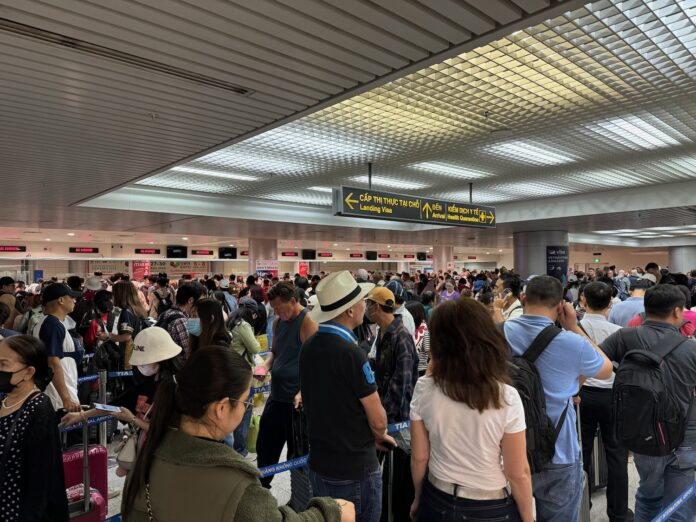
Vietnam Makes Pre-Arrival Declaration Mandatory at Ho Chi Minh City Airport. (Photo: Live and Let's Fly)

Vietnam has introduced a mandatory digital pre-arrival declaration for all foreign nationals entering on a visa through Tan Son Nhat International Airport in Ho Chi Minh City. The requirement took effect on 15 April.

The rule covers all foreign nationals entering Vietnam on any type of visa, including visa-on-arrival and e-visa holders. Overseas Vietnamese traveling on foreign passports also fall within the scope.

Only Vietnamese passport holders and transit passengers remaining airside are exempt.

How It Works

Travelers complete the declaration online through the official portal, or by scanning a QR code provided through official channels. The form requires passport details, flight information, address of stay, and a health self-declaration.

After submitting, travelers receive a confirmation QR code. They must show it to immigration officers on arrival, either on a phone or in print.

Failure to complete the declaration before arrival will result in longer processing times at immigration checkpoints. Travelers without the QR code face manual processing, which can stretch well beyond standard wait times.

Visitors must complete the form 24 to 48 hours before departure.

The measure aims to modernize immigration management, cut congestion during peak hours, and improve the overall passenger experience as part of Vietnam’s broader digital transformation drive.

Part of a Regional Shift

Vietnam’s move is the latest in a broader regional push toward digital border management, with several Southeast Asian countries introducing similar systems in 2025.

Thailand

Thailand rolled out its own digital arrival card, known as the TDAC from 1 May 2025. The system applies to all foreign passport holders arriving by air, land, or sea, and requires travelers to submit passport data and address of stay before arrival.

Thailand had scrapped its paper-based TM6 form back in July 2022 to ease congestion at immigration, but has now reintroduced a digital version to strengthen security and better track tourist movements.

Indonesia

Indonesia also launched its own unified digital arrival card, called All Indonesia, in August 2025. The system brings immigration, customs, and health declarations under one platform, replacing several separate online forms.

Travelers entering through Bali, Jakarta, and Surabaya must complete the form up to 72 hours before arrival and present a QR code on landing.

Laos

Laos itself introduced its own digital immigration system on 1 September 2025. The Lao Digital Immigration Form replaced paper arrival and departure cards and requires all foreign nationals to register online a at least three days before entering or leaving the country. On submission, travelers receive a QR code valid for three days to present at the border.

The system currently operates at four checkpoints: Wattay International Airport in Vientiane, Luang Prabang International Airport, Pakse International Airport, and the First Lao-Thai Friendship Bridge crossing.

Authorities plan to extend it to all checkpoints by end of 2026.

Lao New Year Road Accidents Leave 12 Dead, 250 Injured

Laos Reports 452 Road Accidents, 61 Deaths in August
This image is used only for representation purpose (photo credit: Lao Security News)

Lao authorities have announced the final road accident toll from the Lao New Year holiday period, which each year sees multiple fatalities and hundreds of injuries nationwide.

According to traffic police data from 14 to 16 April, a total of 149 road accidents were recorded, resulting in 12 deaths.

A further 250 people were injured, highlighting ongoing road safety risks during one of the country’s busiest travel periods.

Daily figures show that on 14 April, authorities recorded 51 accidents, with 2 deaths and 91 injuries. On 15 April, another 51 accidents were reported, with fatalities rising to 6 and 71 people injured. On 16 April, cases declined slightly to 47 accidents, with 4 deaths and 88 injuries.

Vehicle damage was also significant, with 262 vehicles involved in accidents over the three-day period.

Provincial data shows incidents occurred nationwide, with Vientiane Province recording the highest number of cases, followed by Vientiane Capital and Savannakhet. Champasak and Luang Prabang also reported notable accident figures, including several fatalities.

The figures come despite increased enforcement efforts. In Vientiane Capital, authorities deployed 561 traffic police officers across 145 checkpoints during the holiday period, conducting alcohol tests, speed checks, and enforcing helmet and seatbelt use. Officers also monitored overcrowding on public transport and managed traffic flow across key routes.

Compared to previous years, the figures show a modest improvement.

During the same period last year, 15 people were killed in over 160 accidents. In 2024, 316 accidents resulted in 33 deaths and 594 injuries.

Despite the decline, authorities say the continued loss of life highlights ongoing road safety challenges during peak holiday periods, even as enforcement measures remain in place.