Home Blog Page 6409

Laos Visas Explained

Laos Visa Explained

By RDK Group
Most foreigners require a visa before entering the territory of Laos. Generally speaking, obtaining a visa to Laos is a relatively simple process, although specific information is not always easy to find. This guide explains each type of visa available, as well as the application process for each:

Tourist Visa (T-B3)

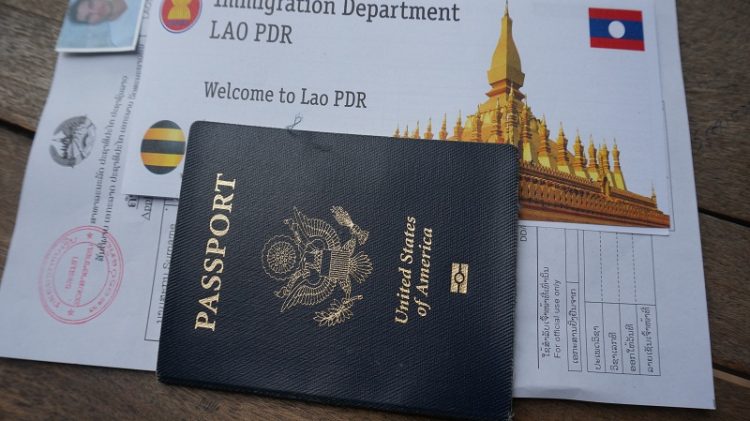
While tourist visas can be obtained at a Lao embassy or consulate abroad, tourists from many countries are offered a tourist visa on arrival in Laos. Obtaining a visa on arrival is a simple process, requiring only filling out a few forms and paying a visa fee at a land border crossing or at airport immigration. The standard fee for a visa is $30 USD, although fees may vary from country to country.

Visas on arrival are available at:

  • Lao international airports in Vientiane, Luang Prabang, Pakse and Savannakhet.
  • Thanaleng Railway Station in Vientiane Capital
  • International land border crossings including Lao-Thai Friendship bridges in Vientiane, Thakhek and Savannakhet, and land borders with other countries.

Citizens of some countries, including Japan, Russia, Switzerland, Republic of Korea, and Luxembourg may enter and remain in Laos without a visa for 15 days. To see a full list of countries with bilateral or unilateral visa exemption agreements, view this list by MOFA.

Citizens of the following countries are not eligible for visas on arrival:

Afghanistan Nauru
Algeria Niger
Bangladesh Nigeria
Burundi Pakistan
Cameroon Senegal
Cote d’Ivoire Sierra Leone
Congo Sri Lanka
Ghana Suriname
Guinea Syria
Guinea Bissau Swaziland
Jordan Tonga
Lesotho Turkey
Liberia Zambia
Libya Zimbabwe
Mozambique


Tourist Visa Fees by Country:

Country          Price (US Dollar)
Australia          30
Canada            42
China               20
India                40
Sweden           31
USA                35
UK                  35
Others             30+-

Tourist Visa Extension:
If you are having a great time in Laos and want to stay longer, your visa can be extended at the Immigration Department, Ministry of Public Security, in Vientiane Capital (off Lane Xang Avenue, here). The extension cost is $2 per day if you apply before your original visa expires, although there is a fine of US $10 per day for each day you overstay your original visa. You’ll need your passport, one passport photo, and the correct amount of money for fees.


Transit Visa (TR-B3)

A Transit Visa is for tourists that will transit through Laos to another destination. This type of visa allows a seven day stay in Laos, and it cannot be extended. When applying for this visa, it may be necessary to provide evidence of an onward trip, such as an air ticket or entry visa for the next destination.


Visitor Visa (B3)

Visitor Visas are for citizens of foreign countries that wish to enter Laos for the purpose of visiting relatives living in Laos. This type of visa can be obtained from Lao embassies or consulates abroad. The visa allows visitors a stay of 30 days in Laos, and it may be extended twice. It may also be necessary to provide a letter from a guarantor in Laos, certified by MOFA, Laos.


Labor Visa (LA-B2)

The LA-B2 Labor Visa is the most common type of visa held by foreigners living and working in Laos. This visa may be for a 3 month, 6 month, or 12 month duration, and is a multiple entry visa, meaning the bearer may exit and re-enter the country as many times as they wish. In order to apply for this visa, the applicant must be legally employed and sponsored by a registered enterprise in Laos which holds a quota for foreign employees. The visa is normally accompanied by a Work Permit, and Stay Permit, and spouse visas are available under this visa.

RDK Group
If you do not have a company to sponsor you, or need assistance in processing a B2 visa, RDK Group can help facilitate this for you. Either visit our website, or complete this form.


Expert Visa (E-B2)

The expert visa is a visa issued to foreign experts, usually working for international organizations or non-government organizations. The conditions and processes are similar to that of the LA-B2 visa. The visa is normally accompanied by a Stay Permit and Work Permit, and spouse visas are available under this visa.


Investor Visa (NI-B2)

The NI-B2 Investor Visa is available to foreign citizens who have invested in an enterprise registered in Laos. This includes foreign investors, stockholders, directors, deputy directors, and technical officers. The visa is normally accompanied by a Stay Permit and Work Permit, and spouse visas are available under this visa.


Media Visa (M-B2)

The Media Visa is a special visa issued to registered foreign journalists who cover events in Laos.


Student Visa (ST-B2)

Student Visas are issued to foreign students that will study in Laos for one to five years. It is a 12 month visa that can be extended every year.


Spouse Visa (SP-B3)

The spouse visa is issued to husbands or wives of other types of visa holders. The spouse visa will normally be for the same duration as that of the original visa holder. A spouse visa holder may not undertake any work while in Laos.


Diplomatic Visa (D-A1)

This type of visa is only available to diplomatic passport holders, including consular officers, heads of international organizations and United Nations agencies, and their families. The visa is a 12 month multiple entry visa, and can be extended every year.


Official Visa (S-A2)

The Official Visa is similar to the A2 visa, and is for the staff members of diplomatic missions, consulates, United Nations agencies, and their families. It can is a 12 month visa which can be extended each year.


Courtesy Visa (C-B1)

The courtesy visa is a visa issued to foreign experts and their families, who perform assignments under bilateral cooperation or grant assistance projects for the government of Laos. The Courtesy Visa is exempt from visa fees and allows multiple entry for 6 months, or until assignment completion.


This article supplied by RDK GROUP.

RDK Group


Lao, Chinese Officials Exchange Views on Socio-economic Development

Confirmation of Laos’ commitment to participate in China’s One Belt, One Road’ initiative will add fresh impetus to and broaden the prospects for the two countries’ future cooperation.

The initiative will further improve the well-being of the Lao people and promote socio-economic development in the country as a whole.

China’s One Belt, One Road initiative is highly compatible with Laos’ national development strategy, said Professor of International Relations from Jinan University in Guangzhou, Dr Zhang Zhenjiang, when he and his delegation met with senior officials from Lao media organisations in Vientiane yesterday.

During the meeting, officials from the two countries exchanged views on topics concerning the One Belt, One Road’ initiative, the economic situation in China and other issues of interest.

Dr Zhenjiang said the planned China-Laos railway would transform Laos from being landlocked to land-link ed.

The China-Laos railway will be the first route to connect Laos with the vast railway system in China, using Chinese technology, equipment and investment.

The project has a total investment of 40 billion Chinese yuan (about US$6 billion), 70 percent of which comes from China, while 30 percent comes from Laos.

The China-Laos railway will cover a distance of 427km and will be completed by 2021. It marks an important milestone in the socio-economic cooperation strategy of the two countries.

The project links to the One Belt, One Road’ initiative of Chinese President Xi Jinping and will contribute to increased friendly relations and cooperation between Laos and China, and between C hina and Asean.

The Lao government has highlighted the significance of the railway in transforming Laos from a landlocked country to a land link and attracting more foreign investment and tourists.

The railway will also serve to boost production in Laos, both for export and to spur economic growth.

With regard to economics, China’s annual GDP growth rate averaged 10 percent for 35 years from 1978 to 2013, but has now slowed to 6-7 percent.

The country’s annual GDP growth rate has fallen to a level unseen since 1978 and a so-called new normal has arisen .

The metric that is most commonly used in the media to gauge China’s macroeconomic movement is year-on-year GDP growth rate — meaning the percent deviation that the economy has grown this year over the same point last year.

While this metric can help to provide a picture of what is happening in China’s economy, its importance has been severely overrated.


Source: Vientiane Times

Vietnam Tops List of Destinations for Lao Students

From 2011-2016 Lao students and officials took more academic courses in Vietnam than any other country, according to figures from the Ministry of Education and Sports.

More than 13,300 Lao students took courses in Vietnam from 2011-2016, while this academic year 3,498 Lao nationals are studying in foreign countries.

Director General of the Student Affairs Department, Associate Prof. Dr Khamleusa Nuansavanh, recently told the Education and Sports newspaper that the 3,498 figure includes 1,688 women studying abroad in academic year 2016-17.

Some 1,680 students received scholarships from the government while others received exchange scholarships arranged between Laos and various countries, and 1,818 students paid for their own studies abroad.

Associate Prof. Dr Khamleusa said more Lao students preferred Vietnam over other countries, with 1,749 people studying in the country in 2016-17. In 2015-16, almost 5,200 Lao nationals studied abroad including 899 on government scholarships, 2,490 through other programmes, and 1,797 being self-financed.

From 2011-2016, more than 13,300 Lao students and officials took courses in Vietnam, along with 3,289 in China, 909 in Thailand, 258 in Japan, and 252 in Australia.

According to the Student Affairs Department, Lao students have studied in 37 countries for bachelor, master’s and PhD degrees in subjects including administration, foreign affairs, law, technology, and agriculture and fisheries.

Associate Prof. Dr Khamleusa invites people wanting to apply for scholarships to study abroad to monitor the Student Affairs Department website: www.dsa.moe.gov.la/lo/.

This website gives the details of foreign scholarships and there are many available for students and officials at several ministries. Many countries provide scholarships for Laos each year, he said.


Source: Vientiane Times

Govt, Japan to Further Develop Human Resources in Legal Sector

To realise the government’s master plan of building the country into a state governed by the rule of law, Laos will continue to work with Japan to enhance their joint efforts to develop institutional and individual capacity in the legal sector.

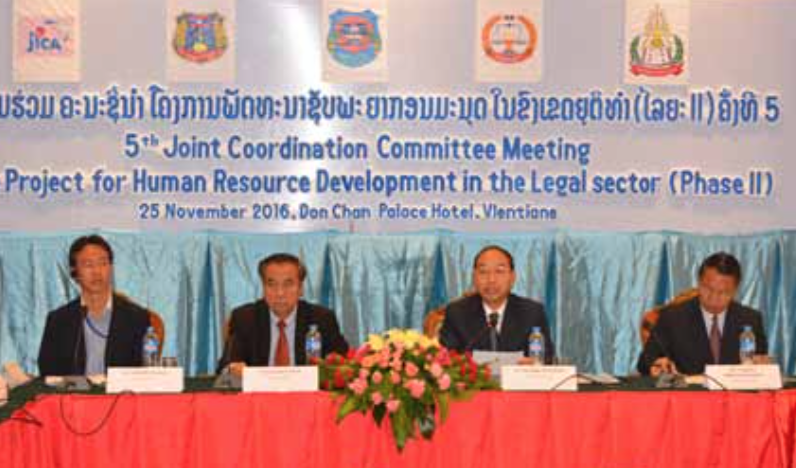
This was the key message delivered by the Vice President of the People’s Supreme Court, Mr Khampha Sengdara, when he addressed the 5th Joint Coordination Committee Meeting of the Project of Human Resource Development in the Legal Sector (phase 2), held in Vientiane on Friday.

Mr Khampha said the project focused on implementing four activities: making civil law, writing handbooks on civil law and economics, writing handbooks on criminal law, and developing an education law institute.

The working group members comprised officials and lecturers from the Ministry of Justice, the People’s Supreme Court, the Supreme People’s Prosecutor Office, and the National University of Laos.

The group has systematically analysed legal theories and practical issues relating to the civil code, civil procedure and criminal procedure, and developing a handbook summarising the result of the analysis.

The group has explained how to use the handbook and its contents to institutions and officials/lecturers in the legal and justice sector.

The project has been implemented through a technical cooperation agreement between the Japan International Cooperation Agency (JICA) and the Ministry of Justice, the People’s Supreme Court, the Supreme People’s Prosecutor Office, and the National University of Laos.

The goal of the project is to enable institutions and officials/lecturers in the legal and justice sectors and legal education to develop their institution/individual capacity to advance legal studies on Lao law on the basis of systematised analysis of theories and practices.

During the meeting, participants discussed the progress and outcomes of the project over its implementation period. According to the terminal evaluation team from JICA, the expected outputs are to be realised as planned in the project design.

Based on the evaluation criteria such as relevance, effectiveness, efficiency, impact and sustainability, the project has been evaluated high or fairly high overall, said Mr Khampha.

The first phase of the project began in 2010 and ended in 2014, focusing on strengthening the capacity of institutions and officials in the Lao legal and justice sectors, as well as legal education.

The meeting was attended by representatives from JICA, the Ministry of Justice, the People’s Supreme Court, the Supreme People’s Prosecutor Office, and the National University of Laos.


Source: Vientiane Times

Four People Killed in UXO-related Accidents over 10 Months

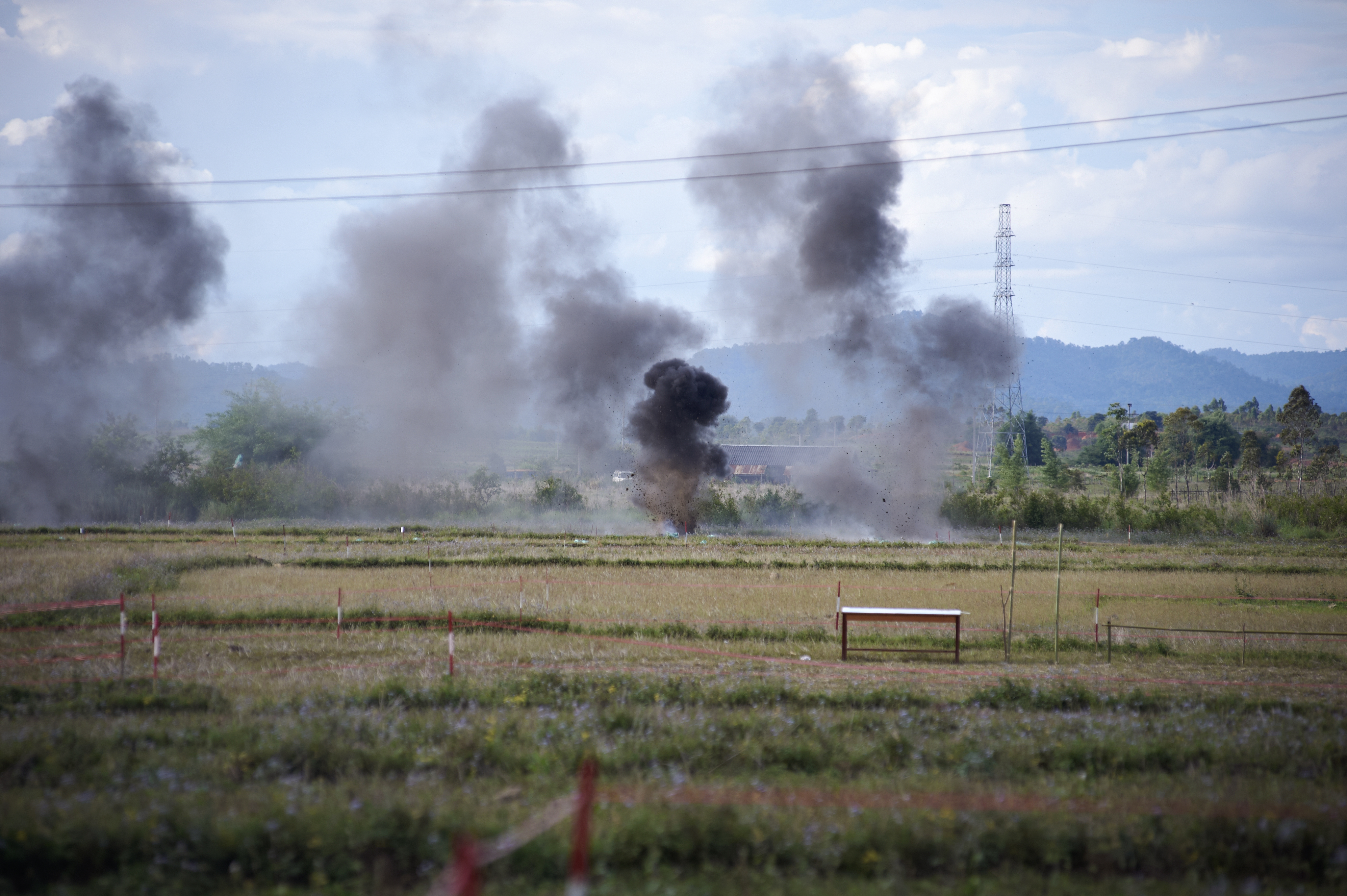
Four people have died and 11people have been injured in UXO-related accidents from January to October 2016, according to a report from the Lao National Unexploded Ordnance Programme (UXO Lao).

The report was disclosed on Friday at UXO Lao’s annual meeting to summarise their work over the past year and plan for the year ahead.

The meeting was attended by Minister of Labour and Social Welfare Dr Khampheng Saysompheng, UXO Lao Director Mr Thipphasone Soukhathammavong, and other officials.

An official from UXO Lao said that from January to October of this year there had been seven UXO-related accidents in which 11 people sustained injuries and four people died.

Three of the accidents occurred in Xieng Khuang province where two people sustained injuries and one was killed.

Another incident in Savannakhet province saw two people sustain injuries.

In Attapeu province, an explosion resulted in five people being injured and one being killed.

An accident in Khammuan province injured one person and killed two, while in Champassak province an explosion injured one person.

Explosions typically occur during the transport, dismantling or burning of UXO, or while villagers are working in their fields.

U XO Lao has worked with international organisations to clear UXO from 2,147 hectares of land, of which 93 percent is needed for farming and 7 percent for development purposes.

Some 84,402 cluster munitions were cleared, including 68,639 bombies and other items. On average, 21 bombies per hectare have been found.

UXO Lao’s target is to remove UXO from 3,200 hectares of land in the provinces of Huaphan, Luang Prabang, Xieng Khuang, Khammuan, Savannakhet, Saravan, Xekong, Attapeu and Champassak.

Addressing the meeting, Dr Khampheng said UXO Lao’s goal is to reduce the number of casualties and provide assistance to the survivors of UXO-related accidents.

During the Indochina War from 1964-73 some 3 million tonnes of UXO were dropped o n Laos, including about 270 million sub-munitions from cluster bombs and about 4 million aircraft bombs.

Tests in the United States have found that cluster munitions have a failure rate of up to 30 percent, meaning a large amount of unexploded devices still remain in Laos.

A total of 87,000 square kilometres of land are thought to be contaminated with UXO.


Source: Vientiane Times

Beekeeping Trial to Sweeten Champassak Honey Production

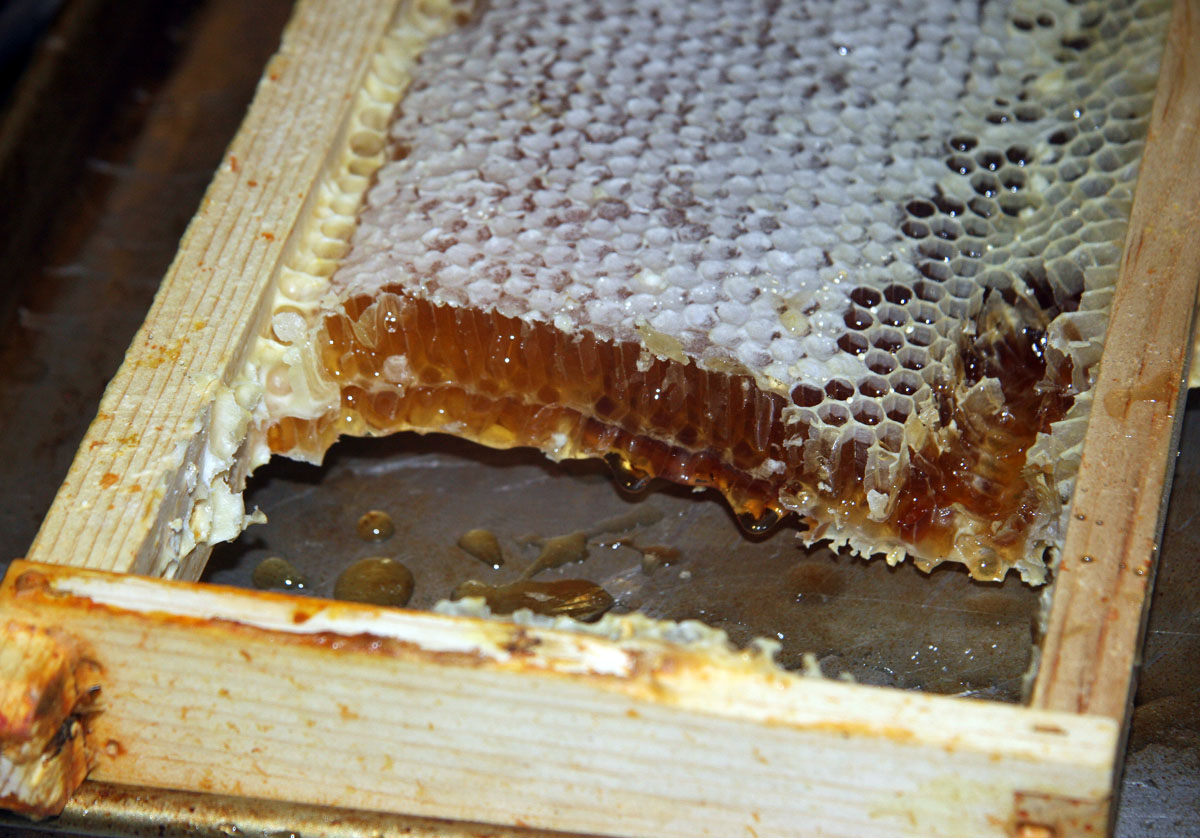
Laos and Vietnam are to begin cooperation in a commercial beekeeping trial to boost honey production in Champassak province.

After the trial, the cooperative project under the Asian Development Bank (ADB) and the International Fund for Agriculture Development (IFAD) will be able to supply beehives and training to local apiarists.

National Project Director of the Sustainable Natural Resources Management and Productivity Enhancement Project, Mr Vinoth Vansy, told Vientiane Times that Vietnam is providing 250 beehives for the trial in Champassak province.

The trial is looking to locate hives where the province’s bees typically make honey, he said.

They expect to know the best areas for honey production after the end of this year.

According to the provincial Agriculture and Forestry Department, Vietnam is currently supplying large quantities of honey to EU countries.

The number of beekeepers in Champassak has declined in recent years due to insufficient market demand with some people abandoning their beehives and leaving them to the wild.

Today, some bottles of honey can be seen for sale in markets with the honey being sourced from the wild by local people.

Some Vientiane consumers are distrustful of local products believing it is blended with imported honey or other ingredients such as sugar and water.

They think that because there are now fewer beehives people are taking shortcuts to ensure sufficient supplies.

However, honey from the southern provinces is still in reasonable supply across the country, even though the peak honey season only occurs in April and May. At this time honey can be seen on sale in many markets, restaurants, guesthouses and hotels by the bottle or jarful.

People have varied uses for honey and it is a popular household ingredient. Many people put half a spoonful into bottled water to give it flavour while others use the honey as a healing product.

A common belief in Vientiane is that honey has a calming effect ensuring a good night’s sleep.

Honey is a natural product which is a safe and wholesome food for adults, children and the elderly. Apart from its great taste and general capacity for enhancing well-being, honey is a healthy substitute for sugar and can help combat obesity and diabetes.


Source: Vientiane Times

Laos, Development Partners to Strengthen Ties for Effective Cooperation

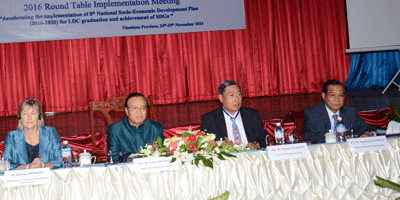
Vientiane province : — Laos will need continuous support from friendly countries and development partners despite the significant achievements that have been made in socio-economic development in recent years.

High level government officials and local authorities revealed the circumstances at the 2016 Round Table Implementation Meeting, which ended yesterday in Vientiane provincial capital.

The meeting was titled Accelerating the implementation of the Eighth National Socio-Economic Development Plan (8th NSEDP 2016-2020) for Least Developed Country graduation and the achievement of the Sustainable Development Goals.

Discussion focused on localisation of the Sustainable Development Goals (SDGs), effective development partnerships, food and nutrition security, green growth, as well as climate change and disaster response preparedness.

In his opening remarks, Deputy Prime Minister and Minister of Finance Mr Somdy Duangdy noted the significance of the meeting taking place outside the country’s capital, and Vientiane province’s socio-economic conditions were explained to participants.

This shows the government’s effort in comprehensively pursuing local development following the Sam Sang (Three Builds) directive: building provinces as strategic units, building districts as comprehensively strong, and building villages as development units, Mr Somdy said.

He reminded the audience of the country’s continuing economic growth, which has been 6.9 percent over the past 10 months, and is predicted to reach 7 percent by the end of this year with income per capita at US$2,027.

Meanwhile, Mr Somdy also noted the internal and external impacts on the country’s economy such as the fall in mineral prices, the rubber price decline, and natural disasters, which he said seriously affected agricultural crops and exports, as well as revenue collection, which did not meet the planned target.

Speaking at the meeting, Minister of Planning and Investment Dr Souphanh Keomixay stressed the inclusion of localisation of the SDGs into the national development agenda as well as at the local level, saying these should reflect effective use of money and labour in project implementation, and strongly support the participation of all sectors, including private businesses and residents.

He also proposed for such participation in the implementation of food and nutrition programmes with stronger and more harmonious coordination.

For green growth and climate change and disaster response preparedness, the minster pressed for the strategy to be realised following the government having ratified the United Nations Agreement on Climate Change.

Amendment of Government Decree No. 75 on Effective Development Aid Implementation was mentioned by Dr Souphanh as a real need, while calling for the ministry and other sectors to pay attention to the matter.

United Nations Coordinator and United Nations Development Programme Representative, Ms Kaarina Immonen, praised the government’s decision to provide a provincial location as the venue for this year’s Round Table meeting.

She congratulated the government for promoting Laos as the first ASEAN country to have submitted the ratification instrument in respect of the Paris Agreement on Climate Change.

She also praised the government as a champion in achieving the Millennium Development Goals, the National Assembly’s engagement in policy issues regarding national development, and the newly founded provincial people’s assemblies as new advocates for the implementation of the NSEDP and SDGs at the local level.

Some areas to be considered for further consultation were revenue and public debt management, which Ms Immonen said required particular attention.

She said the government is encouraged in its commitment to the production of integrated transparent and accountable national budgeting and alignment with ODA growth.


Source: Vientiane Times

Group Visits Route to Freedom Taken by Leaders in 1960

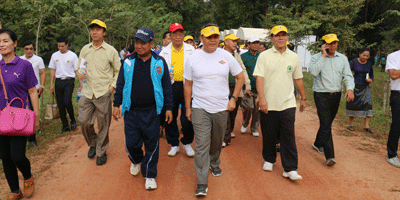
Over 300 people gathered near Tadxone Waterfall in Vientiane’s Naxaithong district on Friday to trace the path taken by the 16 Lao Patriotic Front leaders who made a daring escape from Phonkheng Jail 56 years ago.

The breakout by the revolutionary leaders including Prince Souphanouvong, Nouhak Phoumsavanh and Phoumy Vongvichit was an extraordinary feat and is considered a significant event in Lao history which remains talked about to this day.

Among those joining the 2-km walk to trace the route taken by the Lao Patriotic Front leaders were Party Politburo Member and President of the Lao Front for National Construction, Dr Xaysomphone Phomvihane, and other leaders.

The crowd walked to a cave where Prince Souphanouvong and the other escapees hid before heading to the revolutionary stronghold in northern Laos.

The event was organised by the Lao Front for National Construction and the Vientiane Elderly People’s Association.

President of the Vientiane Elderly People’s Association, Mr Somphong Mongkhonvilay, told the crowd that the goal of the walk was to raise awareness among the younger generation and encourage people never to forget the valiant deeds of the revolutionary leaders who sacrificed so much for the nation.

On July 28, 1959, the American-backed Vientiane government arrested the 16 Lao Patriotic Front leaders and put them in Phonkheng Jail in a bid to suppress the revolutionary movement, Mr Somphong said.

During their time in jail, the group told the soldiers guarding the prison about the political views, revolutionary morale, spirit of patriotism and sacrifices of the revolutionary forces and eventually persuaded their guards to side with them.

Although our revolutionary leaders were in jail, they jointly signed a letter which they sent to the Phouy Sananikone Prime Minister-led government, requesting (the Vientiane government) to release them. But the Vientiane government did not care about the letter, Mr Somphong said.

Over a period of almost 300 days, the situation became more tense and the revolutionary leaders talked their guards into a position of sympathy so that they prepared an escape route.

Finally the leaders escaped in 1960 and headed to Naxaithong district, before walking to the north and the safety of the revolutionary stronghold.

To commemorate the courage of the 16 revolutionary leaders, the Lao Front for National Construction and Vientiane Elderly People’s Association published a book about the incident.

The book keeps alive the story of the leaders’ break for freedom and ensures that the younger generations can learn about the incredible story of their escape.

The book was written by Mr Buasy Chaleunsouk, one of the 16 revolutionary leaders.

A second edition of the book has been printed and earnings from sales will be used to build a memorial to the escapees.


Source: Vientiane Times