

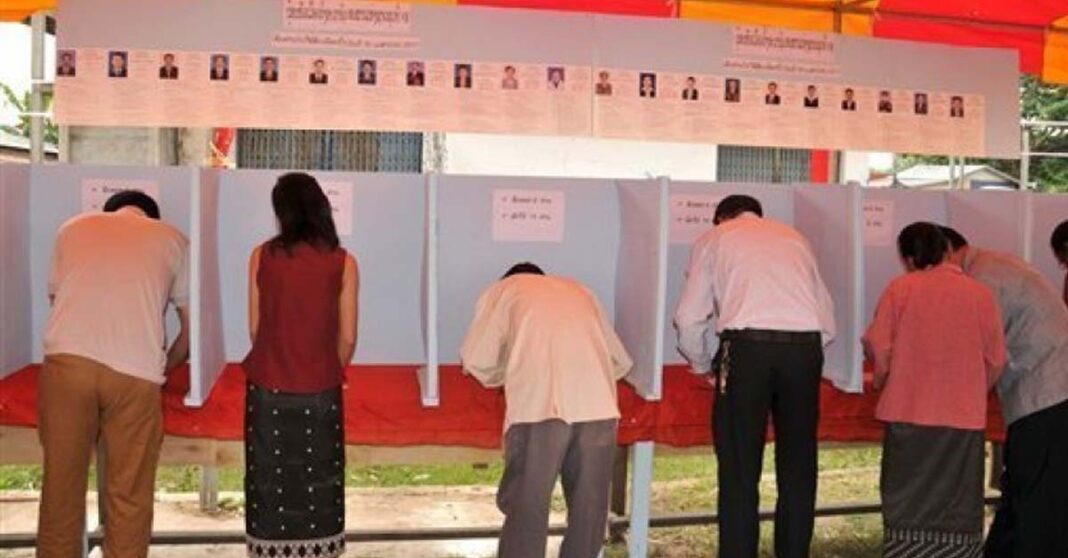
Laos will hold nationwide elections on 22 February to elect members of the National Assembly and Provincial People’s Councils.
The election will be overseen by a 21-member National Election Committee chaired by National Assembly President Xaysomphone Phomvihane.
Lao citizens aged 18 and above will be eligible to vote, except those legally restricted, while authorities are currently compiling candidate lists.
The upcoming vote will select 175 National Assembly members nationwide, an increase from 164 in the current 9th Legislature.
Each parliamentarian represents approximately 50,000 citizens, ensuring proportional representation across the country. These figures are based on the 2021 election, with updated data for 2026 yet to be released.
Transition to the 10th Legislature
The 9th Legislature of the National Assembly will complete its five-year term on 22 March next year, after which the 10th Legislature will assume its duties.
Following the election, the new Assembly will elect state leaders, approve the next government cabinet, and adopt the National Socio-Economic Development Plan for 2026–2030.
From Party Congress to National Vote
The election schedule follows the 12th National Congress of the Lao People’s Revolutionary Party (LPRP), set to take place from 6–8 January. Held every five years, the Congress will elect new Party leadership and define policy directions for the 2026–2030 period.
Delegates selected from provincial and ministerial-level Party congresses will elect a new Party Central Committee. The group will then convene to choose the Party Secretary General, Politburo members, and other key Party bodies. Once the Congress concludes, attention will shift fully to the national elections.
The most recent national elections were held in February 2021, resulting in the current 9th Legislature and existing state leadership.
At a recent meeting attended by all members of the Party Central Committee, leaders reviewed key documents, organisational arrangements, and measures to ensure a smooth political transition in the coming months.
Regional Election Year Ahead
Laos’ 2026 elections will take place amid a broader wave of political transitions across Southeast Asia, with several countries in the region also heading into major electoral or leadership milestones.
Thailand is expected to remain in political focus following recent electoral cycles and ongoing debates over governance reforms, while Indonesia will continue navigating the post-election transition after its 2024 polls, with policy implementation and coalition dynamics carrying into 2026.
Malaysia is likewise entering a critical period as its unity government faces economic pressures and prepares for potential electoral tests at the state or national level.
Myanmar Begins Voting Period
Meanwhile, Myanmar’s military authorities began the first phase of a nationwide election on 28 December 2025, marking the start of a three-stage voting process scheduled to continue on 11 January and 25 January.
The vote comes nearly four years after the military seized power in February 2021. Authorities have described the election as a step toward restoring civilian governance, while opposition groups and independent observers continue to raise concerns over security conditions, restrictions on political participation, and the exclusion of key parties.
Voting is taking place in selected areas, with large parts of the country affected by ongoing conflict and emergency rule, limiting the scope of polling in several regions.
In this context, Laos’ national elections and leadership transition form part of a wider regional pattern of political renewal and policy realignment.
Officials in Laos have stressed that a smooth and orderly election process will remain a priority as the country moves forward with its development agenda during a period of heightened political activity across the region.
