

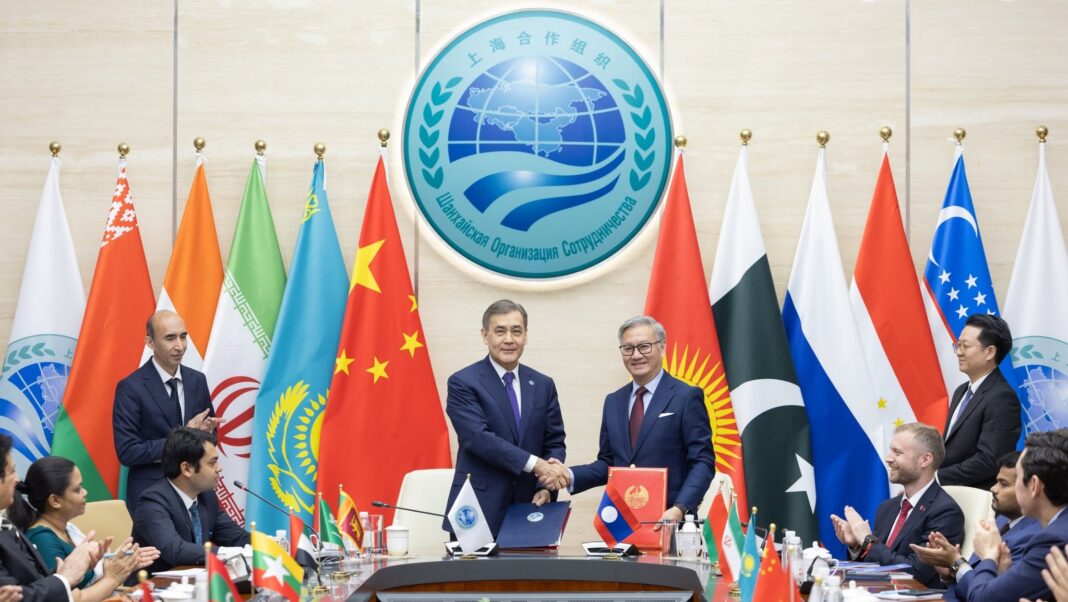
Laos has strengthened its regional ties after formally confirming its status as a Dialogue Partner of the Shanghai Cooperation Organization (SCO), signing an agreement with the organization in Beijing on 10 July.
The agreement puts into effect a decision made by SCO leaders during their summit in Tianjin, China, on 1 September 2025, when Laos was admitted as a Dialogue Partner.
Although Dialogue Partners are not full members of the organization, they can take part in selected meetings, cooperation programs, and sector-specific initiatives alongside SCO member states.
According to Lao Ministry of Foreign Affairs Thongsavanh Phomvihane, the new status will allow Laos to expand cooperation in areas such as trade, investment, transport, tourism, digital transformation, economic development, and sustainable development.
Speaking at the signing ceremony, Thongsavanh described the agreement as an important milestone in relations between Laos and the SCO. He said the government remains committed to strengthening cooperation through the organization’s various mechanisms and programs.
He also highlighted digital transformation as one of Laos’ key development priorities and said the country looks forward to working more closely with SCO members in that field and other areas of mutual interest.
Supporting Regional Connectivity
The partnership aims to strengthen Laos’ ambition of becoming a regional transport and logistics hub by supporting its long-term goal of transforming from a landlocked country into a land-linked one.
During the meeting, both sides noted that Laos serves as an important link between China’s Belt and Road Initiative and the Regional Comprehensive Economic Partnership. They also highlighted the China-Laos Railway as a growing gateway for regional trade and connectivity.
Officials said the new partnership could help Laos deepen cooperation with countries across Central Asia, South Asia, and Eurasia while creating new opportunities for trade, investment, and logistics.
Founded in 2001, the Shanghai Cooperation Organization now has 10 member states, two observer states, and 15 Dialogue Partners, including Laos.
