

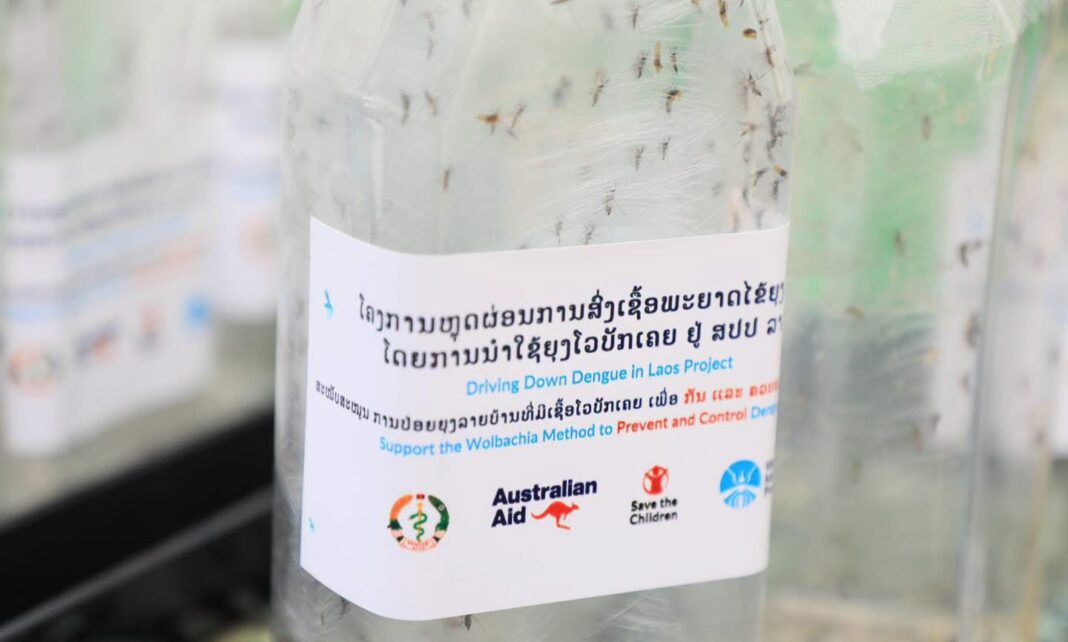
On 11 July, the Ministry of Health’s Department of Communicable Disease Control (DCDC), in partnership with Save the Children International (SCI) and support from the Australian Government and the World Mosquito Program (WMP), has expanded its national efforts to fight mosquito-borne diseases in Luang Prabang, Laos.
The latest Wolbachia mosquito releases, as part of the Driving Down Dengue in Laos (DDDiL) project, mark a significant milestone in strengthening innovative dengue prevention efforts in the northern provinces of the country.
The project harnesses the power of Wolbachia, a naturally occurring bacterium that prevents Aedes aegypti mosquitoes from effectively transmitting dengue viruses. Mosquito releases are now underway in Vientiane Capital, Oudomxay, Luang Prabang, Savannakhet, and Champasak provinces, representing one of Laos’ most significant public health innovations to date. The successful launch follows intensive planning, technical preparation, and grass-roots community engagement conducted between April and June.
The project harnesses the power of Wolbachia, a naturally occurring bacterium that prevents Aedes aegypti mosquitoes from effectively transmitting dengue viruses.
Mosquito releases are now underway in Vientiane Capital, Oudomxay, Luang Prabang, Savannakhet, and Champasak provinces and represents one of Laos’ most significant public health innovations to reduce dengue transmission through safe, evidence-based methods. The successful launch follows intensive planning, technical preparation and grass-roots community engagement between April and June.
Built on Trust, Not Just Technology
Public health innovation succeeds or fails on the trust of the communities it serves and in Laos, that trust has been earned village by village. Between April and June, the project trained 336 village health volunteers across 197 villages in the five target provinces. A series of Training of Trainers sessions, Community Advisory Group meetings, Gender Equality, Disability and Social Inclusion (GEDSI) workshops, youth engagement activities, and Geographic Information System (GIS) mapping strengthened local capacity ensuring communities were well informed before implementation.
An essential factor in the project’s success has been supportedby local communities. In the five areas of the current release target, public acceptance reached over 88%, demonstrating strong confidence in Wolbachia method and its potential to reduce dengue transmission.
The Stakes for Lao Families
Dengue remains a persistent public health challenge in Laos, particularly during the rainy season from May to October. Between 2025 and mid-2026, 1,494 dengue cases were reported nationwide, including four severe cases – each one a family disrupted, a child kept home from school, and a hospital bed filled unnecessarily. .
The evidence from WMP offers real hope. In North Queensland, Australia, sustained Wolbachia levels have made dengue a public health concern of the past. Meanwhile, in Yogyakarta, Indonesia, a landmark trial found a 77 per cent reduction in dengue cases in treated areas compared with untreated ones. The Wolbachia method complements — rather than replaces — existing dengue prevention measures, adding a durable, self-sustaining layer of protection to the tools communities already use.
Speaking at the launch event, Baykham Khattiya, Minister of Health, Laos, stated:
“Dengue fever remains a major public health challenge and a threat to the lives and well-being of people worldwide, causing outbreaks and deaths each year. The Wolbachia mosquito release program is a new innovative method to dengue control that has achieved positive results in many countries. It also represents a releasing hope for more effective dengue prevention and control in the Lao PDR.”
Bounleua Sinxaylorlavong, Chairman of the provincial Administrative Committee, stated:
“Dengue fever was once mainly a rainy-season disease, but it can now occur year-round. Major outbreaks in Lao PDR occurred in 2013, 2019, 2022, and 2023, causing significant loss of life and property. Dengue remains a serious public health challenge, requiring everyone’s cooperation to stay vigilant and prevent its spread”
Luke Ebbs, Country Director for Save the Children International in Laos, said:
“Dengue continues to affect too many families across the country, underscoring the urgent need for new approaches. This initiative is not only about the release of mosquitoes—it is about fewer children falling ill, stronger communities, and a healthier future for Lao PDR. It also reflects the strength of partnership between government, communities, and development partners. Together, we are reducing the burden of dengue while advancing innovation, delivering hope, and creating safer, healthier environments for children and families.”
Australian Ambassador to Laos, Megan Jones said:
“Australia is pleased to support Laos in applying the World Mosquito Program’s Wolbachia method as an innovative, evidence-based approach to reducing dengue transmission. This initiative highlights the strength of our partnership and our shared commitment to protecting families, safeguarding children, and building healthier, more resilient communities across Lao PDR.”
A Proven Path Toward National Protection
This nationwide rollout builds upon a phased expansion strategy that began in Vientiane Capital in 2022. Following successful local trials over the last four years, the project is now scaling up dramatically across all nine districts of the capital as well as four key provinces. This milestone expansion will ultimately bring long-term, sustainable dengue protection to more than 1.2 million people across Laos.
About the World Mosquito Program
The World Mosquito Program (WMP) is a not-for-profit group of companies wholly owned by Monash University, Australia, that works to protect the global community from mosquito-borne viral diseases such as dengue, chikungunya, Zika and yellow fever. After significantly reducing transmission of these viruses in Australia, WMP has expanded to now be working in 16 countries, protecting more than 16 million people across Asia, Oceania and the Americas.
About WMP’s Wolbachia method
Wolbachia – a common bacterium found in about 50 per cent of insects – is introduced in the Aedes aegyptimosquitoes that transmit dengue, chikungunya, Zika and yellow fever. The Wolbachia bacterium prevents the Aedes aegypti mosquitoes from transmitting these diseases.
The Wolbachia mosquitoes are then released in areas where mosquito-borne viruses are endemic. As they breed with wild mosquitoes, the number of Wolbachia mosquitoes grows over time until it remains high without the need for further releases.
Unlike other measures against mosquito-borne diseases, the Wolbachia method is safe for people, mosquitoes and the environment, and offers a long-term and self-sustaining solution to control the spread and impacts of dengue, chikungunya, Zika and yellow fever.
