


The Lao Government has opened a donation channel for all those looking to contribute financially to the fight against the outbreak of COVID-19.
Home Blog
Advantech Launches ASR-D501 AI Companion Computer for Autonomous Drone Applications

Compact, power-efficient platform combines edge AI, multi-sensor perception, flight-controller connectivity, and integrated robotics software for next-generation UAV development
TAIPEI, Oct. 1, 2026 /PRNewswire/ — Advantech, a global leader in AIoT and Edge Computing, today announced the ASR-D501, a compact AI companion and mission computer designed to accelerate the development of autonomous unmanned aerial vehicles (UAVs).
Powered by the Qualcomm® QCS6490, the ASR-D501 delivers up to 12 TOPS of AI performance within a sub-10W power envelope, while integrating multi-camera vision, sensor connectivity, flight-controller interfaces, wireless expansion, and the Advantech Robotic Suite for Drone.
Designed specifically for size-, weight-, and power-constrained airborne applications, the ASR-D501 provides a unified computing platform for real-time AI inference, visual perception, localization, sensor fusion, and mission-level processing. It supports advanced autonomous capabilities including object detection, visual localization, VIO, SLAM, obstacle awareness, and GNSS-denied navigation.
Power-Efficient AI Computing for Autonomous UAVs
The Qualcomm QCS6490 combines heterogeneous CPU, GPU, and NPU computing to enable AI workloads to run directly onboard the drone.
By processing perception and mission-level workloads locally, the ASR-D501 reduces reliance on continuous cloud connectivity while allowing the primary flight controller to remain focused on real-time flight stabilization and actuator control.
Supported AI workloads include:
- Object detection and tracking
- Semantic segmentation
- Visual inspection and anomaly detection
- Obstacle awareness
- Vision-based localization
- Sensor-fusion processing
Multi-Sensor Perception and Flexible Connectivity
To support increasingly sophisticated UAV perception systems, the ASR-D501 integrates five 4-lane MIPI-CSI interfaces, enabling flexible combinations of RGB, monochrome, stereo, and high-resolution cameras.
The platform also provides a 2.5 GbE interface, two USB 3.2 Gen 2 Type-C ports, and onboard interfaces including CAN FD, UART, I2C, and GPIO for connecting LiDAR, depth cameras, IMUs, flight controllers, ESCs, battery-management systems, and other onboard devices.
For long-range and BVLOS-oriented deployments, the ASR-D501 supports Wi-Fi 6E, Bluetooth, and 4G/5G cellular connectivity through M.2 expansion, together with an onboard Nano-SIM. This enables flexible communication architectures for telemetry, command and control, video transmission, and remote mission management.
Accelerating Development with Advantech Robotic Suite for Drone
The ASR-D501 supports Ubuntu 24.04 LTS and the Advantech Robotic Suite for Drone, providing a pre-integrated development environment for autonomous UAV applications.
The software environment connects high-level ROS 2 applications with flight-controller ecosystems including PX4 and ArduPilot, leveraging technologies such as MAVLink, MAVSDK, and MAVROS.
Advantech also provides validated reference workflows that integrate AI perception, visual localization, sensor fusion, mapping, object tracking, path planning, and flight control. By providing a connected software and hardware foundation from perception to flight-control integration, the ASR-D501 helps developers reduce integration complexity and move faster from hardware bring-up to autonomous-flight application development.
Built for Production UAV Deployment
The ASR-D501 is engineered to meet the practical requirements of industrial UAV deployment with a compact, fanless design and industrial-grade reliability.
Key specifications include:
- 100 × 60 mm compact form factor
- Approximately 50g board weight without heatsink
- 5–12V DC input
- Passive / fanless thermal design
- -20°C to 70°C operating temperature
- 3.5 Grms vibration resistance
- Industrial-grade ESD protection
- Lockable connectors
- Long-term product lifecycle support
Expanding Advantech’s UAV Computing Portfolio
The ASR-D501 is part of Advantech’s broader strategy to build a scalable computing portfolio for increasingly diverse UAV architectures and mission requirements.
Beyond the QCS6490-based ASR-D501, Advantech’s UAV roadmap includes OSM- and SMARC-based SOM solutions for flexible system designs, as well as IQ9075M-based platforms for applications requiring higher AI performance and advanced sensor integration. In 2027, Advantech plans to further expand the portfolio with mid-range Qualcomm® CQ8-based solutions.
By combining scalable computing platforms, robotics software integration, sensor ecosystem support, and long-term industrial lifecycle management, Advantech aims to provide drone developers with a clear path from autonomous-flight prototyping to increasingly intelligent and production-ready UAV systems.
To learn more about the ASR-D501 drone computing solutions: Link
Advantech robotics solutions: Robotics eBook / Robotic Suite
About Advantech
Advantech is a global leader in intelligent IoT systems and embedded platforms, with the corporate vision of “Enabling an Intelligent Planet.” To embrace the trends of edge computing and artificial intelligence, Advantech has adopted a sector-driven strategy centered on Edge Computing and Edge AI. The company focuses on five key markets: edge intelligent systems, smart manufacturing, energy and utilities, intelligent healthcare, and intelligent retail and services. By integrating its Edge Computing hardware platforms, WISE-IoT industrial IoT software platform, industry-specific Edge AI solutions, and domain expertise, Advantech enables collaborative business models for integrated industry applications and helps partners connect across the value chain. Advantech also actively co-creates industry ecosystems with partners to accelerate industrial intelligence. www.advantech.com
ROYAL CARIBBEAN REVEALS 2028 SUMMER LINEUP OF ALASKA VACATIONS

|
Vacationers are in for unforgettable adventures to The Last Frontier with 7-night vacations across four Royal Caribbean ships and extended land Cruisetour experiences
MIAMI, Oct. 1, 2026 /PRNewswire/ — Royal Caribbean has unveiled its 2028 Alaska lineup, offering more ways for vacationers to experience the beauty of the Last Frontier on Anthem, the newly amplified Ovation, Serenade and Voyager of the Seas beginning in April 2028. Adventurers can explore Alaska’s majestic glaciers, diverse wildlife and coastal communities on 7-night vacations departing from Seattle, Seward and Vancouver, with ways to extend select journeys on multi-night Cruisetour land experiences. The 2028 lineup of Alaska vacations is now open to book on Royal Caribbean’s website for Crown & Anchor Society loyalty members, ahead of the official opening on Thursday, Oct. 1.

Anthem of the Seas offers a lineup of thrilling experiences. From the RipCord by iFly sky diving experience to the North Star glass observation capsule that takes vacationers more than 300 feet above the ocean, to robust culinary experiences and the Bionic Bar robot bartenders, there are adventures for guests of all ages.
From visiting Mendenhall Glacier in Juneau and exploring the historic charm of Skagway to taking in the rugged landscapes of Icy Strait Point, adventurers can discover the state’s remarkable wildlife, rich heritage and awe-inspiring scenery on bold vacations for all ages. Guests can take in sweeping views of glaciers, mountains and fjords from the all-glass North Star observation capsule on Anthem and Ovation, while enjoying experiences in between destinations like the RipCord by iFly skydiving simulator, bumper cars and roller skating at SeaPlex, and live entertainment at the Royal Theater and Music Hall.
Alaska Summer 2028 Highlights
- Anthem of the Seas – From Seward and Vancouver
From May to September, Anthem will combine Alaska’s iconic coastlines with immersive inland experiences on 7-night vacations and 2- to 6-night Cruisetours that extend the journey before or after the vacation, including adventures to Denali National Park. Vacationers can marvel at one of Alaska’s most spectacular natural wonders at Hubbard Glacier and explore Ketchikan for fishing, kayaking, hiking and zip lining through forests. Back onboard, travelers can take in panoramic views from the North Star observation capsule, enjoy action-packed experiences at SeaPlex – the largest indoor activity space at sea – and refuel at Jamie’s Italian for Tuscan family-style dishes and Johnny Rockets for American classics.
- Ovation of the Seas – From Seattle
The newly amplified Ovation will bring vacationers to Alaska’s natural wonders on 7-night adventures from Seattle between May and September. Vacationers can discover the lush landscapes and rich heritage of Sitka, Skagway and Juneau, along with the breathtaking waterfalls, valleys and mountain views at Endicott Arm and Dawes Glacier. On Ovation, vacationers can make memories between destinations with skydiving at the Ripcord by iFly simulator, dancing at the brand-new Sound Cellar and celebrating with tropical cocktails at the Pesky Parrot tiki bar. To refuel, there’s a variety of international cuisine to indulge in from Italian favorites at Giovanni’s Italian Kitchen, premium cuts at Chops Grille and hibachi at Izumi Teppanyaki.
- Serenade of the Seas – From Vancouver
On Serenade, vacationers can explore Alaska’s rugged mountains, temperate rainforests and wildlife-rich coastline on 7-night getaways from Vancouver from May to September. Adventures await with the longest and highest zipline at Icy Strait Point, hiking in Prince Rupert, British Columbia, and browsing the historic district of Juneau. On deck, adventurers can take on the rock-climbing wall, kick back with poolside movie nights under the stars and enjoy live music at the Schooner Bar. Plus, with exteriors made from over three acres of glass, Serenade’s unique, light-filled design gives way to the grandeur of the Alaskan surroundings from the comfort of the ship.
- Voyager of the Seas – From Seattle
From April to September, vacationers on Voyager can experience 7-night getaways from Seattle to Alaskan towns of Sitka, Juneau and Skagway and Canada’s Victoria, British Columbia. Adventurers can visit national historic sites of the Last Frontier and take in postcard-perfect views of the surrounding mountains and coastal landscapes, while keeping an eye out for wildlife like grizzly bears, harbor seals and bald eagles. Back on Voyager, families can stay active with ice skating and laser tag at Studio B, mini golf and arcade games, while adults can unwind at the Solarium fully climatized pool deck.
Vacationers traveling from Seward can enjoy a seamless beginning-to-end journey with Royal Caribbean Group and the Alaska Railroad’s new state-of-the-art terminal. Designed to elevate every step of the vacation experience, the facility offers stunning mountain views, an effortless arrival and embarkation process, and convenient access to the neighboring Alaska Railroad station, making it easier than ever to explore more of Alaska’s breathtaking destinations. The investment also advances Royal Caribbean Group’s corporate responsibility SEA the Future initiative by creating lasting benefits for the local community, from providing a year-round gathering space for sports, youth programs and other group activities, to hosting events such as the recent award ceremony held for local entrepreneurs who participated in the bespoke small business accelerator program Port Partners.
Vacationers can learn more about the upcoming Alaska adventures on Royal Caribbean’s website.
About Royal Caribbean
Royal Caribbean, part of Royal Caribbean Group (NYSE: RCL), has delivered memorable vacations for more than 50 years. The cruise line’s game-changing ships and signature destinations revolutionize vacations with industry-leading innovations and an all-encompassing combination of experiences, from thrills and ways to chill, to dining and entertainment, for every type of family and vacationer. Voted “Best Cruise Line Overall” for 23 consecutive years in the Travel Weekly Readers Choice Awards, Royal Caribbean makes memories with adventurers across more than 300 destinations in 80 countries on all seven continents, including Perfect Day CocoCay in The Bahamas and Royal Beach Clubs in Paradise Island and Santorini, plus Royal Beach Club Lelepa coming soon.
Media can stay up to date by following @RoyalCaribPR on X and visit www.RoyalCaribbeanPressCenter.com. For additional information or to book, vacationers can visit www.RoyalCaribbean.com, call (800) ROYAL-CARIBBEAN or contact their travel advisor.
Shaping Tradition with Technology: An American Artist’s Ceramic Journey in China

BEIJING, CHINA – Media OutReach Newswire – 30 September 2026 – A new fusion of technology and traditional craftsmanship is taking shape in Jingdezhen, China’s renowned porcelain capital.

American artist Michael May from Oklahoma City has joined forces with local ceramic artist Master Xie to create a one-of-a-kind ceramic vessel combining 3D printing with traditional Chinese ceramic craftsmanship.
The process brings together modern technology and the centuries-old art of blue-and-white porcelain. The vessel is shaped through a combination of handcraft and 3D printing, decorated with traditional qinghua patterns, then glazed and fired in a kiln.
From shaping and painting to glazing and firing, follow the camera to see how a new ceramic artwork comes to life through cross-cultural collaboration.
Hashtag: #CGTN
The issuer is solely responsible for the content of this announcement.

Asian Hall of Fame Announces Class of 2026 Inductees
Legendary icons and trailblazing pioneers exemplify the American Dream
LOS ANGELES, Sept. 30, 2026 /PRNewswire/ — Global legacy platform Asian Hall of Fame announced its Class of 2026 to be inducted on November 5, 2026, in Los Angeles, California. The 22nd Induction Ceremony supports 100 Women In Tech, Entertainment, Science & Sports (WinTESS) scholarships. Title Sponsors are Chairwoman Melinda Rogers, CJ Group, and TAO.
Experience the full interactive Multichannel News Release here: https://www.multivu.com/asian-hall-of-fame/9365751-en-asian-hall-of-fame-announces-class-of-2026-inductees
“During times of worldwide conflict, Asian Hall of Fame serves as a beacon of cross-cultural collaboration and interracial synergy. Class of 2026 Inductees and Goodwill Ambassadors are role models whose endearing legacies advance culture, commerce, and community for generations to come,” states Maki Hsieh, President & CEO of Asian Hall of Fame.
CBS LA Anchor Suzie Suh is Master of Ceremonies. Ed Roth (Goodwill Ambassador 2022) is Musical Director. Prior honorees presenting incoming inductees include The Honorable Fiona Ma, William Wang, and Soo Man LEE.
Preshow begins at 4:00 p.m. PST with red carpet arrivals, charity casino, and pop-up boutique. The program starts at 6:00 p.m. with the UCLA Air Force ROTC Honor Guard and National Anthem. The finale features Miss Asian Hall of Fame Ambassadors and showcases heritage costumes from around the world.
Class of 2026 Medalists
Hideo Nomo, Hall of Fame Sports Pioneer Inductee
Miky Lee, Centennial Medal of Lifetime Achievement
Sophie Chang, Humanitarian Service Medal of Honor
Heritage Excellence Medal to Lynn and Steve Valbuena, Rich Le Roy, Sabrina Castaneda
Inductees
Dave Lu, Managing Partner, Hyphen Capital
Dr. Charles Huang, Founder & Chairman, Pasaca Capital Inc.
Frank Buckley, Emmy Award-Winning KTLA 5 Anchor
Jessica Sanchez, 2025 Winner, America’s Got Talent
Jerry and Charlene Lee, Philanthropists
Kitty Lo, Chair, MHG
Lisa Lu, Cinema Trailblazer
Maggie Tseng, Founder & CEO, TAO
Rose, K-Pop Icon (BLACKPINK)
Simran Baidwan, Emmy Award-Winning Executive Producer
Din Tai Fung, Global Family Legacy Inductee
TSMC, Corporate Tech Inductee
Dennis Quaid, Goodwill Ambassador
Robert Vargas, Goodwill Ambassador
Advocacy Prize to LAPD Detective Sharon Kim
Press can access approved assets at asianhalloffame.org/pressroom.
ABOUT ASIAN HALL OF FAME
Established in 2004, Asian Hall of Fame strengthens interracial synergy by advancing mainstream recognition of Asian achievement and Indigenous legacy. Contact: press@asianhalloffame.org, (626) 600-9418, www.asianhalloffame.org.
WorldSkills’ New Drone Event Takes Flight in Shanghai
SHANGHAI, Sept. 30, 2026 /PRNewswire/ — A report from SMG.
WorldSkills’ New Drone Event Takes Flight in Shanghai
The 48th WorldSkills Competition opened in Shanghai on September 22nd, bringing together young skilled professionals from around the world to compete across dozens of trades and professions. Among the events making their debut this year is Unmanned Aerial Systems, reflecting the rapid growth of the drone industry and rising demand for workers with multidisciplinary technical skills.
In the new event, competitors are required to assemble a drone from more than 200 parts, program its flight-control system and make it fly autonomously — all within 18 hours. The tasks combine mechanical assembly, electronics, computer programming and artificial intelligence.
The addition of the event comes as China’s drone industry continues to expand. In 2025, the output value of China’s civilian drone industry reached 176.1 billion yuan, up around 20 percent year on year, with industrial drones accounting for more than 70 percent of the total.
In Shanghai, drones are being used to inspect power transmission lines, replacing some tasks that once required workers to climb towers. He Bing, a specialist engineer with State Grid Shanghai Municipal Electric Power Company, said around 100 drones are deployed for inspections across the city every day.
“Before, a person had to climb the tower. Maybe one hour. Now, in 10 minutes, we can use the drone to inspect the tower,” He said.
The technology is also moving into entertainment, engineering and overseas markets. Shanghai-based Aoying Tech has operated drone light shows involving more than 14,000 aircraft, while Vertaxi has deployed industrial drones for applications including oil-pipeline inspections overseas.
The growth of the industry is also creating demand for a new type of skilled worker.
Yue Tingting, vice president of Vertaxi, estimates that China’s drone industry faces a talent shortage of more than one million people, including hardware engineers, R&D engineers, drone operators and test engineers.
Vocational schools are responding to that demand. Shanghai Business and Information College plans to introduce a new program in drone assembly, tuning and maintenance, with the potential to train around 100 students.
For students such as Chen Yixuan, drone training already goes far beyond learning how to fly an aircraft. It involves assembly, soldering, programming, flight control and autonomous-flight algorithms.
“The first module is assembly. The second is test flight. The third is coding — making it fly on its own,” Chen said. “Autonomous flight is one of the biggest challenges.”
The debut of Unmanned Aerial Systems at WorldSkills Shanghai therefore reflects a broader shift taking place beyond the competition arena.
As drones move from consumer products into power-grid inspections, engineering, agriculture, emergency response and passenger transportation, companies increasingly need workers who understand not just how to operate an aircraft, but how to build, program, test and maintain an entire unmanned system.
For WorldSkills, that changing industry has created a new competition event. For China’s rapidly expanding drone sector, it has created a new question: who will have the skills needed to build and operate the next generation of unmanned aircraft?
Why Do WorldSkills and Shanghai Match Each Other?
SHANGHAI, Sept. 30, 2026 /PRNewswire/ — A report from SMG
The 48th WorldSkills Competition
The 48th WorldSkills Competition concluded in Shanghai on September 27th, bringing together around 1,400 young competitors from across the world to compete in 64 skill categories ranging from traditional trades to emerging technologies.
Hosted in Shanghai, the biennial international competition showcased not only some of the world’s most highly skilled young professionals, but also how rapidly changing industries are reshaping the skills needed in the workplace.
Seven disciplines made their WorldSkills debut at this year’s competition, reflecting growing demand for new skills as technologies, industries and occupations continue to evolve.
But beyond the medals and competition results, Shanghai 2026 also raised a broader question: How should vocational education keep pace with a changing world of work?
That question is particularly relevant in China, home to the world’s largest vocational education system and one of the world’s largest manufacturing and service economies.
SMG reporter Stephen Rancourt visited vocational schools, spoke with competitors, educators and WorldSkills officials, and explored how competition standards are entering classrooms and training workshops — and why Shanghai has become a meeting point between WorldSkills’ global standards and China’s rapidly evolving demand for skilled talent.
Huawei Pioneers a New Computing Architecture for the AI Era: Making One Million Processors Work as One Computer — Summary of Roundtable Meeting Between Eric Xu and International Media Outlets on September 17


SHANGHAI, CHINA – Media OutReach Newswire – 30 September 2026 – During HUAWEI CONNECT on September 17, 2026, Eric Xu (Huawei’s Rotating Chairman) and Dr. Liao Heng (Chief Scientist of HiSilicon) had a Q&A session with journalists of media outlets to discuss Huawei’s Peerium Computing Architecture for the AI era as well as UnifiedBus (UB).
At last year’s HUAWEI CONNECT, Eric Xu gave a keynote speech and released Ascend chips and their roadmap (including the 950, 960, 970, and SuperPoDs and SuperClusters). He also announced the open release of the UnifiedBus protocol.
At this year’s HUAWEI CONNECT, Huawei announced the Ascend 950 and the Atlas 950 SuperPoD. While the industry is talking about SuperPoDs or supernodes, the ways of making these products differ hugely. The key of SuperPoDs is about allowing several thousand or even tens of thousands of processors to work as one computer.
Today, Huawei announced a SuperPoD based on the Ascend 950 chip. The SuperPoD is powered by a new computing architecture that Huawei has pioneered. This architecture now can make one million processors work as one computer. This architecture is called Peerium, and it can achieve strong scaling to the million-processor level through nested parallelism, unified memory addressing, and peer-to-peer interconnect. It extends the parallelism paradigm of Turing with the introduction of Nested BSP (Nested Bulk Synchronous Parallel).
This architecture also extends the von Neumann single-machine architecture and overruns the master-slave design paradigm that has prevailed for decades. Given that the available technologies in the industry could not support this architecture, Huawei invented a key interconnect technology – UnifiedBus. Ultimately, one million processors can truly work as one larger computer.
UnifiedBus is a high-speed bus that uses an open protocol to scale without a limit to connect CPUs, NPUs, memory, SSDs, interface cards, and switches. With UnifiedBus, peer-to-peer interconnect is achieved across compute, storage, and networking. This fundamentally overruns the traditional master-slave architecture.
The Atlas 950 SuperPoD is a product built upon the Peerium Computing Architecture. A SuperCluster with 256,000 computing cards is currently being deployed and tested.
Q: Dr. Liao, your paper mentioned a SuperPoD that’s made up of 256,000 cards. Is that the upper limit of your technology? Can you tell us more about market demand for your products?
Liao Heng: 256,000 or roughly 200k, this number is not an arbitrary number.
First of all, the purpose of these large clusters is for training. It has a hardware infrastructure that can support the training of foundation models, which today are already in the 5T parameter range.
Over the next two years, there will be roughly 6 or 7 frontier AI labs in China, and all will aim at training foundation language models of sizes ranging from 10 to 40 trillion parameters. These numbers kind of match up to the memory capacity and the size of the SuperPoD. So you need such a scale of infrastructure to train these models.
The second thing is that in China, most data centers have a national plan on this power grid. So 200,000 is a relatively conservative number, given the design of the power delivery system in a single autonomous zone and single data center campus.
As I said, everybody must be quite familiar with the AI model race that’s happening across the globe. And in China, there are at least 3 or 4 tier-1 players that are already well recognized and have achieved tier-1 status.
Q: What are your plans to encourage Chinese model providers to use Ascend chips for training?
Eric Xu: For the Ascend 950, we first launched the 950PR to the market. It’s primarily used for AI inference, and currently the total volume of supply available in the market is not very big. The SuperPoDs based upon the Ascend 950DT are mainly used for AI training. Right now, they are under testing, and their large-scale supply will start at the end of this year or early next year. We are having extensive dialogues and discussions with AI model providers. The testing result of using the Ascend 950DT for training is pretty good. I believe that starting from next year, a lot of AI model training will be based upon SuperPoDs that use the Ascend 950DT. I think at the end of the day, it’s not about how hard we are going to push model providers, but about how much supply capacity we will have. We can only supply based on how much that’s produced. And we hope the value chain will expand its capacity faster to increase supply.
Q: What is Huawei’s take on recent calls by leading AI model providers in the US to slow down AI development?
Eric Xu: We need to look at the level and cadence of AI development in China and the US. AI models in China are largely open-source models and their progress is relatively transparent. If we look at the mainstream model providers in the US, they have more computing power, so maybe only they themselves know where they are in terms of the level of sophistication of their models. The market feeling about AI risks might be weaker in China than in the US. Model providers in China need to speed up their pace to reach a level where they could also feel the risks from AI development. And then, maybe they will feel the same as the leading US model providers. But I always believe that we need to strike a balance between driving AI development and managing AI risks. At the very least, the bottom line is we need to ensure AI for good, not AI for evil.
Q: Does Huawei have plans to bring the Atlas 950 SuperPoD to other markets outside China? If yes, which markets are you going to target? Can you share with us data about your market share in China? What is your take on China’s push for chip self-sufficiency?
Eric Xu: Since we don’t have enough capacity to even satisfy the demand in China, we don’t have plans to expand to the international market in a fully-fledged way. But indeed, there are several countries that have very strong demand. We are doing some testing, and we are providing some supply to those countries, but the volume is quite limited.
Right now, it’s pretty hard to collect data about the market share of NVIDIA in China. But based on the data we have collected, Ascend has surpassed NVIDIA.
China’s push for chip self-sufficiency is an inevitable path forward. China is a country of 1.4 billion people and it’s an industrial powerhouse, so the way people work and live is closely tied to chips. Chinese people have a keen sense of urgency, and will not accept a future in which others decide whether or not we can have access to certain products. Even though our chips may be less advanced, at least their supply is assured, so that you don’t have to worry about chip supply day in and day out. I think that’s certainly the path forward. For the Chinese government, for the domestic industry, and for Huawei, the path forward is undoubtedly to push for full self-sufficiency in terms of chips and the entire semiconductor value chain. We also believe this will become a reality sooner or later.
To read the full Q&A session: https://www.apmultimedianewsroom.com/multimedia-newsroom/huawei-pioneers-a-new-computing-architecture-for-the-ai-era-making-one-million-processors-work-as-one-computer-2
Hashtag: #Huawei
The issuer is solely responsible for the content of this announcement.

Lee Kum Kee Receives Packaging Reduction Charter Gold Award

Century-old Sauce Brand Continues Drive Toward Sustainable Packaging

HONG KONG, CHINA – Media OutReach Newswire – 30 September 2026 – Lee Kum Kee Sauce (“Lee Kum Kee”), the century-old sauce brand, has been honoured with the Gold Award in the inaugural Packaging Reduction Charter by the Environmental Protection Department (EPD) of the Government of the Hong Kong Special Administrative Region. Recognised for outstanding performance in driving packaging reduction and sustainable development, Lee Kum Kee was among the first signatories to the Charter and is one of the first cohort of food manufacturers to receive the award. The honour reflects its role as a responsible corporate citizen committed to advancing sustainable packaging.
Lee Kum Kee receives the Gold Award in the Packaging Reduction Charter.
Launched by the EPD on 31 March 2025, the Packaging Reduction Charter encourages businesses to reassess and reduce packaging usage, foster a waste-reduction culture in the commercial sector, and support Hong Kong’s long-term goal of carbon neutrality. To date, over 140 companies across sectors including retail, logistics, electronics, and food & beverage have joined, with Lee Kum Kee being one of the first. Participating companies undergo an annual professional assessment for packaging reduction, recyclability, reuse/recycling, sustainability, and promotion of packaging reduction. Lee Kum Kee demonstrated multiple packaging optimisation achievements during the assessment process, ultimately earning the Gold Award.
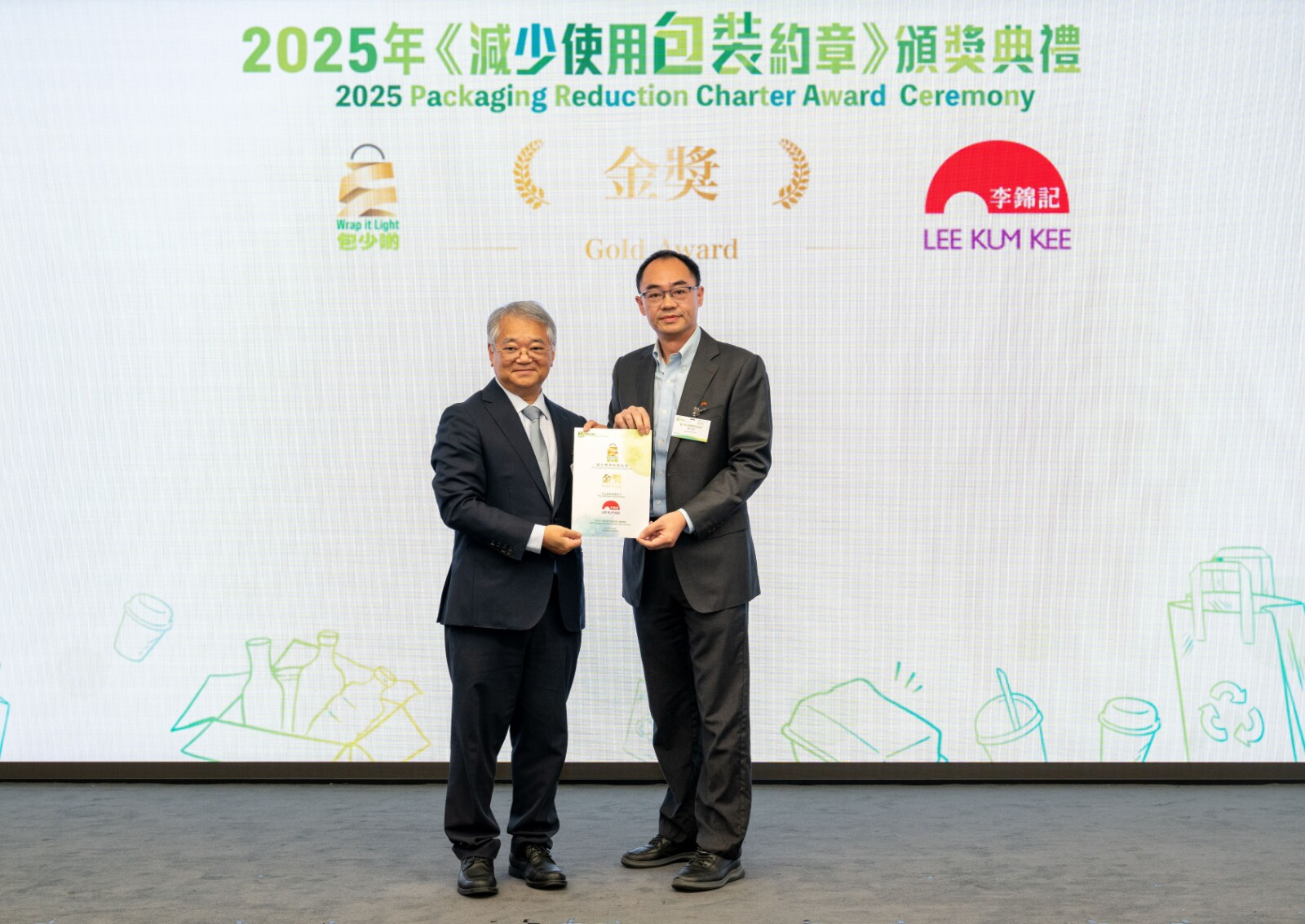
Jan Ling (right), Vice President – Technical Business Development at Lee Kum Kee Sauce receives the award presented by Dr. Chui Ho Kwong, Samuel (left), JP, Director of Environmental Protection Department.
Dodie Hung, Executive Vice President – Corporate Affairs at Lee Kum Kee Sauce, said, “This award is a significant recognition of Lee Kum Kee’s long-standing commitment to sustainable packaging transformation. Guided by our value of ‘Si Li Ji Ren’ (Considering Others’ Interests), we are committed to integrating sustainable development into every aspect of our business operations. Through innovative thinking, we continuously optimise packaging design for greater efficiency and recyclability, delivering high quality, delicious and environmentally responsible products to consumers. Moving forward, we remain dedicated to collaborating with the industry to support Hong Kong’s vision of achieving carbon neutrality.”
Lee Kum Kee continuously refines its packaging with reference to the Practical Guides on Packaging Reduction and Management published by EPD and the Golden Design Rules developed by the Consumer Goods Forum (CGF), driving packaging weight reduction while enhancing recyclability and circular value. Since 2002, Lee Kum Kee has consistently reduced the weight of its glass bottles; for example, in 2025, it cut the weight of its 32-ounce oyster sauce bottles from 410 to 390 grams, saving 10 tonnes of glass throughout the year. Additionally, the company has saved more than 200 tonnes of carton material annually through improved carton designs. Over 95% of packaging materials, by weight, are recyclable.
Lee Kum Kee’s sustainable packaging was featured in the 2026 Golden Design Rules Case Study Booklet during the CGF China Day in early September, confirming that its initiatives align with both local policy directions and international best practices.
For details on Lee Kum Kee and sustainability, please refer to the Lee Kum Kee Global Sustainability Highlights 2025: https://corporate.lkk.com/en/csr
Hashtag: #LeeKumKee #LKK
The issuer is solely responsible for the content of this announcement.
About Lee Kum Kee Sauce
Lee Kum Kee Sauce is the global gateway to Asian culinary culture, dedicated to promoting Chinese culinary culture worldwide. Since 1888, it has brought people together over joyful reunions, shared traditions and memorable meals. Beloved by consumers and chefs alike, Lee Kum Kee Sauce’s range of more than 300 sauces and condiments sparks creativity in kitchens everywhere, inspiring professional and home chefs to experiment, create, and delight. Headquartered in Hong Kong, China and serving over 100 countries and regions, Lee Kum Kee Sauce’s rich heritage, unwavering commitment to quality, sustainable practices and “Constant Entrepreneurship” combine to enable superior experiences through Asian cuisine for people worldwide. For more information, please visit  www.LKK.com.
About the Packaging Reduction Charter
The Packaging Reduction Charter was launched by the Environmental Protection Department of the Hong Kong Special Administrative Region Government in 2025. The Charter aims to bring together enterprises and organisations to advance sustainable packaging solutions through collaborations, reduce packaging waste, and contribute to Hong Kong’s long-term goal of carbon neutrality. The Charter assesses signatories against five key areas, packaging reduction, packaging recyclability, packaging reuse, sustainable packaging, and promotion of packaging reduction, to recognise companies with outstanding performance. For more information, please visit: www.lesspackaging.hk
www.lesspackaging.hk 
