

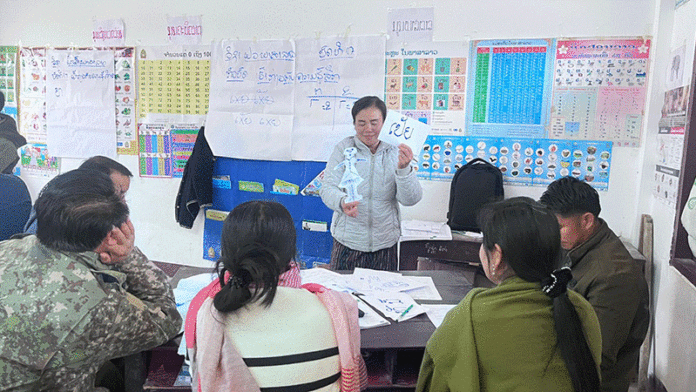
Over 1,120 educators are participating in training workshops this month, aimed at improving classroom management and helping non-Lao speaking students better understand their lessons.
Government Empowers Teachers in Rural Laos Through Workshop
National Grid charging stations in the Nanjing area have achieved full green electricity supply throughout the year

NANJING, China, Jan. 28, 2025 /PRNewswire/ — Recently, new energy vehicle owners in Nanjing received significant news. Mr. Li, a new energy vehicle owner, was pleasantly surprised to notice an “all green electricity” label on the information page of a charging station in Jiangbei New Area, a high-tech zone in Nanjing. This label signifies that the site exclusively uses green electricity for charging new energy vehicles.
Since January this year, all 351 charging stations and 2,573 charging piles operated by the State Grid Corporation in Nanjing have fully transitioned to green electricity supply, which will continue throughout the year. This initiative is expected to consume approximately 72 million KWH of green electricity annually, serving over 2.8 million new energy vehicles traveling 360 million kilometers, thereby reducing carbon dioxide emissions by approximately 41,000 tons.
Green electricity primarily originates from clean energy sources such as solar and wind power, which have minimal environmental impact and are highly effective in reducing pollution and carbon emissions. The State Grid Nanjing Power Supply Company has introduced green electricity into the charging sector through green certificate trading, not only leading the trend of green travel but also promoting societal low-carbon transformation.
Furthermore, the State Grid Nanjing Power Supply Company has invested in constructing comprehensive charging stations that utilize smart microgrids to achieve on-site consumption of green electricity. Additionally, the company actively advocates for increased policy support from relevant government departments for new energy vehicle charging infrastructure, encouraging social charging operators to participate in green electricity consumption and jointly fostering a positive atmosphere for green travel.
HK Accident Lawyers Launches Free Consultation Hotline for Traffic Accident Victims Assistance Scheme Applications

HONG KONG SAR – Media OutReach Newswire – 28 January 2025 – To assist traffic accident victims in understanding the application process for the Traffic Accident Victims Assistance Scheme (commonly referred to as “車手獎”), HK Accident Lawyers has officially launched a Free Consultation Hotline. Through this service, users can fill out a simple form, and our professional team will respond within one working day to provide guidance on common questions regarding the application process.
Hotline Details
HK Accident Lawyers aims to provide traffic accident victims with free information and support to help them navigate the application process for the Traffic Accident Victims Assistance Scheme. It is important to emphasize that we only provide information and guidance; we do not submit applications or handle any application matters on behalf of users. All communication and interactions with the Social Welfare Department must be handled directly by the applicant.
With this hotline, we offer:
- Explanation of the basic requirements and procedures for applying for the Traffic Accident Victims Assistance Scheme.
- Guidance on how to prepare the necessary documents and information.
- Answers to common questions about the application process.
Due to recent media coverage of the Traffic Accident Victims Assistance Scheme, we anticipate an increase in inquiries, which may lead to slightly delayed response times. We appreciate your understanding and patience as we strive to provide the most professional and efficient service to every user.
Important Disclaimer
HK Accident Lawyers serves solely as an impartial platform providing information. We do not provide legal advice, and the information shared through the hotline does not constitute legal guidance or professional opinion. Our role is to assist users in understanding the application process, and the final responsibility for application results lies solely with the applicant.
Hashtag: #HKAccidentLawyers #TrafficAccidentVictimsAssistanceScheme
The issuer is solely responsible for the content of this announcement.
About HK Accident Lawyers
 HK Accident Lawyers is dedicated to providing traffic accident victims with free legal information and lawyer-matching services, helping them connect with suitable professional lawyers to safeguard their rights. In addition to launching the Traffic Accident Victims Assistance Scheme hotline, we offer a wide range of traffic accident resources and support services, striving to be a trusted partner for the public.
For more details or to use the free consultation hotline for the Traffic Accident Victims Assistance Scheme, please visit:
HK Accident Lawyers – Traffic Accident Victims Assistance Scheme

Slither into Savings with iShopChangi’s Lunar New Year Bonanza in Singapore

Kick off the Year of the Snake early with iShopChangi as it rolls out a dazzling array of deals on Lunar New Year essentials. Avoid the festive frenzy and enjoy unbeatable discounts of up to 60% on everything you need to usher in prosperity and joy. From gourmet treats and traditional “Nian Huo” to spring cleaning supplies, exquisite liquors, and fashionable finds, celebrate with flair from now through February at your ultimate online shopping destination.
SINGAPORE – Media OutReach Newswire – 28 January 2025 – From now to 28 February 2025, travellers and non-travellers can wrap themselves in savings while diving into the spirit of the Lunar New Year on iShopChangi. Revel in a parade of premium selections across categories like gourmet food, fine liquors, home essentials, and more, featuring top brands such as Kinohimitsu, Dyson, Hennessy and Sulwhasoo. Plus, with gift-wrapping services and on-demand delivery, celebrating in style is made effortless. Celebrate the Year of the Snake and skip the crowds by shopping online without tax, whether flying or not.

Kick off the Year of the Snake early with iShopChangi as it rolls out a dazzling array of deals on Lunar New Year essentials.
Wrap Yourself in Lunar Prosperity
Delight in a carefully selected assortment featuring renowned brands, from top-tier or award-winning skincare like Sulwhasoo and Ble De Fonty, to sought-after liquors and cutting-edge home and living gadgets from Dyson. Whether updating home decor for festive gatherings or selecting gifts, iShopChangi offers luxury and local favourites to suit every preference—ensuring a prosperous start to the Year of the Snake.
Ready to discover incredible deals? Secure these exclusive promo codes for exceptional savings!
| Lunar New Year Sale (For Non-Travellers and Travellers) | |
| From now till 28 February 2025 | |
| Code | Description |
| 25CNY10 | 10%* off with no min. spend, capped at S$28 |
| 25CNY15 | 15%* off with min. spend S$550, capped at S$118 |
*T&Cs and product exclusions apply. Refer to https://www.ishopchangi.com/en/campaigns/cny-2025 for full terms and conditions.
Festive Feasts for New Year Celebrations
Ready your home for Lunar New Year gatherings with crowd-pleasing delights. Take home the [Bundle of 4] Kinohimitsu Abalone in Brine Soup, featuring superior Japanese abalone for S$48.80, down 46%. Set the snack table with Mdm Ling Bakery’s SET C – 2024 CNY Cookies, which include Premium Pineapple Balls and more, all in vibrant, floral gift boxes for S$91.20. For a traditional touch, choose Shermay’s Singapore Fine Food [Bundle], which combines Prawn Keropok, Keropok Fries, and Fish Packet, perfect for festive sharing that’ll keep the party going at S$21.88. Boost your celebrations with the [Bundle of 3] Lao Xie Zhen Premium Ginseng Essence, a revitalising mix of White and American Ginseng, perfect for gifting or self-care, priced at S$218.24 after a 37% discount.
Turn Heads with Limited Edition Beauty Finds
Elevate any celebration with a touch of luxury with the [CNY Limited Edition] SULWHASOO First Care Activating Serum VI 90ml Duo, designed to awaken your skin’s radiance, available now for S$178. Follow the magic pearls to the GIORGIO ARMANI My Way Eau De Parfum Holiday Set, where bergamot meets Egyptian orange blossom in a luminous start, complemented by a heart of Indian tuberose and jasmine, all for S$198.90 with a 10% reduction.
New Year, New Look
Spice up your look this Lunar New Year with the Marc Jacobs The Leather Micro Bucket Bag in True Red, crafted from full grain leather, now just S$399 after a 47% discount. Alternatively, enhance your style further with the TORY BURCH Kira Chevron Chain Wallet in Desert Dune, offering a leather shoulder guard for added comfort, available for S$575 after a 14% discount. To elevate your ensemble further, adorn yourself with the CHOW TAI FOOK 999.9 Pure Gold Necklace – Zodiac Snake, featuring 999 pure gold and a complimentary bracelet cord, available for S$1080 with a 10% reduction. Complete your festive attire with Naga Earrings by Bohème, inspired by divine half-human, half-serpent beings, priced at S$238. Men can enhance their sporty style with the Breitling Endurance Pro, a lightweight sports chronograph designed for both athleticism and casual wear, now available for S$4990.91.
Prep for Prosperity & Up Your Game
Prepare for the new year with the Dyson V12 Detect Slim Fluffy, expert at capturing dust, animal hair, and allergens—ensuring a spotless home environment. Get it now for just S$799, after an 11% discount. Simplify your cleaning with the Airbot Robotic Vacuum Cleaner X40 Ultra, perfect for maintaining freshness effortlessly, available for S$880.64 after a massive 63% discount. Of course, celebrating the new year means endless entertainment! Keep post-dinner fun alive with the [FREE SAME DAY DELIVERY] Nintendo Switch (OLED Model) Consoles + Hard Case With Clear Screen Protector, yours for S$369. Also, make any space a concert hall with the Bose SoundLink Flex II Bluetooth Speaker, delivering big, bold sound in a compact form—ideal for bringing the party anywhere, available now for S$209.17.
Celebrate with Spirited CNY Toasts
Elevate your Lunar New Year gatherings with the Hennessy XO 700ML CNY 2025 40%, featuring a deluxe decanter in red and purple, adorned with gold floral and snake-inspired motifs. Encased in a premium 100% recyclable box, it’s a tribute to the Chinese New Year, available for S$300. Complement the celebration with Benriach The Twelve (Snake – LNY Limited Edition), a richly sherry-matured single malt with notes of baked fruit and spiced mocha, now just S$112, thanks to a 25% discount. Round off the toast with COURVOISIER XO Royal CNY 40% 700ML, a regal cognac inspired by the illustrious blends served at royal feasts, now available for S$379.80.
Polish your Lunar New Year gifts with exclusive gift-wrapping services* to add a sophisticated touch. Choose from a selection of elegant gift boxes to make your presents even more special for just S$5. And for those urgent gifting needs, take advantage of rapid On-Demand Delivery—order by 5PM (Monday – Saturday) and receive your items within just 2 hours, with a reduced delivery fee of S$10 (from S$20) till the end of February.
Celebrate New Beginnings with iShopChangi
Kick off the new year by trying your luck with the all-new Changi Millionaire Experiences. Spend S$50 or more on iShopChangi or use Changi Pay to double your chances of winning a bespoke luxury experience per quarter, and/or a Porsche Taycan. Also, get access to Changi Editions (Changi-exclusive premiums).
There’s more for newcomers! For new iShopChangi shoppers, the rewards start immediately. Use the promo code
Worried about delivery? As a non-traveller, you can cart out at tax-absorbed prices on iShopChangi and have your items delivered to you for free when you spend at least S$59 and provide a Singapore residential address for delivery. Alternatively, pick up selected products from the T2 Arrival (Public Area) iShopChangi Counter.
Travelling around the world? Enjoy the ultimate convenience and flexibility by shopping for your favourite items up to 30 days in advance and as close as 12 hours before your flight. Collect your order at the various Departure and Arrival Collection Centres. Alternatively, have it conveniently delivered to a local residential address for free with a minimum spend of S$59; an S$8 delivery fee applies for orders below S$59.
Hashtag: #iShopChangi
 https://www.ishopchangi.com/en/home
 https://www.facebook.com/iShopChangi
 https://www.instagram.com/ishopchangi
The issuer is solely responsible for the content of this announcement.
iShopChangi
iShopChangi was launched in 2013 as an extension of Changi Airport’s promise to deliver greater comfort and convenience to travellers in its suite of airport retail offerings. Passengers can browse and purchase tax- and duty-free products across all terminals between 30 days to 12 hours pre-flight on the e-store – and choose to collect their items at Collection Centres within departure, upon arrival or have them delivered free in Singapore. Providing easy access to over 30,000 products across 900 brands and exclusives such as Changi First product launches, the site has since received global recognition with its award for Best Website – Retail Customer Facing at The Moodies: the Airport and Travel Retail Digital Media Awards 2018. In early 2020, the e-commerce store started to retail a selection tax- and duty-absorbed products to Singapore-based residents without the need to fly.

ONYX Hospitality Group Expands the Amari Brand with Exciting New Openings Across Sri Lanka, Laos, and Thailand
BANGKOK, THAILAND – Media OutReach Newswire – 28 January 2025 – ONYX Hospitality Group, Thailand’s leading hospitality management company, is delighted to announce the opening of its latest property and unveil upcoming additions to its Amari portfolio for 2025. The new properties in Sri Lanka, Laos, and Thailand exemplify Amari’s dedication to enriching guest experiences, offering distinctive design, exceptional service, and a deep connection to local culture and stories.
Known for its vibrant warmth and contemporary style inspired by Thai roots, the Amari brand continues to redefine luxury by blending modern elegance with authentic cultural charm.
Amari Colombo, Sri Lanka – Now Open – A Gateway to Sri Lanka’s diverse culture and stunning landscapes
Amari Colombo has proudly opened its doors in the vibrant heart of Sri Lanka’s capital, offering a perfect fusion of modern comfort and the rich heritage of traditional Sri Lanka.
With 167 spacious rooms, the property caters to both leisure and business travellers, serving as a gateway to Sri Lanka’s vibrant culture, beautiful landscapes, and hidden gems.
Key highlights of Amari Colombo include a stunning rooftop pool that offers panoramic views of the vibrant cityscape, dynamic dining options such as Ahāra, which features sustainable seafood prepared with innovative flair, and Prego, the celebrated Italian restaurant making its debut in Sri Lanka. The hotel also features premium lounges and bars like The Chancellor, known for its exquisite mixology, and Club Pahana, an exclusive executive lounge delivering exceptional culinary and beverage experiences.
Amari Colombo is ideally located for those eager to explore the cultural richness of Sri Lanka’s capital. Positioned near the stunning Gangaramaya Temple and vibrant Victoria Park, guests can easily access some of Colombo’s most iconic landmarks. This prime location perfectly complements the warm, inviting Amari hospitality, making it an ideal base for those looking to immerse themselves in the city’s dynamic atmosphere whilst creating unforgettable moments.
For more information: www.amari.com/colombo
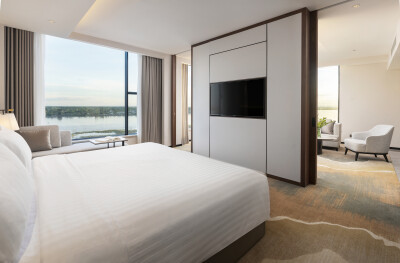
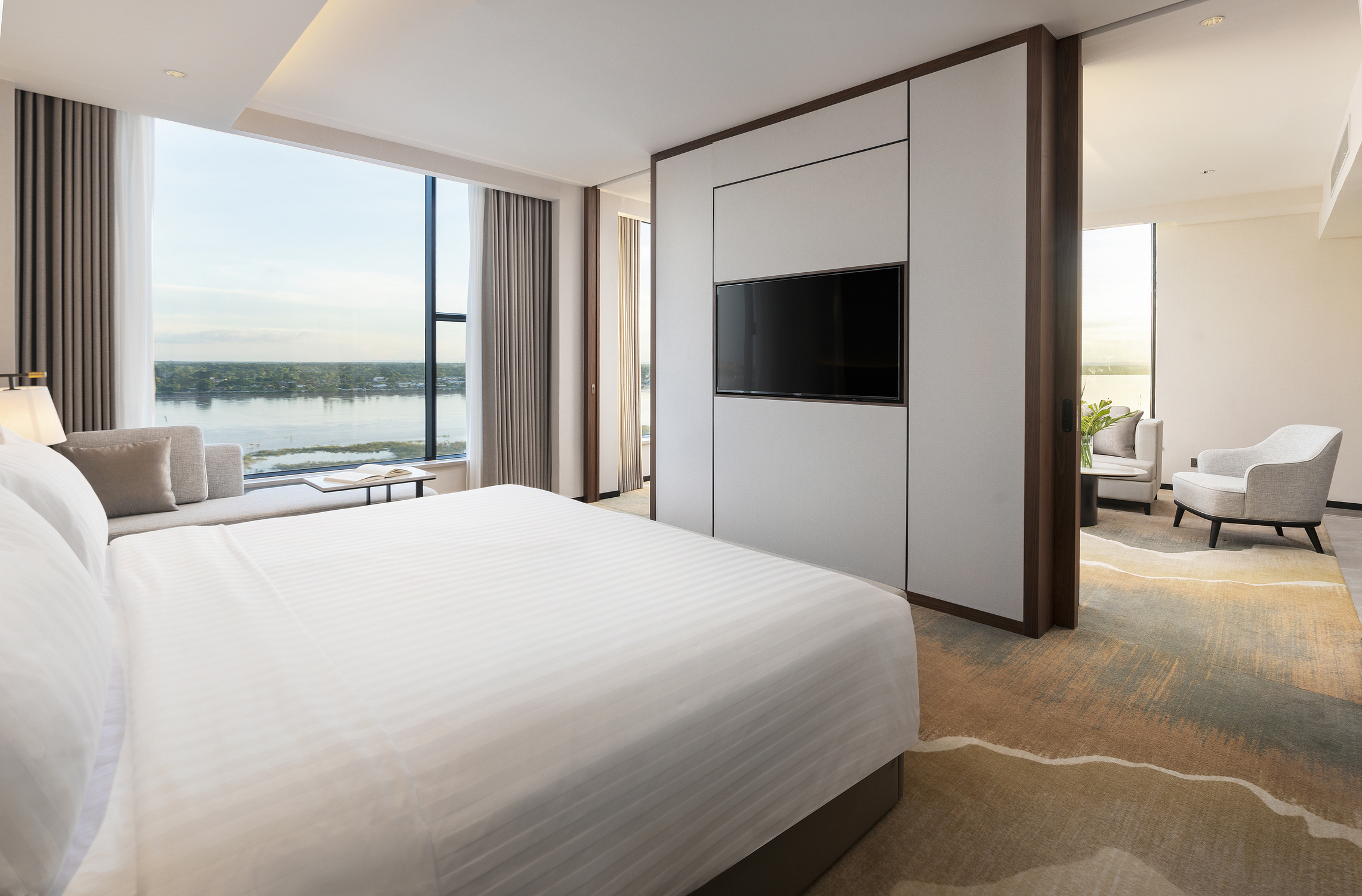
Amari Vientiane, Laos – Scheduled to open March 2025 – Upper Upscale hotel offering full-service amenities, overlooking the Mekong River
Amari Vientiane, set along the serene banks of the Mekong River, is poised to become a standout destination for travellers seeking luxury and cultural immersion.
The hotel features 248 meticulously designed rooms and suites, blending modern Lao and Thai aesthetics to create a sophisticated and inviting retreat. Each space offers breathtaking views, whether of the tranquil Mekong or the dynamic cityscape, setting the stage for relaxation and exploration.
Conveniently located just 4.8 kilometres from Wattay International Airport, Amari Vientiane ensures seamless access for leisure and business travellers alike. Guests can delight in an array of world-class amenities, including a rooftop restaurant, the signature Breeze Spa, and the highest executive club lounge in the capital offering stunning panoramic views.
The hotel serves as a perfect starting point for discovering the city’s rich heritage, vibrant markets, and hidden gems. Whether strolling along the riverbanks or delving into Vientiane’s cultural landmarks, Amari Vientiane provides an ideal base for an unforgettable journey into the heart of Laos.
For more information: Amari Vientiane Laos
Amari The Tide Bangsaen – Scheduled to open May 2025 – A beachfront retreat in Thailand, just over an hour from Bangkok, offering breathtaking coastal views
Amari The Tide Bangsaen reimagines The Tide Resort, offering a serene beachfront escape in Chonburi Province, Thailand—an area undergoing significant growth, particularly in tourism. Situated directly opposite Bangsaen Beach, the hotel combines tranquillity with convenience, just over an hour from Bangkok and 45 minutes from Pattaya. Its location provides easy access to local attractions, shops, and restaurants, making it an ideal retreat for leisure and business travellers alike.
The property features 154 stylish rooms and suites, catering to families, couples, and solo adventurers. Guests can enjoy culinary delights at the Amaya restaurant, which serves a mix of Thai and international cuisine, and the Aloha Beach Café, offering a relaxed beachfront dining experience.
Designed for relaxation and recreation, the hotel includes a signature spa, fitness centre, swimming pool, and kids’ club. For business and event travellers, versatile meeting spaces accommodate up to 900 participants.
Bangsaen Beach is a serene and charming coastal escape, offering a relaxing atmosphere with long stretches of golden sand and tranquil waters, ideal for sunbathing and leisurely strolls. The beach is bordered by palm trees and backed by a lively promenade, where visitors can enjoy local seafood and relax in the nearby cafes and restaurants. With its prime location, exceptional facilities, and commitment to hospitality, Amari The Tide Bangsaen promises an unforgettable experience for all guests.
Existing Portfolio Updates – Amari Koh Samui – New Swimming Pool at the Garden Wing and New Room Categories
Alongside the new and upcoming openings, ONYX Hospitality Group remains dedicated to elevating guest experiences by continually enhancing its existing portfolio. The highly acclaimed Amari Koh Samui is proud to announce the completion of a stunning new swimming pool in the resort’s Garden Wing. Thoughtfully designed to exude both sophistication and tranquillity, this latest addition enhances the resort’s family-friendly charm while reaffirming its commitment to delivering exceptional facilities and unforgettable stays. As the third dedicated pool at the resort, each uniquely tailored to its respective wing, this new feature solidifies Amari Koh Samui’s reputation as a premier destination for relaxation and memorable stays.
The new pool will be further enhanced by the upcoming addition of a range of child-friendly aqua toys, designed to captivate younger guests.
Offering idyllic views of the new swimming pool, Amari Koh Samui is also elevating its guest offerings with the introduction of updated room categories in the Garden Wing. Guests can now select from Superior Pool Side, Superior Pool View, and Superior Garden View rooms, each offering unique views and convenient access to the new pool and lush gardens, ensuring a seamless and comfortable stay. In addition, launching in May 2025, the new Tropical Pool Side Connecting Rooms offer the perfect mix of privacy and togetherness for families and friends. These rooms feature connecting doors for seamless access, balconies with tranquil views of the pool and gardens, and the soothing sound of cascading water for ultimate relaxation.
With these exciting new openings and portfolio enhancements, ONYX Hospitality Group continues to strengthen the Amari brand’s presence in Southeast Asia, cementing its position as a leading medium-sized hospitality management company in the region.
For more information on ONYX Hospitality Group please visit: www.onyx-hospitality.com
Hashtag: #ONYX
The issuer is solely responsible for the content of this announcement.

Vietnam Makes Top 5 Debut in Agoda’s 16th Gold Circle Awards, Celebrating Hospitality Excellence
|
Thailand retains top spot in Agoda’s annual hospitality awards among Southeast Asian dominance
SINGAPORE, Jan. 28, 2025 /PRNewswire/ — Agoda’s prestigious 16th Gold Circle Awards celebrate Southeast Asia’s exceptional hospitality as Thailand retains its top position while Vietnam breaks into the top five for the first time.
The awards further underscore Southeast Asia’s exceptional performance with four out of the top five accolades awarded to markets within the region, a feat last witnessed in 2021. The national ranking is based on how many hotels win a prestigious award within each market.
Japan took second place with 432 hotels followed by Indonesia (#3) with 365 hotels, Vietnam (#4) with 315 hotels and Malaysia (#5) with 311 hotels, rounding out the top 5 for 2024.
This year the awards ceremony witnessed a 53% increase in Gold Circle Award winners compared to 2023, recognizing a record-breaking 3,545 exceptional properties across the globe in 2024. Notably, nearly 50% of the awards went to independent hotels, highlighting the growing appreciation for unique, personalized guest experiences that emphasize creativity and individuality.
Vietnam’s groundbreaking climb from 9th place in 2023 to securing a spot within the top 5 this year highlights its 209% increase in award-winning accommodations to the to the hard work of accommodation providers across the market in ensuring that their customers receive the highest level of service.
“Our Gold Circle Awards serve as a tribute to the dedication and remarkable achievements of our global accommodation partners. Achieving excellence in guest service is ever challenging, yet our partners rise to the occasion year after year,” said Andrew Smith, Senior Vice President of Supply at Agoda. “Vietnam’s entry into the top five showcases its efforts to enhance service quality, reflecting the growing potential of Southeast Asian hospitality.”
Meanwhile, Thailand’s retention of its top spot from 2023 is testament to its enduring excellence. The adaptability of Thailand’s hospitality sector to shifting traveler expectations demonstrates strong reliability and leadership within the industry.
Over the past five years, Agoda has celebrated more than 2,500 unique winners, cementing its reputation for recognizing unparalleled service across the hospitality sector.
The Agoda Gold Circle Awards are presented to properties that excel in several key areas, including offering value-based pricing for customers, providing outstanding traveler experience, and engaging with Agoda’s programs and campaigns.
These criteria ensure that the winners represent the best in the industry, offering guests an outstanding experience. Agoda’s vast network continues to support travelers worldwide in discovering diverse accommodations, flights, and activities.
The awards ceremonies for the 16th Gold Circle Awards will take place in 9 Asian markets across February and March 2025, with celebrations happening in Indonesia, Japan, South Korea, Malaysia, Hong Kong, Taiwan, Singapore, India and Thailand.
For more information on the Agoda Gold Circle Awards winners, please visit https://www.agoda.com/goldcircleaward.
Star-Studded Sponsor Line-up Takes Centre Court at the Singapore Tennis Open 2025

|
Main sponsors include Turkish Airlines, ASICS and Polestar who are set to elevate the Singapore Tennis Open 2025 with their synergistic partnerships.
SINGAPORE, Jan. 28, 2025 /PRNewswire/ — The inaugural Singapore Tennis Open (STO) 2025, which will see global tennis talent taking to the courts from 27 January to 2 February, has revealed an exciting roster of sponsors and partners, including global brands such as Turkish Airlines, ASICS and Polestar. The partnerships not only amplify the tournament’s prestige in its inaugural year, but also reinforce the brands’ support for women in sports at the highest level and their commitment to celebrate the power of tennis to inspire.

- Turkish Airlines – Official Airline
Four-time “World Class” Award winner Turkish Airlines will fly players in style. Adding to the excitement, the STO Singles Champion will receive a pair of round-trip Business Class tickets to any destination worldwide, while the Doubles Champions will each receive one Business Class round-trip ticket to a destination of their choice – a unique prize offering unforgettable adventures and endless journeys. In addition to this, on the final day of the tournament, two lucky fans will win round-trip tickets from Singapore to either Istanbul or Melbourne, courtesy of Turkish Airlines. - ASICS – Official Apparel and Footwear
The tournament’s on-court presence will shine with ASICS apparel and footwear donned by ball kids, officials and umpires, embodying the brand’s synergy with the dynamic spirit of tennis. On-ground staff will also sport ASICS gear, looking sharp while highlighting the brand’s reputation for delivering high quality, innovative and functional sportswear. - Polestar – Official Electric Vehicle
As the Official Electric Vehicle partner, Polestar will provide ground transfers for all players and officials between the competition venue and Official Hotel with their fleet of Polestar 2 fastbacks and Polestar 4 SUV coupés. Patrons will also get the opportunity to see and experience Polestar’s cutting-edge electric vehicles up close with an exclusive showcase at Kallang Wave Mall.
Turkish Airlines is delighted to be part of the STO 2025. Ümit Develi, Turkish Airlines Vice President of Asia & Far East affirmed, “This collaboration celebrates a shared passion for connecting people and places, just as tennis connects fans and players around the globe. We’re glad to be part of this world-class event, offering memorable experiences to both fans and the tennis community.”
Yogesh Gandhi, Managing Director of ASICS Asia, expressed, “We are thrilled to support the inaugural Singapore Tennis Open by providing our apparel and footwear to the ball kids, officials and umpires. More importantly, this partnership underscores our commitment to promoting the sport of tennis and fostering the philosophy of ‘sound mind, sound body’ here in Singapore.”
“Polestar is thrilled to be appointed the Official Electric Vehicle of STO 2025, providing our fleet of high-performance premium electric vehicles made up of Polestar 2 and Polestar 4 models to transport players to and from the Kallang Tennis Hub, and throughout the event. We are proud to support this prestigious event, further cementing our commitment to sustainable electric mobility,” shared Adele Lee, Assistant General Manager, Wearnes Automotive.
Daryl Yeo, Chief Operating Officer at Kallang Alive Sport Management said, “The Singapore Tennis Open 2025 embodies the unifying spirit of tennis, where athletic excellence meets exceptional partnerships. We are very excited to welcome 11 sponsors, amongst them global brands like Turkish Airlines, Asics and Polestar, for the inaugural edition of Singapore Tennis Open. Through a series of activations across multiple platforms, we hope to deliver engaging fan experiences, spotlight the seamless blend of tennis and lifestyle, and connect with the local and international tennis community when they are at Kallang to catch the action.”
Don’t miss the action-packed week at the Singapore Tennis Open 2025, starting with two days of qualifying matches (25 and 26 January) with free access to all patrons, and seven days of main-draw play (27 January to 2 February) at the Kallang Tennis Hub. Fans can look forward to world-class tennis, exciting activities at the Carnival of Tennis, exclusive sponsor showcases, and more! Celebrate the Year of the Snake with your family and friends at this exhilarating showcase of tennis excellence!
Please find the media kit here.
ABOUT SINGAPORE SPORTS HUB
Singapore Sports Hub is an iconic, premier destination offering sporting, entertainment and lifestyle experiences for all to enjoy. This world-class development is managed by Kallang Alive Sport Management Co Pte Ltd (KASM). It offers programming that comprises international recreational and competitive events, live entertainment as well as activities that cater to the broader community. The Singapore Sports Hub aims to serve the sporting and entertainment needs of people from all walks of life.
Home to unique world-class sports facilities within the city, the Singapore Sports Hub plays a critical role in accelerating the development of Singapore’s sports industry, excellence and participation. Located in Kallang, the Singapore Sports Hub includes the following facilities:
- A 55,000-capacity National Stadium with a retractable roof and movable tiered seating
- A 12,000-capacity Singapore Indoor Stadium with pillarless interior
- A 6,000-capacity OCBC Aquatic Centre that meets FINA standards
- A 3,000-capacity OCBC Arena which is scalable and flexible in layout
- Kallang Tennis Hub, Singapore’s first international tournament-ready indoor tennis facility
- Kallang Football Hub housing Singapore’s National Training Centre for football
- Water Sports Centre featuring kayaking and canoeing
- 41,000 sqm Kallang Wave Mall, including indoor climbing wall and Splash-N-Surf facility (Kids Waterpark, Stingray and Lazy River)
- 100PLUS Promenade that encircles the National Stadium
- Singapore Youth Olympic Museum & Singapore Sports Museum
- Shimano Cycling World
- Daily community facilities and activities, including beach volleyball, hard courts (futsal, basketball and netball) lawn bowls, giant chess, skate park and running & cycling paths.
For more information, please visit the Singapore Sports Hub:
Website: www.sportshub.com.sg
Facebook: @sgsportshub
Instagram: @sgsportshub
LinkedIn: @Singapore Sports Hub
X: @sgsportshub
TikTok: @sgsportshub
Global Times: Spring Festival shopping lists showcased in Xi’s pre-holiday visits highlight commitment to people’s well-being
BEIJING, Jan. 28, 2025 /PRNewswire/ — The Spring Festival holds a special place in the hearts of the Chinese people, embodying warmth and family joy. During this festive season, the celebrations of ordinary families resonate deeply with Chinese President Xi Jinping, who genuinely cares about whether the Chinese people can enjoy a prosperous New Year filled with abundance.
“My biggest wish is that all of us will have a happy Lunar New Year. Party committees and governments at all levels should earnestly ensure the supply of electricity, gas, and heating during the festival, ensure that necessities such as ‘vegetable baskets,’ ‘rice bags,’ and ‘fruit plates’ are in ample supply, and strengthen supervision over food safety,” Xi said ahead of the 2023 Chinese New Year, the Xinhua News Agency reported.
“Letting the people of all ethnic groups have a good life,” is Xi’s aspiration, which is evident in his thoughtful consideration of New Year goods each year. Reflecting on Xi’s annual “Spring Festival footsteps,” it is evident that no matter where he goes, he always cares about how the people are living and whether they have prepared their festive goods. This “Spring Festival shopping list” reflects a profound commitment to the well-being of the Chinese people and embodies a beautiful vision for the high-quality development of their lives.
‘We were greatly inspired’
The Spring Festival is a wonderful moment to bid farewell to the old and welcome the new, always bringing new hope to the people. In China, it is not merely a celebration of the changing seasons and the passage of time; it is also a moment brimming with hope for the future.
In February 2015, shortly before the Spring Festival, a group of villagers gathered at the entrance of Liangjiahe village in Northwest China’s Shaanxi Province to welcome Xi. The cave dwellings of Liangjiahe were nestled among the mountains and scattered across the valleys of the Loess Plateau.
As Xi walked with the villagers from the entrance into the heart of the village, memories came rushing back. In 1969, Xi, just shy of turning 16, was sent to live in Liangjiahe as an “educated youth.” He would spend the next seven of his most formative years living in that rural hamlet. That area was where the Communist revolutionaries, including his father, rose to found New China, according to Xinhua.
During this visit, Xi brought gifts such as dumpling flour, rice, cooking oil, and meat products, as well as couplets and New Year paintings, ensuring that every household received a share. As they reminisced and exchanged pleasantries, his primary concern remained the villagers’ well-being, including their food, clothing, and living conditions.
“President Xi asked how we resolved our water issues and how we were living. His questions were so thoughtful; they warmed my heart,” recalled villager Liu Jinlian, as reported by Xinhua. Although the cave dwelling still bore the marks of the past, Liu’s life had undergone a remarkable transformation. “At that time, we had no worries about food or clothing; life was much better than before,” Liu said. “After his visit, the people in the village were greatly inspired to improve our lives.”
In pursuit of poverty alleviation, Liangjiahe established a rural cultural tourism company in 2015, merging tourism development with poverty alleviation efforts. Villagers sprang into action – some opened farm stays, while others became shuttle drivers, finding work right at their doorsteps and benefiting from the burgeoning tourism industry.
Since the 18th National Congress of the Communist Party of China (CPC), Liangjiahe has successfully lifted itself out of poverty by focusing on rural tourism, apple cultivation, and village-enterprise processing. The villagers have transitioned from poverty to prosperity. Per capita net yearly income for villagers soared from 7,917 yuan ($1,093) in 2012 to 18,120 yuan in 2021, Xinhua reported.
Villagers now reside in new homes, operate farm stays, and enjoy paved roads and cultural activity squares. With apple demonstration gardens and modern breeding bases, the people of Liangjiahe are steadily realizing their dreams of a better life through hard work.
In his heart, Xi carries the hopes of countless “Liangjiahes.” “The essence of governance is livelihood, and the right way to ensure people’s livelihoods is to understand the hardships in their lives.” – Xi once cited this ancient proverb to underscore the people-centered philosophy in governance, Xinhua reported.
Stable, fresh supply guaranteed
People’s ability to joyfully celebrate the Chinese New Year largely depends on their access to goods in the market. This has been a concern for Xi, who has often reflected on it during pre-festival inspections at various consumer venues over the years, including community supermarkets, rural shops, and stores at highway service areas.
On February 4, 2021, he visited a supermarket called Heli Huimin Fresh in Guiyang, capital of Southwest China’s Guizhou Province. At the supermarket, he checked the supply of goods for the Spring Festival holidays and their prices, Xinhua reported.
“When President Xi visited, I was filled with excitement. His warm smile lit up our dining area as he inquired about each dish and its price. Learning that customers could enjoy a hearty meal for around 20 yuan, he praised our affordable pricing, clearly valuing the people’s needs,” Liu Bing, the technical guidance at the processing department of the supermarket, told the Global Times.
According to Li Dexiang, who works at the supermarket, the store offers 40 essential goods at government-guided prices, typically 10 to 30 percent lower than nearby markets. Items like radishes and cabbages have been staples in the “one-yuan sales area.”
“The affordability of produce stems from a decade of government rent subsidies, the establishment of supply bases, and direct sourcing, allowing us to pass savings on to consumers,” Li told the Global Times.
This is not the first time Xi has shown concern for the public’s festive shopping needs. In February 2024, he visited Tianjin, emphasizing the need for local governments to enhance the supply of essential goods during the holiday season, ensuring abundance, variety, and quality for a worry-free celebration, Xinhua reported.
With the holiday approaching this year, government departments at all levels across China are intensifying their efforts to stabilize prices and secure supplies. Measures include enhancing emergency response and timely monitoring of goods’ supply and price changes.
A snack brings smiles
In the vibrant village of Desheng in North China’s Hebei Province, villagers believe that a simple snack can bring smiles and prosperity. This festive cake, known as “kai kou xiao,” literally translates to “mouth-opening smile” – an apt name for its appearance as golden, fried dough balls with a cracked surface resembling a grinning mouth.
As the Spring Festival approaches, households like that of Liu Guirong, a 65-year-old villager in Desheng, are bustling with frying up these festive treats. For Liu, “kai kou xiao” has transformed from a traditional festive food into a symbol of her village’s remarkable journey toward rural revitalization and prosperity.
This transformation began in January 2017 when Xi inspected Desheng village, visiting and chatting with poor families, discussing how they could shake off poverty, Xinhua reported.
During this inspection, Xi sampled the “kai kou xiao” and praised its deliciousness. Liu was among those who prepared the snack that day, and also participated in the discussions in which where Xi helped a villager meticulously calculate household income and expenses. Xi called for more efforts to help the poor develop industries that could grow in a sustainable manner, set up sustainable mechanisms for poverty alleviation, and create ways for them to achieve prosperity, according to Xinhua.
The villagers later embarked on a transformation path. Following the path of “simultaneously focusing on industrial development and infrastructure improvement,” they gradually established a thriving rural tourism industry based on homestays, which contributed to the rural revitalization.
The village’s economic fortunes have blossomed since 2020. Ye Runbing, the Party secretary of Desheng village, told the Global Times that that the per capita net income of the villagers increased from 5,800 yuan in 2016 to 24,000 yuan in 2024.
The “kai kou xiao,” once a simple local delicacy, has blossomed into a village signature dish thanks to the remarkable economic transformation of Desheng village and the recognition it received from Xi. Liu also seized this opportunity and launched her own “kai kou xiao” business in her spare time.
As the Spring Festival approaches, Desheng village gears up for a series of cultural events, which has led to a booming “kai kou xiao” business for local villagers.
“Many tourists come to our village specifically to buy this snack as a New Year’s gift to take back home and share with their loved ones,” Liu said. With each 0.5-kilogram package selling for 25 yuan, she sells at least 10 kilograms daily.
“Seeing the village come alive, with smiles brightening everyone’s faces, fills me with joy,” Liu shared. “Today, life in Desheng village is as cheerful as its namesake treat, flourishing more with each passing day,” she said.
The bustling scene surrounding the procurement of “kai kou xiao” epitomizes the vibrant atmosphere found in markets across China at this moment. Each small bundle of New Year goods carries with it the hopes and memories of the people, as well as a reflection of the nation’s prosperity. This year, as China celebrates the Spring Festival, the country stands confident and resilient, forging ahead on the path toward modernization and a brighter future.
