Home Blog Page 6212

Thailand’s First Bullet Train to Include Laos as Destination

Thailand’s First Bullet Train to Include Laos as Destination

Thailand is preparing to launch the country’s first bullet train that will run between Bangkok and Beijing, China, with Laos as one of the intermediate stations.

The “Trans-ASEAN Line” will cover 3,193 kilometers at the cost of about THB 2.07 trillion (USD 67.2 billion) and link Thailand’s Bang Sue with Chiang Mai in the North, Laos in the Northeast, Cambodia in the East and Malaysia in the South.

The Thai government also plans to link the county to other nations as far as Singapore and China through high-speed railways.

It is unclear when the new line would be 100% completed, but the Thai government has already begun the construction of some routes and will “keep calling bids” for the project, Bangkok Post reported on July 6.

In particular, the first route, a Thai-Sino project linking Bangkok and Nong Khai in the far Northeast, is currently under construction and is scheduled to be completed by 2023.

This is a boon to residents in Laos, which is located right next to Nong Khai, since another rail route will take passengers to the Lao capital of Vientiane from the borderline.

The route will reach Mohan, a border town in China’s southern province.

A 414-kilometer new route between Vientiane and Mohan is now 55% complete, said an unnamed Lao official, as quoted by Bangkok Post.

The new line will shorten a traveling time between Vientiane to Mohan from the current up to two days to only three hours.

The Lao official added that the new line would draw between 10 and 20 million Chinese tourists to the country each year.

Road Accidents Continue to Plague Vientiane Capital

Road Accidents Continue to Plague Vientiane Capital

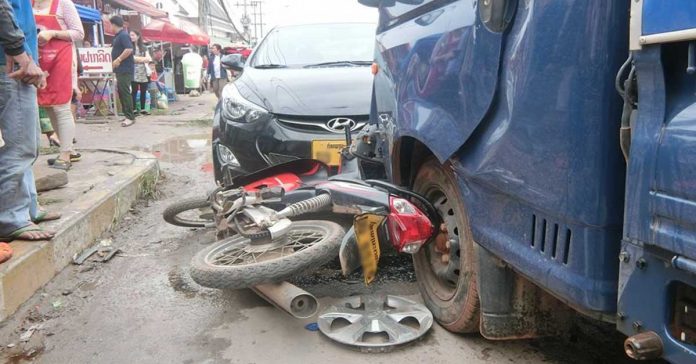
Road accidents continue to plague Vientiane Capital, with the latest figures for the year so far reaching a staggering 525 cases, according to a recent announcement by police.

Lieutenant Colonel Phengsavanh Thammaboun, Head of the Vientiane Capital Traffic Police Department, stated in an interview with the Vientiane Mai that in the first six months of this year, 525 road accidents had occurred within Vientiane.

These figures include 89 deaths.

The district in which the most road accidents occurred was Xaythany District, which saw 148 accidents so far this year, costing the economy LAK 6.3 billion.

Although the number of road accidents remains high, the capital city has at least seen fewer incidents than in previous years, with nine fewer accidents than in 2018, and 17 fewer deaths.

According to reports from the police, almost all road accidents have occurred due to reckless driving or ignorance of traffic regulations. A general lack of awareness or respect for traffic regulations still prevails among drivers in Laos, with many cases of speeding giving rise to accidents.

A large number of vehicles are unroadworthy, causing traffic problems, while drunk driving remains a common occurrence as well.

The Vientiane Capital Road Traffic Department urges all motorists to take extra precautions when driving, ensure that they respect traffic regulations, and exercise better manners when driving – giving way when necessary and respecting the rights of other drivers.

Photo: Vientiane Rescue

Lao Airlines Renews Global Safety Standard Certification

Lao Airlines Renews Global Safety Standard Certification

National flag carrier Lao Airlines has passed an audit and renewed registration from the IATA International Air Transport Association Operational Safety Audit (IOSA).

The IOSA program is an internationally recognized and accepted evaluation system designed to assess the operational management and control systems of an airline.

Six auditors worked with Lao Airlines from June 24 and 28 to evaluate the airline’s services in various fields, including safety, quality of security, flight operations, reporting culture, preventive action, and safety management system.

Lao Airlines first achieved IOSA certification in 2015, and since then, it has undergone a safety inspection every two years by the IATA to ensure the required standards are maintained. The company renewed its certification in 2017.

This marks the latest efforts by the airliner to bolster its safety standards.

Lao Airlines has also signed a strategic partnership agreement with Avia Nautics. Under the partnership, Avia Nautics acts as a consultant for Lao Airlines in extending the Enhanced IOSA.

Huawei to Boost Presence in Laos amid US Sanctions

Huawei to Boost Presence in Laos amid US Sanctions

Huawei has unveiled its latest solutions in Laos such as 5G, smart cities, smart government, and Huawei Cloud in a move that would help the Chinese telecom giant overcome a United States-led sanction.

Speaking at the Laos ICT Expo 2019, which was held last week in Vientiane, Huawei Laos CEO Mark Wong said that the company’s latest technology solutions, such as 5G and smart cities, were in line with Laos’ digital transformation vision and would support the nation to build a complete digital transformation ecosystem.

Wong added that Huawei would continue to provide the best products and solutions for Laos’ digital economy, help realize the vision of a digital nation, and contribute to the transformation of Laos from being landlocked to a land-linked country.

Huawei’s move is not a coincidence given the company’s latest efforts to strengthen its presence in Southeast Asia amid a global sales drop due to US sanctions.

In May, the US put Huawei on a list of companies that American firms cannot trade with unless they have a license, arguing that that the Chinese firm – the world’s largest maker of telecoms equipment and the second biggest smartphone maker – posed a security risk.

Huawei initially dismissed the impact of such a move by the US, but the company founder Ren Zhengfei admitted in June that the company’s international sales of handsets sunk 40% in the past month, adding that it would slash production by USD 30 billion.

Several allies of the US, including Germany, joined hands in the sanction efforts and since Huawei has traditionally drawn its strength from mature telecom markets like Europe, it would be natural for the Chinese firm to seek alternative income sources while minimizing the damage of the sanction.

In Thailand, for instance, Huawei already provides 4G network equipment to major players like True. The Thai government also selected the firm one of the test players for 5G equipment in Chonburi, a region the country hopes to develop into a leading economic zone.

In the Philippines, where two local players are considering launching 5G service, Huawei is in a promising position since the country’s leading telecom operator Globe Telecom’s 4G networks already run entirely on Huawei equipment.

In Malaysia, meanwhile, it has recently signed memorandums of understanding with local companies that hope to introduce 5G in the country.

And there goes Laos. Huawei is currently the third largest mobile vendor in Laos by market share, according to a web analytics firm StatCounter.

As of end-June, its market share stood at 15.36% after Apple with 21.75% and Samsung with 37.4%.

An interesting development is that its share has steadily grown since November last year, while the second largest vendor Apple has witnessed its share dropping since February. The pace is slow, but the gap between the two players is narrowing gradually for sure.

One more gist is that customers in Laos did not seem to have put much emphasis on the possible impact of the US-led sanction against Huawei.

Huawei market share rather increased since May when the sanction was imposed. The number jumped from 14.7% in May to 15.36% in June.

Laos might still account for a very small part of Huawei’s global sales, but as an old saying suggests, drop by drop fills the tub and Huawei appears to understand it well.


Laos Cracks Down on Illegal Foreign-owned Businesses

Chinese workers on the Laos-China Railway

Laos will crack down on foreign-owned businesses operating in the country without the proper permit.

The Lao government has begun to inspect foreign-owned businesses to see whether they comply with Lao laws and regulations, according to ministerial advice by the Ministry of Industry and Commerce, reported by the Vientiane Times last week.

The owners of foreign-owned businesses could face a LAK 10 million (USD 1,150) fine when they are found operating without a business registration certificate and license.

The business owners will have up to 90 days to obtain the legal documents, but they will face another LAK 10 million fine and be ordered to shut down permanently if they fail to do so.

As for registered and licensed foreign-owned businesses, they could face LAK 3 million (USD 344) in case they are found operating outside their approved business areas.

Those who are fined must commit to adjusting their operating licenses in accordance with their actual operational areas. In case they fail, they will face a LAK 5 million (USD 573) fine and be ordered to shut down permanently.

In addition, the authorities will check foreigners engaged in business activities reserved for Lao citizens. They will be asked to sign a document, which will be reviewed by officials at social welfare and public security sectors who will consider the deportation of the documented foreign traders.

The officials will officially report to the Ministry of Industry and Commerce about its implementation within 135 days to receive further guidance on the issue.

Such moves come amid the government’s efforts to improve the business environment to encourage private sector investment. One of the challenges, however, is the number of foreigners operating businesses reserved for local people, such as hairdressers and beauty salons.

The Lao government announced in January a list of controlled businesses, which are subject to government monitoring and regulation, in a move to ease the minds of more investors considering opening in Laos.

Sectors subject to considerations of national security, social order, and environmental protection and the respective regulatory authorities are spelled out in the list.

In various sectors not listed, operators are able to proceed to apply for a business and operating license from the commerce sector without having to consult any other state agencies, provided they do not otherwise contravene Lao laws, orders, decrees, and regulations.

Photo: Xinhua

Blue Emergency Polls in Vientiane to Provide Real-time Emergency Response Service

Emergency Pole Laos

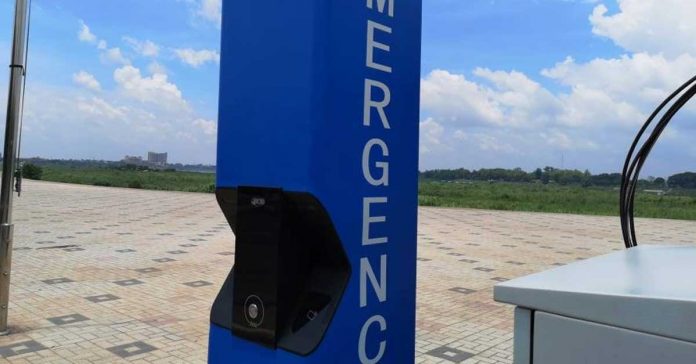
Blue Emergency Poles, which began to appear across Vientiane a few months ago, are designed to provide a real-time emergency response service and on-the-spot assistance when necessary, the Laotian Times has learned.


When citizens press a button attached to the poles, officials at emergency services centers will be online to assist. The officials will be able to talk to callers on the speaker while viewing them through the camera in real time.

They will also send someone when on-the-spot assistance is needed.

An informed source told Laotian Times that the service would also have English speakers to help foreigners and tourists.

Emergency Pole Vientiane

An emergency pole in Chao Anouvong Park, Vientiane Capital

It is still unclear which government body is fully in charge of managing and operating the polls, but the source said it would be the General Police Department of the Ministry of Public Security that oversees the Vientiane police emergency number 1191.

The Lao government is currently finalizing the installation and the service, and there would be an announcement when the service officially commences, the source added.

The currently available emergency lines in Laos are 1190 for fire, 1195 for the ambulance and for police: 1191, 241162, 241163, 241164, and 212703. The Tourist Police can be contacted in Vientiane on 021-251-128.

Laos Tackles Unemployment by Partnering with Top Jobs Site

Laos Tackles Unemployment by Partnering with Top Jobs Site

The Lao government is to provide information on the job market through a new partnership with the country’s largest employment website operator, 108 Jobs, in a move to tackle growing unemployment issues.

Under the agreement signed on June 27, the Employment Service Center under the Ministry of Labor and Social Welfare and Vientiane-based 108-1009 Group will jointly develop a labor market information system to upload employment vacancies on both the ministry’s www.lmi.molsv.gov.la and 108.jobs website.

Two websites will provide information about companies in Laos with job vacancies in different sectors.

In Laos, positions at the government are preferred among job seekers over private sector opportunities as they are considered more secure, the Vientiane Times noted in a recent article,  adding, however, there is a limited quota of such jobs.

The newspaper added that unemployment is among the top issues when comparisons are made with the success of other ASEAN member countries, quoting sources as saying that this is because local job seekers have difficulty accessing information about available positions.

Mr Khamsene Xayavong and Mr Keovisouk Dalansane shake hands after signing their agreement.

Statistics from the Ministry of Labor and Social Welfare show that as much as 9.4 percent of the workforce, representing about 182,000 people, are unemployed.

The World Bank pointed out in one of its latest reports that the growth of Laos over the past years has been attributed mainly to natural resource-based sectors, large infrastructure projects, and public sector spending.

“These sectors are insufficient drivers of quality and sustainable growth. They have not created many jobs,” said analysts quoted in the report.

The World Bank noted that the private sector would be critical in diversifying the economy and creating more jobs to sustain strong growth in the future.

Laos is currently working hard to boost private sector-led growth as it is a priority of Laos’ 8th National Socio-Economic Development Plan for 2016-2020.

Laos, Thailand Sign New Cross-border Road and Rail Deal

Laos, Thailand Sign New Cross-border Road and Rail Deal

Laos and Thailand have signed an agreement to extend road and rail connections between the two countries worth more than THB 3 billion (USD 98.2 million).

Under the agreement, the two countries plan to improve the R11 road linking the Phudu border checkpoint in Uttaradit province in Northern Thailand with the Lao capital, Vientiane. The two-lane road will be paved with asphalt, and will cost about THB 1.8 billion (USD 59 million), The Bangkok Post reported on July 1.

Laos and Thailand also plan to extend the current train route from Nong Khai, Thailand across the border and farther into Vientiane Capital. The route currently concludes at Thanaleng, just one stop from the border, while a 7.5km extension would cost THB 1.6 billion (USD 52.4 million).

The new deal came after the two countries opened a new road connecting the Thai border at Nan Province with Luang Prabang Province in Laos last week.

The new road extends from Hongsa District to Luang Prabang, and then reaches the border crossing with Nan Province in Thailand.

It used to take about nine hours to travel between the two provinces, but the construction of the new road means the trip will now take between four and five hours.

The new road and subsequent drop in travel time are expected to draw more visitors from Thailand to Laos, including Thai nationals and overseas tourists.