Home Blog Page 6490

Laos Utilises Cooperatives to Support Agricultural Growth

Laos need to create the national committee for development of cooperation aiming to support and helping the agriculture sector in its expansion efforts.

For several years, the councils still lacked enough funding for agricultural development from the government

Speaking at the opening ceremony, Deputy Minister of Agriculture and Forestry, Mr Khambounath Xayananh, said at the workshop’s purpose is to review the progress of 2016 and planning for 2017. During the workshop, participants reported the progress of their activities and shared their future plans.

He said, since 2010, the Confederation has strengthened its capacity, focusing on the promotion of the agriculture sector, improving shareholders’ farming systems and empowering farmers as well as production groups and entrepreneurial associations to become voluntarily involved in agribusiness. There are 14 cooperatives nationwide aiming to provide funding support for cooperative development projects to improve and develop the agriculture sector further.

The Lao government has promoted the strengthening of the agricultural sector by improving cultivation techniques and practises through scientifically established methods, he noted.

Such contributions have greatly improved the economic situation of farmers in addition to small and medium enterprises by strengthening their initiative and self-help capabilities, he continued.

This promotion campaign is also supported by international donors like the German Cooperative and Raiffeisen Confederation (DGRV).

Since 2013, the DGRV played an important role in contributing to the development of a legal framework with regard to the cooperative system, he said.

In the agricultural sector, the DGRV is supporting the setting up of farmers’ cooperatives and the provision of their respective institutional capacity building efforts.

In the financial sector, the establishment and strengthening of member based organisations such as village banks and credit unions are also supported.

Laos’ membership in the World Trade Organisation means more competition and new challenges for Lao society and cooperatives can contribute to strengthening farmers’ capacities and marketing power.


Source: Vientiane Times

Laos, Singapore Cooperate in Cyber Protection

Laos’ Ministry of Posts and Telecommunications is working in collaboration with Portcullis Technologies Singapore in the development of the nation’s cyber protection.

A seminar on a new paradigm in Cyber Protection’ was held at the National Conference Centre in Vientiane on Thursday and attended by Director General of Planning and Cooperation Department, Ministry of Posts and Telecommunications, Mr Phoukhong Chithoublok, Managing Director of Portcullis Technologies Singapore, Mr Max Lee and other officials.

The event demonstrated the importance of addressing cyber security, cyber protection in modern business, trends of cyber security and how Laos can leverage the new paradigm in combating and mitigating the cyber threat.

The initiative is in line with the national ICT Vision 2030 and ICT Five Year Strategic Development Plan which aim to advance the adoption of emerging ICT for sustainable development, ensure secure information sharing and data protection, and a safe online environment.

With the increasing complexity of cyber security threats that modern business faces today, the oversimplified approach of detection and removal needs to be overhauled, with a rethink for a more effective strategy.

During the seminar, guest speakers from Malaysia, Vietnam and Cambodia also shared their knowledge on cyber security related issues.

Acting Director General of Lao Computer Emergency Response Team (LaoCERT), Mr Khamla Sounnalat, highlighted there were now 2,611,141 actual internet users in Laos with 2,583,358 using 3G and 4G internet connections.

The Lao government has prioritised the promotion of the information and communications technology (ICT) sector as the engine for socio-economic development.

This includes establishing new laws, regulations, decrees and related legislation for governing and managing the development and usage of the ICT sector as well as creating the cyber security policy in order to protect Critical National Information Infrastructure.

LaoCERT has become a fully operational, trusted channel among the ICT sectors providing alert warnings, incident responses and cyber security advisory. Mr Phoukhong Chithoublok said Laos’ Ministry of Posts and Telecommunications is committed to fulfilling its international obligations in the order to address these global challenges and we are working hard in building a safe and secure ICT infrastructure and services in our own country.

He stressed the ministry also had LaoCERT to coordinate national efforts in cyber security and they had successfully promulgated cyber crime law and were now working on the draft of the national cyber policy.

Meanwhile, Mr Max Lee said Portcullis Technologies will share a new and effective approach to overcome these challenges, in partnership with the reputable Lao-based ICT System Integrator, Datacom Corporation Ltd. This initiative is an important collaborative initiative to introduce uniquely differentiated cyber security training and consultancy for both information technology and operational technology related critical infrastructure in Lao PDR.

The public-private partnership in cyber security was proven to be a formidable contributor to Laos’ ICT industry. They would bring cyber security experts from the region to Laos to provide training and certification thereby boosting the local pool of cyber security professionals.


Source: Vientiane Times

Water Supplies and Sanitation Aiming for Sustainability

The specific goal of the Lao water supply and sanitation sector is focusing on safety, stability and sustainability to improve people’s living condition and contribute to socio-economic development.

That was the message conveyed when water supply and sanitation sector officials of the Ministry of Public Works and Transport, representatives from water supply enterprises and donors met in Vientiane from December 14-15 to consult on strategy and management of the sector.

At the meeting, participants discussed and shared experiences on different topics, especially opportunities and challenges, vision, management, planning, investment, safety and service. Water supply and sanitation is a priority sector for the government in achieving the Sustainability Development Goals, Deputy Minister of Public Works and Transport, Dr Santisouk Simmalavong told the meeting.

One priority is guaranteeing sufficient water supply and access along with decent sanitation for local people.

Everyone around the world understood the importance of good water supply and safe sanitation, which are basic and major factors in improving people’s living conditions and developing human resources of the country, he commented.

Water supply is also a major factor in promoting agricultural production as well as industrial, service and tourism development, Dr Santisouk said.

However, with increased demand for water supplies, the sector needed to expand services and develop the distribution network in the city and to cover 80 percent of the community by 2020 and reach 90 percent by 2030, Dr Santisouk stressed.

To reach the target, he asked the relevant government sectors and private sector to provide effective management and competent service.

He believed the sector would continue to enhance its cooperation and work together to develop water supply networks to be able to provide service to all locations.

While large numbers of people in towns can access water supplies, many people in rural communities are still in need.


Source: Vientiane Times

Laos Prepares for Face-to-face EU FLEGT, VPA Negotiations

The Forest Law Enforcement Governance and Trade (FLEGT) technical working group yesterday met in Vientiane to discuss finalised key parts of the draft timber definitions to be submitted to the European Union (EU) by the end of this month.

The submission is crucial preparation for the first face-to-face negotiations between the government of Laos and the EU on the Voluntary Partnership Agreement (VPA), scheduled for late February next year.

“The proper definition of legal timber is very crucial towards improving sustainable forest management and good governance in Laos, as it helps to enhance understanding among relevant government staff and the private sector in the forestry and timber industry, especially when it comes to forest inspection practices,” Forest Inspection Department’s Director General, Mr Khamphout Phandanouvong said.

“The timber legality definition allows us to identify gaps, redress and improve areas of legislation and regulation that are difficult to implement, impractical or confusing,” he added.

Once the legal definition has been developed through a multi-stakeholder platform and discussion with the EU, a field test of the legality definition is conducted.

The test allows an additional review of the definition to ensure applicability in the field.

During the workshop, participants also had a chance to discuss the scope of the FLEGT VPA negotiation regarding product, market destination and timber sources.

A presentation of the supply chain control and verification procedures highlighted the importance in the FLEGT VPA process.

The first drafts of Timber Legality Definition on wood processing and trading and conversion areas were also discussed during the workshop.

Laos has started to negotiate such an agreement with the EU with assistance from the German Development Cooperation Project, which is supported by the Lao-EU FLEGT Process (proFLEGT), implemented by GIZ.

ProFLEGT is a joint initiative of the Lao government and German Development Cooperation, and is working closely with the Ministry of Agriculture and Forestry through the FLEGT Standing Office under the supervision of the Department of Forest Inspection, the Ministry of Industry and Commerce and the Ministry of Natural Resources and Environment as well as other government agencies, civil society organisations, academia and timber processing industry.

During the initial stage of the Lao EU-FLEGT process, three pilot provinces have been selected, which are Xayaboury, Khammuan and Attapeu.

In this regard, WWF is working with the Department of Forestry Inspection to implement its FLEGT process in the two pilot provinces, Khammuan and Attapeu.

WWF takes a solution-oriented, integrated and local to global approach that seeks synergies with relevant stakeholders to influence drivers of deforestation and degradation.


Source: Vientiane Times

Education, Skills Key to Graduation from LDC Status

Moving out of Least Developed Countries (LDC) status requires raising people’s education and skill level as well as improving their health.

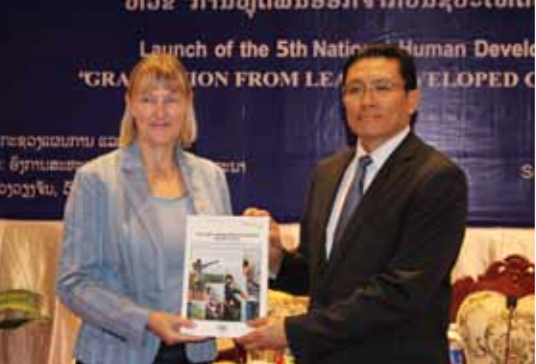
The matter was stated by Deputy Minister of Planning and Investment, Dr Kikeo Chanthaboury during the conference on launching related issues, held in Vientiane on Tuesday.

“Stamping out of the LDC list also obliges raising their income in a sustainable manner, which eventually results in a higher level of human development,” Dr Kikeo said.

Laos’ 5th National Human Development Report and the United Nations Conference on Trade and Development´s (UNCTAD) Least Developed Countries Report 2016 were also launched by UN Resident Coordinator and UNDP Resident Representative to Laos, Ms Kaarina Immonen.

Since deciding on the goal of graduating from Least Developed Country status at the 6th Party Congress in 1996, the Lao government has focused on the criteria for graduation in the country’s main strategic plans, according to the UNDP.

With the intention to support the 8th National Socio-Economic Development Plan (2016-2020) and the Socio-Economic Development Strategy until 2025, the 5thNational Human Development Report focuses on ways to ensure smooth graduation from Least Developed Country (LDC) status.

During the conference, the report revealed that significant progress in human development and poverty reduction has been made in the Lao PDR. Its human development index value has risen significantly in the past decades, while its poverty rate has declined from 46 percent in 1992-93 to slightly over 23 percent in 2012-13. The encouraging progress on the Millennium Development Goals is, however, uneven across regions and ethnic groups as reflected in the concentration of poverty and deprivation in some areas and large gaps of provincial Human Development Index values.

Laos’ Gross National Income per capita and its education and health indicator values are on track to meet the LDC graduation thresholds in the next review by the United Nations’ Committee for Development Policy in 2018, the UNDP said. Despite good progress, the country’s economy lacks structural economic transformation and diversification for smooth LDC graduation.

The export structure remains weak and resilience to economic shocks and natural calamities continues to be low.

Graduation itself is not the goal, but only the first step, argues UNCTAD’s Least Developed Countries Report 2016. To weather the loss of the international support they received as LDCs and confront the challenges that lie further ahead requires what the report calls ‘graduation with momentum’ – a process of structural change to increase the productivity of their economies.

For Laos, international and regional integration will create opportunities to diversify the economy by promoting areas of the country’s comparative advantage and plugging into regional and global production networks.

At the same time, the country needs to overcome the challenges of limited human capital, a small labor force and low investments in human development sectors such as health, education and social protection.


Source: Vientiane Times

ASEAN Strengthens Cooperation on Disaster Response

Military officers from ASEAN countries and dialogue partners met in Vientiane yesterday to discuss ways forward in their cooperation for more effective humanitarian assistance and disaster relief (HADR).

The officers were gathered for the 9th ASEAN Defence Ministers Meeting-Plus Experts Working Group on Humanitarian Assistance and Disaster Meeting as the last meeting for this second phase of cooperation under the Laos-Japan co-chairmanship from 2014 to 2016.

ASEAN is a region at risk of various types of disasters and different levels of severity. Numerous storms hit the Philippines every year, which causes loss of lives and properties.

The 2006 earthquake in the Indian Ocean killed hundreds of thousands of people in Indonesia and Thailand. Similar losses also occurred with Japan in 2011 from strong earthquakes and the consequent enormous tsunami.

Myanmar faced a huge loss from Cyclone Nargis hitting the Irrawaddy River Delta in 2008, while flash floods have also caused deaths and loss of properties in Laos in recent years. The threats of natural disasters have continued with the recent earthquake significantly affected Indonesia’s Aceh province. In his welcoming remarks at yesterday’s meeting, Deputy Minister of Defence, Major General Onesy Senesouk said, “Even though this meeting is the last meeting for this phase of cooperation, this does not mean the end of humanitarian assistance and disaster response.”

“We have to continue the development of our existing cooperation mechanisms and enhance our capacity for more effective and efficient response to emergencies and minimise the loss of lives and properties,” he added.

At the meeting, participants discussed the achievements of cooperation made by the EWG in the past three years, learned about the results of the joint training exercise of the EWGs on HADR and military medicines. They also considered the basic principles of the multinational coordination centre and passed the declaration by affected countries.

Chapter 6 of the Standard Operating Procedure for Regional Standby Arrangements and Coordination of Joint Disaster Relief and Emergency Response Operations was also tabled to the discussion for final agreement.

ASEAN established the Defence Ministers Meeting (ADMM) in 2006 as a platform that allows for open and constructive dialogue on regional security issues of mutual interest at the ministerial level and promotes practical operations among the ASEAN armed forces.

All ASEAN member states are members of the ADMM. The ADMM also engages eight key extra regional partners, namely Australia, China, India, Japan, New Zealand, the Republic of Korea, Russia and the United States through the ADMM-Plus.

At their meeting in Vientiane in May, ASEAN defence ministers agreed on the concept of founding an ASEAN dignitaries readiness group to provide humanitarian assistance and disaster relief.

Major General Onesy said the continued cooperation on humanitarian assistance and disaster relief reflected the joint efforts in realising the task agreed by ASEAN defence ministers.


Source: Vientiane Times

First Lao ICT Expo 2016 Kicks Off in Vientiane

The Lao ICT Expo 2016 kicked off yesterday featuring an exhibition of new applications, devices, telecom operators, e-commerce businesses and finance technology.

The expo is hosted by the Ministry of Posts and Telecommunications and will take place from December 14-18 at the National Convention Centre in Vientiane.

Present at the opening were Deputy Prime Minister, Dr Bounthong Chitmany, Minister of Post and Telecommunications, Dr Thansamay Kommasith, ministers and provincial deputy governors.

The ministry has the role to manage ICT in Laos and in the past it has concentrated on developing modern technical structures such as the National Internet Centre, Cyber Safe Protection Centre, Lao Computer Emergency Response Centre, National Transmission Line, and Lao Satellite.

Herewith, the ministry has also improved and developed legislation to manage and improve ICT such as the law on telecommunications, law on posts, law on prevention and combating cyber crime and law on information technology.

However the ministry has faced challenges such as knowledge and capacity on the use of ICT devices in a beneficial way, as it recognises IT as a double-edged sword.

The IT sector will play a major role in society and socio-economic development. The government aims to develop all working sectors of ICT in a bid to create an advanced government administration and step forward to the digital and modern economic era.

According to organisers, the objective of the event is to showcase innovative and sustainable ICT developments and applications in Laos, including the use of information and communications technology in business to help boost the Lao economy.

It also aims to raise awareness about emerging technologies and bring the ICT sector closer to the general public.

The expo will feature exhibitions of new applications, devices, telecom operators, e-commerce businesses and finance technology.

In addition, the event will provide information to entrepreneurs, agencies and private enterprises on the use of ICT to increase efficiency, promote entrepreneurship, and streamline services.

Seminars on various topics related to ICT will be held, in which participants and experts will share their experience and knowledge related to ICT development and policies in Laos and abroad.

There will also be a focus on promoting e-commerce businesses by showcasing suppliers of agricultural products, cosmetics, medical devices and other consumer items.

Of particular interest to regular consumers at the expo are the special promotions on offer for ICT devices and accessories, with discounts ranging from 20-80 percent, including deals from telecom operators on mobile plans.

A demonstration of the new smartphone and a special exhibit on how ICT is integrated into the Lao government, called “Smart Lao Government”, will also take place.

Other activities are also planned, with musicians from Laos and abroad scheduled to perform.

There will be a mobile application and website building competition, ICT start-up business plan competition, “ICT Super Vote Model 2016” competition, and an ICT beauty competition.


Source: Vientiane Times

Govt Fights Corruption, Vows to Cut Excess

The government has instructed its anti-corruption body to work out necessary measures and carry out inspection to fight against corruption in all forms.

The instruction was made at the two-day meeting between the government cabinet, Vientiane Mayor and provincial governors that concluded on Wednesday in Vientiane.

Chaired by Prime Minister Thongloun Sisoulith, the meeting entrusted a committee in charge of debt payment for state investment projects to draw up measures for debt payment so that debt would be paid in a transparent manner and prevent the accumulation of more debt.

The Ministry of Finance was assigned to work with relevant departments to accelerate measures to exercise frugal spending and cutting extravagance in each particular field.

In this regard, frugality should begin from restricting the use of or cutting spending on state vehicles and ensuring state investment projects and purchasing undergo proper bidding processes.

The participants discussed a Prime Ministerial Order on the implementation of the 2017 socio-economic development plan, budget plan and currency plan and agreed to upgrade the order into a Prime Ministerial Decree that details measures to pursue the economic growth target of 7 percent.

The Ministry of Finance was told to work with relevant sectors to inspect and ensure that budget obligations are paid to the state and pay attention to revenue collection and expenditure.

It was also instructed to modernise mechanisms to ensure transparent revenue collection and expenditure that can be inspected.

The meeting told the central bank to pay attention to manage and maintain the inflation rate at an appropriate level, as well as address the exchange rate gap between the banking system and the non-banking system.

Participants agreed to carry out implementing the Prime Ministerial Order No 15 that imposes tough action to regulate wood processing plants, businesses and the prohibition on exports of unfinished wooden products.

The meeting told the authorities in charge to implement a decision that orders the shutdown of 28 sawmills located near or inside forest areas by December 2016.

The authorities were told to take action to manage goods prices in local markets to prevent unreasonable increases in prices.

The meeting instructed the relevant bodies to ensure that the salary for civil servants is paid in a timely manner.

Concluding the meeting, Prime Minister Thongloun told the cabinet members, Vientiane Mayor and provincial governors to strive to maintain political stability, security and social order conducive to socio-economic development.

The premier called for the participants to exert full efforts to pursue the 2017 socio-economic development agendas.

PM Thongloun told the participants to attach great attention to and take into account the recommendations of the National Assembly and provincial councils.


Source: Vientiane Times