Home Blog Page 6508

Ministry Struggles to Ensure Quality Food, Drugs

Shortages of some drugs, their inappropriate use by doctors, unregulated circulation of pharmaceutical products, and chemically contaminated food are just some of the issues the Ministry of Health is seeking to address.

Deputy Minister of Health Mr Khamphone Phoutthavong noted the challenges in his opening remarks at a meeting on food and drugs held yesterday to review the sector’s achievements over the past five years and discuss future plans.

Food and drug experts from around the country and representatives from the ministries of Science and Technology, and Agriculture and Forestry are attending the three day meeting, which continues tomorrow.

Mr Khamphone highlighted the implementation of the health development policy and strategy over the past five years, saying several laws and regulations had been enacted and amended.

Other achievements included the quality guarantee system for food and drugs both before and post distribution, development of good laboratory practices, gaining ISO17025 accreditation, joint supply of drugs and medical equipment, centralised logistics, development of natural medicinal resources, the promotion and parallel use of modern and traditional medicine, and good manufacturing production (GMP) certification.

The deputy minister outlined the challenges the sector has to overcome in food and drug management. These included the s hortage of basic drugs at dispensaries and district hospitals, the inappropriate use of drugs or use of brand name drugs over cheaper generics, and the dispensing of antibiotics and stimulants by pharmacies without prescription.

According to the deputy minister, around 30 percent of drugs in distribution by private pharmacies were not registered with the government, medicine prices varied among hospitals, there was weak inspection of food and drugs at border checkpoints, and half of drinking water factories’ products were not registered.

Mr Khamphone also mentioned the shortage of personnel, technical facilities and coordination mechanisms as other challenges.

“If we don’t hurry up in addressing these it could affect consumers’ health and safety and in the future we could lose the advantage in joining the ASEAN Economic Community,” he said.

Speaking at the meeting, the ministry’s Food and Drugs Department Director General Dr Somthavy Changvisommith stressed that the government’s aim was to increase people’s ability to access quality food and drugs.

In her remarks at the meeting, World Health Organisation Health System Coordinator in Laos, Ms Monica Fong, noted that drugs were key elements in people’s daily lives, saying everyone expected that food and drugs should be of the same quality and would protect them against health hazards, including hazards arising from tainted food and substandard drugs.

“This is very important these days as we see increasing cases of antimicrobial resistance and the emergence of superbugs,” she added.

More than 1,700 drugs are registered with the department, and three pharmaceutical factories – Pharmaceutical Factory No. 3, CBF Pharmaceutical Factory, and Kodufa – were granted GMP certificates.

Around 50 percent of the drugs in circulation in Laos are manufactured locally and estimated to be worth US$11.7 million.


Source: Vientiane Times

Several Deals to Be Signed during Vietnam Leader’s Visit

Several agreements are expected to be signed during the upcoming state visit to Laos by Vietnam’s Party leader, seeking to boost cooperation between the two neighbours, a senior government official has said.

Vietnam Communist Party’s General Secretary Nguyen Phu Trong will pay a three-day state visit to Laos from November 24-26 at the invitation of his Lao counterpart Bounnhang Vorachit, the External Relations Committee of the Lao People’s Revolutionary Party’s Central Committee announced last week.

An official from the Laos-Vietnam Intergovernmental Committee told Vientiane Times yesterday that the documents to be inked include some that aim to boost economic cooperation between Laos and Vietnam, with that country being one of the top three foreign investors in Laos.

Vietnam’s Prime Minister Nguyen Xuan Phuc was reported as saying that a number of important issues will be discussed while many agreements are expected to be signed during the visit by General Secretary Nguyen Phu Trong, Vietnam Breaking News reported earlier this month, citing the Vietnam News Agency.

PM Phuc made the comment when he recently received Lao Minister of Planning and Investment Dr Souphanh Keomisay during his visit to Hanoi, when preparations for the visit were discussed.

The Vietnamese PM said the visit by the Vietnamese Party leader was important to both countries so they needed to make thorough preparations for the occasion, especially in relation to the cooperation documents to be inked, according to Vietnam Breaking News.

PM Phuc asked the two sides to work closely to realise the two governments’ cooperation plan for 2016 and prepare for the 39th meeting of the Vietnam-Laos intergovernmental committee slated for next year.

Regarding certain issues, PM Phuc said as a landlocked country, Laos could transport goods via Vietnam’s ports. Whether it chooses to use Vung Ang port or Cua Lo port in central Vietnam, it must comply with local regulations.

The two sides need to provide the best possible conditions for the scheduled implementation of power projects and electricity sale and purchase, PM Phuc noted, asking the Lao government to continue improving the investment climate and to facilitate Vietnamese business operations.

Dr Souphanh’s working visit to Vietnam aims to prepare for the visit by Party General Secretary Nguyen Phu Trong. The Lao minister said Laos wants to promote the sale and purchase of electricity with Vietnam, according to Vietnam Breaking News.


Source: Vientiane Times

ADB, Microsoft, Govt Expand Economic Opportunities for Youth

The Asian Development Bank (ADB), Microsoft and the Ministry of Education and Sports have signed a Letter of Intent to collaborate and develop a technology platform to provide Lao youth with access to online technical and vocational training resources and employment services.

The document was signed yesterday by Deputy Minister of Education and Sports, Associate Prof. Dr Kongsy Sengmany, Microsoft’s Marketing and Operation Lead, Rena Chai, and Deputy Director General of ADB’s Southeast Asia Department, Noriko Ogawa.

Speaking at the signing ceremony, Associate Prof. Dr Kongsy stressed that the cooperation between the three parties would help Lao youths to seek jobs and generate income for their families, saying “The platform is very significant to our government in helping young people to upgrade their skills.”

He said the ministry planed to expand this platform to not only vocational schools and other institutions in Vientiane, but also to other schools in remote areas in a bid to help young people broaden their knowledge and access skills training.

“ADB recognises that inclusive education is essential to build the human capital needed to drive innovation, increase productivity, and accelerate private sector development,” Ms Ogawa said.

“Integrating an innovative technology platform into our education sector assistance programmes will help deliver longer-lasting benefits to the Lao economy.”

The platform called YouthWorks supports government efforts to use information and communication technology to boost access to education and employment services.

It will provide an online localised knowledge repository and open-access courses, career guidance and job placement services, free of charge.

YouthWorks empowers job seekers and entrepreneurs to develop the skills and knowledge needed to find decent jobs.

The collaboration is in association with the ADB-financed second Strengthening Technical and Vocational Education and Training (TVET) Project.

The platform complements project efforts to increase access to quality TVET programmes and career guidance services.

The ADB, based in Manila, is dedicated to reducing poverty in Asia and the Pacific through inclusive economic growth, environmentally sustainable growth, and regional integration.

Established in 1966, next month ADB marks 50 years of development partnership in the region. It is owned by 67 members – 48 from the region. In 2015, ADB assistance totalled US$27.2 billion, including cofinancing of US$10.7 billion.


Source: Vientiane Times

Parliament Spells Out Additional Measures to Drive Development, Growth

The National Assembly (NA) has spelled out additional measures for the government to undertake, adding to the 10 measures presented by the government and adopted by parliament to drive social and economic development and spur growth.

In the Resolution adopted by the Assembly’s ordinary session which ended on Friday, parliament asked the government to create conditions conducive for the development of micro, small and medium enterprises, which are the country’s economic foundation.

The lawmakers told the government to seriously reform state enterprises that are suffering from financial illiquidity.

The government was asked to properly implement policies to promote and attract better quality investment, while minimising dependence on natural-resource-driven growth.

The NA told the government to take strong action to carry out national-scale goods production, improve production quality, develop products for which Laos has potential as well as Lao brand products, and to seek markets. This could be achieved by introducing policies to enable farmers and operators to access technical assistance, finance, and markets.

Amid the current financial difficulties, lawmakers advised the government to place its investment focus on state- funded projects that would bring sound economic returns, while suspending those projects with low economic returns.

The government was told to review its education and health targets. Those targets failing to meet the set indicators would be taken into account when drawing up plans to pursue the UN’s Sustainable Development Goals.

Parliament asked the government to do more to expand pre-school education and improve primary and secondary school education.

The lawmakers also told the government to place a greater emphasis on upgrading professional skills and raising ethical standards among doctors. They called for the government to train and distribute more healthcare staff to dispensaries and district hospitals.

The NA stressed the need to expand the social security system within communities and to carry out inspections to prevent contaminated food from being sold.

Parliament also told the government to take urgent action to complete the upgrade of labour skill standards and training curriculums to facilitate training of the workforce to meet the required standards and integrate with the Asean Economic Community.

Concerning unregulated resettlement, the NA called for the government to do more to stabilise resettlement and livelihoods for rural villagers.

The government was told to allocate appropriate investment for poverty-fighting initiatives in the 23 remaining poor districts, especially the poorest districts in Xaysomboun, Huaphan, Phongsaly and Xekong provinces in order to narrow the development gap between towns and rural areas.

The NA called for the government to define the national land policy to ensure it was in harmony with the national socio-economic development plan. Parliament asked the government to urgently introduce measures to address the environmental and social impacts caused by the unregulated use of chemicals in farming and manufacturing.

The government was told to take immediate action to address issues concerning polluted water and air as well as the bad smells caused by factories and investment projects, which affect local communities.

The NA told the government to take tougher action to regulate the timber industry. It also asked the government to appoint a task force working group under the Prime Minister’s Office to follow up and ensure that all ministries and local departments implement the policies and measures approved by parliament during this ordinary session.


Source: Vientiane Times

BCEL-KT: Trade Summary (Nov 21, 2016)

Trade Summary

On Monday,  Lao Securities Exchange index edged up by 1.66 % to 999.12 points. The total trading volume was 1,900 shares from Electricity and Banking stocks, worth 9,735,000 kip. EDL-Gen gained 100 kip to closed at 4,900 kip for 200 shares, while BCEL closed at 5,150 kip for 1,700 shares matched. In addition, the other stocks had no trading; their prices remained stable at 6,100 kip for LWPC, 2,500 kip for PTL and 3,000 kip for SVN.


AirAsia Creates New Link to Laos

AirAsia has expanded its connectivity in Laos with the launch of flights between Kuala Lumpur and Luang Prabang.

Marking the first direct link between the two Southeast Asian cities, the new KL service will complement AirAsia’s existing Bangkok-Luang Prabang flights, and the direct services connecting KL and Bangkok with Vientiane.

“We are very happy to be the first and only airline to connect Luang Prabang to Kuala Lumpur directly,” said AirAsia’s CEO, Aireen Omar. “We are also pleased to be the airline that connects the people of Laos to two of the main cities in ASEAN, Bangkok and Kuala Lumpur, which are both major AirAsia hubs.

“We want to further champion connectivity to second and third-tier cities, and help to grow the market together,” she added.

The new flights will depart KL every Monday, Wednesday, Friday and Sunday at 0645 and arrive in Luang Prabang at 0840. The return services then leave the UNESCO-listed Lao city at  0925 and arrive back in KL at 1330.

Source: Travel Daily Media

Singapore-Laos Avoidance of Double Taxation Agreement Enter Into Force

The new Singapore-Lao People’s Democratic Republic Avoidance of Double Taxation Agreement (DTA) entered into force on 11 November 2016.

The DTA provides clarity on tax matters and eliminates double taxation relating to cross-border transactions between the two countries.

A DTA between Singapore and another jurisdiction serves to prevent double taxation of income earned in one jurisdiction by a resident of the other jurisdiction.

A DTA also makes clear the taxing rights between Singapore and her treaty partner on different types of income arising from cross-border economic activities between the two jurisdictions.

The agreements also provide for reduction or exemption of tax on certain types of income.

Generally, Singapore’s DTAs and EOI Arrangements include provisions for the exchange of information for tax purposes. Treaty partners may request for information under the DTAs or EOI Arrangements from the Comptroller of Income Tax.

Source: CFO Innovation

Australia Continues to Support Financial Inclusion through Village Banks in Laos

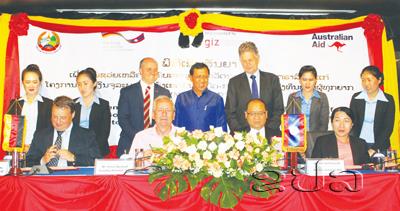
The Australian Government has provided additional funding of 1.83 million Australian dollars for the project ‘Microfinance in Rural Areas-Access to Finance for the Poor’ (AFP) in Laos, according to a press release by GIZ on Nov 17.

The AFP project was initiated under German Development Cooperation in 2009. The Australian Government has provided substantial financial support to the project since 2013 in order to expand the geographical focus of the project to the provinces of Champassak, Saravan and Savannakhet and to advance work on financial literacy and consumer protection. The AFP project is being jointly implemented by the Lao central bank – Bank of the Lao PDR (BoL) and Deutsche Gesellschaft für Internationale Zusammenarbeit (GIZ)

The project works towards improving access to –and responsible usage of – financial services in rural areas of Lao PDR through community-managed village banks. To date the AFP project successfully serves 529 village banks in six provinces of Laos on a monthly basis.

Mr Sonexay Sithpaxay, Deputy Governor of the Bank of the Lao PDR, Australian Ambassador to Laos Mr John Williams and German Ambassador Mr Michael Grau attended the signing ceremony. Mr Sithpazay thanked the Australian Government for their continued support to advance financial inclusion in Lao PDR. He acknowledged the project’s continued success and urged stakeholders to keep a strong focus on further increasing the quality of operations. Mr Sithpaxay added that the project has contributed well to improving the livelihoods of Lao people and creating more conducive microfinance sector regulations.

Australian Ambassador to Laos Mr John Williams congratulated BoL and GIZ for the effective project implementation, and highlighted the strong achievements of the project in bringing sustainable financial services to the underserved rural population, and building their knowledge, skills and attitude when it comes to household finances. He continued by emphasizing: ‘Australia is proud to be one of the Lao PDR’s most important partners in the microfinance sector.  We are delighted to be working closely with our friends from Germany and UNCDF, and with Bank of the Lao PDR to deliver these programmes for the Lao people.

“We understand that the projects are having a direct impact in strengthening rural entrepreneurship and incomes and supporting poverty alleviation. We know access to finance is a great enabler of inclusive private sector development,” William said.

In his speech, German Ambassador Mr Grau stressed the importance of financial services to advance local economic development, and the role village banks play in this process.  He further highlighted the project’s success in organizing local communities, holding elections to assign governance boards, and providing continuous capacity development for their members. Mr Grau proudly referred to the Lao-German government negotiations that we held at beginning of November and in which the German Government committed additional finance for the project as well.

The AFP project builds on more than ten years of experience with the overall objective to enable the rural population to access and make better use of sustainable financial services. To reach this goal, AFP has supported the Bank of Lao PDR in the formulation of the PRIME Ministerial Decree on Microfinance Institutions and setting up a market surveillance software system for the Financial Institution Supervision Department.

To enhance the sustainability of village-bank operations, the project funded specialized microfinance institutions that provide permanent oversight, technical support as well as saving and credit facilities for members. Today, seven specialized microfinance institutions are providing assistance to local village banks in 22 target districts. Three NSOs are already covering their expenditures through operating income, proving that the concept is financially viable. By October 2016, the project had facilitated the foundation of 529 village banks, which manage more than 58,173 active accounts. The value of accumulated savings already exceeds 102 billon kip (US$12.5 million). More than 18,500 members are currently borrowing a total volume of 93 billion kip (US$11.4 million) from their village tanks. AFP puts a special focus on the empowerment of women, and more than every third decision-making position in the village banks is now held by women.

The additional funding underlines that project stakeholders are committed to further enhance financial inclusion in Laos. AFP village banks have proven to be an effective instrument and an important pillar that is widely accepted by international donors, Lao government agencies and society. Important next steps are to build on the project’s knowledge and to scale up the approach to better support the additional 5,000 village funds which currently exist in Laos.


Source: Vientiane Times