Home Blog Page 6602

Why the Mekong River Commission Matters

Despite its limitations, the body is key to ongoing efforts to save one of the world’s largest and longest rivers.

The Mekong River Commission (MRC) is gearing up for another test of its effectiveness following the announcement of Laos’ plans to construct the Pak Beng hydropower project, the third proposed dam on the Mekong mainstream.

Laos must undergo a six-month consultation process before proceeding with the hydropower project, as mandated by the 1995 Mekong Agreement. For the previous two mainstream dams, Xayaburi and Don Sahong, the consultation processes ended in disagreement. Though downstream countries called for further studies of the social and environmental impacts of each dam, Laos nevertheless moved forward unilaterally with construction.

Critics point to the failure of previous consultation processes as evidence that the MRC can never be an effective platform for Mekong river governance. However, the value of the MRC should not be based entirely upon the success of the consultation processes for large infrastructure projects. The organization produces important data and analysis and works to strengthen norms of basin-wide cooperation, both of which can help to encourage more sustainable approaches to Mekong river development.

The MRC-led consultation process for the Pak Beng dam will likely place the MRC under heightened scrutiny in the coming months. The onslaught of criticism has already begun, with the MRC being characterized as “weak,” “all but irrelevant,” and as having a reputation that is “hanging by a thread.” For decades, critics have pointed out that the MRC lacks legally-binding authority over its member states. The 1995 Mekong Agreement that created the MRC does not give downstream states veto power over upstream development projects and no legal mechanism exists to punish states that fail to follow through with the MRC’s principles or procedures. Further, China’s refusal to join the MRC as a full member undermines the power of the regional organization. In the past, China has sidelined the MRC while developing infrastructure on its portion of the river and investing in projects in the lower Mekong states.

The international media has tended to focus on the MRC’s dramatic cuts in staff and foreign funding over the last few years as evidence of a crisis hitting the MRC. However, many reports of these cutbacks fail to point out that since 2010, the MRC has been undergoing a program of dramatic reforms to transfer ownership of the MRC from foreign donors to Mekong countries themselves. One part of this plan is a new funding mechanism in which member countries gradually increase their contributions to the MRC with the goal of achieving financial independence by 2030. If successful, the transfer of ownership from foreign donors to member countries will help the MRC achieve greater public legitimacy in the region and greater buy-in from member country governments. However, it will also require that the organization be much smaller and take on fewer responsibilities.

As is widely recognized in discussions on other Southeast Asian regional organizations like ASEAN, Southeast Asian nations tend to adhere strongly to the principles of non-interference and consensus based decision-making. Therefore, an intergovernmental body like the MRC is unlikely to be given the capacity to make binding regulations on hydropower development any time soon. However, the MRC can use other tools to influence decision makers and enhance the public’s understanding of the issues surrounding the Mekong Basin.

The MRC does data collection, analysis, and reporting work that help to influence decision making on Mekong river management and development. This work covers a wide scope, but much of it tends to get lost in the shadow of the attention-grabbing debates over hydropower. In an effort to respond to the serious risks to the basin posed by climate change, the MRC has developed basin-wide climate change scenarios and worked to coordinate climate change adaptation strategies across the Lower Mekong basin.

The MRC has also conducted extensive research on Mekong fisheries, which has shaped understandings of just how valuable these fisheries are. This is important because national estimates of the revenues from this sector had been dramatically underestimated. Some of the MRC’s most important research has been on the cumulative impacts of the proposed dams on the Mekong mainstream (Strategic Environmental Assessment, 2010; Council Study, ongoing;  ISH0306, ongoing). Dam developers conducting the environmental impacts assessments for individual dams are not doing this type of comprehensive basin-wide analysis that takes into account the effects of cascades of dams.

In addition to its research and analysis work, the MRC also provides one of the few platforms for basin-wide dialogue on contentious issues surrounding Mekong river development. Even when this dialogue does not produce the optimal end-result, substantive benefits are delivered by these processes, which involve not only governments, but also a broader range of stakeholders. The MRC has struggled in the past to promote public participation in its activities. Multi-stakeholder engagement on issues of national importance is inherently controversial within the Mekong countries, where civil liberties are restricted to varying degrees. However, the MRC is making efforts to encourage more public participation in Mekong river governance.

The MRC is currently training its first cohort of RSAT facilitators. RSAT is a basin-wide hydropower sustainability assessment tool designed to help a wide range of stakeholders come together to discuss hydropower sustainability issues in a river basin context. With this tool and through other initiatives, the MRC could help to bridge the divide not only between Mekong governments but also between governments, their people, and the private sector. This is one aspect of the MRC that may set it apart from China’s new Lancang-Mekong Cooperation Mechanism (LMCM), which seems to focus primarily on economic cooperation between Mekong governments.

Much has changed since the signing of the Mekong Agreement in 1995. Climate change, increased private funding for dams, increased Chinese engagement in the Lower Mekong basin, and hydropower development on the Mekong mainstream have all made basin-wide Mekong river governance more important and more complex. All Mekong countries stand to benefit if the MRC has the capacity to continue to provide high-quality knowledge products and act as a platform for improved cooperation on sustainable management of the Mekong River. However, in order to do so, the MRC must work hard to restore its image both within the Mekong region and internationally.

Gabriella Neusner is an intern for the Stimson Center’s Southeast Asia program and a second year graduate student at American University’s School for International Service.

Source: The Diplomat

Thai Kasikornbank Eyes Regional Expansion; Plans 2nd Branch in Laos

Thailand’s Kasikornbank Pcl said on Tuesday it plans to open a second branch in Laos and upgrade the status of its local bank in China in 2017 as part of a regional expansion.

With assets of $68 billion, Thailand’s fourth-largest lender by assets is looking to open branches in Vietnam, Indonesia and Myanmar by 2018, the bank’s president, Kattiya Indaravijaya, told a news conference.

Loans and assets from foreign operations accounted for less than 5 percent of the bank’s current total loan portfolio, and the proportion is expected to gradually increase over the next few years, she added.

Like other major Thai banks, Kasikornbank is looking to expand its business in fast-growing economies in Southeast Asia to help offset a slowdown in the domestic market.

Kasikornbank is aiming at a loan growth of 4-6 percent in 2017 – assuming the Thai economy would grow 3.3 percent next year – and expected its non-performing loans to make up 3.3-3.4 percent of total loans, Kattiya said.

In the first nine months, the bank’s loans grew 5 percent, versus a target of 6-7 percent for the whole of 2016, she said.

Source: Reuters

China Is Transforming Southeast Asia Faster Than Ever

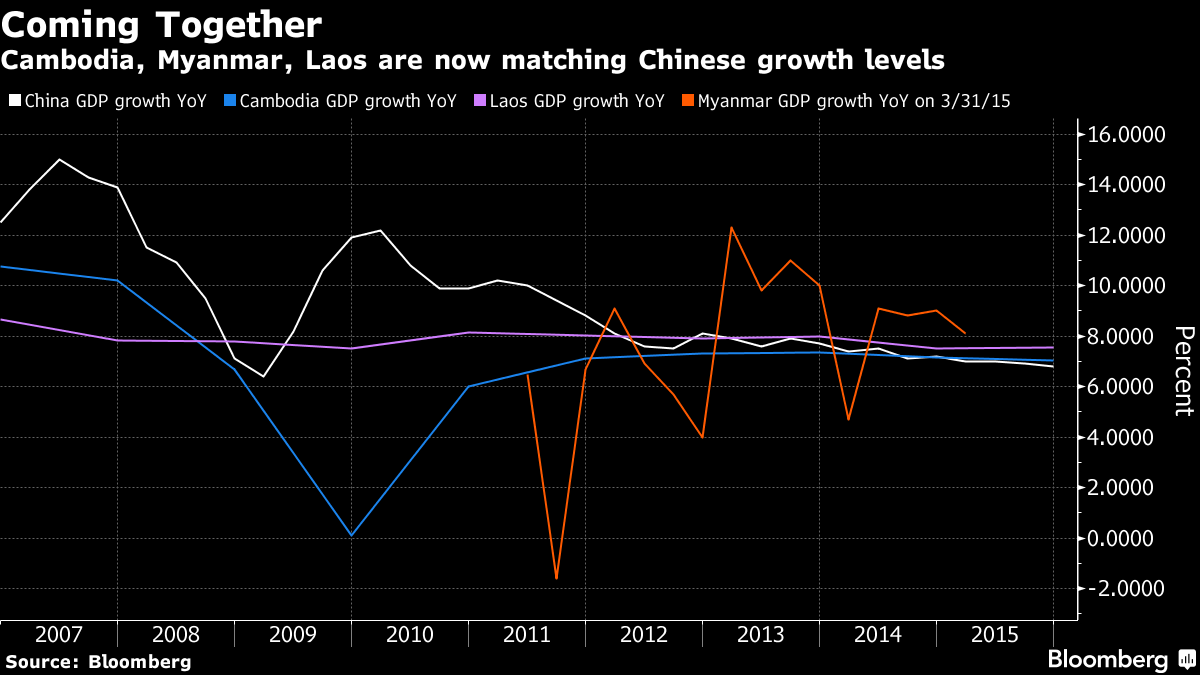
China’s investment is transforming its smaller Southeast Asian neighbors like never before while helping turn Cambodia, Laos and Myanmar into bigger destinations for its exports.

That’s driving some of the world’s fastest economic growth rates and providing Chinese companies with low-cost alternatives as they seek to move capacity out of the country. It’s also helping Asia’s largest economy and nations in its orbit adapt to what looks more and more like a new era of waning U.S. commitment to the region from a more inward-looking administration of President-elect Donald Trump.

“China’s definitely looking at these countries in general as an area where it can sell products and get good return for its investments,” said Edward Lee, an economist with Standard Chartered Plc in Singapore. “China itself is getting more expensive for its companies, and that’s reinforcing this trend.”

China is investing in everything from railroads to real estate in Cambodia, Laos and Myanmar — the frontier-market economies of the Association of Southeast Asian Nations.

China Minsheng Investment Group and LYP Group, headed by Senator Ly Yong Phat, signed a $1.5 billion deal last week to build a 2,000-hectare city near Cambodia’s capital, Phnom Penh, with a convention center, hotels, golf course, and amusement parks, the official Xinhua News Agency reported. The spending equals roughly one-tenth of the country’s $15.9 billion gross domestic product.

Belt, Road

In landlocked Laos, work started last year on the China-Laos railway, which will stretch 414 kilometers (257 miles) from the border to the capital, Vientiane. The project, part of Chinese President Xi Jinping’s One Belt, One Road initiative, will cost $5.4 billion, according to Xinhua. Xi met last week with Lao Prime Minister Thongloun Sisoulith in Beijing, where he pledged stronger ties.

Myanmar, which is liberalizing its economy and adopting market reforms after a transition to democracy, is forecast by the International Monetary Fund to expand 8.1 percent this year, the fastest in the world after Iraq. De-facto leader Aung San Suu Kyi has been quick to engage China since taking office this year, including visiting Xi in Beijing. China is its largest trading partner, accounting for about 40 percent of Myanmar’s total last year, and is building a special economic zone, power plant and deep-water seaport on the west coast.

For an explainer on China’s Silk Road, click here

Cambodia’s economy is projected to grow 7 percent this year, while Laos is set for 7.5 percent expansion. Myanmar’s currency, the kyat, was Asia’s top performer in the first five months of the year, but has weakened about 10 percent against the dollar since June as the U.S. currency strengthened

As Sino-Cambodian relations have flourished, so has trade, with two-way commerce climbing to $4.8 billion last year. That’s more than double from 2012, the year Cambodia warmed up to Beijing by opposing mention of China’s assertiveness in the South China Sea during a regional summit in Phnom Penh.

Most Chinese money flowing in to Cambodia, Laos, and Myanmar is lending on highly concessionary terms to finance construction projects run by Chinese firms, especially in Laos, said Derek Scissors, Washington-based chief economist at China Beige Book International, who specializes in studying the country’s foreign investment. Chinese construction and investment since 2005 equal about 15 percent of Lao GDP, which it couldn’t have financed from other nations, he said.

“The power sector is basically Chinese-built, bringing electricity to the majority of the population,” while China built several hydroelectric plants to increase electrification, Scissors said. “There were grand plans for Myanmar, but investment and construction actually realized is more conventional, in the energy and mining sectors.”

Garments, Shoes

Cambodia, Laos and Myanmar are becoming more incorporated with China’s supply chains, buying intermediate goods from its factories and selling consumer items such as garments and shoes that are often made by companies owned or funded by China. Its imports from the three Southeast Asian economies more than doubled in the past five years, IMF data show.

Such dependence on China isn’t without risks. Beijing accounts for the largest chunk of foreign investment in Cambodia and also about 43 percent of the country’s total debt stock, mostly in loans from Chinese development banks to Cambodia’s government, according to the IMF. Similarly, China’s railroad in Laos equals about half of its $10.5 billion 2015 GDP.

“This reliance on a narrow production and export base has many downsides,” the IMF said in a recent report. “A majority of Cambodian garment factories concentrate on cut-make-trim processes, which are at the bottom of value chain and also small part of the overall production. As a result, firms in Cambodia have limited leverage and autonomy.”

Cambodia has gained particular appeal for Chinese manufacturers seeking to relocate, which aligns with China’s strategy to export industrial capacity through initiatives such as One Belt, One Road. Cambodia’s $121 average monthly wage is just a fifth of China’s $613 average, according to the International Labour Organization in Geneva.

The biggest risk for frontier Asean economies is that Chinese inflows create “extractive” elites who entrench themselves in power, said Song Seng Wun, an economist at CIMB Private Banking in Singapore.

“These economies are getting a lot of money and opportunity from China,” he said. “If wealth is concentrated in the hands of a few, that may lead to problems and instability. The key here is developing a middle income group that Chinese companies will be targeting as a consumer.”

Source: Bloomberg Markets

Japan Tech Firms Start Lao PDR Data Center Project

Toyota Tsusho, Internet Initiative Japan, and Mitsubishi UFJ Morgan Stanley Securities announced the start of a joint demonstration project in the Lao PDR.

The firms said the project is aimed at evaluating the effectiveness of greenhouse gas emission reduction effect and energy efficiency using advanced container-type data center technology.

Lao PDR’s first government-operated eco data center was completed in Vientiane on November.

With integrated cloud infrastructure and security solutions, the new data center will serve as a cornerstone of Lao PDR’s IT foundation and contribute to the development of e-government applications for their people.

Additionally, the data center will be utilized for training future generations of IT engineers, industrial development and for a broad range of other initiatives. By operating the data center, the Lao PDR government also aims to strengthen its IT governance.

This data center is also expected to serve as a springboard for the maturation of the local IT industry, encouraging Japanese-related companies to expand their IT business in the country.

The highly energy efficient data center leverages IIJ’s IT/cooling all-in-one packaged design “co-IZmo/I.”

This design approach made it possible to complete the data center in just 7 months after construction began in May 2016 (about one-third the time typically required for conventional building-type data centers).

This project is conducted on the basis of the commission by the New Energy and Industrial Technology Development Organization (NEDO), as part of its Global Warming Mitigation Technology Promotion Project selected in July 2015.

The governments of Japan and Lao PDR have signed the bilateral document concerning the Joint Crediting Mechanism.

Source: Telecomasia.net

CARE Works with Laos to Eradicate Violence against Women, Children

CARE International has cooperated with the Lao government, Lao Women’s Union and line ministries to promote gender equality and combat violence against women and children in Laos.

“Today, we have fifteen projects being implemented across the country. Among which, three projects are focused on preventative measures against violence against women through raising public awareness about violence against women in rural and remote areas. They are supported by the European Union and the Australian government,” said Glenn Bon, Country Director, CARE International (Laos).

CARE previously worked with the United Nations making a guidebook to encourage men and women to take part in community-based campaigns combating violence against women and children.

CARE has also supported village, district and provincial campaigns for gender equality and women’s empowerment to strengthen the capability of Lao Women’s Union representatives by ensuring that they have a role on the projects and supported the government campaigns to visit villages and to provide moral and technical support for gender equality approaches.

Since 1993, CARE has provided a number of long-term development programmes in Laos. Its focus is on improving livelihoods, ensuring food security and community development in remote rural areas; preventing the spread of avian influenza and other emerging infectious diseases; and supporting vulnerable women and girls.


Source: KPL

Boun Khao Chi (Makhaboucha)

During February (depending on the lunar calendar)

This ceremony is held at “Wats” (temples) across the country in the morning, when a special “bread made of sticky rice” is offered. The festival is held during the third full moon of the lunar calendar. The festival commemorates the original teachings of the Lord Buddha given to over a thousand monks who came spontaneously to hear him preach. The festival is marked by grand parades of candle-bearing worshippers circling their local temples, making merit amidst much religious music and chanting.

The ceremony is held in the morning for the purpose of commemorating the speech given by Buddha to 1,250 enlightened monks. Temple goers circumnavigate the Wat three times with candles in a ceremony known as vien tian. Boun Khao Chi – special bread of sticky rice, coated with egg and then grilled, is made and offered to the monks. This offering occurs during Makhaboucha.


Source: KPL

Preparations Discussed for 13th Meeting on Foreign Affairs

Over 100 senior officials of the Ministry of Foreign Affairs met in Vientiane to discuss their preparations for the 13thNational Meeting on Foreign Affairs, which has been scheduled for Dec 15-16.

“The meeting will review the implementation of the Party policy on external affairs over the past five years by the Ministry of Foreign Affairs and diplomatic offices located overseas,” said Minister of Foreign Affairs Saleumxay Kommasith.

“The participants will exchange views evaluating the performance of the Ministry of Foreign Affairs and relevant organizations, identifying shortcomings and seeking proper solutions to the problems so that we can record greater achievements in foreign affairs in line with the guidance stated in the resolution of the 10th Party Congress,” said Mr Saleumxay.


Source: KPL

Vietnam’s PM Asks Lao, Vietnamese News Agencies to Foster Links

(KPL/TTXVN) Vietnam’s Prime Minister Nguyen Xuan Phuc has suggested the Vietnam News Agency (TTXVN) and the Laos News Agency (KPL) continue maintaining cooperation to meet communication requirements in each country.

In a reception for visiting KLP General Director Sounthone Khanthavong in Hanoi on December 7, the Vietnamese Prime Minister highlighted the flourishing development of the Laos – Vietnam traditional friendship, special solidarity and comprehensive cooperation, saying that it is particularly valuable in the world.

He affirmed the Vietnamese Party, State and people always attach importance to nurturing the relationship, and create the most favourable conditions for the two countries’ ministries, sectors and localities to expand links.

Expressing his joy at the reinforced partnership between TTXVN and KPL in recent times, the PM said he hopes the two agencies continue to perform well their duty of popularising the Vietnam-Laos relations, which will be maintained perpetually in the future.

The Vietnamese government will create all favourable conditions for TTXVN to build plans to cooperate with and support KPL in the coming time, he stated.

TTXVN General Director Nguyen Duc Loi informed the PM of the talks and the signing of cooperation agreements between the two agencies on the same day.

Accordingly, the two sides agreed to improve the quality of news for exchange, while strengthening communications on the special ties between Laos and Vietnam. They will increase media coverage of the respective countries and their people for stronger Laos – Vietnam relations.

KPL will continue helping TTXVN publish the Vietnam Pictorial in Lao language in Laos, while promoting the publication’s online version as well as the TTXVN’s electronic newspaper VietnamPlus on KPL’s website.

It also pledged to support the re-appearance of the TTXVN-run television channel Vnews on Laos’ cable TV system in 2017.

Meanwhile, the TTXVN will assist the KPL in upgrading its website, while coordinating with and supporting the KPL to launch the Internet system in KPL’s new headquarters.

For his part, Sounthone Khanthavong said his agency and TTXVN always join hand in disseminating the Laos – Vietnam relations, adding that the two sides are coordinating in a project to popularise the bilateral relationship towards the 40th anniversary of the signing of the Laos – Vietnam Friendship and Cooperation Treaty (July 18, 1977-2017).

He expressed his hope that PM Phuc will continue facilitating TTXVN-KPL collaboration in the time ahead, thus helping them excellently performing their mission as State news agencies.


Source: KPL