SINGAPORE – Media OutReach Newswire – 26 December 2025 – Z.ai has released GLM-4.7, the latest version of its open-source large language model, ahead of Christmas, as the company steps up efforts to position its models for real-world software development and production use.
The new model is designed around practical engineering workflows, with a focus on long-running task execution, stable tool calling, and multi-step reasoning, capabilities that have become increasingly important as developers deploy large language models in complex, agent-based systems.
Compared with its predecessor, GLM-4.6, GLM-4.7 shows notable gains in code generation, complex reasoning, and agent execution. According to Z.ai, the model delivers more consistent and controllable performance over extended tasks, while producing cleaner and more concise language output, addressing a common weakness in many open-source models.
To evaluate performance in realistic settings, Z.ai tested GLM-4.7 on 100 practical programming tasks in production-like environments such as Claude Code, spanning front-end, back-end, and command-execution scenarios. The company said GLM-4.7 achieved higher task completion rates and greater stability than GLM-4.6, and has since been adopted as the default model for its GLM Coding Plan.
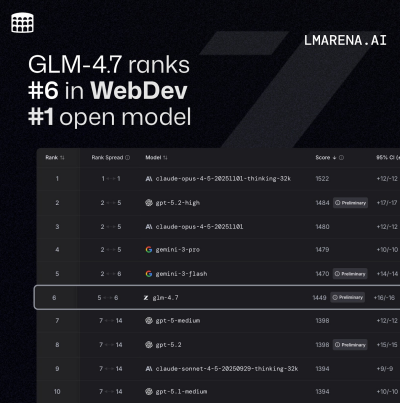
Benchmark results also place GLM-4.7 among the strongest open-source models currently available. It scored 67.5 on BrowseComp and 87.4 on τ²-Bench, the latter marking a new high for open-source systems. In coding-focused evaluations, including SWE-bench Verified and LiveCodeBench v6, its overall performance approaches that of Claude Sonnet 4.5. In Code Arena’s large-scale blind evaluation, which aggregates votes from more than one million comparisons, GLM-4.7 ranked first among open-source models.
The model is available through the BigModel.cn API and has been integrated into Z.ai’s full-stack development platform, according to the company. As open-source models take on a more prominent role in the global technology ecosystem, Z.ai’s progress offers a clear indication of how such systems may continue to evolve, and what they might enable next.
SHANGHAI, Dec. 26, 2025 /PRNewswire/ — On December 24, Henan Province’s first dedicated container terminal, with an annual handling capacity of one million TEUs, formally commenced operations at the Central Operating Area of Zhoukou Port’s Central Port Zone. Twelve automated port cranes and an integrated automation system, custom-built by Shanghai Zhenhua Heavy Industries Co., Ltd. (ZPMC), were simultaneously put into service. The project marks a new phase in the digitalization, automation, and scale-up of inland waterway shipping in Central China, while providing a replicable automation model purpose-designed for inland river operating conditions.
As the flagship project of Henan Province’s “11246” inland waterway development initiative, the Central Operating Area of Zhoukou Port’s Central Port Zone is positioned as a key logistics hub linking central and western China with the Yangtze River Delta. The project includes 13 berths capable of handling 2,000-ton vessels, with a designed annual throughput of 1.075 million TEUs. Once fully operational, Zhoukou Port will function as a specialized, hub-oriented multimodal port, serving domestic demand while connecting to global markets. It is expected to become one of China’s leading inland ports, enhancing regional connectivity and facilitating the flow of Henan’s cargo to overseas destinations, while serving as a gateway for deeper integration into the global maritime trade network.
As the equipment and smart-systems provider for the Zhoukou Port Central Operating Area, ZPMC addressed challenges posed by complex inland hydrological conditions and navigation requirements. The company developed and manufactured six energy-efficient, modular ship-to-shore (STS) cranes and six rail-mounted gantry (RMG) cranes configured for inland waterways. The STS cranes feature lightweight structural designs and reduced wind-load profiles. The RMG cranes incorporate an “8-rope 2.0” anti-sway system, enabling a single-cycle operation time of 120 seconds. Together, these systems support high-throughput, stable, and reliable inland terminal operations.
In addition, the automation system delivered by ZPMC integrates terminal management and control software across the container-handling process, from vessel operations to horizontal transport and yard management. It replaces traditional labor-intensive workflows with automated, digitally coordinated end-to-end operations, enabling real-time system-wide coordination. Following commissioning, productivity of the STS cranes at Zhoukou Port is expected to increase by 30 percent, with each crane capable of handling up to 120,000 TEUs annually, significantly enhancing throughput capacity and competitiveness while providing a validated, scalable framework for modernizing inland port operations across China.
BANGKOK, THAILAND – Media OutReach Newswire – 26 December 2025 – Tourism remains one of the most important engines driving Thailand’s economy. Beyond generating revenue, it plays a vital role in job creation, nation branding, and even influencing investment decisions. However, fostering sustainable growth in the tourism sector is far from straightforward. The industry continues to face multiple challenges, including convenience and accessibility, intensifying competition among destinations worldwide, and changing traveller behaviours — all of which directly affect tourists’ travel decisions.
NIA Joins Forces with TAT to Reignite ‘Amazing Thailand’
Towards the end of this year, Thailand is preparing to reignite global attention with a renewed wave of ‘Amazing Thailand.’ The government and private sector are rolling out a comprehensive set of tourism-stimulus measures that address both economic impact and national image. One of the most talked-about highlights is the appointment of Lalisa ‘Lisa’ Manobal as the new brand ambassador — not only a global-level artist, but also a powerful representation of Thailand’s contemporary image on the world stage.
Another key highlight to watch closely is the launch of the ‘Amazing Thailand Innovation Gadget’ platform, developed through a collaboration between the National Innovation Agency (Public Organisation), or NIA, and the Tourism Authority of Thailand (TAT). This initiative aims to elevate Thailand’s tourism industry into the era of Smart Tourism in a tangible and comprehensive way.
The platform is designed to function as Thailand’s first-ever tourism innovation repository, bringing together tourism-related technologies and solutions in one centralised space. These range from route-planning technologies, accommodation booking systems, and tourist-data management, to experience-creation tools that personalise journeys and enhance engagement. More than a simple innovation directory, the platform represents a turning point — a mechanism that connects entrepreneurs, developers, and creative talents to co-create new ‘Amazing’ experiences, spanning the entire traveller journey from trip planning to the final moment of travel for visitors worldwide.
Learning from Global Leaders Where Tourism Meets Technology
The world has entered an era where tourism is no longer driven solely by beautiful destinations and cultural heritage. Instead, competitiveness increasingly depends on experiences and technology. As a result, many countries are rapidly upgrading their tourism sectors to become smarter, more emotionally engaging, and better aligned with the expectations of modern travellers.
Japan, for example, stands as a model of cultural-innovation integration, leveraging anime, music, cuisine, and fashion as globally recognisable soft power. Recently, the Japanese government has rebooted efforts to fuse cultural roots with advanced technology through initiatives such as Virtual Remix Japan, which enables global audiences to participate in art exhibitions, festivals, and anime worlds in real time via VR and AR. This exemplifies a seamless blend of past and future.
Meanwhile, South Korea has aggressively combined technology and tourism to enhance attractiveness and vibrancy. The country actively promotes start-ups offering cloud-based hotel-management platforms, real-time translation technologies, blockchain services for international tourists, and platforms linking tourism with overseas education. South Korea has also built a tourism ecosystem that integrates smart cities, digital technology, and contemporary culture, using K-pop artists as a major driving force.
In Barcelona, Spain, one of Europe’s leading smart cities, tourism has been elevated through intelligent urban and visitor-experience management. From smart traffic systems and energy-saving public bike services to big-data-driven analysis of tourist behaviour, visitors can plan accommodation, restaurants, and travel routes through a single integrated application. This approach creates a balanced coexistence between tourism and urban life. Together, these examples demonstrate that technology is no longer merely a supporting tool, but the core differentiator in the modern tourism economy.
Amazing Thailand Innovation Gadget: Elevating Thai Tourism Through a Fully Integrated Innovation Ecosystem
NIA and TAT have officially announced a landmark collaboration with the launch of the ‘Amazing Thailand Innovation Gadget’ platform, which serves as Thailand’s first tourism innovation repository. The initiative aims to propel Thai tourism fully into the Smart Tourism era.
The platform aggregates tourism-related technologies and innovative solutions from start-ups and entrepreneurs nationwide, enabling real-world deployment across the entire Thai tourism value chain. Its objective is to build a strong tourism-innovation ecosystem through integrated collaboration across all sectors, while enhancing entrepreneurs’ capacity to apply innovation and technology suited to the specific contexts of different destinations.
This approach is designed to create premium tourism experiences for both domestic and international travellers, delivering sustainable economic and social benefits for Thailand. Importantly, the country will gain a continuously expandable tourism-innovation repository, strengthening long-term competitiveness in the global tourism market.
From Creative Power and Culture to Driving Thailand’s Tourism Economy
Dr. Krithpaka Boonfueng, Executive Director of the National Innovation Agency, stated that the innovations featured on the platform will primarily be Travel Tech-related technologies. The platform is open to start-ups, entrepreneurs, developers, and business partners with the interest and capability to co-create elevated tourism experiences while advancing Thailand’s Smart Tourism ecosystem.
Currently, NIA supports and has incubated more than 80 high-potential tourism-technology start-ups and entrepreneurs, spanning areas such as community-based tourism (Local Alike), hospitality solutions (Ascend Travel), urban mobility (MuvMi), social impact marketplaces (SocialGiver), and backend customer-journey management systems (Appointment Anywhere). These solutions enable entrepreneurs and developers to access tools tailored to their specific contexts.
NIA believes that all stakeholders play a vital role in elevating Thailand’s tourism industry by integrating technology with creativity, culture, and local identity. This integration goes beyond artists, cuisine, or traditional culture, extending into tangible, scalable innovations that create new economic value for local communities.
Thai – Tech – Tourism: A Major Integrated Leap Forward
Dr Krithpaka further noted that tourism is one of the core engines of the global economy, particularly following recovery from the COVID-19 pandemic. According to data from the World Travel & Tourism Council (WTTC), in 2024 the global travel and tourism sector contributed USD 10.9 trillion, or 10% of global GDP, and supported 357 million jobs worldwide.
The United Nations World Tourism Organization (UN Tourism) has emphasised that innovation is a critical driver of economic growth, enabling new business models, attracting investment, and differentiating destinations through unique tourism formats.
Another crucial factor not to be overlooked is the global TravelTech investment ecosystem, which remains robust. In the post-pandemic era, major tourism companies have increased technology investment by an average of 14% in 2024, reflecting strong confidence in technology as a competitive advantage.
Key areas of investment focus include Smarter Retailing and Personalisation, which deliver highly tailored customer experiences; GenAI and Autonomous Agents, next-generation AI capable of analysing, planning, and executing tasks independently — such as automated travel recommendations, trip planning, and booking management; and Sustainability, with growing investment in start-ups that reduce carbon emissions through diverse solutions.
These global trends align closely with the capabilities and diversity of Thai start-ups, positioning Thailand to connect seamlessly with international movements and deliver truly tangible ‘Amazing’ experiences.
NIA stands ready to connect knowledge, technology, and innovation capital across public agencies, private enterprises, and Thai start-ups to drive concrete outcomes in the tourism-innovation ecosystem. This effort extends beyond enhancing tourism businesses; it represents the creation of a future-oriented industry that fuses creativity and culture with technological power.
Through this integrated approach, Thailand aims to elevate economic value, cultural richness, and sustainability — and to advance decisively towards becoming a Global Innovation Tourism Hub in a meaningful and lasting way. Hashtag: #NIA #NationalInnovationAgency
Leifras Co., Ltd., Tachibana Gakuen Educational Corporation, and Matsumoto Co., Ltd. Enter into a Memorandum of Understanding
TOKYO, Dec. 26, 2025 /PRNewswire/ — LEIFRAS Co., Ltd. (Nasdaq: LFS) (the “Company” or “Leifras”), a sports and social business company dedicated to youth sports and community engagement, announced that it entered into a memorandum of understanding (the “MOU”) with Tachibana Gakuen Educational Institution (“Tachibana Gakuen”), a high school specializing in education for students who have been absent from school, and Matsumoto Co., Ltd. (“Matsumoto”), a comprehensive printing company. Under the MOU, the three parties plan to launch a collaborative project (the “Project”) aimed at supporting students affected by school refusal and addressing this increasingly serious social issue in Japan.
Pursuant to the MOU, Leifras agrees to contribute its expertise and operational know-how in running sports schools and other sports education and training businesses. Tachibana Gakuen agrees to provide guidance on school management and support for students who are not attending school. Matsumoto agrees to provide land and facilities in Kitakyushu City necessary for the execution of the Project and to oversee the entire project.
A Dedicated Solution to the Ever-growing Problem of School Refusal
Japan’s birth rate continues to decline, with the annual birth rate expected to fall below 665,000 in fiscal year 2025. Meanwhile, according to a survey by Japan’s Ministry of Education, Culture, Sports, Science and Technology, the problem of school refusal continues to worsen, with the number of children and students not attending school projected to reach 353,970 in fiscal year 2024. Approximately one in 15 junior high school students is absent from school, a figure that has been increasing for 12 consecutive years since fiscal year 2013, nearly tripling the previous level.[1] Against the backdrop of a declining birth rate that makes every child valuable to society, the number of school absentee students continues to reach new record highs. From the perspective of nurturing and securing the talent that will lead society in the future, Leifras recognizes school refusal as a serious issue that must be addressed in a timely manner. Leifras, Tachibana Gakuen, and Matsumoto believe the private sector must take action to address this important issue.
Aim of the Project
Leifras, Tachibana Gakuen, and Matsumoto plan to collaborate to create and provide a new form of education, going beyond the boundaries of educational institutions and corporations, each contributing their specialized know-how. The Project is intended not only as a social contribution activity, but also as a sustainable business model that meets growing social needs. The close collaboration between educational institutions and corporations seeks to realize a rare model that combines high economic value and social value, establishing a solid revenue base while nurturing young people who represent the hope of the future and fostering society.
School Refusal and Chronic Absenteeism in Europe and the US and the Possibility of Global Expansion
School refusal is not an issue unique to Japan. The increase in students who are absent from school for long periods of time is also recognized as a social problem in Europe and in the United States. The knowledge and know-how cultivated through the Project has the potential to be expanded to global markets, including the United States, in the future.
The Rise of Chronic Absenteeism in the United States
In the United States, students who miss more than 10% of school days per year are defined as “chronically absent,” and this has become a major educational issue. According to the 2022 school year data from the U.S. Department of Education, the national average of chronic absenteeism rate is 28%, with the rate exceeding 40% in some areas, representing a serious situation.[2]
Comparison with Organisation for Economic Co-operation and Development (OECD) Countries
According to the Programme for International Student Assessment (PISA) 2015 report, the OECD average for students who have “missed at least one full day of school in the previous two weeks” is 20%, and even compared to Japan’s figure at the time (approximately 2%), the percentage of students who have experienced absences in OECD countries tends to be higher.[3]
Mr. Kiyotaka Ito, the Representative Director and Chief Executive Officer of Leifras, commented, “We are pleased to enter into the MOU with Tachibana Gakuen and Matsumoto to launch the collaborative Project. The Project marks a major innovation in our endeavors to establish a profitable and sustainable business model that delivers both social and economic value. We plan to first establish a highly scalable and profitable model in Fukuoka Prefecture, followed by rapid nationwide expansion, positioning the Project as a new core pillar of our business. Looking ahead, the Project is not intended to remain limited to the framework of the three companies alone. We intend to build a broader partnership to create a business ecosystem and incorporate the knowledge and technologies of diverse companies to continuously develop new, high-value-added services. We believe the ‘new business model for supporting school refusal’ established through the Project will achieve success in Japan and, over time, be adapted and expanded to Western countries that also face these issues.”
About LEIFRAS Co., Ltd.
Headquartered in Tokyo, Leifras is a sports and social business company dedicated to youth sports and community engagement. The Company primarily provides services related to the organization and operations of sports schools and sports events for children. As of December 31, 2024, Leifras was recognized as one of Japan’s largest operators of children’s sports schools in terms of both membership and facilities by Tokyo Shoko Research. The Company’s approach to sports education emphasizes the development of non-cognitive skills, following the teaching principle “acknowledge, praise, encourage, and motivate.” The holistic approach that integrates physical and mental development sets Leifras apart in the industry. Building upon deep experience and know-how in sports education, Leifras also operates a robust social business sector, dispatching sports coaches to meet various community needs with the aim to promote physical health, social inclusion, and community well-being across different demographics. For more information, please visit the Company’s website: https://ir.leifras.co.jp/.
About Tachibana Gakuen Educational Corporation
Based in Fukuoka City, Tachibana Gakuen is a high school that accepts students who have been absent from school from all over the country. Guided by its founder’s belief that “When a child is neglected, education loses its light,” Tachibana Gakuen has developed a distinctive educational approach that has attracted significant attention nationwide. Boards of education and various organizations from all over the country visited to inspect the school. For more information, please visit: https://www.tachibanahs.net/.
About Matsumoto Co., Ltd.
Matsumoto Co., Ltd. is a comprehensive printing company founded in 1932 and headquartered in Kitakyushu City (Tokyo Stock Exchange Standard Market: 7901). The company delivers albums to approximately 7,000 schools annually. Matsumoto was a pioneer in the industry, establishing a commercial inkjet printing factory and constantly investing in cutting-edge businesses. In recent years, the company has expanded beyond the printing business and, since February 2023, has also been working on businesses using Web3 and blockchain. For more information, please visit: https://www.matsumoto-inc.co.jp/.
Forward-Looking Statements
Certain statements in this announcement are forward-looking statements. These forward-looking statements involve known and unknown risks and uncertainties and are based on the Company’s current expectations and projections about future events that the Company believes may affect its financial condition, results of operations, business strategy, and financial needs. Investors can find many (but not all) of these statements by the use of words such as “approximates,” “believes,” “hopes,” “expects,” “anticipates,” “estimates,” “projects,” “intends,” “plans,” “will,” “would,” “should,” “could,” “may,” or other similar expressions in this press release. The Company undertakes no obligation to update or revise publicly any forward-looking statements to reflect subsequent occurring events or circumstances, or changes in its expectations, except as may be required by law. These statements are subject to uncertainties and risks, including, but not limited to, the uncertainties related to market conditions, and other factors discussed in the “Risk Factors” section of the registration statement the Company filed with the U.S. Securities and Exchange Commission (the “SEC”). Although the Company believes that the expectations expressed in these forward-looking statements are reasonable, it cannot assure you that such expectations will turn out to be correct, and the Company cautions investors that actual results may differ materially from the anticipated results and encourages investors to review other factors that may affect its future results in the registration statement and other filings with the SEC. Additional factors are discussed in the Company’s filings with the SEC, which are available for review at www.sec.gov.
For more information, please contact:
LEIFRAS Co., Ltd. Investor Relations Department Email: IR@leifras.co.jp
Ascent Investor Relations LLC Tina Xiao Phone: +1-646-932-7242 Email: investors@ascent-ir.com
[3] Y. Yano, “Study of Measures to School Non-Attendance in Japan and G7 Participating Countries,” Research Bulletin (Sakushin Gakuin University Women’s College), Dec. 28, 2023, indexed in J-GLOBAL (Japan Science and Technology Agency), https://jglobal.jst.go.jp/en/detail?JGLOBAL_ID=202502253648969710.
Road accident in Champasack Province on 25 December 2025. This photo is used for representational purpose only. (Photo credit: Champasack 1623 Rescue)
Laos reported more than 5,700 traffic accidents in the first eleven months of 2025, marking a decline compared to the higher number recorded nationwide in 2024, according to the Traffic Police Department.
From January to November, Laos recorded 5,740 traffic accidents, leading to 8,873 injuries and 782 deaths, Khamsone Sidavong, Head of the Traffic Police Department noted in a report on 26 December.
The major contributor was the International New Year 2025 celebrations, when 170 accidents occurred over a short period, causing 17 deaths. Authorities identified speeding, drunk driving, and failure to yield as the main causes.
Officials also warned that careless driving during the holiday period on crowded roads significantly increases the risk of serious accidents.
To prevent accidents during the upcoming celebrations, authorities have intensified inspections on main roads and at key high-risk locations, while urging motorists to avoid drinking and driving, refrain from using mobile phones while driving, wear helmets properly, and strictly follow traffic laws.
In 2024, Laos recorded 6,789 accidents nationwide, including 10,312 injuries, 929 fatalities, and 12,212 vehicles damaged, some beyond repair.
Saysettha Stupa and Saysettha District at Attapeu Province. (Picture by Tourism Laos)
Attapeu Province has lifted 29,289 families out of poverty, according to Chairman of the Attapeu Provincial Administrative Committee Tanuxay Chandanalith, who presented the update during the 10th Ordinary Session of the Attapeu Provincial People’s Council on December 24.
Tanuxay said the province currently comprises five districts and 140 villages, with a total of 32,257 families. Of these, 29,289 households have moved above the poverty line. As a result, 127 villages and three districts are now officially classified as out of poverty.
Alongside this progress, living standards across the province have continued to improve. A total of 24,455 families have been recognized as developed households, while 80 villages have achieved developed village status. In addition, three large villages have evolved into rural town centers, and three districts have been designated as developed districts.
Efforts to promote exemplary livelihoods have also gained momentum through model family programs, which have been implemented in seven villages. In Saysettha district alone, 97 families have been recognized as model households, including 30 farming families and 53 livestock-raising families.
Tanuxay noted that poverty reduction remains a central priority for the provincial administration. He said state investment, policy bank credit, grants, loans, and community contributions have been strategically directed toward infrastructure development and livelihood support.
These measures, he added, have strengthened production capacity, improved access to basic services, and raised living conditions, particularly in rural and remote areas, while laying a stronger foundation for long-term economic and social development across Attapeu Province.
SHIJIAZHUANG, China, Dec. 26, 2025 /PRNewswire/ — A News Report from Great Wall New Media:
From photovoltaic new energy to intelligent connected vehicles, and further to integrated wind–solar–storage projects, Hebei Province is accelerating the development of a diversified and synergistic energy industry, supported by a strong manufacturing base and abundant resource endowments. Among Hebei’s 107 key specialty industry clusters, the photovoltaic new energy industrial cluster in Ningjin County is one of the earliest new energy industrial bases in China.
In recent years, Ningjin County has continued to improve its business environment while accelerating the high-end, intelligent and green development of its new energy industry. By actively promoting integrated wind–solar–storage projects and expanding the international market for photovoltaic products, the cluster’s agglomeration effect and spillover capacity have been steadily strengthened.
Not long ago, representatives from energy authorities of Brandenburg, Germany, proactively engaged with Hebei’s new energy enterprises, holding in-depth discussions on such topics as new energy technology applications and industrial collaboration. The Brandenburg side expressed its willingness to further deepen pragmatic cooperation with Hebei enterprises in energy transition and clean energy development, with a view to achieving mutual benefit and win-win outcomes.
In this episode of What Hebei Can Offer, Daniel, a Great Wall Overseas Communication Officer from Germany, takes viewers to the photovoltaic new energy industrial cluster in Ningjin County, Xingtai City, to explore how the county has leveraged a well-developed industrial chain and strong technological innovation to transform itself from “the home of China’s electric wires and cables” into one of the country’s leading photovoltaic new energy industrial clusters.
TAIPEI, Dec. 26, 2025 /PRNewswire/ — TutorABC Group today announced a major upgrade to its corporate training portfolio with the launch of Oxford Business English, a specialized curriculum series designed to enhance professional communication across 12 key industries. This strategic initiative targets the growing demand from global enterprises for high-precision language training that goes beyond general fluency.
TutorABC Launches 12 Specialized Industry Curriculums to Power Global Workforce Transformation
As multinational corporations continue to integrate their global teams, the need for sector-specific communication skills has surged. TutorABC Group’s new program directly addresses this by equipping professionals with the exact vocabulary, scenarios, and soft skills required in their specific fields.
The Oxford Business English integrates authoritative materials from Oxford University Press with TutorABC Group’s proprietary AI-matching technology. The curriculum is divided into three strategic pillars covering 12 specialized pathways:
Service Excellence: Hospitality, Healthcare, Retail, Aviation.
Each Oxford Business English program builds real workplace communication skills through:
Industry Language Essentials: Key terms and expressions used in the field.
Workplace Scenarios: Meetings, client interactions, and daily communication practice.
Practical Skills: Presenting, negotiating, writing emails, and working with global teams.
AI-Personalized Learning: AI recommends the right teacher, lessons, and exercises.
Progress Tracking: Clear feedback and measurable improvement.
Samuel Yang, Co-Chairman and CEO of TutorABC Group, stated, “In today’s global business environment, ‘being fluent’ is no longer enough. An engineer needs to explain technical specifications; a banker needs to negotiate complex terms. With Oxford Business English, we are moving from teaching English to teaching business execution in English. This is how we empower our clients to compete globally.”
Already the preferred partner for over 3,000 enterprises—including Apple, Mercedes-Benz, Shiseido, and Sheraton—TutorABC Group’s specialized curricula bridge the gap between corporate requirements and individual career goals. Whether upskilling teams in the Technology and Luxury sectors or preparing professionals for work visas in Australia and the UK, the program ensures learners master the practical negotiation and presentation skills essential for the international stage.
Rodney Miles, Co-Chairman of TutorABC Group, stated, “These specialized pathways represent a long-term investment in building sustainable professional capabilities. We don’t believe in one-size-fits-all learning. From organizations developing future-ready teams to individuals navigating global career transitions, our role is to provide structured, role-specific pathways that turn learning into measurable professional growth.”
Global Education Group: A Global leader in online English and Chinese education with over 20 years of experience, serving learners in more than 100 countries.
Proven Scale & Trust: Serving 100 million learners, supported by 35,000+ teachers and trusted by 3,000+ corporate clients, including Apple, Google, Microsoft, TSMC, HSBC, and PwC.
Academic & Industry Recognition: First online education provider in Asia-Pacific to receive the highest-level WASC accreditation (2025).
Technology & Innovation: US$300 million invested in R&D with 19 patented technologies powering AI-driven learning.
Global Footprint: Headquartered in Hong Kong with offices worldwide, partnering with Oxford, Cambridge, National Geographic Learning, Kaplan, ETS, and Barron’s.






 https://www.nia.or.th/