Home Blog Page 4879

Asia Pacific countries shine as potential offshore destinations for global companies in Kearney’s Global Services Location Index

  • Eight Asia Pacific countries place in the top 15 as the most attractive destinations for offshore services globally.

  • 2023 Index focuses on talent regeneration and digital skills, bringing Singapore into the limelight as APAC’s emerging technology destination for establishing innovation hubs.

SINGAPORE – Media OutReach – 8 August 2023 – Global management consultancy Kearney has published its 2023 Global Services Location Index (GSLI) that studies the critical factors that make countries attractive as potential locations for offshore services.

In an era of rapidly evolving global business landscapes, business services like information technology, business process outsourcing (BPO), and engineering are increasingly being delivered across borders as companies seek to reduce costs, scale talent, and increase efficiency by utilizing the global talent base. In the current climate, Asia Pacific (APAC) markets shine as potential offshore service destinations, with India, China and Malaysia continuing to lead the index as the top three destinations respectively.

The GSLI ranks 78 countries based on 52 metrics that cover four dimensions including financial attractiveness, people skill and availability, business environment, and digital resonance.

Strong outlook for APAC

Continuing their strong showing in GSLI 2021, APAC countries lead this year’s Index, with India, China and Malaysia in the top three largely due to cost advantage, talent availability, and strong skills. Meanwhile, Indonesia, Vietnam, Thailand, the Philippines, and Singapore are ranked among the top 15. Singapore jumps 24 ranks from 38th to 14th in this year’s rank, the highest leap by any country.

A breakdown of the performance of APAC countries within the GSLI, namely India, China, Malaysia, Indonesia, Vietnam, Thailand, the Philippines, and Singapore can be found in the appendix.
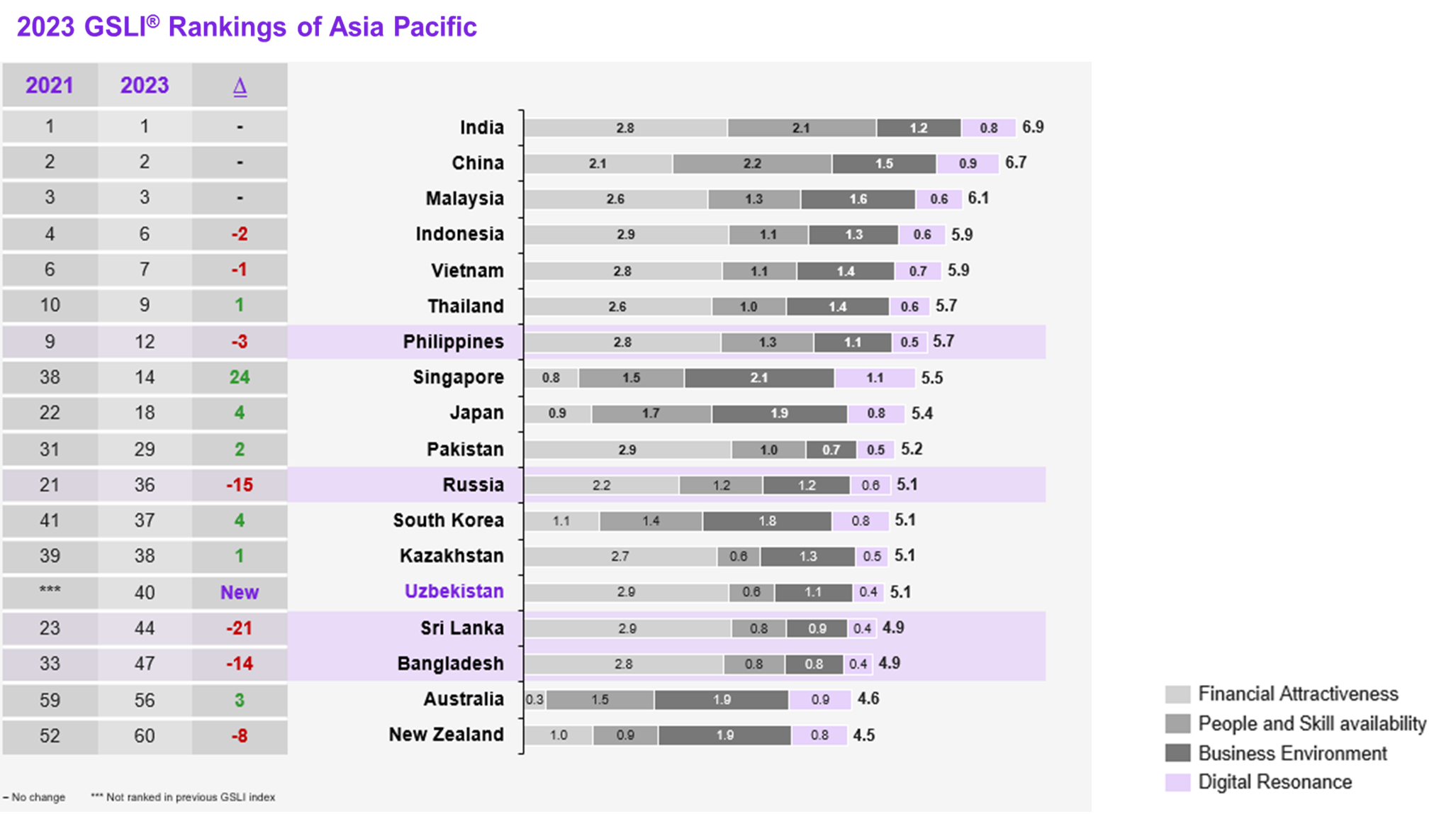
2023 GSLI APAC Rankings

“Geopolitical, economic, and technological forces have spurred significant changes in the global labor market. Therefore, a country’s ability to reskill and redeploy its workforce in response to changing market demands and technological disruptions is key to improving its attractiveness as an offshore location for business services,” says Arjun Sethi, Kearney’s Global Vice Chair of Digital Transformation, Regional Head and Chairman of Kearney’s APAC Region, and co-author of the 2023 GSLI report.Talent regeneration will be the most crucial gamechanger as Industry 4.0 continues to reshape the demand for future skills and jobs. And this is what has kept the top three countries – India, China and Malaysia – solid in the Index for a few years now, while the rest have been fairly fluid in their positions.” Adding on he said, “So in a nutshell, while building regenerative talent pools, everything, everywhere, all at once, is what a country should seek to achieve – to consistently stay ahead of the curve.”

Talent regeneration key for continued attraction

A key trend emphasized in this year’s report is the importance of talent regeneration – a country’s ability to rapidly reskill and redeploy its workforce in response to changing market demands and technological disruptions to maintain and enhance its attractiveness as an offshore location.

With the emergence and adoption of digital technologies, cost-centric service locations are at risk of losing their competitiveness to more developed and technologically advanced countries as more work and processes will be automated. Talent regeneration, therefore, will serve as the backbone of this shift.

Through a talent regeneration matrix, this year’s report shows the talent regeneration capacity and maturity of countries. Singapore shines as APAC and Southeast Asia’s premier emerging technology destination and innovation hub. India and China also exhibit strong talent regeneration and are projected to lead the world in terms of the availability of a tech-enabled workforce. Additionally, traditional offshoring leaders in the region such as India, China, Malaysia, Indonesia, Vietnam and Thailand will need to invest heavily in talent regeneration as the labor cost advantage becomes less relevant given the technological disruptions and socioeconomic factors.

About the 2023 Kearney Global Service Locations Index

The 78 countries in the 2023 Global Services Location Index were selected based on corporate input, current remote services activity, and government initiatives to promote the sector. They were evaluated against 52 metrics across four major categories: financial attractiveness, people skills and availability, business environment, and digital resonance. This year, Kearney refocused the Index to be more forward-looking and captured digital resonance and talent regenerative capabilities and availability. In the process, a few metrics were dropped from the people skills availability and digital resonance pillars that were focusing on traditional IT, and new digitally focused parameters were added. This along with global trends and key local disruptors led to marked differences in some countries’ rankings.

To access the report, click here
Hashtag: #Kearney #GlobalServicesLocationIndex

The issuer is solely responsible for the content of this announcement.

About Kearney

Kearney is a leading global management consulting firm. For nearly 100 years, we have been a trusted advisor to C-suites, government bodies, and nonprofit organizations. Our people make us who we are. Driven to be the difference between a big idea and making it happen, we help our clients break through.

Appendix: Assessment of APAC Countries in 2023 GSLI

India (GSLI rank 1) is a traditional leader in outsourcing because the country has a skilled workforce at a low cost. Demand is booming for AI, ML, and data processing skills, which are expected to be the top technologies in the next five to 10 years. Seizing the opportunity, the government has launched programs such as PM Kaushal Vikas Yojana 4.0 to upskill 4.7 million people on i4.0 technologies such as AI, 3D printing, drones, and the Internet of Things (IoT). To keep the momentum, India is building on its strong science, technology, engineering, and math (STEM) backbone and educating young students on crypto, AI, and other new-age technologies under the National Education Policy 2020. The new National Data Governance Policy will strengthen India as a high-skill, low- to mid-cost market and fulfill the vision to “Make AI in India.”

China (GSLI rank 2) is a tech leader focusing on self-sufficiency amid the tech stack wars with the west. A leader in filing tech-based patents on AI, ML, quantum computing, blockchain, and cloud, China’s economy is leading in the adoption of digitalization with a strong focus on digital skills enhancement. The nation is building a strong STEM education system by introducing emerging technologies such as AI, analytics, and 3D design along with high cognitive, social, and emotional skills at an early stage. In addition, many application-oriented universities are open to flexible paths, such as the “3+4” program. In 2021, more than 300 universities offered full-time courses in AI. The government is also working with employers to develop industry-specific frameworks that identify the skills that workers need to succeed in each industry, and employers are investing in training and development to keep their employees up to date on the latest technologies and trends. Strong PISA statistics and a variety of industry and academia partnerships are keeping the momentum going. Despite government-funded and public–private initiatives to develop digital skills, China is facing an uncertain workforce size in the mid and long term because of its aging population and low birth rate. The one-child act has been a major contributing factor to the flattening and contracting of China’s population.

Malaysia (GSLI rank 3) benefits from a strong focus on building digital skills, the adoption of emerging technologies, and government support for developing digital skills. A workforce equipped with advanced digital skills such as cloud architecture, analytics, AI, and software development contributes an estimated $105.7 billion a year to the country’s GDP. Already a hub for top companies, Malaysia’s digital economy has initiatives to help tech start-ups integrate across the region, and the country is making investments to attract Fortune 500 tech companies to create high-value jobs. The country is also banking on public–private partnerships to narrow the skills gap and achieve the goals of its transformative Malaysia 5.0 initiative while also fulfilling initiatives such as the #MyDigitalMaker Movement, eUsahawan, Premier Digital Tech Institute, and Digital Skills Training Directory to upskill and reskill its population.

Indonesia (GSLI rank 6) has a massive workforce of about 135 million people, but there is a shortage of skilled workers. Only 40 percent of the workforce has the skills needed to work with emerging technologies, which led to it slipping two spots on this year’s GSLI. Indonesia’s emerging focus on digital skills enhancement is helping it resurge, with IT behemoths expressing interest in investing in the digital economy because of its cost-effectiveness. The central government in Jakarta has been seeking support from US and Japanese decision-makers to make Indonesia a corporate relocation center. The government is prioritizing vocational training to strengthen skills and has launched Kartu Prakerja, a digital adult learning program.

Vietnam (GSLI rank 7) remains a strong Asian outsourcing destination. The presence of major technology companies demonstrates that the country is a global digital hub, motivating it to continue upskilling its workforce.

Thailand (GSLI rank 9) jumped one spot on the back of its financial attractiveness and business environment. Its future lies in capitalizing on its population’s digital skills to become an innovation hub. Thailand’s digital transformation efforts have been intensifying, with the Ministry of Labor partnering with public firms to upskill about 4 million digital citizens and launching a Smart Skills program to provide access to online courses on digital skills such as IT support and data analytics.

The Philippines (GSLI rank 12) continues to be the business process outsourcing (BPO) engine of Asia: it is home to more than 1,000 BPO companies with nearly 1.2 million employees. However, it slipped three spots in this year’s GSLI, primarily because of the rise of Mexico and Colombia as nearshore capability centers with proximity to the United States. With growing demand for technologies such as AI, ML, the IoT, and automation, the demand for a skilled workforce is also growing. To seize this opportunity, the government offers the Technical Education and Skills Development Authority and a wide range of courses in the BPO sector—from basic customer service to more specialized knowledge such as data analysis and cloud computing. In 2022, Digital Edge debuted in the market by launching a data center there, helping to bridge the digital divide in Southeast Asia’s most dynamic countries.

Singapore (GSLI rank 14) jumped 24 spots, primarily because of its digital resonance and capabilities to foster innovation, which is reflected in the country’s thriving tech-based start-up ecosystem. Its tech economy will need another 1.2 million digitally skilled workers by 2025, and with demand growing, the need for a suitable workforce will also grow. To meet this demand, the government is working through research, innovation, and enterprise plans, including a $19 billion investment over a five-year period to advance its R&D landscape. Singapore is investing in training programs and initiatives to help workers develop their skills and in support initiatives such as SkillsFuture Singapore, TechSkills Accelerator, and Industry Transformation Maps. Private-sector firms are also investing in the development of a skilled workforce, and many private collaborations are aimed at upscaling private companies and educational institutions.


Support Flood Victims in Laos by Donating to These Five Organizations

Volunteers from Vientiane Rescue 1623 in Khammouane province, Laos. (Photo: Vientiane Rescue 1623)

Eight provinces across Laos have been the victims of flash floods, affecting thousands of households across the country, especially in Khammouane, Bolikhamxay, and Savannakhet. As a result, several government and volunteer organizations have stepped in to help in rescue and immediate assistance efforts for affected victims.

Achieving New Milestones in Label Recycling

Avery Dennison is advancing AD Circular — their state-of-the-art, pressure-sensitive label waste recycling program — in ASEAN

SINGAPORE – Media OutReach – 8 August 2023 – Avery Dennison Corporation (NYSE:AVY), a leader in global materials science and manufacturing, is taking responsibility for the matrix and liner waste its labels generate by providing an accessible and efficient recycling program that helps turn them into valuable resources.

Caption


In 2022, Avery Dennison’s global recycling program was relaunched as AD Circular in ASEAN and has since saved 2,628 tons of label waste. This is done by recycling glassine liners into white or corrugated paper, or by incinerating matrix and others into fuel and energy, the ash from which is used to make cement powder or bricks. By incorporating various ways of recycling, Avery Dennison is ensuring zero waste generation.

“AD Circular is a simple process that costs the same or less compared with other recycling programs or disposal services,” says Darren Milligan, Vice President and General Manager of Label and Packaging Materials, Avery Dennison ASEAN. “We believe this is a beneficial program and expect to gain more participation from converters and brands — and hopefully help them reach their own sustainability goals as well.”

Sam Manlosa Jr., the Head of Geocycle, expresses enthusiasm and support for Avery Dennison’s initiative. “Geocycle and Holcim Philippines are thrilled to partner with AD Circular to drive circularity. We are one in the belief that sustainability is a non-negotiable value when doing business, and we will further strengthen our partnership in the years to come.”

Anan Hongsongkeat, Packaging and Recycling Business Division Manager of SCG International Corporation Co., Ltd., adds, “With over 40 years of expertise in end-to-end supply chain solutions and a strong focus on green solutions to help our partners achieve their sustainability journey, SCG International is proud to collaborate with Avery Dennison in driving sustainable initiatives. We are inspired by their commitment to circularity and, together, through partnerships and recycling programs like AD Circular, we can create a better tomorrow for a greener future.”

Avery Dennison continues to expand its partnership with recyclers across the ASEAN value chain, with more recycling options underway. AD Circular is currently available in Thailand, Malaysia, Vietnam, the Philippines and Indonesia (coming soon). The launch of the program is being explored in Singapore. Visit label.averydennison.com to learn more.

Hashtag: #AveryDennison

The issuer is solely responsible for the content of this announcement.

Crypto Forecast: Big Moves Await Bitcoin (BTC), Filecoin (FIL) and InQubeta (QUBE)

Road Town, BVI – News Direct – 8 August 2023 – In the high-octane world of cryptocurrencies, Bitcoin (BTC), Filecoin (FIL), and InQubeta (QUBE) are gaining attention. Investors anticipate big moves for these digital currencies, suggesting that they are promising candidates for adding value to portfolios. As the crypto market continues to expand and evolve, here’s a look at the growth trajectories of these three cryptocurrencies.

Visit InQubeta Presale

InQubeta: The Innovative AI-focused Platform

Starting off with a unique crypto player, InQubeta is changing the game by marrying blockchain technology and artificial intelligence. Built on the Ethereum network, the company’s QUBE token is quickly gaining traction among investors for its high-growth potential.

The InQubeta platform aims to connect investors with AI start-ups, creating an ecosystem where ideas and investments flourish. Their deflationary ERC20 token, QUBE, fuels this ecosystem. Following a successful pre-sale, which saw the company raise over $2 million, the token has caught the attention of investors worldwide. It recently entered the third stage of the presale round, and the price is already up by 60% from the beta stage.

Unlike traditional cryptocurrencies, QUBE’s value is driven by a 2% burn rate and a 5% buy/sell tax, which rewards QUBE holders. By using a deflationary model, QUBE is expected to increase in value over time, as supply gradually diminishes.

The success of the QUBE presale and the subsequent increase in token value underscores InQubeta’s potential. As the company prepares to launch its NFT marketplace, InQubeta Swap, and the InQubeta DAO, the future looks promising for QUBE and its holders.

Visit InQubeta Presale

Bitcoin: The Showstopper

Bitcoin (BTC), the first-ever cryptocurrency, remains a heavyweight in the market, despite recent market turbulence. BTC’s value continues to fluctuate around key resistance levels, leading to predictions of big moves in the future.

While Bitcoin has recently dropped below the key support level of $30,000, market analysts believe that this could be a temporary retracement before a larger upward trend. The decentralized nature of Bitcoin and its position as a “store of value” means that it continues to attract institutional and retail investors alike.

Filecoin: The Future of Decentralized Storage

Filecoin (FIL), the token of the decentralized storage system, is another cryptocurrency expected to make significant strides. The platform allows users to rent out their spare storage space or buy space from others, creating a decentralized “marketplace” for data storage.

FIL has experienced steady growth, largely due to the increased adoption of decentralized storage solutions. As more businesses and individuals seek out secure, reliable storage options that offer more control over data, the demand for services like Filecoin is expected to increase.

Cryptocurrency: An Ever-Evolving Landscape

In the ever-evolving world of cryptocurrencies, BTC, FIL, and QUBE are showing strong potential for growth. While Bitcoin continues to lead in market value, innovative platforms like InQubeta and Filecoin provide compelling investment opportunities.

Investors are keeping a close eye on these three cryptocurrencies, anticipating big moves in the near future. As we continue to monitor the crypto landscape, it’s clear that these digital currencies are set to redefine how we think about finance, investment, and digital technology.

Visit InQubeta Presale

Contact Details

InQubeta
marketing@inqubeta.ai

Hashtag: #BlockchainDigest

The issuer is solely responsible for the content of this announcement.

Dengue Fever Outbreak Worsens as Monsoon Rains Continue

Doctors in Laos treating a patient with dengue fever.

Health authorities in Laos have reported a significant increase in dengue fever cases across the country, raising concerns among officials and prompting urgent preventive measures.

Eight Provinces in Laos Ravaged by Severe Flooding and Landslides

Hundreds of people have been displaced across the country, and at least two fatalities have been recorded in Bolikhamxay due to widespread flooding and landslides amid the ongoing monsoon.

Cambodia’s King Appoints Army Chief Hun Manet as Successor to His Father, Long-Ruling Hun Sen

Cambodia’s King Appoints Army Chief Hun Manet as Successor to His Father, Long-Ruling Hun Sen
Hun Manet, son of Cambodian Prime Minister Hun Sen, receives flowers from his supporters as he leads a procession to mark the end of an election campaign of the Cambodia People's Party in Phnom Penh, Cambodia. (Photo: AP)

PHNOM PENH, Cambodia (AP) — Cambodia’s king on Monday formally appointed army chief Hun Manet to succeed his father and long-ruling Prime Minister Hun Sen as the nation’s leader later this month after their party sealed victory in a one-sided election last month.

Geologists Team at HKU Becomes First in Hong Kong to Retrieve Lunar Samples – Set to Unveil the Mysteries of the Moon’s Volcanic History

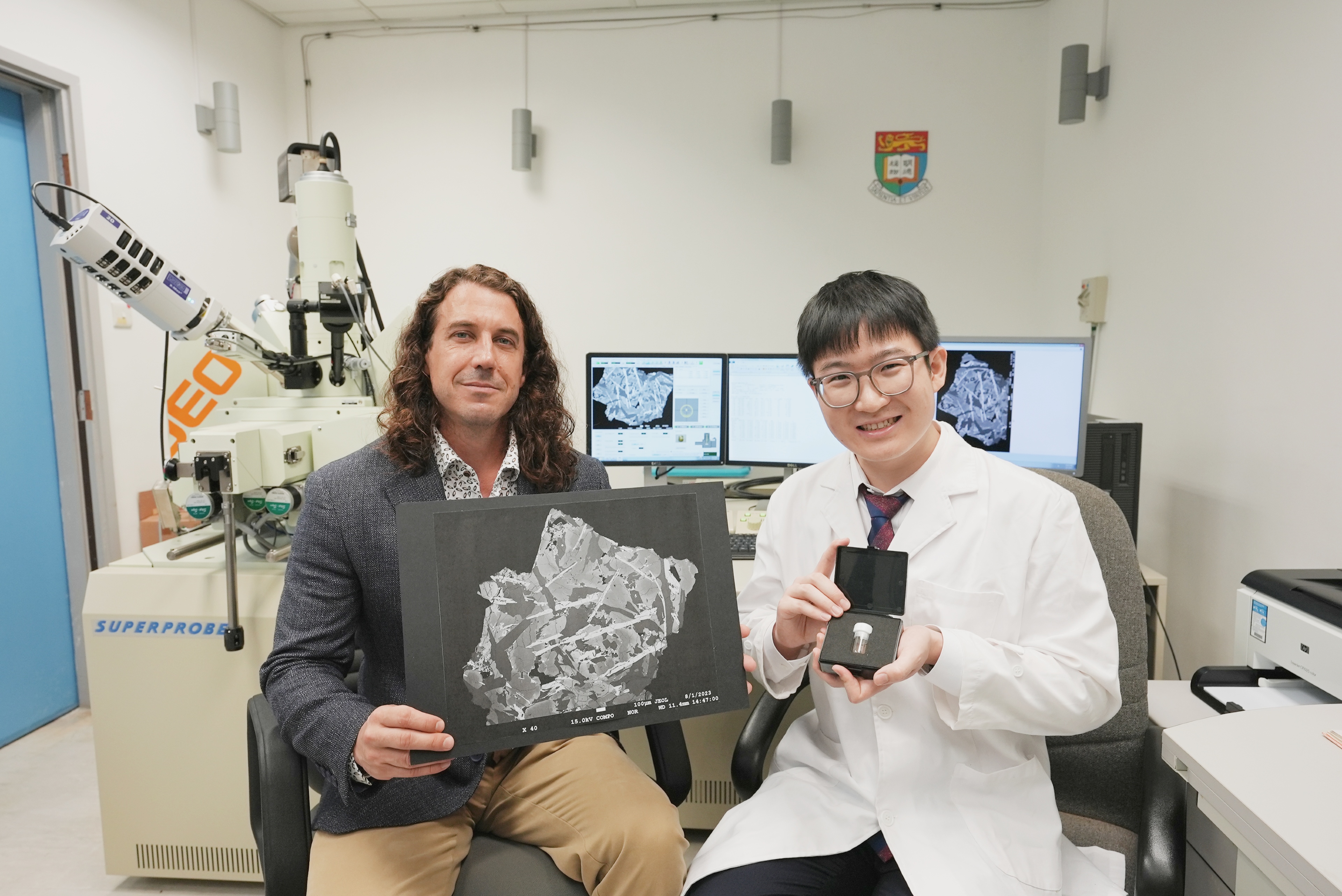
HONG KONG SAR – Media OutReach – 7 August 2023 – The geologists at The University of Hong Kong (HKU) have achieved a historic feat by obtaining lunar soil samples collected by the Chinese lunar probe Chang’e-5 in 2020. This marks the first time that a Hong Kong research team has secured such samples.

With the support of Dr Joseph MICHALSKI of HKU Department of Earth Sciences, Postdoctoral Fellow Dr Yuqi QIAN formed a team to apply for the lunar samples. The team obtained approval from the China National Space Administration's Lunar Exploration and Space Engineering Centre to study the lunar soil samples.
With the support of Dr Joseph MICHALSKI of HKU Department of Earth Sciences, Postdoctoral Fellow Dr Yuqi QIAN formed a team to apply for the lunar samples. The team obtained approval from the China National Space Administration’s Lunar Exploration and Space Engineering Centre to study the lunar soil samples.

Led by postdoctoral fellow Dr Yuqi QIAN from the Department of Earth Sciences, Faculty of Science, the team obtained approval from the China National Space Administration’s Lunar Exploration and Space Engineering Centre to study the lunar soil samples. Dr Qian personally travelled to Beijing to retrieve the samples, which weigh 822.6 milligrams in total. These lunar samples offer valuable insights into the Moon’s geological and thermal history and its connection to the formation and evolution of planetary bodies in the Solar System. The achievement by the HKU team underscores the university’s growing contributions to China’s lunar and planetary exploration efforts.

‘This is a dream come true for us and Hong Kong’s space science community,’ said Qian, who is eager to analyse the samples using state-of-the-art instruments at the university. ‘We hope to reveal the secrets of the Moon and gain insights into the early Earth, which could have important implications for our understanding of the Solar System and beyond.’

Previous Study on the Chang’e-5 Landing Site Paves the Way

Dr Qian is making waves in the field of planetary geology with his exceptional research on the Chang’e-5 landing site. Having published the first paper documenting the site and constructing a complete picture, he has been focusing on different aspects such as regolith properties, volcanic history and the provenance of lunar soils. His research work has been published in top-tier journals and widely cited, with over 400 citations, solidifying his position as an emerging expert. Recently, Dr Qian joined HKU as a postdoctoral fellow after obtaining his doctoral degree in Planetary Geology from China University of Geosciences.

Drawing on years of research on the Moon, the most exhilarating moment of his research career was an exciting discovery regarding the latest volcanic activity on the Moon’s surface – he discovered that the eastern part of the pre-selected Chang’e-5 landing region contained one of the youngest mare basalts on the Moon.

Recognising the scientific significance of this finding, he proposed that Chang’e-5 should explore this region to collect these young basalts, which were younger than any previously returned lunar basalts.

In 2020, Chang’e-5 successfully landed on the lunar surface within the Procellarum KREEP Terrane, a chemical anomaly province known for its elevated heat-producing elements and lunar volcanic deposits. Upon analysing the samples collected from this region, scientists were stunned to discover that the basalts were 2.0 billion years old – almost 1 billion years younger than any previous lunar volcanic samples collected by Apollo or Luna missions. This ground-breaking discovery confirmed Dr Qian’s prediction and has reshaped our understanding of lunar history. It has also raised the question: how did the young volcanism originate?

Dr Qian had been working tirelessly on this question, using remote sensing techniques to explore the volcanic history of the Chang’e-5 landing site. His previous research proposed that the Chang’e-5 basalts originated from the source vent of Rima Sharp, whose channel is only ~15 km from the landing site. Rima Sharp is a lunar sinuous rille whose formation required tons of lavas and was highly likely to be sampled by Chang’e-5.

Gearing up for Insights into Moon’s Volcanic History and Evolution of Planetary Bodies in the Solar System

After joining HKU, Dr Qian recognised the potential of the support and resources available at the university to make progress in understanding young lunar volcanism with samples. When Dr Qian learned about the sixth batch of lunar research samples is open for application earlier this year, he swiftly mobilised scientists in the department to join his application. ‘I knew this was an opportunity we could not miss for the further development of lunar science at HKU and with our collaborators throughout Hong Kong,’ said Dr Qian.

With the support of Dr Joseph MICHALSKI of the Department of Earth Sciences, an expert with extensive experience in planetary geology and mineralogy, Dr Qian formed a team to apply for the lunar samples. Other members of the department included Professor Guochun ZHAO, a renowned geologist specialising in tectonic processes and the evolution of the Earth’s lithosphere; Dr Weiran LI, a volcanologist specialising in magmatism, volatile cycling, and volcanic hazards; Professor Min SUN, a prominent geochemist focusing in the evolution of old continents; Professor Jian ZHANG, a structural geologist with expertise in crustal growth and tectonic evolution; and Dr Yiliang LI, an astrobiologist whose research centres in the search for life beyond Earth.

Now, armed with the returning samples and his previous research, Dr Qian and the team can link remote sensing and laboratory studies to unravel the secrets behind the lunar basalts and address the question that has puzzled scientists about the origins of young volcanism on the Moon. The team aims to use petrological-volcanological and spectroscopic techniques to reconstruct and study lunar magmas’ generation, ascent, and eruption, focusing on the evolution of volatiles in the lunar soil samples. By analysing the volatiles in the samples, the team hopes to gain insights into the history of lunar late volcanism and the distribution and evolution of volatiles in the Moon’s magma system, providing valuable information about the Moon’s geological and thermal history and its connection to the formation and evolution of the Solar System in the future.

Dr Qian’s supervisor Dr Joseph Michalski established the Planetary Spectroscopy and Mineralogy Lab at HKU, with the aim of providing laboratory support for space missions. He stated that the successful acquisition of lunar samples from the Chang’e-5 mission proved the value of the laboratory and expressed his hope for future collaborations in sample research. He said, ‘We are also proud to work with our collaborators at the Hong Kong Polytechnic University and other universities in HK to build a strong space research community, that might help with our future collaborations and explorations.’

Dr Qian expressed that he is thrilled to be part of the effort to explore the Moon, Mars, and beyond. He stated, ‘I believe that space exploration is crucial for humanity’s future. It is an exciting time to be involved in this field, and I hope our research will inspire future generations to continue exploring and expanding our knowledge of the vast space.’

In addition to studying the samples collected by Chang’e-5, Dr Qian eagerly anticipates the upcoming Chang’e-6 mission to the lunar farside. He hopes to conduct further research on lunar geology based on China’s future lunar missions, especially the crewed ones and the International Lunar Research Station, which could provide valuable insights into the formation and evolution of the Moon and lead human’s way to other worlds.

More information about Dr Yuqi Qian: https://yuqiqian.com
More information about Dr Joseph Michalski: https://www.clays.space

Learn about Dr Qian’s EPMA Analysis of Lunar Samples in this Video: http://bit.ly/HKULunarSamples2023
Image download: https://bit.ly/LunarSamples2023PC

Hashtag: #HKU

The issuer is solely responsible for the content of this announcement.