Home Blog Page 6275

Max Mara vs Laos’ Oma Ethnic Group: Fashion Chain Facing Claims of Textile Plagiarism, Design Theft

Oma People of Laos versus Max Mara in Plagiarism, Design Theft Claim

The Laotian Times looks at the plagiarism accusations lodged against fashion chain Max Mara by the Traditional Arts and Ethnology Centre. In doing so, we also welcome the chance to publish Max Mara’s response to these claims as soon as they become available.

Alleged plagiarism of traditional designs of ethnic minority groups has hit the headlines in Laos with Italian born private fashion chain being accused of pilfering the property of the Oma people, an ethnic group who reside in the mountainous north and north-east of South East Asia’s multiethnic Laos.

No mention of origin. Products promoted on Max Mara Weekend Zagreb Instagram. #MaxOma Direct link:https://www.instagram.com/p/BvqktKiHM6A/(update: Max Mara has taken down this social media post!)

Posted by Traditional Arts and Ethnology Centre on ວັນຈັນ ທີ 8 ເມສາ 2019

Weekend MaxMara Zagreb

Posted by Traditional Arts and Ethnology Centre on ວັນຈັນ ທີ 8 ເມສາ 2019

Social media shares have hit the thousands for the underdog story of the year as the diminutive cultural community of a small number of villages goes into bat against global fashion giant Max Mara after the discovery of the alleged design theft in Croatia.

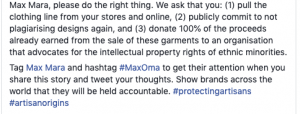
The campaign calls for Max Mara to (1) pull the clothing line from its stores and online, (2) publicly commit to not plagiarising designs again, and (3) donate 100% of the proceeds already earned from the sale of these garments to an organisation that advocates for the intellectual property rights of ethnic minorities.

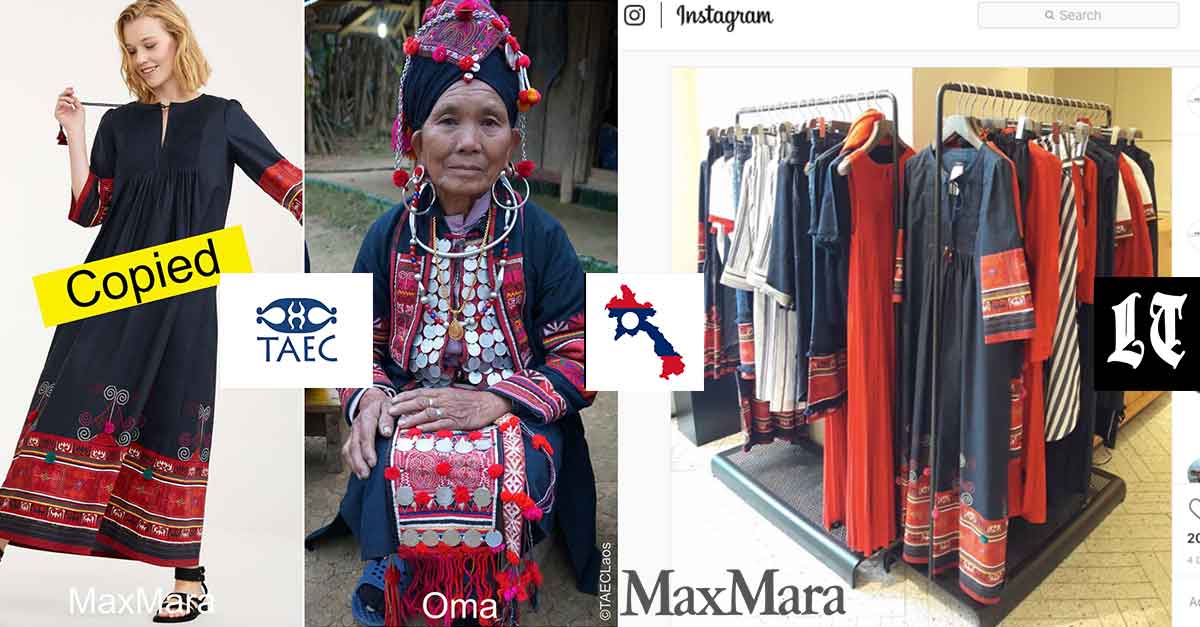
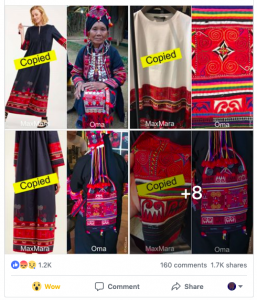
Side by side comparison. #MaxOma

Posted by Traditional Arts and Ethnology Centre on ວັນຈັນ ທີ 8 ເມສາ 2019

Multi-million dollar fashion brand Max Mara is exploiting cultural designs and heritage of the Oma, an isolated ethnic minority group in northern Laos, without any acknowledgment or compensation, Luang Prabang’s Traditional Arts & Ethnology Centre alleges.

No mention of origin of the "ethnic print" or the Oma on their website. #MaxOma

Posted by Traditional Arts and Ethnology Centre on ວັນຈັນ ທີ 8 ເມສາ 2019

“Our grandparents passed down these traditions to our parents, and our parents to us. We are the Oma people, and we preserve our culture by making and wearing our traditional clothes. We need them especially for funeral rites, out of respect to our ancestors.” – Khampheng Loma, Head of Nanam Village

Campaigning alongside Laos’ Oma people is the Traditional Arts & Ethnology Centre in UNESCO World Heritage Listed Luang Prabang.

In fact, it was the discovery of the alleged examples of appropriation by the centre’s staff in far-away Croatia that has led to the accusations against the fashion giant.Lauren Ellis, former employee of Traditional Arts and Ethnology Centre and current museums curator based in Melbourne.

Side by side comparison. #MaxOma

Posted by Traditional Arts and Ethnology Centre on ວັນຈັນ ທີ 8 ເມສາ 2019

Her reaction when she discovered the Max Mara collection in one of the brand’s stores in Zagreb, Croatia?

“I had to do a double take. It was only because I had worked in Laos that I immediately recognized the designs as Oma. They had copied the patterns exactly. I couldn’t believe that this major brand would sell such blatantly stolen designs.” 

Now, together the Oma and the TAEC are highlighting appropriation of the owners’ intellectual property following alleged Infringements by the Italian-founded fashion chain Max Mara.
Working with embroidery and applique is very challenging. Each motif is difficult and time-consuming to make. But, this is our tradition. Now, we can make products to sell to help support our families.” – Khampheng Loma, Head of Nanam Village

Side by side comparison. #MaxOma

Posted by Traditional Arts and Ethnology Centre on ວັນຈັນ ທີ 8 ເມສາ 2019

The handmade textiles of the Oma are incredibly detailed, taking a huge amount of time, skill, and patience. To see them reduced to a printed pattern on a mass-produced garment is heartbreaking.” – Tara Gujadhur, TAEC Co-Director

Side by side comparison. #MaxOma

Posted by Traditional Arts and Ethnology Centre on ວັນຈັນ ທີ 8 ເມສາ 2019

“The issue here is not the integration of Oma motifs in a more globalized world through the collection of Max Mara,” Dr. Lissoir said.

Cultures are fluid. Communities and their traditions and handicrafts are in constant change. They adapt themselves and get inspired by other cultures. Always have, always will.

However, Max Mara didn’t get inspired by Oma motifs and reinterpret them. They simply scanned a handmade piece and printed it on clothes without even mentioning the existence of Oma community.

This is not cultural appreciation. This is not creative interpretation. This is plagiarism.”


TAEC’s full statement reads:

“ITALIAN FASHION BRAND MAX MARA PLAGIARISES DESIGNS OF ETHNIC MINORITY GROUP IN LAOS”

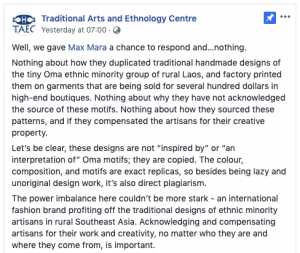
“Multi-million dollar fashion brand Max Mara is exploiting cultural designs and heritage of the Oma, an isolated ethnic minority group in northern Laos, without any acknowledgement or compensation, Luang Prabang’s Traditional Arts & Ethnology Centre alleges.

Max Mara Fashion Group, a multi-billion dollar Italian couture fashion house plagiarised traditional designs of the Oma ethnic minority group in their Spring/Summer 2019 collection.

The patterns appeared in dresses, skirts and blouses presented in the collection’s “Max Mara Weekend” resort line.

The Oma, a small ethnic community living in the hills of Phongsaly Province in northern Laos, embroider, stitch, and appliqué these colorful designs onto their traditional clothing, including head scarves, jackets, and leg wraps.

Max Mara digitally duplicated and printed the designs onto fabric, reducing painstaking, traditional motifs to factory-produced patterns.

The colours, composition, shapes, and even placement, are identical to the original Oma designs. Max Mara’s design and marketing team has not acknowledged or compensated the Oma in marketing, labeling, or display of the collection in their stores and online shop, nor have they responded to urgent enquiries on the issue.

A largely agrarian community, the Oma live in the remote mountains northern Laos, northwestern Vietnam and southern China. Their exact population and number of villages is difficult to establish, as they are often grouped as part of the larger Akha ethnic group.

However, it is estimated that in Laos there are fewer than 2,000 Oma across seven villages.

Traditional clothing is still a vital part of the identity and pride of Oma people — handspun, indigo-dyed garments with vibrant red embroidery and applique is distinctive and unique to their group.

In recent years, Oma women have begun to earn income through the sale of their distinctive crafts. In remote communities with few economic opportunities, these earnings are vital, and used towards improved nutrition, health, and education for their families.

Founded in 1951 by Italian Achille Maramotti, Max Mara Fashion Group has grown into an international fashion powerhouse with over 2,200 stores in 105 countries and an online shop.

In 2017, Max Mara Fashion Group recorded global sales of €1.558 million, across all brands.

Unlike most couture houses which are publicly traded or held by multinational corporations, Max Mara Fashion Group is privately-held and helmed by Luigi Maramotti, CEO and a member of the original founding family.

Co-Founder of the Traditional Arts and Ethnology Centre (TAEC), a social enterprise founded to celebrate and promote Laos’ ethnic cultural heritage and support rural artisans, is Tara Gujadhur.

“This is not an example of simple cultural appropriation, where designers utilize ‘ethnic-inspired’ elements, colors, materials, or styling, toeing the murky line between appreciation and appropriation,” Gujadhur said.

“This is stealing the work of artisans who do not have the tools to fight it on their own,”

TAEC’s small team based in Luang Prabang, Laos, is working to draw attention to Max Mara Fashion Group’s negligent behavior.

Upon discovering the company’s plagiarism purely by chance, they sent repeated emails and messages to Max Mara’s headquarters, with no response.

As a result, TAEC is now taking to social media to amplify their message and enlist the public’s support.

A call for action is being shared from TAEC’s Facebook and Instagram page (@taeclaos), where photo comparisons of the products can be found, as well.

“A design is intellectual property, whether it’s sketched in a notebook by an illustrator, mocked up by a graphic designer on a computer, or embroidered on indigo-dyed cotton in a remote village in Laos. If it’s generally understood that using someone’s photography or written work without acknowledgment or permission is wrong, why would a handcrafted textile design be any different?,” Gujadhur said.

“Over the past three decades, protecting the intellectual property rights of the third world and indigenous peoples has become recognized as crucial, although how this should be done is much more debatable. We are looking at ways to assist the communities we work with to tackle this issue.”

“For this behavior to go unchecked is dangerous, as it sends the message that creative work that is traditional and shared by a community and culture in the developing world does not deserve the same kind of protections given to contemporary designs by individual ‘artists’ in the West.

“Companies can harvest motifs, materials, and ideas freely from communities that lack the educational, financial, and technological resources to have their rights recognized.”

TAEC began working with the Oma in Nanam Village in 2010 when the organization was hired by a German development agency to survey their crafts and identify potential income-generating opportunities for the community.

Since then, TAEC has helped Nanam to create more market-oriented products, such as pouches, cuffs, and wine bottle sleeves, generating much-needed cash for the women artisans and their families.

The handicrafts are sold in TAEC’s museum shops in Luang Prabang, a UNESCO World Heritage site and one of Laos’ few cities that draws significant international tourism.

Currently, TAEC works with over 30 communities across Laos, with fifty percent of the proceeds from their shops flowing directly to artisans.

TAEC has spoken to Khampheng Loma, the headman of Nanam Village, and not surprisingly, he was somewhat unclear about the issue.

“The artisans we work with live in a very remote community, so their life experience is completely removed from issues of intellectual property rights.

However, we will continue to discuss it with them, as we recognize this as an important, long-term process,” according to Thongkhoun Soutthivilay, TAEC’s Co-Director, who works closely with the Oma women on handicraft production.

“Each motif has a special meaning,” Loma said.

“Our tradition of embroidery makes us who we are. In our culture, you have to know how to embroider to be able to call yourself Oma.”

TAEC’s campaign to draw attention to this issue is now live, using Facebook, Instagram, and influencers across platforms to call out Max Mara’s plagiarism.

The campaign calls for Max Mara to (1) pull the clothing line from its stores and online, (2) publicly commit to not plagiarising designs again, and (3) donate 100% of the proceeds already earned from the sale of these garments to an organisation that advocates for the intellectual property rights of ethnic minorities.

The Traditional Arts and Ethnology Centre (TAEC) is a local social enterprise founded in 2006 to promote the appreciation and transmission of Laos’ ethnic cultural heritage and livelihoods based on traditional skills.

The Centre’s primary activities are two-fold: a museum, and fair-trade handicrafts shops directly linked with artisan communities. The Centre’s work includes school outreach activities, craft workshops, lectures, research, and a non-profit foundation.

What did Max Mara do?

Max Mara used traditional designs of the Oma ethnic minority group in their Spring/Summer 2019 collection for the “Max Mara Weekend” clothing line, without acknowledgment, and likely without permission or compensation. Oma women embroider, stitch, and appliqué these designs onto their traditional clothing, including head scarves, jackets, and leg wraps. Max Mara had these designs digitally duplicated and printed onto fabric, reducing painstaking, traditional motifs to factory-produced patterns. The colors, composition, shapes, and even placement are identical to the Oma designs.

Who are the Oma?

The Oma are a small ethnic group living in mainland Southeast Asia. They speak a language belonging to the Sino-Tibetan ethnolinguistic family, like the Akha – a community more numerous and widely recognized by the general public. While Oma are often described as a sub-group of Akha ethnic group (and called “Akha Oma”), many consider themselves a distinct community. This association with the Akha makes the exact population and number of villages of the Oma difficult to pin down. However, it is estimated that there are fewer than 2,000 Oma in Laos, inhabiting seven villages in Phongsaly province. Small Oma communities may also exist in neighboring southern China, northwest Vietnam, and Myanmar.


Can copying a design be considered “plagiarism?”

Absolutely. A design is intellectual property. Whether it’s sketched in a notebook by an illustrator, mocked up by a graphic designer on a computer, or embroidered on indigo-dyed cotton in a remote village in Laos. If it is generally understood that using someone’s photography or written work without acknowledgment or permission is wrong, why would a handcrafted textile design be any different? Over the past three decades, protecting the intellectual property (IP) rights of third-world and indigenous peoples has become recognized as essential, though how it should be done is much more debatable.

TAEC Co-Director, Tara, working with the Oma artisans in 2017 to understand the time involved in creating their clothing.Photo credit: Radium Tam

Posted by Traditional Arts and Ethnology Centre on ວັນຈັນ ທີ 8 ເມສາ 2019

If the designs have no patent, how can Max Mara be held accountable?

Public opinion. Unfortunately, it is not uncommon for traditional knowledge, artwork, design, and ideas to be co-opted by multinational corporations who have the power and financial clout to either ignore IP claims or drag them out in court. However, we have seen that a public outcry, negative press, and boycotting of brands can pressure companies to admit wrongdoing and improve their practices.


What should Max Mara have done if they wanted to feature the Oma’s designs?

They had many options. They could have approached the Oma community or artisans directly, and ordered their handmade work for a fair price to incorporate into their clothing, generating income for the community. There are organizations, like Nest, that work with brands to help link them to artisan groups and social enterprises in developing countries to collaborate. These partnerships can result in wonderfully creative products that also generate great visibility and earnings for both the brand and the communities. At the very least, Max Mara should have attributed the designs to the Oma (avoiding the generic “ethnic” term) and committed a certain percentage of profit to go towards education, rural development, or advocacy work with Oma communities.

How has the Oma community reacted to this issue?

The Oma artisans TAEC works with live in a very remote community, so their life experience is completely removed from issues of intellectual property rights. However, we will continue to discuss it with them, as we recognize this as an important, long-term process.

If they don’t understand the issue, why does it matter?

Plagiarism is wrong, whether the plagiarised feel wronged or not. Letting this kind of corporate behavior go unchecked is dangerous, as it sends the message that creative work that is traditional and shared by a community and culture in the developing world does not deserve the same kind of protections given to contemporary designs by individual “artists” in the West. Companies can harvest motifs, materials, and ideas freely from communities that lack the educational, financial, and technological resources to have their rights recognized.

How did TAEC get involved?

TAEC has worked with the Oma since 2010 when we were hired to survey their crafts and identify potential income-generating opportunities for their artisans. Most recently, we have worked with them on documenting their traditional music and new year’s celebrations. Nanam Village is an approximately 9-hour drive from Luang Prabang, part of it unpaved, and is by far the most remote village (of 30 across Laos) that TAEC works with.

On Tuesday, 2 April 2019, a friend and former colleague was in Zagreb, Croatia, and saw the designs through a Max Mara shop window. She immediately shared pictures with us. Amazed, we initially thought it might be actual handcrafted work from the Oma that was incorporated into the clothing. Upon further examination, it became clear that not only were the Oma not credited in the name of the garment, on tags, or online, but the motifs were simply digitally reproduced and mass-printed. TAEC immediately reached out to Max Mara’s headquarters through various e-mail addresses and social media channels. After a week with no response, TAEC feels it’s important to make this issue public.

What should Max Mara do now to right this?

Max Mara should: (1) pull the clothing line from its stores and online, (2) publicly commit to not plagiarising designs again, and (3) donate 100% of the proceeds already earned from the sale of these garments to an organization that advocates for the intellectual property rights of ethnic minorities.”

 

Traditional Arts and Ethnology Centre, Luang Prabang, Laos


Tokyo 2020’s Road: Para-Swimmers Dive In As All Laos Meet Proves Milestone En Route Toward National Teams, Paralympic Dreams

Laos First National Para-Swimming Championships 2019

With just some 500 days or so to go to the Tokyo 2020 Paralympic Games, inclement weather did not stop swimmers including prospective Lao Paralympic Athletes heating up the lanes at the first national competition for para-swimmers in Laos’ capital Vientiane as 25 swimmers from 12 Laos provinces took part.

Posted by アジアの障害者活動を支援する会(ADDP) on ວັນອາທິດ ທີ 7 ເມສາ 2019

.

Posted by アジアの障害者活動を支援する会(ADDP) on ວັນອາທິດ ທີ 7 ເມສາ 2019

Posted by アジアの障害者活動を支援する会(ADDP) on ວັນອາທິດ ທີ 7 ເມສາ 2019


Posted by アジアの障害者活動を支援する会(ADDP) on ວັນອາທິດ ທີ 7 ເມສາ 2019

The tournament was made up of people from various backgrounds.,

Posted by アジアの障害者活動を支援する会(ADDP) on ວັນອາທິດ ທີ 7 ເມສາ 2019

 
Competitors ranged from swimmers with wide-raging representative experience to those who have practiced in rivers because there is no pool in their district.
 Popular singer and an official supporter of JICA Laos -ອົງການຮ່ວມມືສາກົນຢີ່ປຸ່ນ-  Tar Apacts lent excitement to the gathering. His track “Love is all Around” is a motivational tune that encourages hope and participation for all folk.
 In the wake of the tournament, swimmers are practicing continuously towards future competitions along the Road to Tokyo 2020 Paralympic Games and beyond.

Posted by アジアの障害者活動を支援する会(ADDP) on ວັນອາທິດ ທີ 7 ເມສາ 2019

 Similarly, the hope is that the quality of Laos Para-swimming is further developed.

Posted by アジアの障害者活動を支援する会(ADDP) on ວັນອາທິດ ທີ 7 ເມສາ 2019

Asian Development with the Disabled Persons – ADDP is aiming to continue to support the potential and capacity development of Laos’ para-athletes, coaches and officials.

Posted by アジアの障害者活動を支援する会(ADDP) on ວັນອາທິດ ທີ 7 ເມສາ 2019


Posted by アジアの障害者活動を支援する会(ADDP) on ວັນອາທິດ ທີ 7 ເມສາ 2019

The Laotian Times is proud to support these efforts.

Laos First National Para-Swimming Championships 2019

Future Electric: EV Destiny Driving Rapidly Towards Laos

Electric Vehicles (EV) closer in Laos with Agreement Between EDl & EVLao

Promising prospects for electric vehicles (EV) in Laos as an agreement signed between power producer ລັດວິສາຫະກິດໄຟຟ້າລາວ EDL and electric-powered vehicle proponents EVLao, The Laotian Times reports.

Looking to industry leaders at manufacturing hotpots like Japan, Germany & China, it would appear the early arrival of the electric age when it comes to motor vehicle transport is already well and truly upon us.

In Laos, a milestone was marked with the holding of the nation’s first electric vehicle summit and MoU signing last week in the capital Vientiane at the very first Lao National Electric Vehicle Summit.

. The agreement will see the trial of vehicle charging stations and technology to push progress towards a future where electric vehicles are more free to traverse the highways and byways of Laos and beyond.

ພາບບັນຍາກາດງານ LAO National Electric Vehicle Summit 2019

Posted by EVLao on ວັນພະຫັດ ທີ 4 ເມສາ 2019


“The future is already here – it’s just not evenly distributed.” – William Gibson

At a time when technology is progressing faster than ever, these words attributed to futurist and science-fiction writer William Gibson are revealing.

It doesn’t take a genius to guess that in the future, roads in Laos are expected to see many more electric cars than we can see today.

A net electricity exporter and fuel oil importer, one can see the attraction of electric vehicles even before the other benefits are taken into account.

Yet with a transformation this big, there is plenty to consider.

Preparing the socio-economy for the changing needs of the modern era as they quickly transforming with the availability of cleaner energy technologies involves resolutions to complicated challenges.

Given that successful deployment of electric vehicles in Laos requires public and private partnerships, It is important to look at technical mechanisms for using electric vehicles in Laos as well as tax policies and the expected infrastructure investment profiles.

Posted by EVLao on ວັນອາທິດ ທີ 31 ມີນາ 2019

EV Lao and EDL agree to trial electric vehicles

An aim is to study the feasibility of using the electricity system to provide energy-powered vehicles in the Lao PDR.

On the morning of April 2, 2019, at Landmark Hotel in Vientiane, a memorandum of understanding (MOU) was held jointly with EV Lao Co., Ltd. between the Lao Electric Power Enterprise EDL and EV Lao Company Limited.

How long until the entire world (& Laos!) has electric cars?

It’s a billion dollar question.

What we do know is that the vehicle fleet in Laos, as in other countries, must become less carbon intensive if we are to avoid the worst effects of catastrophic climate change.

While not exactly at the leading edge of uptake, prospects for electric vehicles in Laos are positive from the current low base.

The movements in the global environment and technical landscape are favoring the development of low carbon transportation in ways never seen before.

Laos will be affected by developments worldwide and in major manufacturing hubs.

The nation’s capacity to benefit will depend on both regulators, public and private sectors to grab a hold of the wheel and steer Laos to a cleaner motoring future.


Electric Vehicles (EV) closer in Laos with Agreement Between EDl & EVLao

Laos Criminalizes Animal Abuse in Updated Penal Code

Laos ​Penal Code Criminalizes Animal Abuse

Laos has added a new section to its penal code that criminalizes animal abuse.

This section appears in the latest version of the country’s penal code, which was promulgated by the Lao Government on November 18, 2018.

Article 353 of the updated penal code states that individuals who abuse or mistreat animals, including acts such as ​incarceration without food or water, use of animals for labor without adequate rest, severe beatings, transportation in substandard conditions, cruel slaughter of animals, or the use of poison against animals, will face imprisonment or fines of between 500,000 kip to 3,000,000 kip.

Repeat offenders will face imprisonment from three months to one year, and be fined up to 10,000,000 kip.

The new addition to the penal code demonstrates a shift in attitudes toward animals, and will assist in ensuring the protection of animals against abuse.

While animal abuse is commonplace in some sectors of society, the inclusion of animal protection in the penal code will give law enforcement officers the authority to punish those who abuse animals, or those who overwork animals used for labor.

If adequately enforced, the new law could affect popular cultural pastimes such as cock fighting, or the abuse of animals for tourism purposes. Meanwhile, the law may be used as further ammunition against the trade in dog meat or that of wild animals. 

According to an official at the People’s Supreme Court contacted by the Laotian Times, any act of animal abuse may be reported directly to the Criminal Investigation Division of the relevant district.


Photo: Captured Abroad

Flying In: Singapore’s Scoot Swoops Into Laos’ Vientiane, World Heritage Listed Luang Prabang

Flying from Singapore to Laos and beyond just got easier after Scoot launched its inaugural flights from the city-state to the jewel of the Mekong.

The inaugural journey marks the start of a three-times-weekly service from Singapore to Luang Prabang and Vientiane.

The flight was reported in local media including The Laotian Times sister publication ລາວໂພສຕ໌ Laopost.

The addition of the two destinations in Laos brings to a total of 67 in Scoot’s network across 19 countries and territories.

It is also the only airline offering direct Singapore-Laos services after routes were transferred from sister airline SilkAir, the regional wing of Singapore Airlines.

The routes will be operated with Scoot’s A320 aircraft.

To celebrate Scoot’s maiden flight to Laos, traditional Lao music was played over the sound system in the aircraft.

Passengers onboard were tested on their knowledge of Laos and Scoot in a fun quiz.

Five lucky passengers walked away with prizes including Scoot travel voucher valued at SGD100, a Scoot travel organizer, a Laos travel guide, Scoot-in-Style lounge access and for the kids, a Scoot Nano Brick Aircraft and Control Tower Playset.

The flights operate on a circular routing departing from Singapore for Luang Prabang, followed by Vientiane, before heading back to Singapore.

Chief Commercial Officer of Scoot Mr Vinod Kannan welcomed guests celebrating the inaugural flight.

“Laos is a hidden gem that is yet to be discovered by many and is the ideal destination for people looking to escape from the concrete jungle,” he said.

“With Vientiane and Luang Prabang joining our network, our customers now have more travel choices, and travelers from Laos can also explore more destinations around the world via Singapore.”

Upon landing at Luang Prabang Airport and Wattay International Airport in Vientiane, the A320 aircraft named Yellow Tail, was greeted with a traditional water cannon salute.

Doing, Doing, Done: Can-Do Cycle Team Dai Rides On Against Odds For HOPE Children’s Charity

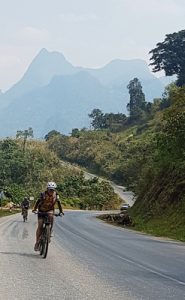
Cyclist Charity Team Dai on a Mountaintop!

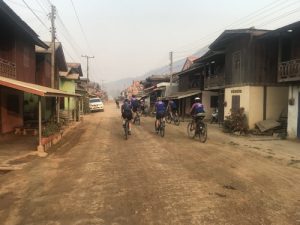
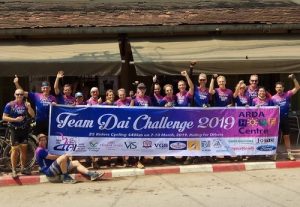
Laos-based international cyclist charity Team Dai including keen cyclist Ms Thu Ng from Vietnam tackle multiple challenges, raise confidence levels and much-needed funds, seeking to surpass the USD15,000 donation mark for disadvantaged children’s Hope Centre. 

Thinking of cycling, in some parts of the world, and lycra-clad road warriors and their aspirants will come to mind.

In others, perhaps a leisurely cruise down a local bike path or in a park, perhaps by a lake or riverside.

Elsewhere, this is not quite the case. In the case of developing countries like Laos, cycling is often seen as hot, old fashioned, disadvantageous and even highly dangerous.

Road safety is also a malleable concept. Drink driving too often prevails, peaking during festive seasons.

You could say being a cyclist in Laos is generally no “ride in the park”.

In fact, it can be an activity that best suits the determined.

The fairly flat Vientiane plain notwithstanding, Laos is certainly a majority mountainous country.

The quality of roads can leave a great deal wanting. Its a fact that surfacing on many a Lao thoroughfare is often in a more rustic condition than you see at the neighbors. Add a very warm, tropical climate and variable air quality as issues that impact.


It is also a developing nation where most folks aspire to motor vehicle ownership, cycling does not convey the status it does in more developed nations.

Cycling them puts you in close contact with all the vehicles, large and small, controlled by drivers of all levels of skill, experience, and temperament.

So why would a woman cycle?

It’s a question keen rider Ms Thu Ng knows better than most.

Growing up in neighboring Vietnam before making a home with her husband from Laos, she has been living in the capital Vientiane for some years.

"This year's Team Dai Challenge was my fourth. For me, it was another great year of riding with like-minded and supportive Team Dai members." Thu Ng, cyclist
“This year’s Team Dai Challenge was my fourth. For me, it was another great year of riding with like-minded and supportive Team Dai members.” Ms Thu Ng

She comes up against reflexively scornful attitudes toward the humble bicycle and cyclists both on the streets and at home.
It’s positive health and social impacts are less understood.

Cycling can be seen as a dangerous activity and certainly not one for a woman, particularly wife or mother, to be engaged in.

Ms Thu Ng tackled her fourth Team Dai Challenge for charity raising some US$14,630 to date for the HOPE Center’s work.

She shared her thoughts on the ride from her perspective as a keen cyclist and woman.

“This year’s Team Dai Challenge was my fourth and for me, it was another great year of riding with like-minded and supportive Team Dai members.” 

“In the Asian culture in which I grew up, I normally get told that women should stay home and not risk their lives.

“This mindset makes it hard for us women to engage in what is seen as extreme sports or exercise.”

“But I am a real optimist and believe that the best part of life is having the freedom to do whatever you are passionate about.

“This is happiness and this is all about life.”

Team Dai members including Ms Thu Ng

Similarly, she was drawn to the engaging aspect of making a contribution to the society of the country she calls home.

“It has been said that giving is a simple solution towards some of the world’s most complicated problems. 

“So every year, we volunteer our time and efforts to carry out Team Dai’s mission of raising funds to help our community.

“For me personally, the ability to give support and spread love is the very best part of every Team Dai challenge.”

Team Dai Cyclist Charity Efforts Fund HOPE

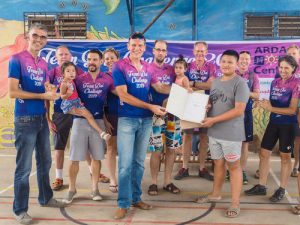
The recipient of this affection in 2019 is the HOPE Centre, a community outreach program launched by ARDA Language Centre Vientiane in 2006.

HOPE Centre helps over 200 children and youth who are at risk of abuse, exploitation, and human trafficking.

The center aims to serve the most vulnerable children and youth in the community to see them grow and develop in a healthy way and give them new hope for the future.

It does so by providing a safe environment where children begging on the streets, those living in slum communities and working could stop in during the day to bathe, receive medical care, a nutritious meal, general education and be involved in other activities including arts & crafts, music, sports and participate in special events.

Staff work alongside families living in poor communities to alleviate child labor and exploitation by helping them improve their livelihoods, parenting skills, and living conditions so that their children will have a suitable place to live and attend school.

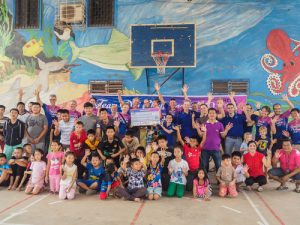
Cyclist Charity Team Dai at HOPE Center

Trauma counseling, educational therapy, and social skills development to child victims of abuse and exploitation help them address past experiences and move forward to lead productive lives.

Scholarships are also provided to help deter children from begging or being forced into other forms of child labor while providing enhanced educational opportunities.

Meanwhile, sporting activities including soccer and volleyball are used to divert children and youth from being drawn into a downward spiral including drug abuse.

Team Dai Cyclist Members in Luang Prabang
Team Dai Cyclists in Luang Prabang

Located at ARDA Language Centre in Vientiane, HOPE Centre welcomes every child, particularly the poor and vulnerable, a worthy cause Team Dai are proud to support.

Team Dai Cyclist Celebrates
Team Dai Cyclist Celebrates Calf-Building Charity Efforts

$US10Mil in Deals, Referrals As Laos’ First Real Estate Expo Results Reviewed

The first-ever Laorealestate.la Expo was a huge success, with over 3000 local and international property investors welcomed to Don Chan Palace on the 1st & 2nd of March, 2019. Over the two days, the event generated over 10 million USD in property sales and finance referrals
The first-ever Laorealestate.la Expo with over 3000 local and international property investors welcomed to Don Chan Palace on the 1st & 2nd of March, 2019. Over the two days, the event generated over 10 million USD in property sales and finance referrals.

Time flies! So do real estate investment, advertising, financing and development opportunities…

That’s clearly a philosophy what many folks ascribe to in Laos as some $US10 million in real estate-related deals and financing agreements were inked at the first Lao Real Estate Expo earlier in this month of March, according to organizers.

Lao Real Estate Expo 2019

The promise of prosperity aplenty attracted all comers in March 2019 as Laorealestate.la, and the Lao National Chamber of Commerce and Industry (LNCCI) teamed up with Laos’ leading online marketplace, www.yula.la for the expo.

RDK Group, publisher of The Laotian Times, Champa Meuanglao and Laopost and contributor Laos Briefly joined to capture the excitement.

Champa MeuangLao Magazine, sister publication of the Laotian Times under publisher RDK Group at Laorealestate.la Expo

First Ever Lao Real Estate Expo 2019 by LNCCI & laorealestate.la Laos Briefly with Champa Meuang Lao, Laotian TImes & Lao Post.

Posted by Laos Briefly on ວັນສຸກ ທີ 1 ມີນາ 2019

Savvy clients & suppliers and B2B’s were out in force, hunting for trade and investment opportunities alike.

Now, footage and imagery from the expo have gone online. Take a look and see if you can spot you and yours (and any other promising opportunities!)


ພາບບັນຍາກາດພາຍໃນງານມະຫະກຳອະສັງຫາລິມະສັບ 2019 ຄັ້ງທຳອິດໃນລາວເຮົາ ໃນ ວັນທີ 1 – 2 ມີນາ ທາງທີມງານຂໍສະແດງຄວາມຮູ້ບຸນຄຸນທີ່ໃຫ້ຄວາມສົນໃຈໃນງານເຮົາຢ່າງຫຼົ້ນຫລາມ ຈົນເຮັດໃຫ້ງານເຮົາປະສົບຜົນສຳເລັດເປັນຢ່າງຍິ່ງໃຫຍ່

Posted by Yula.la on ວັນອັງຄານ ທີ 5 ມີນາ 2019

According to organizers Yula.la & laorealestate.la;

“The first-ever Laorealestate.la Expo was a huge success, with over 3000 local and international property investors welcomed to Don Chan Palace on the 1st & 2nd of March, 2019.

“Over the two days, the event generated over 10 million USD in property sales and finance referrals.

“Powered by Yula.la, Lao’s leading online marketplace, and in partnership with the LNCCI, over 50 property developers, banks, insurers, and related businesses were on show at the first expo, along with 20+ informative real estate seminars to educate investors and industry insiders.

“Keep your eyes and ears open for the next Laorealestate.la Expo, coming soon!”

English and Chinese below:ຖືວ່າເປັນການປະສົບຜົນສຳເລັດຄັ້ງຫຍິ່ງໃຫຍ່ສຳລັບງານ Laorealestate.la Expo…

Posted by Yula.la on ວັນອັງຄານ ທີ 26 ມີນາ 2019


Travel Plans? Laos Set to Provide eVisa From June 2019

Laos EVisa Program Planned for June Implementation

Laos has announced it will begin offering electronic visas (eVisa) to foreign tourists and travelers from June this year.

Establishment of the eVisa program will commence in mid-2019, according to a Lao Ministry of Foreign Affairs notice issued earlier this month dated March 11.

Laos' eVisa plans announced in note issued via Ministry of Foreign Affairs.
Laos’ eVisa plans announced in note issued via Ministry of Foreign Affairs.

The move comes as the government takes steps to modernize and ensure visa procedures are faster and more convenient for tourist visa applicants, according to the notice.

It is also another means by which the government hopes to attract more tourism to the country.

The Ministry of Foreign Affairs consular office is working with all other ministries and departments to ensure the comprehensive and timely development of the eVisa program.

The eVisa program, it is hoped, will allow foreign visitors greater access to information and more convenience in visa processing, and will assist in making the country more widely known among tourists.

It comes as policymakers and the private sector seek to capitalize on the benefits of improved connectivity and widen the range of offerings to attract valuable tourism and travel-related income and investment.

© The Laotian Times