The rain-swollen Mekong River and its sediments are affecting capacity to meet the daily demand for water in the Lao capital Vientiane and its surrounds, the water supply authority warns.
The State Water Supply Enterprise has called on Vientiane residents to conserve water and consider storing additional supplies for later use.
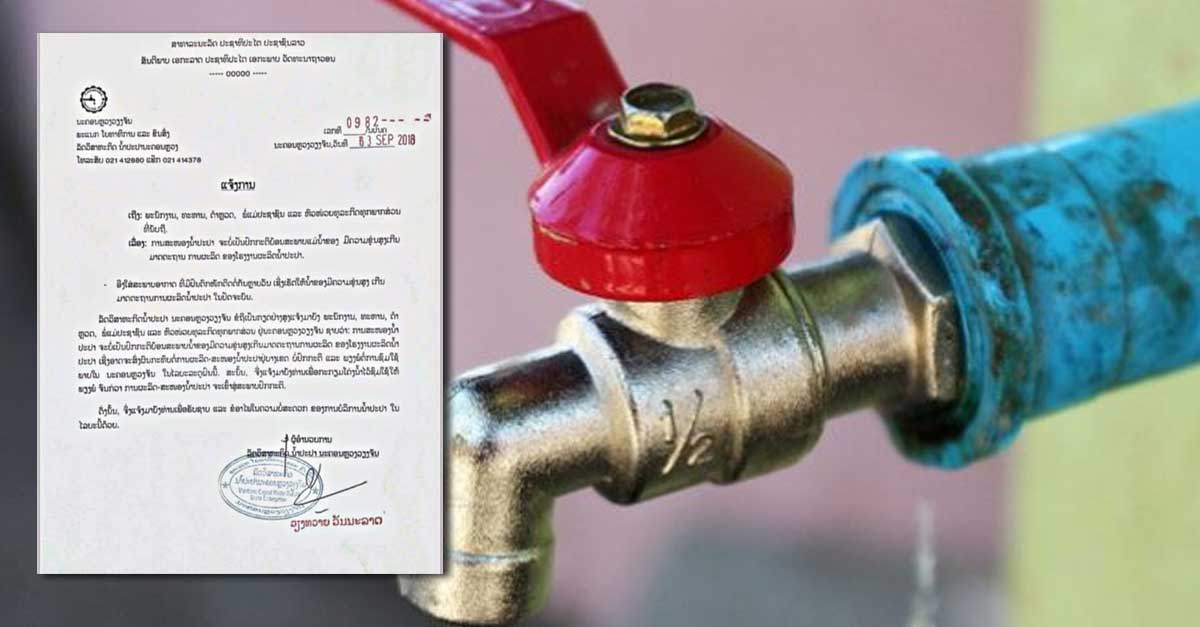
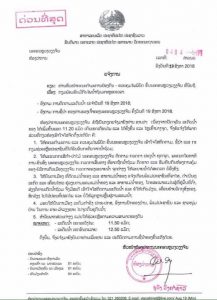
Vientiane’s water supplies are expected to be affected by the high levels of turbidity in the Mekong which exceed the production standards of water production plants, a public notice from the State Water Supply Enterprisedated Tuesday, September 6 informed.
“The Vientiane capital water supply state enterprise would like to inform employees, soldiers, police, citizens and businesspeople in Vientiane Capital that: the provision of water supply will be irregular because of high levels of turbidity, which may affect production and provision of the city’s water supply in some areas, with irregular or insufficient supply until the end of the rainy season.” the notice read.
“Therefore, citizens are urged to store water for household use until regular production can resume.”
“Therefore, this notice is to inform you and apologize for any inconvenience in the facilitation of water supply during this time.”
The warning comes as Luang Prabang continues to face challenges arising from a swollen Nam Khan River which rose to temporarily flood water supply production facilities at Phanom and at Phou Luang in Luang Prabang city last week.
“Regarding the water production facilities at Phou Pheung and Phou Xang Kham, these are still in regular service, but water supply within Luang Prabang City may face shortages in certain areas due to demand,“ a notice from the provincial Department of Public Works and Transport’s Water Supply State Enterprise (WSSE) on August 31 read.
Development of domestic capacities in the field of water supply for Laos’ Ministry and provincial departments of Public Works and Transport and WSSEs has long benefited from cooperation and expertise from Japan provided via the Japan International Cooperation Agency (JICA).
According to a JICA factsheet entitled “Safe and Sustainable Water Supply: From the water source to the tap”, the relatively turbid nature of rivers in the region provides additional challenges, and particularly as a result of extreme events.
“Many rivers in Asia are more turbid than Japanese rivers and necessitate different treatment and operation methods,” it reads.
“Reviewing the technology nurtured in Japan and developing it according to the overseas needs is an opportunity to improve the current technology.”
Improved domestic cross-border transport and logistics, coupled with widening and deepening demand for clean, green vegetables and fruit both in neighboring China and across the emerging economies of Asia presents a host of potential niche opportunities for Laos to capitalize upon, an audience in Vientiane has heard.
Laos’ geographical position, economic potential, road and rail transport development and relatively high rate of rural dwellers make the need for a more productive agricultural sector inevitable and imperative as well as desirable, the ANZ Food, Beverage and Agriculture Forum was told in the capital.
Despite updates on the risks from global economic headwinds on trade, the mood remained upbeat in Vientiane last week at the forum organised by the Lao institutional arm of the Melbourne, Australia headquartered ANZ Bank, one of Australia’s big four financial institutions.
Increased interest in the agriculture, food and beverage production sectors come at a time when Lao policy is attempting to walk a fine fiscal line, seeking increased investment into the landlocked country to make the most of opportunities afforded by improved regional transport and infrastructure links and the demand driven by consumer trends in much larger neighboring markets.
Existing strengths such as the country’s famed coffee and tea crops, and potentials such as milk production were important areas on which to focus, ANZ Agribusiness Insights head Mr Michael Whitehead told the forum.
High-quality products based on clean and green production and carefully niche targeting alongside the development of “Brand Lao / Brand Laos” were ways to thrive and prosper in a competitive global environment as consumer tastes and relative supply capacities continue to rapidly evolve across the region.
The forum saw attendance from Lao and international firms large, medium, small as were representatives of ministerial bodies, the diplomatic corps and international organizations.
Advice and experience of established firms in Laos was also aired and shared by business in the form of the Carslberg-invested Lao Brewery Company, producer of the popular Beerlao and Tigerhead Water brands as well as Lao franchisee for Pepsi Cola was joined by firms including Mekong Timber Plantations.
Hosted by Crowne Plaza Hotel Vientiane, forum attendees included Vice Minister of Industry and Commerce H.E. Phanthong Phitthoumma, Vice Minister of Finance, Mme Thipphakone Chanthavongsa, Vice President of LNCCI, Mr Daovone Phachanthavong, along with Australia’s Ambassador to the Lao PDR, Mr Jean-Bernard Carrasco.
Joining Mr Whitehead were ANZ’s Head of Food, Beverage and Agribusiness, Patrick Vizzone, and CEO ANZ Laos Rufus Pinto for the August 30 event.
Holders of diplomatic passports from the Kingdom of Norway and the Lao PDR have now been exempt from applying for entry visas to each others’ countries since the two nations signed an agreement in Singapore on the sidelines of the 51st ASEAN Foreign Ministers’ Meeting. The visa exemption has taken effect since the 1st of September.
The agreement stipulates that diplomatic passport holders from both countries that have not been posted to the territory of the other country are permitted to travel freely between the two countries for a period of no more than 90 days.
Under the agreement, a visa will not be granted to the holders of diplomatic passports, or their family members, working at embassies or consulates or international organizations located in the other country.
The Bank of Laos (BOL) has issued a notice warning the public against the use of cryptocurrencies, including Bitcoin, Ethereum, and Litecoin, which are unregulated currencies that are not tied to physical cash reserves.
The notice, dated 29 August, is addressed to traders, merchants and ordinary citizens alike, warning against the purchase and sale of cryptocurrencies. It warns of the risks of cryptocurrency, and urges Lao people to study the issue in depth prior to making any investment or purchase of such products.
According to the notice, the rate of global technological advancement is ever-increasing, including the use of Blockchain technology, which is used in electronic financial transactions and is the basis for the rise of cryptocurrency.
Some Lao businesses have already begun acceptance of payment for goods and services in cryptocurrencies, as well as advertising investment or trade in these digital monies.
The Bank of Laos states in its notice that in accordance with the Law on Payment Systems, No. 32/NA, dated 07 November 2017, cryptocurrencies are not real currencies and should not be used for payment of debt. This is because the cryptocurrencies do not meet the standards required for use as currency and are not currently regulated by any legislation in Laos.
Secondly, Lao people are urged to take precautions before making any investment or trade in cryptocurrencies because of the significant risk attached to them, such as its potential use in money laundering or the funding of terrorist activities.
Traders are also warned that the currency suffers severe price volatility, and may be offered as payment for fraudulent activities.
A source at the Bank of Laos told the Laotian Times in a telephone interview that while there is no regulation governing the use of cryptocurrencies in Laos, such currencies can not to be used as a legitimate form of payment, making them effectively illegal.
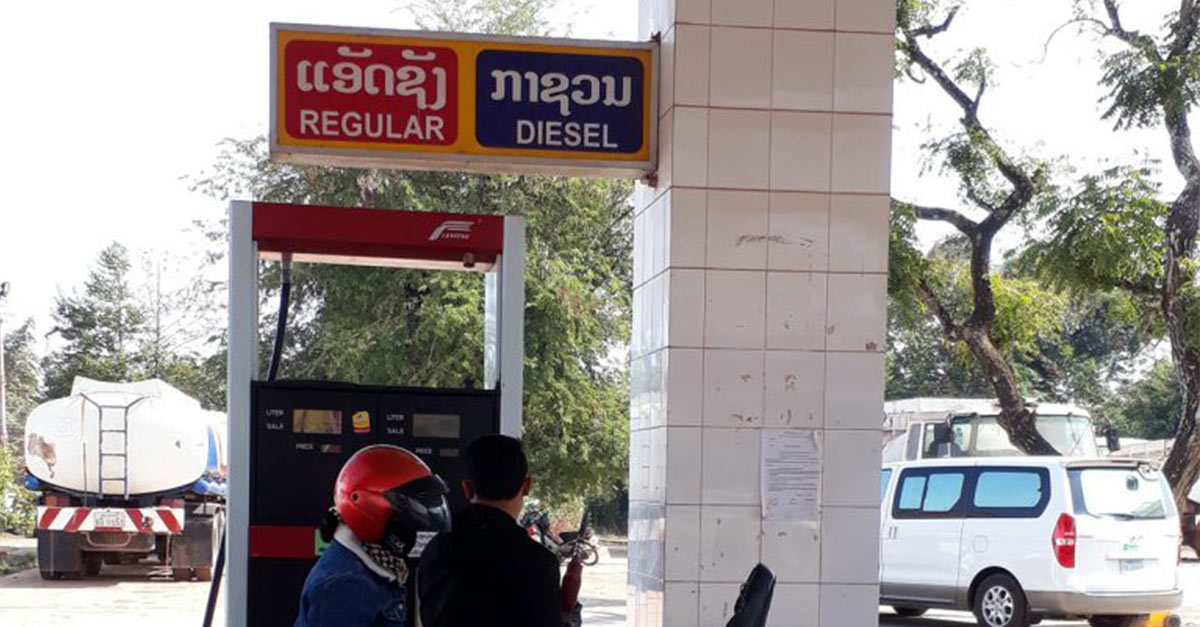
An official from the Ministry of Energy and Mines revealed that Laos placed second in the list of the most expensive ASEAN countries in which to buy fuel.
The government officer released the startling statistic (dated May 2018) during a workshop aimed at sharing information and knowledge about electric vehicles and its application in and relevance to the Lao market. The workshop was organized by the Transport Department of the Ministry of Public Works and Transport and sponsored by EVLAO and CHOSEN Energy.
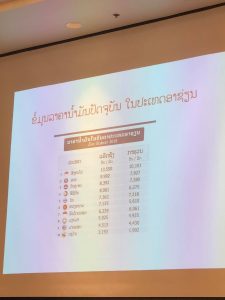
While Singapore topped the list at 13,550 kip/liter (gasoline) and 10,101 kip/liter (diesel) as the most expensive place to buy fuel, Laos came second at 9,992 kip/liter (gasoline) and 7,927 kip/liter (diesel).
Cambodia, the Philippines and Thailand placed 3rd, 4th and 5th, respectively. The cheapest place to buy fuel was oil-rich Brunei at 3,193 kip/liter (gasoline) and 1,902 kip/liter (diesel).
How do fuel prices differ in the ASEAN countries?
Transport Department Deputy Director General Boualith Pathomthong told workshop participants that the world was at present confronting the dual challenges of climate change and air pollution caused in part by the presence of an increasing number of traditional motor vehicles.
Many workshop speakers noted that many countries around the world were currently adopting policies and practices aimed at curbing the use of internal combustion engine-based vehicles, citing electric vehicles as a viable, environmentally-friendly alternative. They also noted that the use of electric vehicles could dramatically reduce Laos’ dependency on oil imports.
The biggest and most powerful smartphone is back in its latest iteration, the Samsung Galaxy Note 9, and comes with the new intelligent S Pen to really blow away the competition.
The product was officially launched in Laos by Lao Samsung Electronics on Tuesday.
The Samsung Galaxy Note 9 is possibly the highest performance Android device on the market, and includes a 4000 mAh battery with fast power charge, for long life and use.
It features a dual rear camera system including two 12-megapixel cameras, one wide angle with dual aperture and the other a 2x telephoto camera.
The phone includes 128 GB of internal memory and RAM at 6\8 GB, and features a 6.4 inch Super AMOLED Infinity Display screen size with QHD resolution and HDMI connectivity.
The latest addition to the newest in the Galaxy series is the Bluetooth-enabled S Pen, which uses a supercapacitor to operate the S Pen away from the phone for up to 30 minutes. Users can then simply slide the S Pen back into the phone body for a full charge.
The Intelligent S Pen can be used to activate functions on the phone itself, such as video or camera remote control, power point slide control, etc.
According to Managing Director of Lao Samsung Electronics, Mr. Seungho Choi, Samsung not only leads the smartphone market, but continually focuses on developing new functions for the convenience of users.
The Samsung Galaxy Note 9 was launched at an official ceremony in Vientiane, attended by Mr. Seungho Choi, alongside members of the business community, government officials, and invited guests.
The Samsung Galaxy Note 9 is now available at all Samsung retailers across the country.
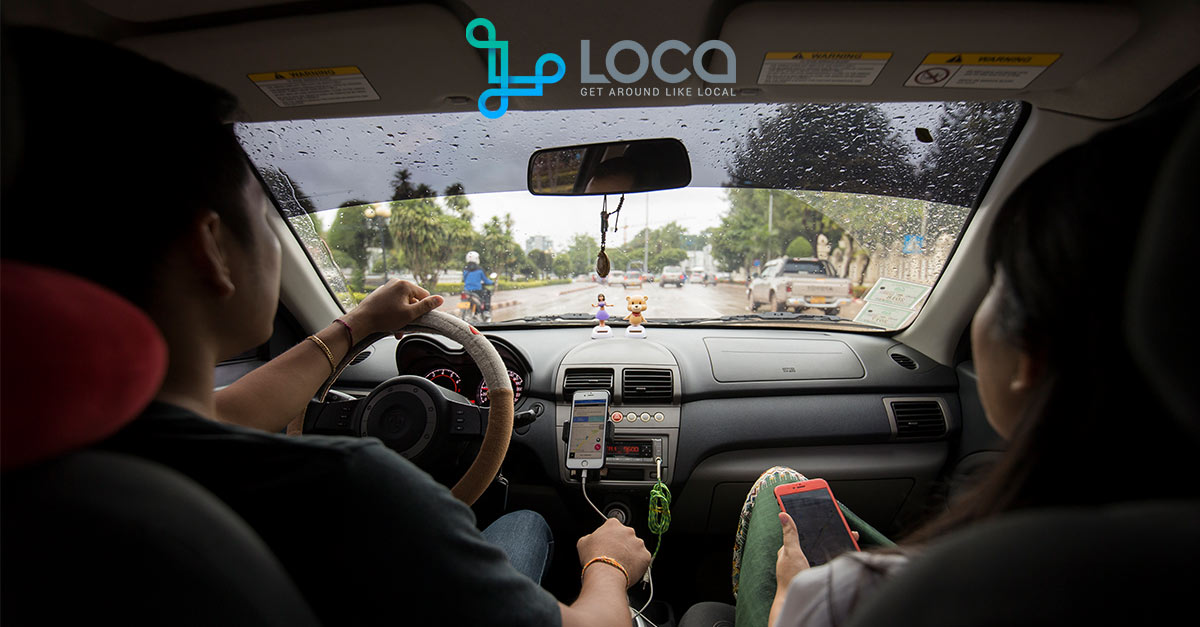
Not surprisingly, to make my way over to LOCA headquarters for this story, I downloaded and installed the LOCA app. A vehicle was sent to my office to pick me up, and I tracked its progress on my mobile phone until a small, unassuming hatchback pulled neatly up against the curb. A message appeared on my screen; “I am here.” I hopped in the front seat and was greeted with a shy smile from Pui, my designated driver for the trip.
Pui says most of her passengers are foreigners already familiar with the ride-sharing concept. They are often business travelers visiting the city for the first time, taking a LOCA trip from meeting to meeting. She is one of the few full-time LOCA drivers who work Monday to Friday.
Pui, a full-time LOCA driver, escorts a passenger (the writer) to his destination
“My family has no idea what I’m doing. They don’t understand exactly what LOCA is. But they are happy that I’m working,” she says, noting that before LOCA she was unemployed.
“I worked as a delivery driver a few years ago. I liked the freedom it gave me, so I thought I’d try this. I get to be my own boss and I meet a lot of new people.”
With over 900,000 vehicles on the road and no viable public transport system insight, traffic in Vientiane is becoming a thing – a thing mentioned in casual conversation, a thing appearing in news reports, and a thing to be battled during the daily commute. Roads are small, cars are big, and people still double park to buy a bunch of bananas. It’s no wonder, then, that local tech firm Bizgital put their heads together and came up with a solution.
Arriving at the Bizgital building, I input a special promo code and find 80,000 kip sitting in my LOCA virtual wallet. The trip cost 25,000 kip, leaving me with some extra credit. Pui waits for her next passenger, and I head up the stairs to meet Souliyo Vongdala, Chief Technology Officer at Bizgital, the man behind the LOCA ride-sharing app.
It took six months for the team to draft the driver registration procedures, and Souliyo assures me that all drivers are thoroughly screened. They are provided a training video, and their first few rides are monitored to ensure they adhere to LOCA’s internal safety regulations.
Souliyo Vongdala, CTO of local technology firm Bizgital
“We have systems in place to minimize safety risks, although we can’t be there for every trip. If a vehicle’s insurance policy expires, for example, that vehicle will be automatically suspended until a new insurance policy is taken out.”
Cash payment was out initially, says Souliyo, but it was brought back in at a later stage due to high demand. And the problem of cash management turned out to be an opportunity.
“If you complete a trip that’s worth 50,000, you can give the driver a 100,000 kip note and ask them to deposit the remainder into your LOCA virtual wallet. That way you’ll have 50,000 kip in your account to use for future trips. The system automatically manages this.”
Drivers are paid weekly, and can choose their own working hours. However, being an entirely new concept, many drivers are apprehensive at first, unsure if they will turn a profit. To combat this, LOCA is investing heavily by setting guaranteed payments for drivers in case they don’t get enough traffic.
The dearth of public transportation is one of the reasons the LOCA app was created. But Souliyo sees more opportunities for his application with corporate clients, who can now send employees around town without the use of private vehicles.
“Your company will have access to a back-end system, and you can add employees into your account. LOCA will bill you for trips at the end of the month. Not only will you know how much it cost, but also where your staff go. It’s fair for both sides.”
LOCA’s beautiful and modern user interface
When asked if he’s worried about competition from taxis, Souliyo smiles. He knows that LOCA is cheaper than many taxis, and easier to find. And it eliminates discrimination against tourists, who are often charged double by certain unscrupulous taxi drivers.
The application now has over two thousand registrants, including over fifty drivers. But surprisingly, the biggest request from local people so far has been an extension of the app to include motorbike taxis. And LOCA is working with insurance agencies to make this happen.
“Even me, I want to take a motorbike taxi because it will be cheaper and faster during peak hour,” says Souliyo.
LOCA trips can be paid for with Visa or MasterCard, as well as cash, and the developers are working with local finance institutions to bring QR code payments online. So the future looks bright for LOCA, who plan to expand to every major city in Laos within the next few years.
When asked about the name of the app, Souliyo gives another knowing smile, and says that all the proposed names were thoroughly researched.
Bizgital team behind the LOCA app
LOCA is making a fantastic offer to the public: simply download the app and get your first ride for 80,000 Kip by entering the promo code “GETLOCAL80“. This promotion is available to new users only. Use this code with the wallet payment method when requesting your first ride.
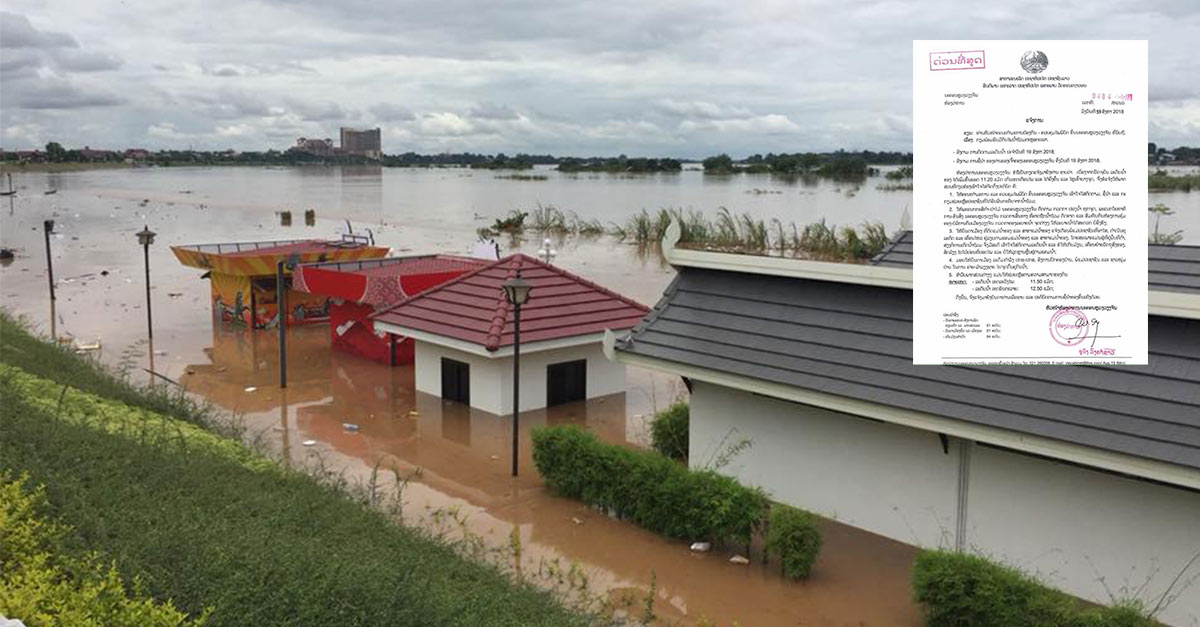
Nakarath City in Chao Anouvong Park Partially Submerged Under Water
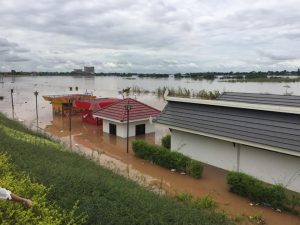
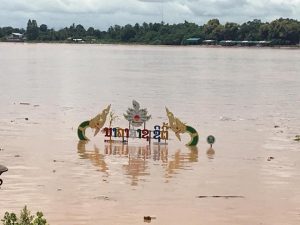
Aug 19 – Vientiane Capital authorities are on high alert as they prepare to protect against flooding in some areas of the capital city, after water levels were reported to have risen to 11.2 meters. 11.5 meters is the alarming level while 12.5 meters is considered dangerous.
The Vientiane Capital Authority has requested that the following public bodies of Vientiane Capital take the necessary precautions:
Commission on the Prevention and Control of Natural Disasters to monitor, instruct and prepare to provide assistance to the local population
Department of Agriculture and Forestry to monitor and inspect all water gateways
Department of Public Works and Transport to inspect all roads that may be impacted by flood water
Office of Urban Planning and Administration to check all sewage system points to ensure efficient drainage of flood water
Authorities of all districts near the Mekong River and its tributaries to warn its denizens, especially the ones in low grounds, to move all personal belongings to safe, high grounds; children to avoid playing near riverbanks
Law enforcement (military, police and village militias) officials as well as individuals are urged to create sandbags and use them to protect against flooding
Other parties to assist in whatever way they can
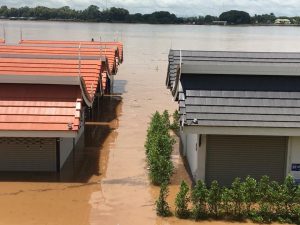
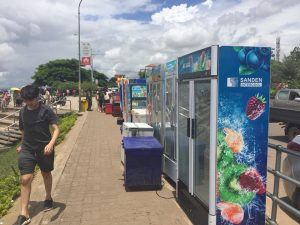
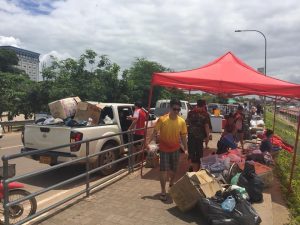
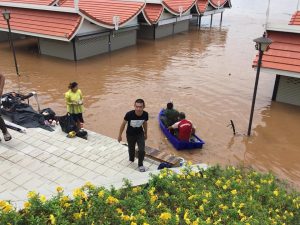
Images taken from Mahason Magazine show the alarming rise in the water levels of the Mekong River in the capital. Shop owners of the new market stalls in Nakarath City on the Chao Anouvong Park riverbank can be seen moving their belongings to high ground. The shops have been almost completely submerged under water. No casualties have yet been reported.