An economic update released last month by the National Economic Research Institute (NERI), a government body led by former Prime Minister Bouasone Bouphavanh, stated that the mining sector’s contribution to the country’s economy will continue to drop over the coming years as a lower output is predicted for this natural resource-based sector.
NERI did not identify the factors contributing to the lower productivity of the mining sector. However, it is widely recognized that the mining sector, particularly two major mining operations, has seen a fall in the production of raw materials. One of these is the Sepon mine, the operations of which are expected to close in 2020 due to the exhaustion of resources.
Despite the mining sector’s lower contribution to the economy, economists at the institute remained confident that Laos’ overall economic growth rate would fall between 6.5% and 7% in 2018, already a comparatively high rate in Southeast Asia.
According to NERI’s report, another major driving force for the economy is electricity generation. A number of hydropower facilities have launched commercial operations, including the Hongsa Lignite power plant, Nam Ou 2 and 5 hydropower plants, Xekaman 1 and Nam Mang 1 hydropower plants.
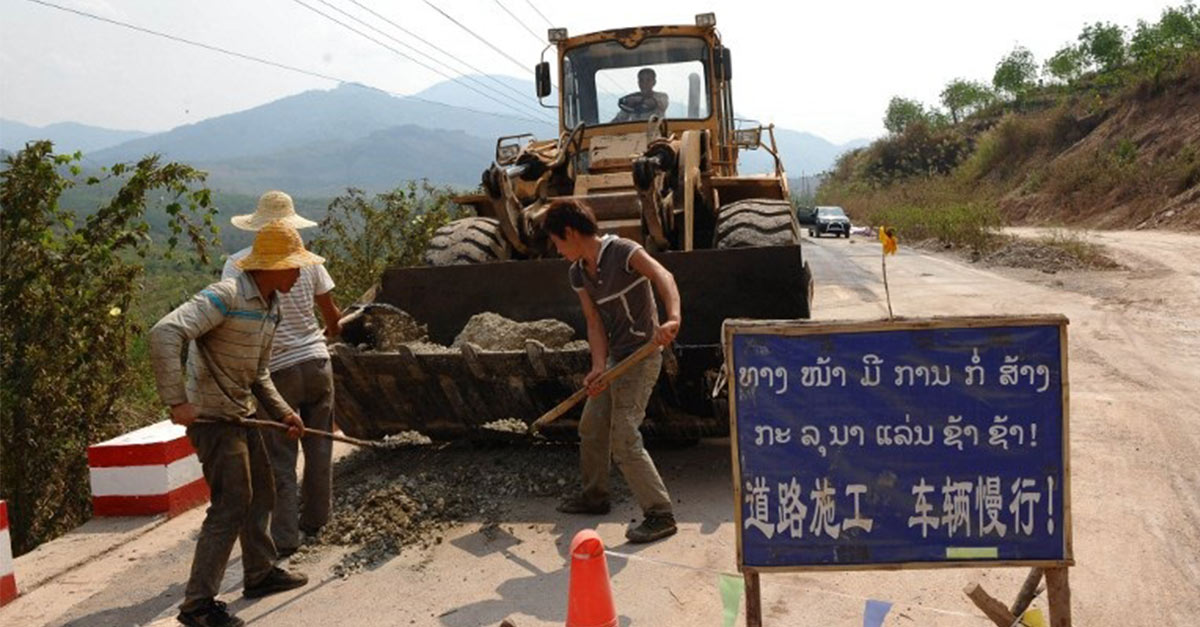
Apart from hydropower, the construction industry will play an essential role in reinforcing strong economic growth, according to the economists. They cited the construction of the Laos-China Railway as a key driver of this sector’s development. Additionally, the services sector, particularly retail sales, will make a significant contribution to the economy.
International banks such as the World Bank and Asian Development Bank recently released their own economic forecasts, and their findings were consistent with those of the National Economic Research Institute.
These international development partners have repeatedly advised the Lao government to diversify its economic base and to cease its dependence on natural resources – a perspective that is viewed as unsustainable. They also want the government to pay greater attention to the development of agriculture, in which a majority of the population is employed. They said the emergence of this sector as a key economic driver will lift a larger number of people from poverty.
The government has taken note of the current situation and has embarked on a mission, spearheaded by the current Prime Minister, to improve the business climate to attract more investment in non-resource sectors. However, observers said this mission is very challenging and will take time.
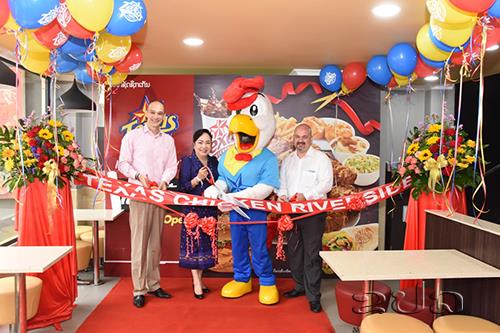
Texas Chicken, the American fried chicken chain, has officially opened its second branch in Vientiane Capital, marking the expansion of the brand in Laos.
The branch opened on 2 May on Francois Ngin Road, in a location popular with tourists and local people along the Mekong River.
Texas Chicken says it hopes to expand to seven branches within Laos in future, creating employment and offering job opportunities and professional training for unskilled Lao people.
The opening event was attended by Mr. Mickael Frangin, General Manager of Express Food Group Laos,
representatives of Express Food Group, shareholder Mrs Chanthachone Vongxay, and members of the press.
Texas Chicken is an American chain of restaurants specializing in fried chicken, which trades inside the United States as “Church’s Chicken.” The chain was founded as Church’s Fried Chicken To Go by George W. Church Sr. in 1952, in San Antonio, Texas.
The company now has over 1,700 locations in 25 countries, and is the third largest fried chicken chain in the world.
The first Texas Chicken restaurant to open in Laos was the That Luang branch, which was opened in 2016 by Express Food Group, a subsidiary of RMA Group, which also operates pizza and ice-cream restaurants throughout Southeast Asia.
The Texas Chicken restaurants in Laos have a core menu of classic Texas Chicken favorites, including hand-battered, freshly prepared original and spicy flavored spicy fried chicken, with honey-butter biscuits.
The second Vientiane branch of the fried chicken chain is located here.
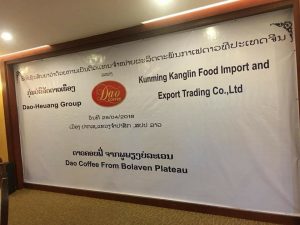
The Dao Heuang Group, one of the biggest producers of coffee in Laos, is expanding its overseas sales network to China, where coffee consumption has been increasing by 15-20% per year.
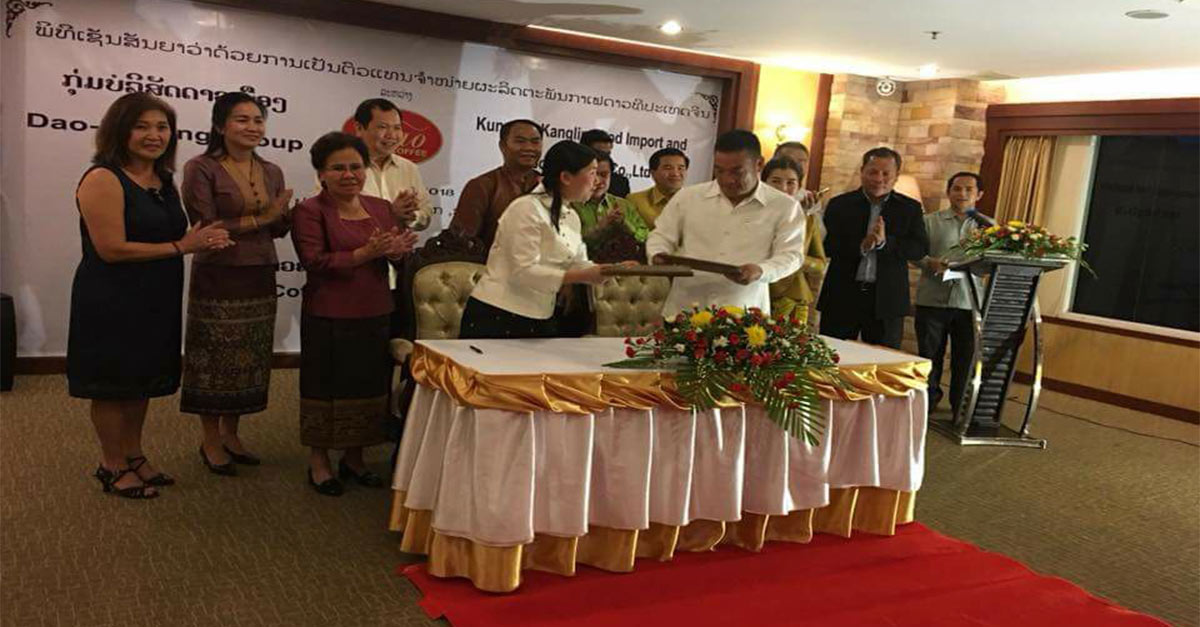
Dao Heuang and Kunming Kanglin Food Import and Export Trading Company reached an agreement on buying-selling and dealership authorization of Dao coffee products in China.
The contract was signed by Vice President of the Dao Heuang Group, Boonheuang Carol Litdang, and a representative of the Kunming Kanglin Food Import and Export Trading Company, Khamseng Xayapheng, on April 28 in Champasak.
The agreement will enter into effect for three years until 2021.
General Manager of Kunming Kanglin Food Import and Export Trading Company, Li Lin He, said that the export of Dao coffee to China made sense because the latter is a huge country with a huge population and rapid and strong economic growth. These conditions provided the commercial rationale for the expansion of Dao products to consumers in China.
He added that his company recognized that Dao coffee was sourced from the Bolaven Plateau in the south of Laos. The plateau has a special climate and geography that provides a high quality yield and the coffee crop is processed by Dao’s own coffee plant. It is a big processing industry that uses modern technology of high standards.
Recently, there are some in China, where the tradition for many years has been to drink tea, have changed their drinking culture and are now consuming more coffee.
While considerable local and international attention have been focused on the arrival of Chinese tourists to Laos, another tourist group, Koreans, are bringing much needed foreign currency into the country.
In recent years, Laos has experienced a tremendous rise in the number of Korean tourists making them the fourth largest group of foreign tourists coming to Laos (behind Thai, Vietnamese and Chinese). It has been observed that travelers from Korea prefer primarily to take holidays in the central and northern parts of Laos, electing to spend most of their time in the capital city of Vientiane, Vang Vieng, and Luang Prabang.
Since the broadcast of a reality TV show shot in Vang Vieng in 2014, Koreans of all ages have descended on the town every year. It is no wonder that hotels like Riverside Boutique Resort would look for Korean-speaking interns. A few years back, Koreans made up 42% of his guests.
However, the majority of Koreans hardly visit the southern part of Laos, which also boasts a large number of scenic and cultural charms.
Korean Ambassador to Laos, Shin Sung Soon has mentioned the need for more advertising to be done to promote the attractions of the southern provinces of Champasak and Attapeu, so that Koreans would know more about these areas and want to visit them. He also said that if southern attractions were more developed and advertised, they could become an attractive option for Koreans enticing more and more of the latter to come.
“The cooperation between Laos and the Republic of Korea on tourism is very impressive as last year witnessed more than 170,000 Koreans visiting Laos and more than 10,000 Lao people visiting Korea,” said the ambassador.
Thanks to the Lao government’s visa-free entry policy for Koreans for stays of up to 15 days, it is now substantially easier for Koreans to view Laos as viable holiday destination.
Apart from the favorable state initiative, there are currently five daily direct flights between Laos and Korea. This has also spurred an increase in the number of visitors. Five direct flights a day is considerable compared to the two daily flights between Korea and Vietnam and even more astounding when compared to the six flights a day between Korea and Thailand, which is a regional hub for air travel.
With Korea’s Incheon International Airport being a regional transit hub, Ambassador Shin said direct flights to this airport help connect Laos with many parts of the world, further boosting foreign tourist arrivals.
To encourage more Koreans to stay longer in Laos, the ambassador said the visa-free stay should be extended, pointing out that 15 days was insufficient for backpackers.
“The 15-day visa exemption is adequate for people coming to Laos as part of a tour group, but it’s not long enough for independent travellers,” Ambassador Shin said, adding that backpackers were likely to need more time to explore Laos.
He added that he would ask the government to consider extending the visa exemption period from 15 to 30 days.
The government has set a goal of attracting 5.2 million international visitors, with the revenue target figure set at approximately US$910 million. But there are major challenges to meeting the targets, the institute said in its latest outlook.
The main obstacles include limited promotional advertising, high cost of general services and living costs, and lack of tourism products. Poor basic infrastructure, especially road access to tourist sites, is another drawback.
Laos has experienced a dip in foreign tourist arrivals in recent years even as other countries in the region such as Thailand, Vietnam and Cambodia are experiencing substantial growth, according to the outlook, which underlined the need for Laos to work hard to tackle the challenges.
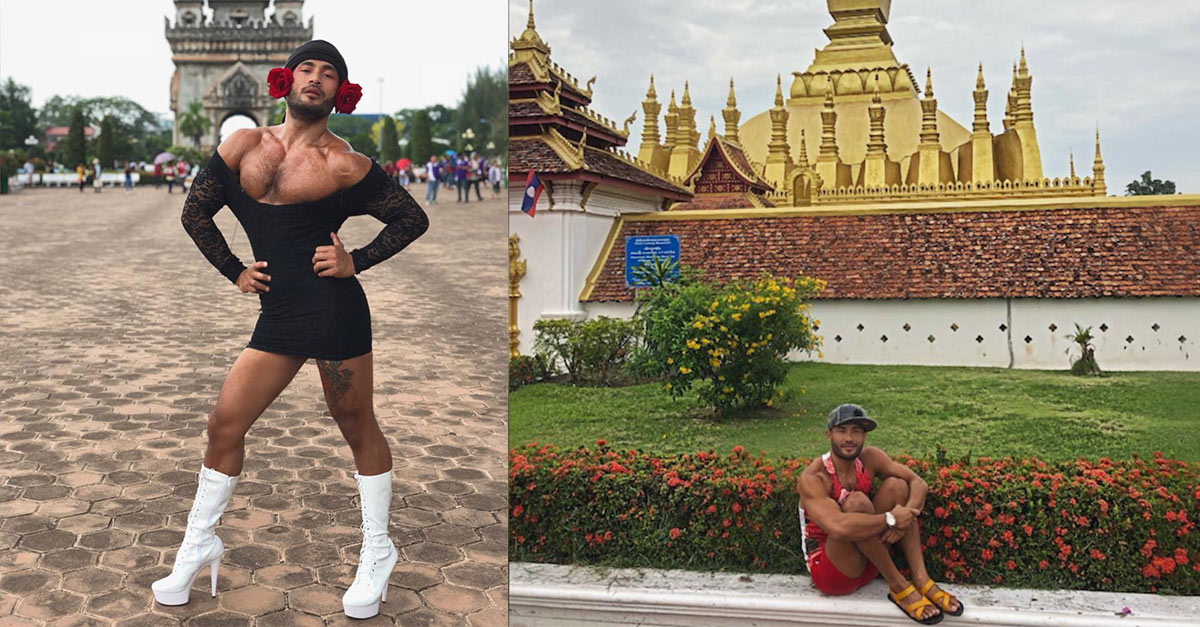
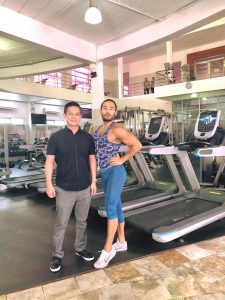
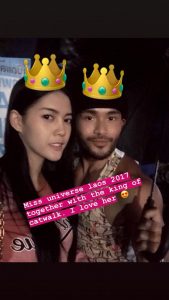
Social media celebrity Sinon Loresca has recently arrived in Vientiane and has stirred up a lot of commotion in its sleepy capital with his infamously provocative catwalk, sensationalized by his popular Instagram account which has over 440,000 followers and his Facebook Page with over a million LIKES.
Dubbed the “King of the Catwalk,” Loresca has a tremendously chiseled body and the perfect tan to accompany it. He has been hailed as one of the most talented gay men to strut in high heels in the most mundane of places including airports, beaches, sidewalks and most recently at Patouxay Monument.
By some estimates, the “Patouxay Catwalk” video, in which Loresca is seen walking his dog in high heels in front of the Patouxay Monument in Vientiane Capital, has been viewed more times in one day than the official Laos Simply Beautiful video has in several weeks.
Apart from Patouxay, Loresca visited a number of Vientiane’s famous destinations including That Luang.
While it is safe to say that the King of the Catwalk’s visit to Laos was neither staged nor officially sanctioned by the Visit Laos Year Campaign 2018, the amount of publicity generated by his social media posts and videos on Facebook and Instagram has most certainly brought much needed tourist attention to Laos.
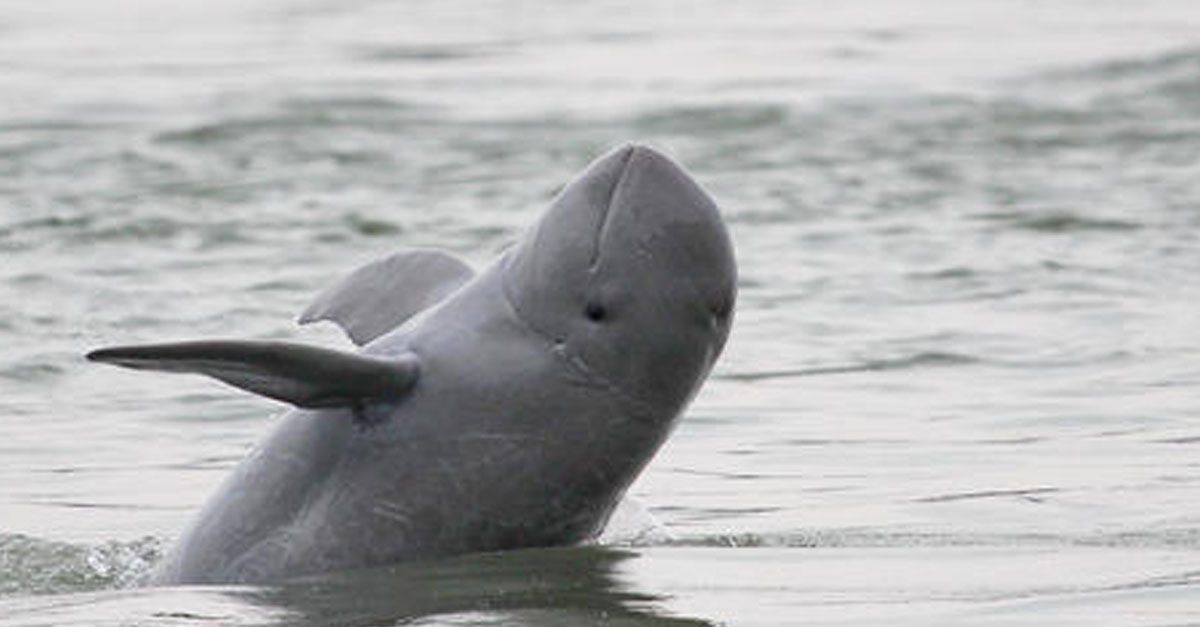
The population of Irrawaddy dolphins in the Mekong River has increased for the first time in twenty years, according to a recent WWF report.
The Irrawaddy dolphin, found only in Southeast Asia, is considered critically endangered. They are found in the Mekong River, the Irrawaddy River in Myanmar, and the Mahakham River of Borneo Island.
The number of Irrawaddy dolphins in the Mekong River has now increased to 90 animals, however, a 15 percent increase over an estimate of 80 made in 2015.
The survey area stretched from Kratie in Cambodia to the Khone Phapheng Falls in Champasack Province, Laos.
The WWF has stated that while the increased numbers are good news, the dolphins remain threatened by illegal fishing methods, increased boat traffic and dam projects.
However, efforts by the WWF, the governments of the countries involved, and local tourism has made a difference.
Dolphin watching and ecotourism are important businesses for communities on the river, and the WWF hopes that this can help bring the animal back from the brink of extinction.
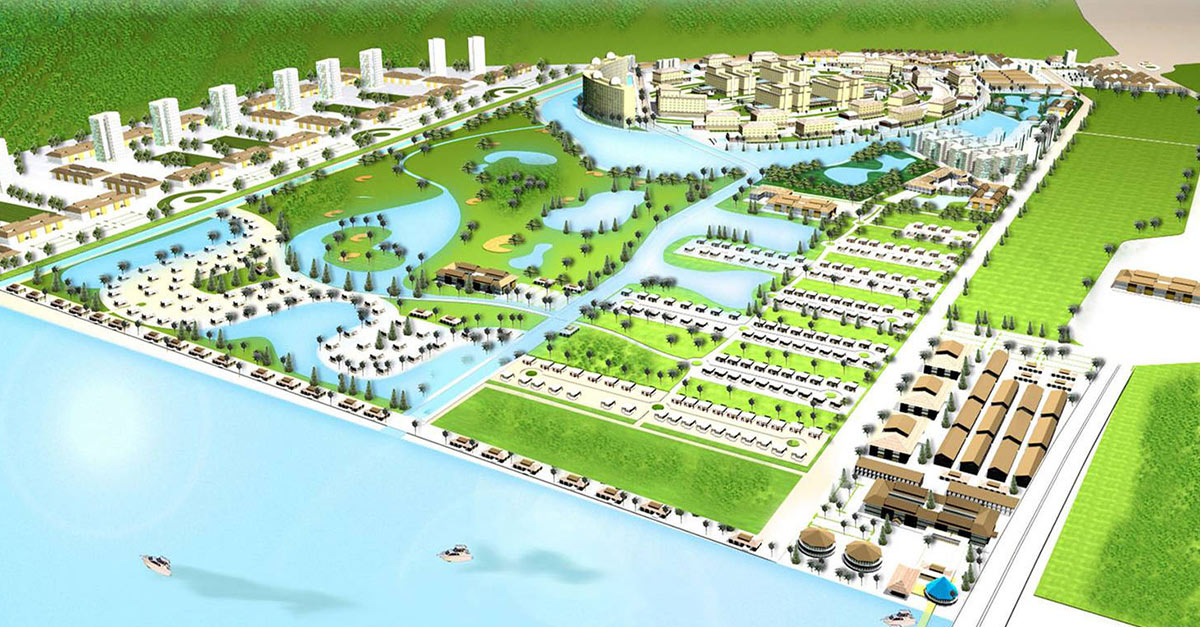
Throughout Laos’ economic expansion history, a number of initiatives have been launched to improve the investment climate in the country. One of those successful initiatives is the Special/Specific Economic Zone or SEZ.
Since the first was set up in 2002, there are now 12 active special and specific economic zones nationwide. About 377 companies from Laos and overseas have thus far invested in the zones which cover an area of 19,612 hectares with a total registered capital of US$8 billion, of which US$1.8 billion has already been spent, according to a government report.
SEZs have generated revenues of over US$20 million for the government and created 20,000 jobs of which more than 9,000 have been jobs for Lao people.
In 2017 alone, some 71 companies invested in the zones (an increase of 30 companies when compared to 2016), with a registered capital of over US$92 million. Of the total 71 companies, 58 firms were foreign and have invested in services (48%), trading (37%) and the industrial sector (15%).
The largest number of firms investing in the zones are from China (38 companies), followed by those from Laos (13 firms), Thailand (6 firms), Japan (5 firms) and Malaysia (3 firms). Over the past few years, the government has restructured the management of SEZs and improved the capacity of its human resources to better facilitate foreign investment in Laos. The government has attached great importance to the development of SEZs, aiming to attract investment from the private sector in Laos and overseas and generate more domestic jobs and boost socio-economic development.
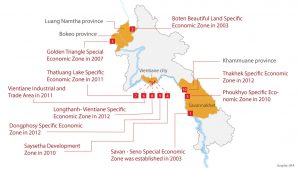
Graphic courtesy of RFA
In addition, the government is committed to attracting more quality investment to the zones in various forms, with efforts being centered on investment promotion for the SEZs.
Previously, the management authorities of SEZs also worked with Lao embassies in foreign countries, particularly in China, Japan and many countries in Europe, to help attract investment.
By investing in SEZs, investors benefit from a tax break policy which will contribute to lowering their production costs for export.
Apart from its abundant natural resources, geographic location in the middle of the region and relatively low cost of labor, Laos enjoys tariff exemptions under the Generalized System of Preferences (GSP) from over 50 countries.
According to the government report, approximately US$2 billion have poured into special and specific economic zones in Laos by private investors over the past 16 years.
Setting up a Business in the SEZs
In order to set up a business in a special or specific economic zone, companies need to apply for a license with the Secretariat to National Committee for Special Economic Zones (NCSEZ). The terms of the investment will depend on the type, size and location of each special and specific economic zone. In general, however, investments on special or specific economic zones cannot exceed 99 years and are reviewed on a case by case basis with the approval of the government.
Investing in a SEZ can be done in two ways: general investment and promotional investment. A general investment allows the developer or investor to invest in all sectors within the SEZ, except those forbidden by the government, such as trading of arms, drugs, poisonous chemicals, etc. Promotional investment, on the other hand, involves industries that are strongly supported within s SEZ and regulated by the SEZ Administrative Committee. These activities include investment in electronic industries, scientific and new technology research, tourism infrastructure, organic products, etc.
The application process for investing is the same for general and promotion investment. Each economic zone is equipped with a One Stop Service Office to facilitate investment applications within the zone. This system allows investors to interact with only one regulatory authority, which in turn acquires the necessary licensing and approvals from various government bodies. Both domestic and foreign investors and legal entities must submit the investment application to the Economic Board of the SEZ in which they wish to invest.
Benefits of Investing in SEZs
Some of the benefits offered by the NCSEZ to developers and investors that wish to start businesses in the special economic zones include tax exemptions for importing equipment and raw materials for infrastructure construction, and reductions in income tax and value added tax (depending on the business type). In addition, foreign investors have been given the right to reside in Laos with their families during the time of the investment, among some other privileges as indicated by the laws and regulations.
Where are the current SEZs in Laos?
Existing SEZs include Savan-Seno Special Economic Zone in Savannakhet (a central point in the East-West Economic Corridor), Golden Triangle Special Economic Zone in Bokeo, Boten Dankham Specific Economic Zone in Luang Namtha, the Vientiane Industrial and Trade Area (VITA Park), Saysettha Development Zone in Vientiane, Phoukhyo Specific Economic Zone in Khammouane, the That Luang Lake Specific Economic Zone in Vientiane, Long Thanh-Vientiane Specific Economic Zone, the Dongphosy Specific Economic Zone, Thakhek Specific Economic Zone and the Pakse-Japan Specific Economic Zone in Champasak.
While the government has set a goal of attracting 5.2 million tourists with projected revenues of approximately US$910 million, the National Economic Research Institute (NERI) shares a slightly more cautious view.
NERI believes that limited promotional advertising for the campaign, a relatively high cost of general services and living costs, and lack of tourism products all combine to prevent Laos from reaching its ambitious goal. Additionally, lack of infrastructure, tourism site accessibility, lack of tourist activities and safe transport services all work against the country’s efforts.
Last year, the number of foreign tourists who visited Laos dropped 8.7% compared to 2016. Visitors from Europe decreased 27 percent, 2 percent for Korea and 11 percent for Thai, NERI reported.
Meanwhile, the tourism sector in the region, especially Thailand, Vietnam and Cambodia have been experiencing tremendous growth. NERI has recommended that the government prioritize and promote Visit Laos Year throughout the country and globally.
In the past few months, the government in cooperation with a variety government bodies and commercial businesses, has promoted activities associated with Visit Laos Year through public media. Local authorities have also organized cultural festivals and traditional activities to promote tourism and attract visitors, as well as awareness among Lao people to help to promote national culture and traditions.
Relevant departments have advised traders, public and private transport providers and service entrepreneurs around the country to offer good service at fair prices to tourists when they visit Laos. The Ministry of Information, Culture and Tourism (MOICT) has also invested billions of kip to cooperate with CNN media to promote activities within the country, according to an official from the Tourism Marketing Department.
On a more positive note, the government expects the service sector to grow by 6.4%, covering 41.83% of GDP this year. Services is one of the main sectors driving economic growth and is expected to grow by 8.5%, with the number of tourists expected to increase by 6%, according to the Ministry of Planning and Investment. MOICT reported that during 2016, Laos earned US$724 million from tourist arrivals, a slight reduction from US$725 million in revenue in 2015.