Home Blog Page 6408

WhatsApp the Most Popular Mobile App in Laos

WhatsApp the Most Popular Mobile App in Laos

WhatsApp is the most popular mobile application in Laos, according to a report by the Korea Trade-Investment Promotion Agency (Kotra).

“WhatsApp is the most popular mobile messengers for people across Laos, with features that allow them to communicate with each other easily when their phone numbers are stored on their cell phones.” Kotra wrote.

In second place is Facebook Messenger, a web-based messenger operated by Facebook.

The agency explained that Facebook is not only popular among individuals in Laos but also linked to Facebook pages operated by most companies and institutions in the country.

Facebook Messenger was followed by Garena Free Fire, a mobile first-person shooter game in which players fight against each other until only one player survives.

TikTok, a short-form mobile video sharing app was the next most popular app.

Line messenger took 7th place among popular mobile applications in the Laos.

According to Kotra’s survey, Lao people mainly use Line Messenger to communicate with Thai people and purchase products from Thailand.

Line Messenger is one of the most popular mobile messenger applications in Thailand, with more than 32 million users.

Among locally developed applications, the BCEL ONE mobile banking app developed by Banque Pour le Commerce Exterieur Lao Public (BCEL), Laos’ largest commercial bank, ranked 11th, and an app to type the Lao language ranked 28th.

Most used applications in Laos as of June 24:

1. WhatsApp
2. Facebook Messenger
3. Facebook
4. Garena Free Fire
5. Tiktok
6. Mobile Legends: Bang Bang
7. Line
8. YouTube
9. Ulike
10. iMovie
11. BCEL One
12. Adobe Lightroom

(Source: Kotra)

Laos Launches Online eVisa Service

Laos Launches Online eVisa Service

Lao has launched its long-awaited electronic tourist visa (eVisa) service, which will allow foreigners to apply for a visa online prior to arriving in the country.

The official website for the eVisa application process is https://laoevisa.gov.la

At this stage, the eVisa service will be available at two international ports, namely Wattay International Airport and Lao-Thai Friendship Bridge 1, using the official website mentioned above.

Currently, only tourist visas valid for 30 days are available on the website, and it will take up to three days to obtain it.

Applicants need to follow three steps to obtain the visa online:

Step 1: Provide the application details and upload the necessary documents.
Step 2: Review application and pay the fee online.
Step 3: Download the eVisa Approval Letter

When eVisa application is approved, the letter will be sent to the applicant’s email address that was informed at the time of registration.

According to the eVisa website, payments can be made with VISA, MasterCard, JCB and UnionPay.

Laos first announced its plan to introduce the eVisa system earlier this year with a hope to attract more tourists to the country.

The country set up a goal to have 4.5 million tourists this year. About 4.1 million people visited Laos last year, an 8.2% increase from the previous year.

Laos’ Plain of Jars Becomes UNESCO World Heritage Site

Laos’ Plain of Jars Becomes UNESCO World Heritage Site
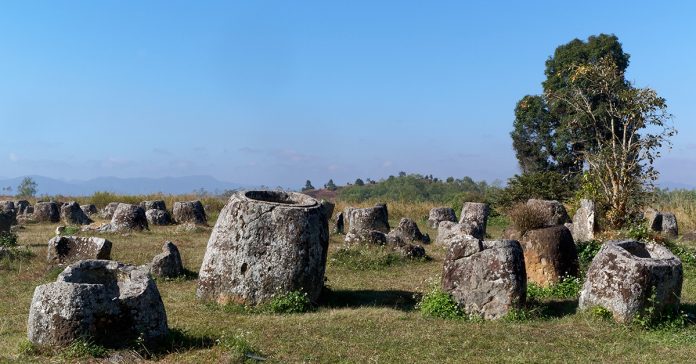
Laos’ Plain of Jars became a UNESCO World Heritage Site in 2020.

The Plain of Jars in Xiangkhouang Province, Laos, has been added to the list of World Heritage Sites by the United Nations Educational, Scientific and Cultural Organization (UNESCO).

The announcement was made at the 43rd Session of the World Heritage Committee held in Baku, Azerbaijan, on July 5.

The Plain of Jars, located on a plateau in northern Laos, is named for the more than 2,100 tubular-shaped megalithic stone jars that are believed to have been used for funerary practices in the Iron Age, according to UNESCO.

Human remains, burial goods, and ceramics discovered at the site dated by comparative material from Dong Son in Viet Nam, to the Early Iron Age from approximately 500 BCE to 800 CE.  The site has been shrouded in mystery for some time.

Laos has been working for 20 years to have the Plain of Jars listed as a World Heritage Site.

In 1998, the Lao government joined hands with UNESCO to initiate a multi-year phased program to safeguard and develop the site.

The program was designed to put mechanisms in place that ensure ongoing protection of the heritage resources linked to bringing socio-economic benefits for the local communities.

At that time, the Lao government expressed commitment to protect and develop the Plain of Jars and nominate the site for World Heritage inscription.

The inscription of the Plain of Jars means that the Plain of Jars is Laos’ third World Heritage Site. The old town of Luang Prabang in Luang Prabang province was inscribed in 1995, followed by Vat Phou and associated Ancient Settlements within the Champasak Cultural Landscape in 2001.

Apart from the Plain of Jars, UNESCO inscribed another six cultural sites in other countries on the World Heritage List.

They were the Dilmun Burial Mounds in Bahrain, Budj Bim Cultural Landscape in Australia, Archaeological Ruins of Liangzhu City in China, Jaipur City in Rajasthan, India, Ombilin Coal Mining Heritage of Sawahlunto in Indonesia, and the Mozu-Furuichi Kofun Group: Mounded Tombs of Ancient Japan in Japan.

Thailand’s First Bullet Train to Include Laos as Destination

Thailand’s First Bullet Train to Include Laos as Destination

Thailand is preparing to launch the country’s first bullet train that will run between Bangkok and Beijing, China, with Laos as one of the intermediate stations.

The “Trans-ASEAN Line” will cover 3,193 kilometers at the cost of about THB 2.07 trillion (USD 67.2 billion) and link Thailand’s Bang Sue with Chiang Mai in the North, Laos in the Northeast, Cambodia in the East and Malaysia in the South.

The Thai government also plans to link the county to other nations as far as Singapore and China through high-speed railways.

It is unclear when the new line would be 100% completed, but the Thai government has already begun the construction of some routes and will “keep calling bids” for the project, Bangkok Post reported on July 6.

In particular, the first route, a Thai-Sino project linking Bangkok and Nong Khai in the far Northeast, is currently under construction and is scheduled to be completed by 2023.

This is a boon to residents in Laos, which is located right next to Nong Khai, since another rail route will take passengers to the Lao capital of Vientiane from the borderline.

The route will reach Mohan, a border town in China’s southern province.

A 414-kilometer new route between Vientiane and Mohan is now 55% complete, said an unnamed Lao official, as quoted by Bangkok Post.

The new line will shorten a traveling time between Vientiane to Mohan from the current up to two days to only three hours.

The Lao official added that the new line would draw between 10 and 20 million Chinese tourists to the country each year.

Road Accidents Continue to Plague Vientiane Capital

Road Accidents Continue to Plague Vientiane Capital

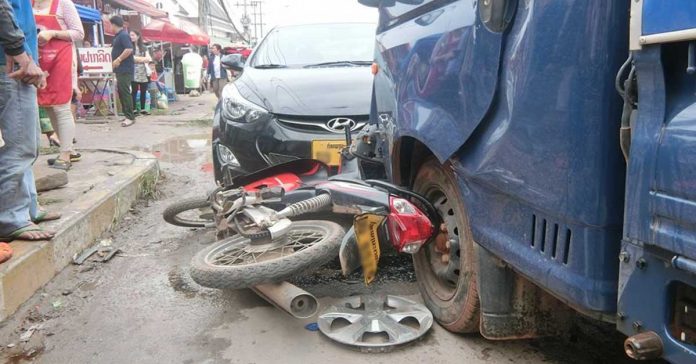
Road accidents continue to plague Vientiane Capital, with the latest figures for the year so far reaching a staggering 525 cases, according to a recent announcement by police.

Lieutenant Colonel Phengsavanh Thammaboun, Head of the Vientiane Capital Traffic Police Department, stated in an interview with the Vientiane Mai that in the first six months of this year, 525 road accidents had occurred within Vientiane.

These figures include 89 deaths.

The district in which the most road accidents occurred was Xaythany District, which saw 148 accidents so far this year, costing the economy LAK 6.3 billion.

Although the number of road accidents remains high, the capital city has at least seen fewer incidents than in previous years, with nine fewer accidents than in 2018, and 17 fewer deaths.

According to reports from the police, almost all road accidents have occurred due to reckless driving or ignorance of traffic regulations. A general lack of awareness or respect for traffic regulations still prevails among drivers in Laos, with many cases of speeding giving rise to accidents.

A large number of vehicles are unroadworthy, causing traffic problems, while drunk driving remains a common occurrence as well.

The Vientiane Capital Road Traffic Department urges all motorists to take extra precautions when driving, ensure that they respect traffic regulations, and exercise better manners when driving – giving way when necessary and respecting the rights of other drivers.

Photo: Vientiane Rescue

Lao Airlines Renews Global Safety Standard Certification

Lao Airlines Renews Global Safety Standard Certification

National flag carrier Lao Airlines has passed an audit and renewed registration from the IATA International Air Transport Association Operational Safety Audit (IOSA).

The IOSA program is an internationally recognized and accepted evaluation system designed to assess the operational management and control systems of an airline.

Six auditors worked with Lao Airlines from June 24 and 28 to evaluate the airline’s services in various fields, including safety, quality of security, flight operations, reporting culture, preventive action, and safety management system.

Lao Airlines first achieved IOSA certification in 2015, and since then, it has undergone a safety inspection every two years by the IATA to ensure the required standards are maintained. The company renewed its certification in 2017.

This marks the latest efforts by the airliner to bolster its safety standards.

Lao Airlines has also signed a strategic partnership agreement with Avia Nautics. Under the partnership, Avia Nautics acts as a consultant for Lao Airlines in extending the Enhanced IOSA.

Huawei to Boost Presence in Laos amid US Sanctions

Huawei to Boost Presence in Laos amid US Sanctions

Huawei has unveiled its latest solutions in Laos such as 5G, smart cities, smart government, and Huawei Cloud in a move that would help the Chinese telecom giant overcome a United States-led sanction.

Speaking at the Laos ICT Expo 2019, which was held last week in Vientiane, Huawei Laos CEO Mark Wong said that the company’s latest technology solutions, such as 5G and smart cities, were in line with Laos’ digital transformation vision and would support the nation to build a complete digital transformation ecosystem.

Wong added that Huawei would continue to provide the best products and solutions for Laos’ digital economy, help realize the vision of a digital nation, and contribute to the transformation of Laos from being landlocked to a land-linked country.

Huawei’s move is not a coincidence given the company’s latest efforts to strengthen its presence in Southeast Asia amid a global sales drop due to US sanctions.

In May, the US put Huawei on a list of companies that American firms cannot trade with unless they have a license, arguing that that the Chinese firm – the world’s largest maker of telecoms equipment and the second biggest smartphone maker – posed a security risk.

Huawei initially dismissed the impact of such a move by the US, but the company founder Ren Zhengfei admitted in June that the company’s international sales of handsets sunk 40% in the past month, adding that it would slash production by USD 30 billion.

Several allies of the US, including Germany, joined hands in the sanction efforts and since Huawei has traditionally drawn its strength from mature telecom markets like Europe, it would be natural for the Chinese firm to seek alternative income sources while minimizing the damage of the sanction.

In Thailand, for instance, Huawei already provides 4G network equipment to major players like True. The Thai government also selected the firm one of the test players for 5G equipment in Chonburi, a region the country hopes to develop into a leading economic zone.

In the Philippines, where two local players are considering launching 5G service, Huawei is in a promising position since the country’s leading telecom operator Globe Telecom’s 4G networks already run entirely on Huawei equipment.

In Malaysia, meanwhile, it has recently signed memorandums of understanding with local companies that hope to introduce 5G in the country.

And there goes Laos. Huawei is currently the third largest mobile vendor in Laos by market share, according to a web analytics firm StatCounter.

As of end-June, its market share stood at 15.36% after Apple with 21.75% and Samsung with 37.4%.

An interesting development is that its share has steadily grown since November last year, while the second largest vendor Apple has witnessed its share dropping since February. The pace is slow, but the gap between the two players is narrowing gradually for sure.

One more gist is that customers in Laos did not seem to have put much emphasis on the possible impact of the US-led sanction against Huawei.

Huawei market share rather increased since May when the sanction was imposed. The number jumped from 14.7% in May to 15.36% in June.

Laos might still account for a very small part of Huawei’s global sales, but as an old saying suggests, drop by drop fills the tub and Huawei appears to understand it well.


Laos Cracks Down on Illegal Foreign-owned Businesses

Chinese workers on the Laos-China Railway

Laos will crack down on foreign-owned businesses operating in the country without the proper permit.

The Lao government has begun to inspect foreign-owned businesses to see whether they comply with Lao laws and regulations, according to ministerial advice by the Ministry of Industry and Commerce, reported by the Vientiane Times last week.

The owners of foreign-owned businesses could face a LAK 10 million (USD 1,150) fine when they are found operating without a business registration certificate and license.

The business owners will have up to 90 days to obtain the legal documents, but they will face another LAK 10 million fine and be ordered to shut down permanently if they fail to do so.

As for registered and licensed foreign-owned businesses, they could face LAK 3 million (USD 344) in case they are found operating outside their approved business areas.

Those who are fined must commit to adjusting their operating licenses in accordance with their actual operational areas. In case they fail, they will face a LAK 5 million (USD 573) fine and be ordered to shut down permanently.

In addition, the authorities will check foreigners engaged in business activities reserved for Lao citizens. They will be asked to sign a document, which will be reviewed by officials at social welfare and public security sectors who will consider the deportation of the documented foreign traders.

The officials will officially report to the Ministry of Industry and Commerce about its implementation within 135 days to receive further guidance on the issue.

Such moves come amid the government’s efforts to improve the business environment to encourage private sector investment. One of the challenges, however, is the number of foreigners operating businesses reserved for local people, such as hairdressers and beauty salons.

The Lao government announced in January a list of controlled businesses, which are subject to government monitoring and regulation, in a move to ease the minds of more investors considering opening in Laos.

Sectors subject to considerations of national security, social order, and environmental protection and the respective regulatory authorities are spelled out in the list.

In various sectors not listed, operators are able to proceed to apply for a business and operating license from the commerce sector without having to consult any other state agencies, provided they do not otherwise contravene Lao laws, orders, decrees, and regulations.

Photo: Xinhua