

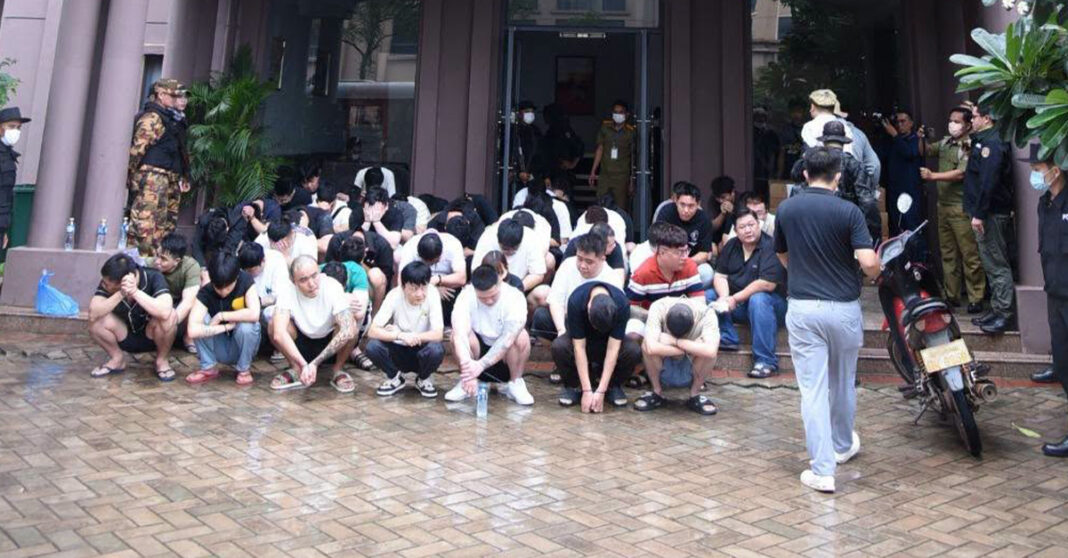
Laos has detained more than 550 people in raids targeting online scams and illegal gambling operations so far in August, as authorities step up a nationwide crackdown that has now netted more than 1,100 suspects since mid-July.
The latest figures come after a series of raids across Vientiane Capital and Vientiane Province, with Chinese nationals making up a large proportion of those detained.
On 18 August, authorities reported that 84 Chinese nationals had been arrested during raids on a guesthouse and an apartment in Huayhong village, Vientiane.
The raids, carried out in Chanthabouly District between 23 July and 7 August, uncovered laptops, mobile phones, passports, Chinese identification cards and other equipment allegedly linked to scam activities.
The suspects and seized evidence were transferred to Vientiane’s Public Security authorities, who are investigating the operation and seeking to identify its alleged ringleaders.
Several Raids
The arrests were among several large-scale operations carried out across the capital this month.
On 12 August, police raided an alleged cybercrime operation at the Athena Hotel, a two-building compound in Nongsanokham village, Sikhottabong district. They detained 74 suspects, including 71 Chinese nationals, one Vietnamese woman and two Taiwanese nationals.
Police seized computers and mobile phones and also found illegal drugs, including ketamine-laced e-cigarettes and compressed marijuana, according to authorities.
The same day, police in Vientiane Province and Vang Vieng district inspected two hotels allegedly being used as bases for internet crime. They detained 78 foreign nationals, including 77 Chinese citizens and one Malaysian. None had valid passports, according to authorities.
Four days earlier, on 8 August, police raided an alleged telecommunications fraud and online gambling operation in the Thatluang Lake Special Economic Zone, detaining 261 suspects from seven nationalities.
Chinese nationals accounted for 153 of those arrested, followed by 61 Vietnamese and 36 Thai nationals. Taiwanese, Malaysian, South Korean and Myanmar nationals were also among those detained.
The operation was the largest single haul reported during the current crackdown.
On 1 August, authorities carried out six coordinated raids in Sikhottabong and Hatsayfong districts, arresting 63 people, most of them Chinese nationals.
One raid in Salakham village uncovered an alleged scam call center with thousands of mobile phones and led to the arrest of 24 Chinese suspects.
Crackdown Beyond Vientiane
The campaign has also extended into the provinces.
On 18 August, authorities reported that police in Paklay district, Xayaboury Province, had arrested 47 suspects, including 10 women, during a 13 July raid on a guesthouse.
Police seized 22 laptops, 228 mobile phones and other evidence.
Some of the suspects told authorities that seven Chinese nationals had recruited and trained them from May, paying most workers about USD 600 a month and a Lao interpreter about USD 455 a month.
Authorities are also continuing to transfer Thai nationals detained during a major raid in July.
Police arrested 589 people during a 18 July operation at ST Vegus Company Limited in Hadsayfong district. As of 18 August, 268 of the 373 Thai nationals detained in the case had been handed over to Thailand, while 105 remained in Laos awaiting transfer.
The latest operations follow a wider push by the Lao government against cybercrime and organised scam networks.
Prime Minister Sonexay Siphandone told the National Assembly in early July that authorities had arrested more than 4,400 cybercrime suspects from 25 nationalities across Laos during the first half of 2026.
About 1,000 arrests were made in July alone, according to official reports.
The latest raids suggest the campaign has continued to intensify into August, with authorities targeting alleged scam call centres, online gambling operations and other facilities believed to be involved in cybercrime.
