Home Blog Page 6528

Workforce Fails to Meet Needs of Job Market

Balancing the available workforce with the reality of the job market, which includes hiring workers for new jobs and reshuffling officials into new positions, has fallen far short of the annual target, the government told the National Assembly recently.

Only 48,236 people were placed in new jobs over the first 10 months of the 2015-16 fiscal year, representing just 33.68 percent of the annual target set at 143,230 people.

However, the government will strive to place 143,000 people in new jobs and positions in 2017 and maintain the unemployment rate at 2 percent, Minister of Planning and Investment Dr Souphanh Keomixay told parliament’s ongoing ordinary session.

Over the first 10 months of the 2015-16 fiscal year, thousands of new jobs have been created in Laos with at least 2,468 being created through labour recruitment agencies.

In addition, Lao nationals have been sent to work in neighbouring countries while those already there without legal documents have been legalised, bringing the combined number of workers to 45,768, the minister said.

The labour recruitment system has followed the government’s goal to promote the industry and service sectors.

Of the 48,236 people who were placed in new jobs, as many as 29,291 or 60.72 percent entered the service sector, the highest percentage – followed by industry with 13,757 people or 28.52 percent, while only 5,188 people or 10.76 percent entered the agriculture sector.

To meet next year’s target and create more jobs, the government will attempt to provide vocational training for 131,600 people in order to keep the unemployment rate at 2 percent, Dr Souphanh told parliament.

He presented a report that summarised the implementation of the first 10 months of the socio-economic development plan, expectations for the plan for the whole year, and the plan for 2017.

Minister of Labour and Social Welfare Dr Khampheng Xaysompheng admitted that the workforce lacked adequate skills and that Laos suffered from a shortage of skilled technicians.

He told parliament his ministry would work hard to address the issue and pledged to draw up the necessary regulations to facilitate labour skill development by regulating vocational training centres and setting up new centres among other initiatives.

By 2020 when the population is expected to reach 7.3 million people, it is estimated that the workforce will comprise as many as 4.7 million people representing 64.5 percent of the total population.

Of the total, it is envisaged that 64 percent will be needed by the agriculture sector, 24 percent in the service sector, and 12 percent will be needed for industry, construction and mining.


Source: Vientiane Times

NUOL Celebrates 20th Anniversary with Bold Aspirations

The National University of Laos (NUOL) plans to bolster education at all levels, from kindergarten to tertiary education, so that the university matches the standards of institutions overseas.

In particular, it seeks to integrate the comprehensive development of education into the national psyche, so that its quality is respected by the whole of society. This would enable graduates to rise to the standards required for assimilation into the ASEAN Community.

Over the past 20 years the university has assisted with social and economic development and has trained many thousands of graduates.

This success was celebrated at the university on Saturday, when its 20th anniversary was acknowledged by Vice President Mr Phankham Viphavanh, Deputy Prime Minister Dr Sonexay Siphandone, ministers, senior officials, lecturers and students.

Dr Sonexay pinned a Class 2 Labour Order to the NUOL flag, while 14 lecturers considered to be the best scholars in their faculties received certificates from Minister of Education and Sports Ms Sengdeuane Lachanthaboune.

Mr Phankham thanked the Ministry of Education and Sports, officials, staff and students from Laos and other countries who gathered to celebrate the anniversary.

He said the ministry and NUOL had worked side by side to improve the standard of education.

The two entities wanted to achieve even more in the future so that education levels matched others in the ASEAN Community and enabled staff and graduates to work more closely with international organisations.

The NUOL was established on November 5, 1996, with 10 faculties. Today there are 12 faculties, 11 management offices, two institutions, four NUOL campuses, a hospital and a secondary school run by the university and the ministry.

The university employs 1,981 personnel and 1,514 lecturers, of whom 645 are women. A total of 134 teaching staff hold doctorate degrees, 825 have master’s degrees and 924 have a bachelor degree. There are seven professors and 129 associate professors.

From 1996 to 2015, a total of 89,956 people have graduated from NUOL, including 31,847 women. This academic year there are more than 21,000 students studying in the various faculties.

As well as the National University of Laos, the University of Health Sciences teaches graduate programmes, along with Savannakhet University, Souphanouvong University in Luang Prabang province, and Champassak University.

The celebrations on Saturday included many activities in which lecturers and students participated.

The university does its best to assist students in need or facing various problems. It seeks scholarships from international organisations and companies to help disadvantaged students, reward outstanding students, and give poor students the chance to continue their education. This assistance has benefitted almost 1,000 people to date.

The NUOL has partnered in educational activities with foreign universities and international organisations. It has signed memorandums of understanding with more than 100 universities in 29 countries as well as 14 international organisations. Lecturers and students at NUOL helped with the 25th SEA Games held in Vientiane in 2009, and the university hosted the 16th ASEAN University Games in 2012. It also hosted the National University Games earlier this year and NUOL students took part in the ASEAN University Games in Singapore this year.


Source: Vientiane Times

BCEL-KT: Trade Summary (Nov 4, 2016)

Trade Summary

LSX kept losing on Friday, down slightly by 0.67 points to close at 990.94 points with 54,300 shares traded. EDL-Gen closed unchanged at 4,850 kip on 53,000 shares matched, worth about 258 million kip. On the other hand, BCEL closed lower 50 kip at 5,150 kip, with just 1,300 shares traded. The other three stocks closed unchanged at 6,100 kip (LWPC), 2,500 kip (PTL) and 3,000 kip (SVN).

Lachanthaboun Appointed as President of National Olympic Committee of Laos

Sengdeuane Lachanthaboun has been elected as the new President of the National Olympic Committee of Laos (NOCL).

Also the Minister for Education and Sports in the Asian country, Lachanthaboun will serve a four-year term until the Tokyo 2020 Olympic Games.

She is also the President of the Lao Table Tennis Federation with her election coming amid closer ties between the Laos NOC and the country’s Sport Ministry.

Lachanthaboun feels that it her “honour and responsibility” to continue the development of sport in Laos, and has pledged to “commit herself fully to the task of promoting and fostering the Olympic movement in Laos and the world”.

“We look forward to working closely with the International Olympic Committee, Association of National Olympic Committees, Olympic Council of Asia and the family of other NOCs to strengthen our bilateral relations,” said vice president and secretary general Somphu Phongsa.

Phongsa had been the acting President of the organisation before Lachanthaboun’s election.

Laos has never won an Olympic medal and sent six athletes to the Rio 2016 Games in August.

Athletes Xaysa Anousone and Laenly Phoutthavong competed on the track in the men’s 110 metres hurdles and women’s 100m respectively, with cyclist Ariya Phounsavath failing to finish the men’s road race.

Judoka Soukphaxay Sithisane competed in the men’s under-60 kilogram class with swimmers Santisouk Inthavong and Siri Arun Budcharern racing in the men’s and women’s 50m freestyle respectively.

262a4cfe935b484285efd8db3d5437a0_th

Source: Inside the Games

Borikhamxay Districts Achieve Milestone in Sanitation

Borikhamxay province: Two districts in this province – Pakxan and Thaphabath  are the first in the country to achieve Open Defecation Free (ODF) status now that all residents have access to improved sanitation.

The ODF programme began in June 2015, supported by the Central Nam Saat initiative under UNICEF.

Speaking at a ceremony on Tuesday to announce the districts’ success, Borikhamxay provincial Governor DrKongkeoXaysongkham said the two districts were the first in the entire country to achieve this status. These means that all 75,000 people including children and women in all 80 villages of these districts are now using toilets and no one is practising open defecation.

The achievement follows the government’s efforts to improve sanitation and hygiene and thus the health and well-being of communities across the country.

DrKongkeo said  today we are declaring that these two districts no longer practice open defecation. But health officials need to increase understanding of the importance of this work among local people as many families are poorly informed about the need for good hygiene and still don’t understand why it is necessary.

Sustaining their ODF status will be challenging for the districts, as they must comply with several criteria including use of a toilet, handwashing with soap, use of safe water, use of safe food, a clean house, and a clean environment.

A representative of UNICEF in Laos, Mr. Bishnu Timilsina, said this was a significant milestone because these are the very first ODF districts out of seven in Borikhamxay and are the first to be so declared in the whole of Laos. Allow me to take this opportunity to congratulate Thaphabath and Pakxan districts and everyone who contributed to this achievement, he said.

I wish to acknowledge the joint efforts of the provincial health department, Lao Women’s Union and other government agencies with support from UNICEF. This is remarkable teamwork to increase access to improved sanitation in these target districts.

We are working together with the province and district authorities, village chiefs, community leaders, young people, children and all residents, Mr. Timilsina added.

A practice that has gone on for hundreds, even thousands of years, has now disappeared after sustained effort over several years, he said. This is a life-changing moment for the populations of Pakxan and Thaphabath, as poor sanitation remains one of the biggest barriers to development because of its impact on health and education.

Mr. Timilsina said that even before starting school children are at risk from poor sanitation. Acute respiratory infections and diarrhoea diseases are the main cause of infant mortality and are related to unclean water, poor hygiene, and a lack of sanitation.

Open defecation is a major cause of malnutrition and stunting. The availability and use of toilets is important to the health and nutrition of children.

It is crucial for those living in remote rural areas to understand the link between basic sanitation and improved health. The contrast between urban and rural populations using improved sanitation is significant. In Laos, 91 percent of urban dwellers use improved sanitation compared with 48 percent of people living in rural areas.

Source: Vientiane Times

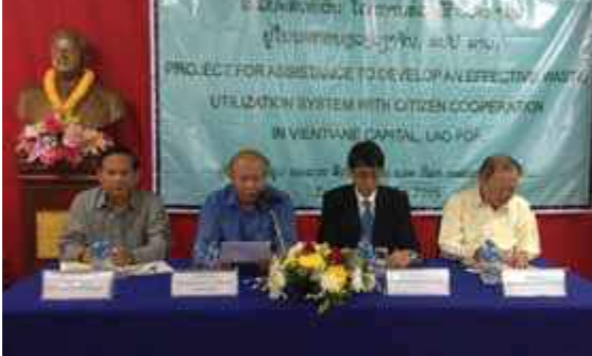
Kyoto Extends Support for Waste Management Project

Japan’s Kyoto Prefecture has committed to continue to help clean up Vientiane after an initiative launched by the two cities in November 2015 proved successful.

The community-based waste management project supported by the Japan International Cooperation Agency (JICA) helped to develop an effective waste utilisation system with people’s participation in the villages of Akard, Anou, Kaoyord, and That Luang Kang.

Under the project, four Lao officials went to Kyoto to learn how such a project is being operated there. In addition, other officials underwent training in related fields in Laos so they could lead villagers in carrying out activities, including classifying waste.

Officials on both sides on Wednesday announced they would continue with the project to develop an effective waste utilisation system in Vientiane in cooperation with local residents, Director of the Natural Resources and Environment Department Mr. Bounhome Heangsavath reported at the opening ceremony of the next phase of the initiative.


Source: Vientiane Times

Ministry, Partners Seek to Ensure all Children Finish Primary School

The main challenge facing the government and its development partners is the need to ensure that many more children complete primary school.

The Ministry of Education and Sports has set new nationwide enrolment targets. An enrolment rate of 51 percent is the new target for the 3-5 age group, while for lower secondary schools the target is an enrolment rate of 85 percent, up from 82 percent, within 2017 or beyond.

The figures were quoted during discussions at the ongoing National Assembly Ordinary Session.

Currently 82 percent of all children attending primary school in Laos complete their studies, an increase from 79 percent last year. The ministry’s aim is to raise this figure to 98 percent by the end of 2020 as one of the targets set under the Millennium Development Goals (MDGs).

To achieve this target, the ministry called on state and private school administrators and education officials around the country to step up efforts to address the challenges facing the sector.

Figures show that only about two-thirds of children nationwide complete their primary education, with those coming from remote villages in the most educationally disadvantaged districts facing the greatest hurdles.

A ministry official, experts and researchers told Vientiane Times this week there is an urgent need to tackle issues such as poor school conditions, overcrowding, drug abuse and literacy rates, and the high dropout rate.

Making sure that children are able to stay in school and complete the full five grades of primary school remains a major challenge, they said.

While education has seen significant progress in recent years, greater efforts are essential to break through the barriers that still prevent many children, especially rural girls, from entering and staying in school, they noted.

Making sure that everyone benefits from a good education is critical to unleashing the country’s human resource potential and ensuring that Laos graduates from Least Developed Country status by 2020.

The ministry reported that national primary school enrolment rates have risen to 95.2 percent, up from 94.1 percent in the 2011-12 academic year. The gap between male and female enrolment has also narrowed, from 7 percent to 2 percent.

High levels of malnutrition in early childhood linked to rural poverty also represent a particular cause for concern, as hunger impairs brain development and diminishes children’s ability to learn.

Expansion of primary and secondary education, and improvements in literacy rates, especially for women, are also high priorities.

Source: Vientiane Times

Oudomxay Schoolchildren Get Refurbished Library after Floods

Room to Read Laos has approved a special project to re-establish a library at Mokvieng Primary School in Baeng district, Oudomxay province, which suffered serious damage from flooding a few months ago.

The school was initially supported by Room to Read Laos with the provision of a library in 2014, which was well used until it was damaged in the rainy season.

A teacher at the school recalled the sight when first seeing the library after it was flooded. Most of the books were gone or lying on the floor covered in mud. Everything was gone and we were desperate.

The students and parents enthusiastically helped to recreate the library and were very excited when it was finished. Now the library is open regularly again and continues to serve the local community, he said.

Room to Read Laos coordinator, Ms Manysone Philathivong, told Vientiane Times after the flooding in Baeng district that the programme had provided over 300 new books, some library equipment and basic educational materials for the children at Mokvieng Primary School.

Meanwhile, programme staff are providing training in teaching methods and literacy instruction for local teachers to enable these schools to master the reading and writing of Lao as vital elements before moving on to learn other subjects in higher grades.

Room to Read Laos has also arranged for 25,000 children’s books covering a large variety of themed stories to be delivered to primary schools that lack children’s books in Pakxe and Phonthong districts in Champassak province when new libraries are built there.

Ms Manysone said the new libraries are now under construction and are expected to be completed by the end of this year, supported by Room to Read Laos.

Mokvieng Primary School has a total of 158 students and eight teachers, and teaches grades 1-5. The school is located in Mokvieng village about 20km from central Baeng district in a mountainous area.

The only way to reach the school is by small mountainous roads which are very difficult to access in the rainy season.

The flooding occurred in early August and a letter requesting help with the library’s renovation was sent by the school through the village education committee, with the support of the district and provincial education and sports department.

Room to Read Laos began operating in 2005 through three programmes: school construction, school libraries, and book publishing, to provide for schools in remote areas that lack children’s books.

The number of children borrowing books from libraries who receive assistance from Room to Read Laos is now about 150,000 a year, as recorded from 2012-2015.

T he number of people using school library services, including students and village communities, averages more than 500,000 people a year.

Room to Read seeks to transform the lives of millions of children in developing countries by focusing on literacy and gender equality in education.

Source: Vientiane Times