Home Blog Page 6529

Chicken Farm Stink Raised at National Assembly

The National Assembly’s Committee on Economic Technology and the Environment has reported to the Assembly’s ongoing debate session that complaints are being made about a chicken farm in Bachiangchaleunsouk district, Champassak province.

According to the committee, despite being rural people, local residents are quite disturbed by the smell coming from the farm.

Deputy Director of the provincial Agriculture and Forestry Department, Mr. Viengsay Sipraphone, told Vientiane Times on Thursday that there are many chicken farms in the district but that the smells are only emanating from the Soukchaleun farm.

A team from the department and the provincial Natural Resources and Environment Department visited the farm to look into the matter and suggest possible solutions.

The farm owner promised to tackle the problem after the end of Lent, at the end of last month, he said.

The farm has two machines that it uses to bake the dung in order to reduce the smell from the chickens’ excrement but this seems insufficient to eliminate the smells as the chickens produce about 50 tonnes of waste a month.

When the dung is dampened by rain, the smell gets stronger. However, the farm owners have promised to buy another four to six machines in order to bake the remaining dung.

The dung that is baked will be sold to farmers as fertiliser.

The farm was originally located far away from communities in Bachiangchaleunsouk district but because of population growth many houses have since been built nearby.

Farms in the district currently provide between 300,000 to 400,000 eggs a day for delivery to people in the provinces of Champassak, Saravan, Xekong and Attapeu.

More eggs will be produced for sale to markets in Savannakhet and Khammuan provinces.

However, the eggs are not packaged attractively so some potential buyers reject them .

If farm owners do not take steps to improve the appearance of their packaging, their market share may decline as more and more people want eggs that look appealing.

The eggs are sold in cardboard cartons and come straight from the farm and are not washed beforehand, so some of them have dung attached. Nowadays, people in Vientiane don’t want to buy eggs if they look dirty.

Source: Vientiane Times
Government, Development Partners Prepare for Polio Vaccination Campaign

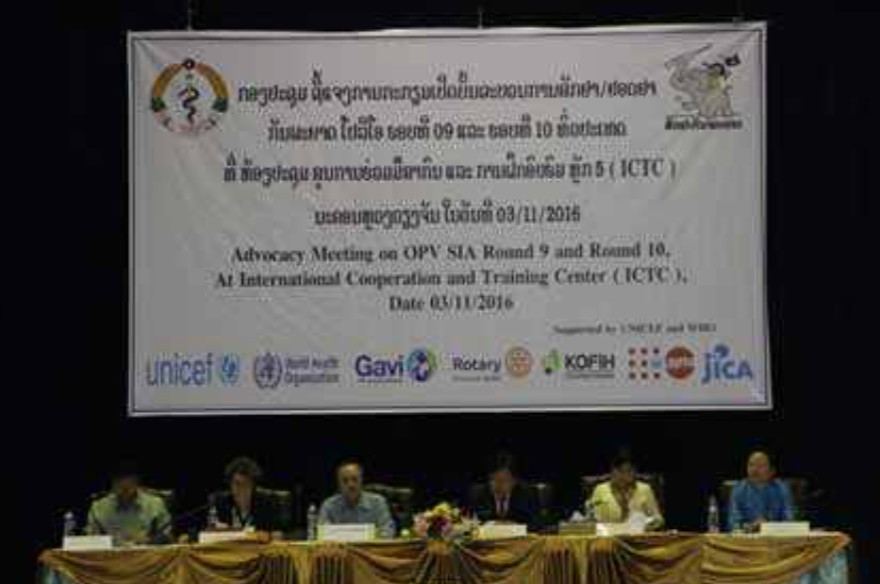
The Ministry of Health, in cooperation with various development partners, yesterday held a meeting in Vientiane to prepare for a countrywide polio vaccination campaign.

The polio vaccination project is supported by UNICEF and the World Health Organisation (WHO).

The meeting was attended by health officials and representatives from the WHO, UNICEF, Rotarian International of Japan, JICA and the Korea Foundation for International Healthcare.

The meeting was chaired by Health Minister, Prof. Dr Bounkong Syhavong.

The project aims to erase polio in Laos by carrying out round 9 and round 10 of polio vaccinations, which will be held in November and January 2017.

Prof. Dr Bounkong reviewed the outcomes of previous polio vaccination drives from the first to eighth rounds. Vaccinations were administered in Xaysomboun, Borikhamxay and XiengKhuang provinces.

Since the third round, the project has been run in every province of the country. Vaccinations are given to children under 15 years of age and people at risk of infection with the virus in 67 districts. 120,000 people have been vaccinated with each round reaching 97 percent of the target population.

Nevertheless, children under 5 years of age are still at risk of polio infection due to the failure to inoculate the entire population, stressing the vital importance of rounds 9 and 10 in fully eradicating the virus.

According to the WHO Laos office, the organisation will boost the Minister of Health’s initiatives on the prevention of polio by focusing on children at risk in target provinces. If their plan succeeds, polio will be eradicated in Laos by 2017.

Source: Vientiane Times

Ceilings Imposed to Lower Interest Rates: Bank Governor

Ceilings for deposit and loan interest rates have been imposed in an attempt to manage and lower the interest rate that commercial banks charge borrowers, the central bank governor has said.

Governor of the Bank of the Lao PDR Dr Somphao Phaysith recently made the comment as he detailed bank loan policies to boost production and economic growth in response to questions raised by members of the National Assembly (NA) during the ongoing ordinary session.

The central bank has stipulated that the deposit interest rate for commercial banks must not exceed the inflation rate by more than 2 percent. The difference between the deposit and loan interest rates must not exceed 4 percent, a decrease from the 5 percent imposed previously.

Interest rates for both deposits and loans have decreased compared to previous rates, which should be acceptable, the governor said.

The central bank stepped in last year to manage interest rates after learning the rates were previously too high.

Commercial bank lending rates were driven by market mechanisms from 1995 to 2013. The demand for loans has increased so commercial banks have raised interest rates on deposits to attract more depositors. The increase in deposit rates and other administrative costs drove loan interest rates higher, causing the central bank to intervene.

I n addition, the central bank charges only about 5 percent or slightly more than 5 percent from commercial banks who borrow short-term loans from the central bank for their financial liquidity.

The explanation came amid complaints that interest rates on bank loans in Laos were too high.

For example, interest rates charged by Banque Pour Le Commerce Exterieur Lao Public (BCEL) start from 9 percent for loans in kip with a lending period of no more than 12 months. Interest rates for different borrowing currencies and different levels of risk are charged differently.

The governor said multiple banking policies have been applied to support and drive economic growth, adding that since a few years ago the central bank has permitted commercial banks to use almost all their registered capital to be released as loans.

In addition, banks have mobilised capital from overseas financial sources to be released. As a result, banks have attracted considerable deposits.

By July (the 10th month of the 2015-16 fiscal year), commercial banks had accumulated more than 59,616 billion kip in deposits representing 54.84 percent of Gross Domestic Product (GDP). This was an increase of more than 5,692 billion kip compared to the same period last fiscal year.

Commercial banks will strive to increase deposits to 57 percent of GDP by the end of 2016 and further increase this to 84 percent by 2020.

Credit [loans] is increasing every year, Dr Somphao told the session.

We will do all we can to create conditions that are conducive to business growth.

The inflation rate has been maintained at about 1.2 to 1.3 percent.

The governor told the parliament the central bank had undertaken a study and was prepared to issue a new regulation that would allow businesses including importers to borrow bank loans in foreign currency to facilitate their trade.

The current regulation permits only those businesses whose income is in foreign currency to borrow in foreign currency.

As of July, there are 42 commercial banks and 158 legal financial institutions, which are not banks.

Source: Vientiane Times

Mass Organisations Comment on NA, Government Performance

Public debt, abuse of power and other misconduct by government officials are some of the issues highlighted by mass organisations for the National Assembly (NA) and other government bodies to address.

Vice President of the Lao Front for National Construction, Ms Khamchanh Phomsengsavanh, representing the Front, Youth Union, Lao Women’s Union and other mass organisations, outlined their proposals to the NA and government yesterday at the Assembly’s ongoing debate session.

We propose to review for consideration the government’s investment debt, as a number of projects have been approved, while the government has repaid them, Ms Khamchanh said.

The huge public debt is burdening the country and its people, contributing to the fragility of the national economy, she added.

The mass organisations called on the NA to enhance their oversight, pointing out that many projects approved by the NA have been delayed, while others have proven to be totally ineffective.

Abuse of power by some officials in Vientiane was also included in the comments made by the organisations, who claimed corrupt officials hindered ordinary people’s attempt to make a living.

Mass organisations also remarked on the illegal import of vehicles, saying they were used by officials at the Ministry of Public Security and Ministry of National Defence.

If ordinary people committed such crimes they would be punished, but officials are not treated in the same way, Ms Khamchanh said.

She also passed on messages from people in the northern provinces, who want the government to clarify the social and environmental impacts concerning the planned Laos-China railway.

Other issues raised by mass organisations included illegal logging, the extraction of alluvial gold, the market price of crops, government employees abusing land reserves, and the delay of road construction projects.

They also wanted the government to review the importation of electricity, which consumes huge amounts of state money and creates significant public debt.

The 13 villages near the biggest hydropower dam in Nakai district, which have no access to electricity, was also a matter raised by the organisations for government consideration.

The placing of trade unions and other mass organisations within business units and factories and the increasing drug abuse by labourers who then became violent were also raised, with organisations calling on the government to enforce stricter measures against drug dealers.

The organisations asked the Ministry of Health to look into the ethics of medical staff following public complaints that they left medical students on standby at night and on holidays, which led to the unnecessary death of hospital patients. They also asked the government to control exaggerated advertising by private hospitals, along with health checks and treatment fees, after members of the public complained that these were too expensive.

Another issue raised was the number of signs put up by restaurants, companies and hotels, many of which were in foreign languages, along with the increase in the number of young people following foreign trends, and the excessive use of loudspeakers, bright lights and light boxes for advertising purposes, which caused public annoyance.

The organisation also raised concerns about monks who did not comply with Buddhist principles and violated the ethics of Buddhism by engaging in intimacy with people of the opposite sex.

Some leaders and followers of other religions in Laos were also said to be infringing their basic tenets.

Non-transparency and nepotism in public recruitment is also a significant concern the mass organisations want the NA and government to inspect.

For example, they said many people have worked for government agencies for five years, but were not granted civil servant status while others who had just recently graduated obtained the status after one year. Moreover, they said bribery used to obtain government jobs and promotion is rife, including in the public security and national defence agencies.

The organisations also requested closer monitoring of judiciary agencies and the police, which they said was weak, citing the detention of people without the authorisation of prosecutors, with some being detained without being charged or accused for longer than was stipulated by the law.

Source: Vientiane Times

Irrawaddy Dolphins Functionally Extinct in Laos: Survey

The population of critically endangered Mekong River Dolphins – Irrawaddy Dolphins – in the Cheuteal trans-boundary pool between southern Laos and northern Cambodia has shrunk by 50 percent this year and the population is functionally extinct in Laos.

World Wildlife Fund (WWF) survey teams from Laos and Cambodia recently conducted a dolphin abundance survey and confirmed the current number and breeding status of the dolphins in the trans-boundary pool.

The survey teams reported that the group has now shrunk to just three individuals  from six earlier this year. There is now little hope for a reversal of the situation, as the small population is no longer viable.

Functional extinction results when there are too few potential breeding pairs available to ensure the survival of the population, they said.

The population of Irrawaddy Dolphins is functionally extinct in the near future if we don’t have good measures to protect them, WWF-Laos Southern Provinces Coordinator Ms Amphone Phommachak said.

In an interview with Vientiane Times yesterday, Ms Amphone stressed that the use of gillnets, especially unmanned gillnets, is thought to be one of the main reasons for the demise of the dolphins. Gillnets are vertical panels of netting set in a straight line across a river to catch fish. Being large aquatic mammals, Mekong River dolphins, as well as other endangered aquatic species, are often caught in gillnets, and drown as a consequence.

The use of gillnets in the Mekong River is prohibited in Cambodia  where there are an estimated 80 dolphins  but not in Laos.

Only the actual deep pool off Hangsadam village in Khong district, Champassak province, where the dolphins are, is protected. Gillnets are, however, used directly outside of the pool where the dolphins often swim and risk being trapped.

The WWF calls for an immediate ban on all gillnets for a two kilometre radius around the Cheuteal pool (4 km in the rainy season) and increased enforcement against violators.

The WWF also asks for increased enforcement of gillnet bans in other Mekong River dolphin pools to protect the remaining dolphin population.

The alarming decline of Mekong Irrawaddy dolphins in Laos that we have witnessed this year is tragic. At this stage, we fear that in a year or two, there may be no more dolphins in Laos, the WWF Conservation Director for the Greater Mekong Teak Seng said.

The loss of this iconic species for Laos is even more tragic given that it was entirely preventable through strict enforcement against gillnets fishing.

The Irrawaddy dolphins in the Mekong River have long been a favourite attraction among travellers and tourists in southern Laos. Their feared disappearance from Lao waters may cause a hard blow to eco-tourism in the area.

Irrawaddy dolphins can be found in some coastal areas in Asia but there are only three freshwater subpopulations: in the Ayeyarwady River in Myanmar, in the Mahakam River in Indonesia, and in the Mekong River in Cambodia and Laos.

Source: Vientiane Times

University Needs to Raise Standards: PM

The National University of Laos should set its sights on national development, especially in terms of the quality of the graduates it is producing, as they are fundamental to the nation’s progress.

The university is only in the initial stages of its success. There is still a crucial need for well qualified, capable and experienced staff and administrators, to participate in national development, so that Laos will become a modern and civilised nation.

Prime Minister Thongloun Sisoulith made this statement yesterday to mark the 20th anniversary of the university (5/11/1996-5/11/2016), the country’s major institute for advanced education.

Mr. Thongloun said the Party and government have a strategic plan for socio-economic development from now until the year 2020, which aims to raise Laos out of the UN’s list of least developed countries.

To further develop the country and accomplish this objective, one of the main areas of development must be human resources. Everybody has to try hard and keep on training to deal with the reality of the situation. We should all devote ourselves to serve the country as needed, he said.

I strongly believe that all of you will be ready to further educate yourselves to be the next generation of workers for our Party and state, with a firm political ideology, faithful to the nation, capable, serious and creative, in order to succeed in your assigned tasks.

Acting President of the National University of Laos, Prof. Dr Somsy Gnophanxay, also gave a presentation reflecting on the 20 years of the institution’s success in accordance with its plans.

He congratulated teachers and students on their accomplishments in curriculum development, teaching and learning activities, scientific research, staff development, infrastructure building, internal and international curriculums, and intellectual performance.

In 2015-16, the university had 1,981 staff, including teachers and administrators, while 21,535 students were taking courses in 12 faculties.

Fully 699 students come from Cambodia, China, Cuba, Japan, Republic of Korea, Mongolia, Myanmar, Turkey and Vietnam.

The purpose of the anniversary celebration is to mark the significant historical achievements of the institution over the past decade, and to recognise the contribution of leading officials from the university and the Ministry of Education and Sports.

The ceremony to celebrate the 20-year anniversary was full of good cheer, and was attended by the Minister of Education and Sports Ms Sengdeuane Lachanthaboun, Minister of Information, Culture and Tourism Prof. Dr Bosengkham Vongdara and other invited guests

Source: Vientiane Times

Laos Lacks Condo Law, Lags Behind other ASEAN Nations

Condo in Laos

By Work Live Laos
Have you ever dreamed of purchasing a condo and living out your days with a breezy view of Vientiane from the penthouse suite? While this dream may be close to a reality, it is best to check the legalities before snapping up that top floor condo.

Are there condos in Laos?

Yes, there are. Most condo projects have been constructed within Specific Economic Zones, such as the That Luang Marsh Specific Economic Zone (SEZ), where a Chinese developer, Wan Feng Shanghai Real Estate Company, has constructed a number of 19 storey condo structures. Reportedly, six of the seven completed condos have already been sold, according to a Vientiane Times video.

Another two 45 storey condo projects are set for construction in the Thakhek Specific Economic Zone as part of the Thakhaek Dreamworld City project.

 Why are there so few condos in Laos?

While there a lot of apartment buildings in Laos, almost all of them are built and operated as rental apartments by private owners. It is not possible for apartment constructors or developers to sell units as individual properties due to the lack of clear legislation.

Furthermore, there is still no current Lao law that separates ownership of land from ownership of any structure upon it. No law on strata title. This means that whosoever owns the land on which a condo is built technically owns the entire condo building (regardless of who originally constructed the condominium building).

Can foreigners own a condo in Laos?

Short answer: no, a foreigner cannot own a condo in Laos.

To truly own a condo, a foreigner would need to own the land it is built on, since there is still no law separating land from structures, as mentioned above.

That Luang Marsh Condos

So why are condos being advertised for sale?

The condos currently advertised for sale at specific economic zones are technically not for sale, and in actual fact are being sublet (long-term).

The developer has taken out a specially approved long-term concession on the economic zone, and is then allowed to sub-lease parts of structures built there. Foreigners and locals alike are eligible to lease a part of the structure in the form of a condo unit. This means that, in theory, you are “buying” the condo but only for the life of the developer’s investment.

Ultimately, at the expiration of the developer’s concession, the condominiums will revert to the owner of the land (usually the government).  Although Article 58 of the Lao Investment Promotion Law states that foreign investors with registered capital of US $500,000 and above are entitled to purchase land use rights, the government allocates this land, and rights are only valid for the duration of the investment term.

How does this compare to other ASEAN nations?

The Lao PDR is in fact the only country in ASEAN without any law separating land from structures, and one of the only nations without any specific law governing condos. It is also the only ASEAN nation currently not offering any form of title to foreigners; every other ASEAN nation offers strata title, which effectively allows foreigners the right to co-own condominium buildings.

Here’s a breakdown of foreign property ownership laws in other ASEAN nations:


ASEAN Nation Title Type Permitted To Foreigners Most Recent Legislation What it means
Brunei Strata Title 2012 Law -All land sales must be approved by the Sultan

-Limitation of 60 years on period of ownership

Cambodia Strata Title Law on Providing Foreigners with Ownership Rights in Private Units of Co-Owned Buildings, 2010 Foreigners can co-own condos but cannot own land
Indonesia -Limited Landed Title

-Strata Title

Government Regulation No. 103/2015 on House Ownership of Foreigners Residing in Indonesia),
2015
-Restricted to new properties

-Limitation of 80 years on period of ownership

Malaysia -Freehold Title

-Leasehold Title

Section 433B of the National Land Code, 1965


-Various programs promoting foreign investment

-Some minimum investment conditions apply

Myanmar -Strata Title Condominium Law of 2016 -Foreigners may own up to 40% of a condominium (including the land)
Philippines -Strata Title Condominium Act of 1966 -Foreigners may co-own up to 40% of a condominium building
Singapore -Strata Title

-Limited Landed Title

Residential Property Act, Revised 2009 -Foreigners may co-own less than 100% of a condominium building

-Foreigners can own land with special permission.

Thailand -Strata Title Condominium Act, 1979, Updated 2008


-Foreigners may co-own condominium buildings at no more than 49% of a building.

-Locations of condos are restricted to certain areas in Bangkok, Phuket, and Pattaya.

Vietnam -Strata Title

-Limited Landed Title

Law on Real Estate Business;

Law on Real Residential Housing,
2015

-Limitation of 50 years on period of ownership

– Limitation on number of properties owned, or percentage of ownership of condos


This article supplied by Work Live Laos real estate agency.
Work Live Laos

SilkAir and Sabre Join Forces to Help Laos Grow Its Tourism Market

Luang Prabang, Laos - May 16 2015: Tourists shop in the famous night market in Luang Prabang just outside the Royal Palace complex and the Haw Pha Bang temple.

SilkAir and Sabre Corporation are backing Laos in the expansion of its tourism industry by making the airline’s new flights to the emerging destination available via the Global Distribution System (GDS).

The two companies inked a new distribution agreement, which opens SilkAir’s new Singapore-Laos fares and ancillary services to travel agents for booking through the Sabre Travel Marketplace.

It is the first time the air content will be available to travel agents via this channel.

The regional wing of Singapore Airlines launched its Singapore-Vientiane-Luang Prabang-Singapore flights on October 31 through a codeshare agreement with Lao Airlines.

Ryan Pua, SilkAir’s vice president, commercial, said the new routes would support Laos’s emergence as a popular international tourism destination.

The new service connects Laos with the joint Singapore Airlines and SilkAir network of over 100 cities worldwide via Singapore Changi Airport hub and connecting international flights.

“Now, through our agreement with Sabre these flights will also be made available to over 425,000 Sabre-connected travel agents globally, supporting further growth in travel bookings to and from Laos,” Pua added.

Hans Belle, vice president of supplier commerce and strategic partnerships for Sabre Travel Network Asia Pacific, said Laos has significant potential as an international tourism destination.

“Continued visitor growth is being further supported by a Government commitment to promote the industry, ongoing infrastructure development and the country’s entry into the ASEAN Economic Community last year.”

In 2015 total visitor numbers to Laos reached 4.6 million. Lao Tourism Development Department projects the number to double by 2025, reaching nine million.

Sabre is the first GDS to enable electronic ticketing of SilkAir tickets among authorised travel agents in Laos, which is a non-IATA Billing and Settlement Plan (BSP) country.

Read more at: WebinTravel