Home Blog Page 6441

Cambodian Troops Begin Live-fire Drills at Laos Border

Cambodian Troops Train Laos Border

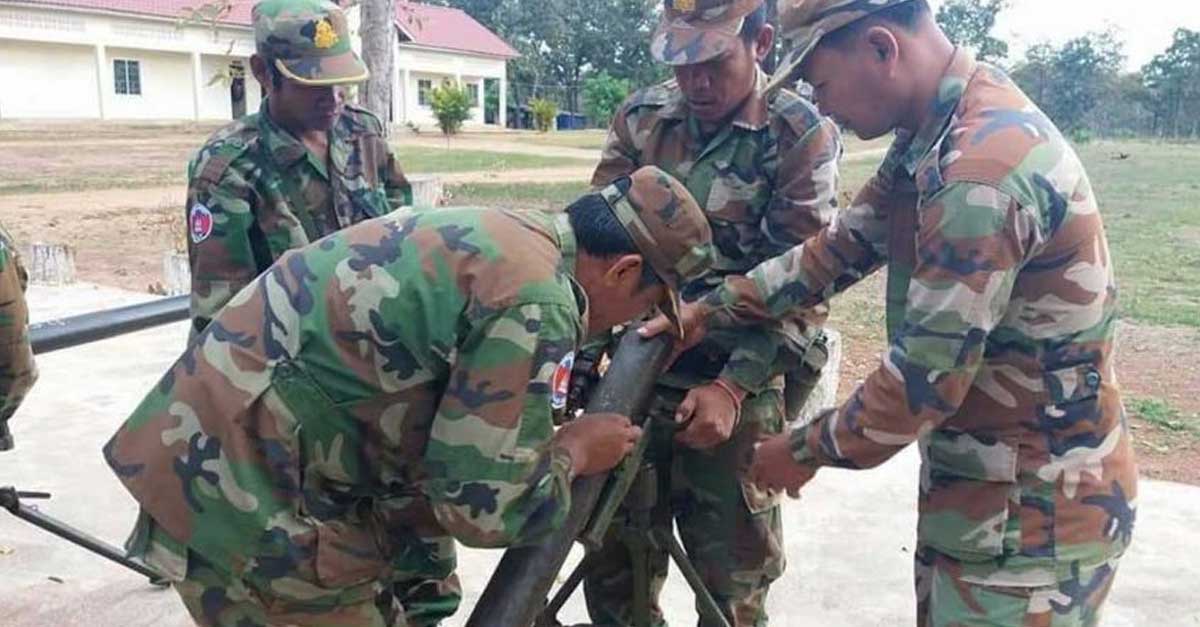
Cambodian troops stationed on the border with Laos commenced live-fire drills yesterday, just six months after a flare-up caused severe border tensions between the two countries.

Cambodian Prime Minister Hun Sen created Infantry Brigade 128 last August after a confrontation with the Lao military. The brigade is now using live mortars as part of special training alleged to improve skills and defend territorial integrity.

According to reports in the Phnom Penh Post, the Lao side was informed of the drills prior to commencement.

Troops from Laos were accused of crossing the border into Cambodian territory amid a dispute over road construction. This sparked the public announcement of an ultimatum, requesting Laos withdraw its troops within six days or suffer the consequences.

The border dispute was peacefully resolved, however, when Prime Minister Hun Sen flew to Laos to engage in talks upon invitation by Lao Prime Minister Thongloun Sisoulith.

Many experts claim that the entire episode has been nothing more than political games, with the Cambodian Prime Minister attempting to fan the flames of nationalism amid the looming Cambodian general elections, due in July this year.


Source: Phnom Penh Post

Smuggled Snakes Seized en route to Laos

smuggled snakes Laos

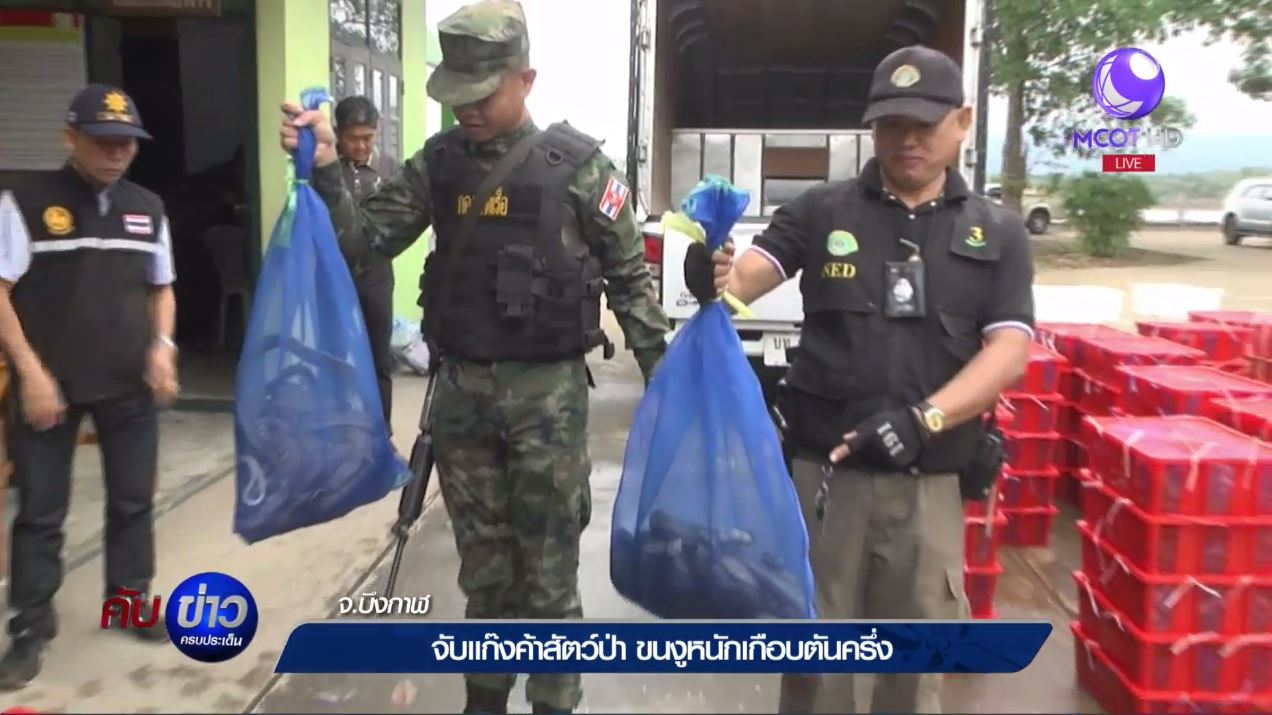
Thai border police have seized a shipment of smuggled snakes bound for Laos.

Police noticed a suspicious vehicle near the border area in Bueng Kan Province, which borders Paksan District, Bolikhamxay Province of Laos last week. Upon inspection, hundreds of protected snake species’ were found inside.

1,362 kilograms of live snakes were seized, including 209 cobras and 162 long tail rat snakes.

smuggled snakes bound for Laos seized

Suspects told the police that they had been hired for 10,000 baht to drive the cargo north into Laos.

Police estimate the value of the 1,684 snakes seized to be approximately 500,000 baht.

The suspects, who have yet to be named, were detained at the Pakkat District police station and charged with illegal possession and trafficking of protected wildlife.

It is unclear if Laos was to be the snakes’ final destination, or if the country were to be used as a transit location, with the snakes bound for bordering countries Vietnam or China.

Source: TNA
Photos: TNA

Chi Nai Mo Water Supply Plant to Receive Major Upgrade

On the 21st of February, a procurement agreement was signed for the US $92-million expansion of Chi Nai Mo Water Supply Plant in Vientiane Capital.

The project will be funded with a low-interest loan from the JICA (Japan International Cooperation Agency).

The signing ceremony took place at Crowne Plaza Vientiane between Director of the Vientiane Public Works and Transport Department Mr Dethsongkham Thammavong, Director of the Lao Water Supply Enterprise Mr Khampheuy Vongsakhamphoui and Director of Oriental Consultants Global Asia Ryohei Ishii, in the gracious presence of Vientiane Capital Vice Mayor Mr Keophilavan Aphailath, Deputy Minister of Public Works and Transport Mrs Vilaikham Phosalath, Deputy Minister of Finance Mrs Thipphakone Chanthavongsa, representatives of JICA and other officials.

Vientiane has set an ambitious plan to increase the number of households with access to water supply to 80% for suburban areas and 90% for the entire population in the country’s capital, according to the Manager of the Vientiane Water Supply Expansion Project Mrs Bouavone Luangkhod.

“We assigned the Department of Public Works and Transport and the Vientiane Water Supply Enterprise to conduct a feasibility study with JICA into the waterworks expansion project in 2014. And based on our estimates, the project will be able to provide safe water to 160,000 people and increase the daily production of the Chi Nai Mo water supply plant from 40,000 cubic meters (current capacity) to 380,000 cubic metres by 2025,” said Mrs Bouavone.

The financial loan provided by the Government of Japan will be divided into two amounts; the first one being spent on consultancy for the project and another one for the construction of infrastructure and facilities.

Under the agreement, the Vientiane Water Supply Enterprise is required to pay the debt within 30 years.

Source: KPL

Calculating our safety

Most young people, when they dream of working for an airline, imagine themselves airborne.

Whether as a pilot or among the cabin crew, airline work usually involves flying, right?

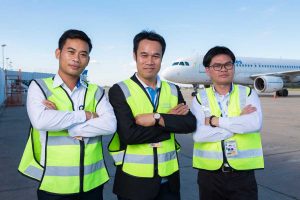
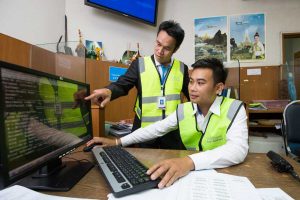
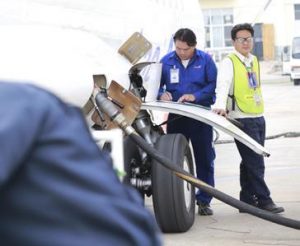
Not for Sisavath Southammavong (centre), who spends his days in an office poring over complicated mathematical formulas, all related to the weigh and balances of everything that goes into an aeroplane before takeoff.

From fuel to food, baggage to passengers, staff to cargo, Sisavath and his team are across it, in numerical terms, making precise calculations to ensure the safety of everyone involved.

Sisavath loves his work, but it wasn’t always a dream job for him. When he finished college and graduated at the age of 23, he, like everyone else, had plans to be a pilot. But health problems forced him to choose a different tack, and he eventually trained to join Lao Airlines’ Weight Balance Division. That was 14 years ago, and he hasn’t look back.

Now the manager of his division, he oversees a staff of 11 and plans to stay in the job until he retires.

But even though he enjoys coming into work every day, the job isn’t always easy.

“A lot of people would like to come and work for this division, but they don’t realise that it’s actually quite difficult work,” he says.

“This job is quite strict with calculations, you have to be exact and precise and sure, and if you’re not that kind of person and don’t like learning formulas, it’s not for you,” he says.

And the training required to do the work is equally rigorous, with four mandatory technical courses, and re-training every two years.

But while the training is world-class and Sisavath has international-grade skills, he has no plans to leave the airline, or his home country.

Instead, he encourages as many people as possible to join him in his field of work, from friends and family to neighbours and their families.

“One of my nephews has already said he wants to be like me,” says Sisavath, with pride.

“But it is important to do it properly and remember safety at all times.


Originally Published in: Champa Meuanglao

48 Hours in PAKSE

Got 48 hours in Pakse to Eat, See, and Do? Use this guide courtesy of Champa Meuanglao magazine, the official inflight magazine of Lao Airlines.

Milk and More

It was an innocent question about buffalo curd that started four expats on a life-changing journey to rural Luang Prabang.

Australians Susie Martin and Steven McWhirter, and Americans Rachel and Matt O’Shea were living as expats in Singapore, half high-flying executives, half trailing spouses.

Yearning for a quieter life, Rachel and Susie came to Laos on a reconnaissance mission, taking in a cooking class in Luang Prabang with an eye to opening a hotel. Wandering through the morning markets with their instructing chef, Susie asked, casually, where they could buy buffalo curd. She was met with stares of horror.

It turned out that, incredibly for them, residents of Luang Prabang had no idea, in a land full of buffalo, that the beasts could be milked.
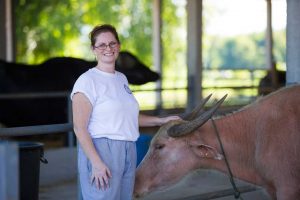
A more concrete idea began to take shape, even as the foursome moved their lives – including five children between them – to Luang Prabang in 2014, where they rented and ran a guesthouse.

After “some sleepless nights and much research”, the team decided that they could set up the country’s first buffalo dairy themselves, and that the local community could benefit in the process.
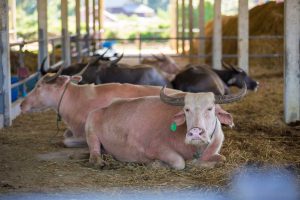
Their combined training was about as contemporary as you can get – lots of Googling and plenty of YouTube tutorials – before they negotiated to rent three buffalo from a local farmer. There followed six weeks of enthusiastic and much-talked-about daily milking – with a milling audience each day – before they finally had enough milk to bring back into town and start making some cheese.
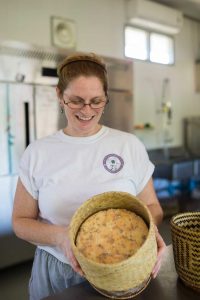
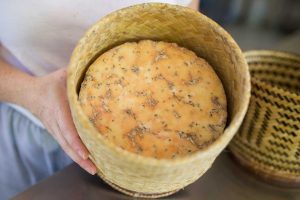
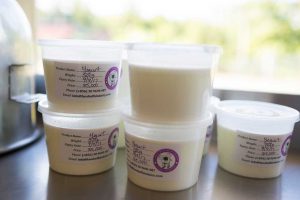
  And not just mozzarella and ricotta, but also yoghurt, ice-cream and cheesecake, that

they shared with local food suppliers, grocery stores, restaurants and friends.

Upon tasting the product, all anyone wanted to know is when the dairy would begin in earnest.

Today, the Laos Buffalo Dairy is well and truly up and running, with 10 buffalo producing 60-80 litres of milk each week (and several more animals about to produce offspring). And while the animals don’t yield nearly as much milk as cows (less than 3 litres a day, while cows produce between 30-50 a day), the product is remarkably high in fat and proteins.

The farm rents each buffalo for around six months, longer if the milk is good, and quarantine and vaccinate pregnant animals against various diseases.
“We’re also working with the Lao government to implement a cross-breeding program to improve the genetic stock of local buffalo, which will mean healthier animals with higher meat and milk yield,” she says.

But, walking us through the milking shed, where we are required to wear protective clothing and rubber boots, Rachel tells us it wasn’t an easy journey.

“We realised what a massive undertaking it would be right from the beginning,” she says.

“Laos, being a developing country, is used to NGOs coming in for a specified period of time and spending a specific amount of money. We had a very hard time explaining that we were planning to be a sustainable business that would go on and on, as long as there was demand for the products we produced and farmers to work with.”

Even then, the team had to apply for nine different government licenses, interview staff and hire 25 “adventurous souls” prepared to help this team of crazy falangs realise their dream.

But they also knew from the outset the scale of the project’s potential.


Written by:  
Sally Pryor
Photos: Phoonsab Thevongsa
Originally Published in: Champa Meuanglao (Official Lao Airlines In-flight Magazine)

27 Cows Killed and Villages Affected By Lightning Strike in Northern Provinces

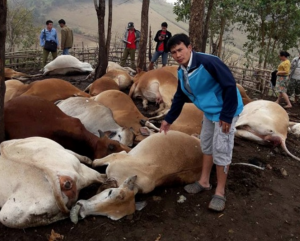
A lightning strike is reported to have killed 27 cows of local villagers in the District of Kenethao in Sayaboury on Thursday morning.

Earlier Wednesday evening, a hailstorm caused damaged to the roofs of 80 households, including 70 houses in Phawai Village and 10 houses in Khangphanien village in the District of Nonghed in Xieng Kuang.

So far, no human casualties have been reported.

Source: KPL

Vietnamese Citizen Behind Fraudulent Laokham Company

Laokham Director named as Vietnamese national

The director of Laokham Consultant Investment Sole Co Ltd, which defrauded the public into making investments, has been named as Vietnamese national Vu Manh Coung.

Mr Vu Manh Coung, 48 years, and his head accountant were arrested on January 16 after members of the public accused the company of defrauding them.

The Lao Ecomonic Police department commenced an investigation into the company six months ago after the company was reported to be running a pyramid scheme and failing to return funds to investors.

Since the news broke on Monday, the number of complaints filed against the company has risen to 80, with total public losses valued at over US$1 million.

Those making deposits were both Lao and Vietnamese nationals, according to a statement by the police.

Laokham was formed in 2013 under the guise of providing investment consultancy to its customers, however it abused the trust of customers and invested their money improperly and in violation of Lao laws.

The company took deposits from customers and used the funds to purchase land and other assets, according to an employee who asked to remain anonymous.

It maintained three branches in Vientiane, Savannakhet, and Pakse. Its website is still operational at www.laokham.la.

This is the second such scam run by a foreign investor in Laos, with a case still under investigation against Cambodian national, Huot Sovonn, who duped the public under his Asianface real estate company.