Home Blog Page 6477

Laos Hopes to Diversify Destinations for Tourists

Laos Hopes to Diversify Destinations for Tourists

Laos has seen a dramatic increase in the number of South Korean tourists over the past few years after the reality TV show, “Youth Over Flowers,” featured  Korean actors visiting famous locations in Laos, particularly in Vang Vieng.

The number of visitors from South Korea to Laos grew in 2015 and 2016, finally beginning to plateau in 2017. The overall market share of South Korea rose to 4.4 percent in 2017, however, according to a report by Laos’s Ministry of Information, Culture and Tourism. The number jumped from 96,085 in 2014 to 170,571 in 2017.

South Korea’s tourism industry took advantage of this trend, launching a series of package tour programs targeting those who wanted to follow the same itinerary presented in the show.

As of this writing, it is still not difficult to find “TV show-themed” tourism programs in South Korea, luring customers with the same old itinerary they developed several years ago.

While Laos still attracts Korean tourists, especially in Vang Vieng, many of these do not make a second trip to Laos.

And this issue is notable among visitors from other countries as well.

According to the latest survey conducted by the tourism ministry, only 7.9 percent of respondents said it was their returning visit to Laos. In contrast, first-time visitors accounted for 75.2 percent.

The Lao government has invited 12 representatives from Malaysia, Singapore, Thailand, China, Japan and South Korea to Bolikhamxay and Khammouane provinces, in a bid to promote other parts of the country.

The familiarization trip to the two provinces is taking place between July 12 and 17 and is designed to publicize some of Laos’ tourist attractions and encourage the tour operators to include some of these locations in their package tours, according to the Vientiane Times on July 15.

The two provinces are considered lesser-known destinations for foreign tourists, compared with the Lao capital Vientiane or famous locations such as Vang Vieng.

Kettasone Sundar, Director of the Marketing Division of the ministry’s Tourism Marketing Promotion Department, told the media that the program would raise the profile of the country’s tourist attractions and the exciting destinations it can offer.

If the Lao government’s goal is realized, more foreign tourists will visit the beautiful natural scenery of Bolikhamxay or Khammouane Province.

Laos attracted more than 4.1 million foreign tourists last year, an 8.2 percent increase from the previous year. Tourism generated revenue of more than USD 755 million in 2018.

Meanwhile, it is expected that at least 4.5 million people will visit Laos this year, generating revenue of more than USD 700 million.

Photo: Champa Meuanglao

Laos Sees Drop in Foreign Direct Investment Inflow

Laos Sees Drop in Foreign Direct Investment Inflow

Foreign direct investment (FDI) inflow to Laos decreased in 2018 amid a drop in new investment from China, a recent report has shown.

FDI inflow to Laos last year stood at USD 1.3 billion, a 17 percent drop from the previous year, according to the World Investment Report 2019 by United Nations Conference on Trade and Development (UNCTAD).

Foreign Direct Investment, or FDI, refers to an investment made by a firm or individual in one country into business interests located in another country.

“The contraction was mostly due to a deceleration of new investment from China,” UNCTAD said in the report without citing figures.

In 2017, China was the largest foreign investor in Laos, with its investments accounting for 25.2% of the total FDI of the country.

Despite a minor setback, Laos has seen FDI inflow rising over the past few years.

FDI inflow to Laos has increased from USD 427 million in 2013 to USD 721 million in 2014 and USD 1.1 billion in 2015.

After experiencing a slight drop in 2016 to USD 997 million, the figure jumped to USD 1.5 billion in 2017.

Such growth comes amid the Lao government’s efforts for “active investment liberalization,” the report noted.

Last year, for instance, the country abolished the minimum registered capital requirements for certain foreign investors, according to the report.

It also promulgated a new investment promotion law, offering various incentives to attract investment in both promoted industries and hardship areas.

Laos is one of the regional players that have been using special economic zones (SEZs) as key policy instruments for the attraction of investment for industrial development.

“In Cambodia, the Lao People’s Democratic Republic and Thailand, most SEZs have been developed near border corridors with neighboring countries, to promote cross-border trade and investment,” UNCTAD said in the report.

UNCTAD also cited Laos as one of the examples countries that have created SEZs to promote tourism or tourism-related industries.

Such zones include the Savan-Seno SEZ, which was developed through a joint venture between Malaysian private companies and the Lao government in 2003.

“Despite its landlocked status, Laos is raising its FDI game as engagement with donors and investors grows,” Nick Freeman wrote in February in fDi Intelligence Magazine, a service from the Financial Times that provides an up-to-date review of global investment activity.

“Laos’s policymakers have largely pursued a reform agenda in order to keep the international donor community engaged,” Freeman added.

He explained some of the largest foreign investment projects in Laos had been enacted as “soft power” projections, intended to establish an economic foothold in the country, citing China’s Belt and Road Initiative.

Freeman also noted that the Laos government has sought ways of utilizing the power of the Mekong River and its tributaries as a source of foreign earnings, citing hydropower projects including the Nam Theun 2 hydropower project.

Photo: Lao-China Railway

WhatsApp the Most Popular Mobile App in Laos

WhatsApp the Most Popular Mobile App in Laos

WhatsApp is the most popular mobile application in Laos, according to a report by the Korea Trade-Investment Promotion Agency (Kotra).

“WhatsApp is the most popular mobile messengers for people across Laos, with features that allow them to communicate with each other easily when their phone numbers are stored on their cell phones.” Kotra wrote.

In second place is Facebook Messenger, a web-based messenger operated by Facebook.

The agency explained that Facebook is not only popular among individuals in Laos but also linked to Facebook pages operated by most companies and institutions in the country.

Facebook Messenger was followed by Garena Free Fire, a mobile first-person shooter game in which players fight against each other until only one player survives.

TikTok, a short-form mobile video sharing app was the next most popular app.

Line messenger took 7th place among popular mobile applications in the Laos.

According to Kotra’s survey, Lao people mainly use Line Messenger to communicate with Thai people and purchase products from Thailand.

Line Messenger is one of the most popular mobile messenger applications in Thailand, with more than 32 million users.

Among locally developed applications, the BCEL ONE mobile banking app developed by Banque Pour le Commerce Exterieur Lao Public (BCEL), Laos’ largest commercial bank, ranked 11th, and an app to type the Lao language ranked 28th.

Most used applications in Laos as of June 24:

1. WhatsApp
2. Facebook Messenger
3. Facebook
4. Garena Free Fire
5. Tiktok
6. Mobile Legends: Bang Bang
7. Line
8. YouTube
9. Ulike
10. iMovie
11. BCEL One
12. Adobe Lightroom

(Source: Kotra)

Laos Launches Online eVisa Service

Laos Launches Online eVisa Service

Lao has launched its long-awaited electronic tourist visa (eVisa) service, which will allow foreigners to apply for a visa online prior to arriving in the country.

The official website for the eVisa application process is https://laoevisa.gov.la

At this stage, the eVisa service will be available at two international ports, namely Wattay International Airport and Lao-Thai Friendship Bridge 1, using the official website mentioned above.

Currently, only tourist visas valid for 30 days are available on the website, and it will take up to three days to obtain it.

Applicants need to follow three steps to obtain the visa online:

Step 1: Provide the application details and upload the necessary documents.
Step 2: Review application and pay the fee online.
Step 3: Download the eVisa Approval Letter

When eVisa application is approved, the letter will be sent to the applicant’s email address that was informed at the time of registration.

According to the eVisa website, payments can be made with VISA, MasterCard, JCB and UnionPay.

Laos first announced its plan to introduce the eVisa system earlier this year with a hope to attract more tourists to the country.

The country set up a goal to have 4.5 million tourists this year. About 4.1 million people visited Laos last year, an 8.2% increase from the previous year.

Laos’ Plain of Jars Becomes UNESCO World Heritage Site

Laos’ Plain of Jars Becomes UNESCO World Heritage Site
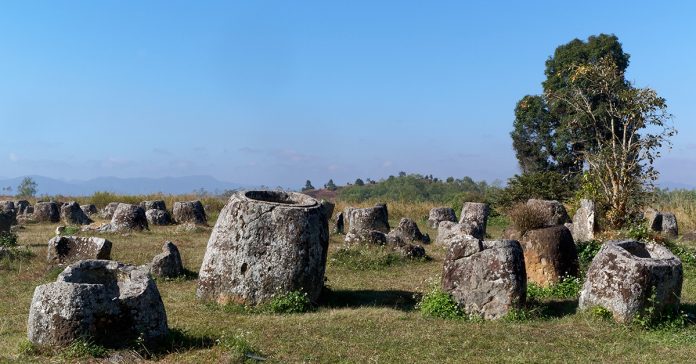
Laos’ Plain of Jars became a UNESCO World Heritage Site in 2020.

The Plain of Jars in Xiangkhouang Province, Laos, has been added to the list of World Heritage Sites by the United Nations Educational, Scientific and Cultural Organization (UNESCO).

The announcement was made at the 43rd Session of the World Heritage Committee held in Baku, Azerbaijan, on July 5.

The Plain of Jars, located on a plateau in northern Laos, is named for the more than 2,100 tubular-shaped megalithic stone jars that are believed to have been used for funerary practices in the Iron Age, according to UNESCO.

Human remains, burial goods, and ceramics discovered at the site dated by comparative material from Dong Son in Viet Nam, to the Early Iron Age from approximately 500 BCE to 800 CE.  The site has been shrouded in mystery for some time.

Laos has been working for 20 years to have the Plain of Jars listed as a World Heritage Site.

In 1998, the Lao government joined hands with UNESCO to initiate a multi-year phased program to safeguard and develop the site.

The program was designed to put mechanisms in place that ensure ongoing protection of the heritage resources linked to bringing socio-economic benefits for the local communities.

At that time, the Lao government expressed commitment to protect and develop the Plain of Jars and nominate the site for World Heritage inscription.

The inscription of the Plain of Jars means that the Plain of Jars is Laos’ third World Heritage Site. The old town of Luang Prabang in Luang Prabang province was inscribed in 1995, followed by Vat Phou and associated Ancient Settlements within the Champasak Cultural Landscape in 2001.

Apart from the Plain of Jars, UNESCO inscribed another six cultural sites in other countries on the World Heritage List.

They were the Dilmun Burial Mounds in Bahrain, Budj Bim Cultural Landscape in Australia, Archaeological Ruins of Liangzhu City in China, Jaipur City in Rajasthan, India, Ombilin Coal Mining Heritage of Sawahlunto in Indonesia, and the Mozu-Furuichi Kofun Group: Mounded Tombs of Ancient Japan in Japan.

Thailand’s First Bullet Train to Include Laos as Destination

Thailand’s First Bullet Train to Include Laos as Destination

Thailand is preparing to launch the country’s first bullet train that will run between Bangkok and Beijing, China, with Laos as one of the intermediate stations.

The “Trans-ASEAN Line” will cover 3,193 kilometers at the cost of about THB 2.07 trillion (USD 67.2 billion) and link Thailand’s Bang Sue with Chiang Mai in the North, Laos in the Northeast, Cambodia in the East and Malaysia in the South.

The Thai government also plans to link the county to other nations as far as Singapore and China through high-speed railways.

It is unclear when the new line would be 100% completed, but the Thai government has already begun the construction of some routes and will “keep calling bids” for the project, Bangkok Post reported on July 6.

In particular, the first route, a Thai-Sino project linking Bangkok and Nong Khai in the far Northeast, is currently under construction and is scheduled to be completed by 2023.

This is a boon to residents in Laos, which is located right next to Nong Khai, since another rail route will take passengers to the Lao capital of Vientiane from the borderline.

The route will reach Mohan, a border town in China’s southern province.

A 414-kilometer new route between Vientiane and Mohan is now 55% complete, said an unnamed Lao official, as quoted by Bangkok Post.

The new line will shorten a traveling time between Vientiane to Mohan from the current up to two days to only three hours.

The Lao official added that the new line would draw between 10 and 20 million Chinese tourists to the country each year.

Road Accidents Continue to Plague Vientiane Capital

Road Accidents Continue to Plague Vientiane Capital

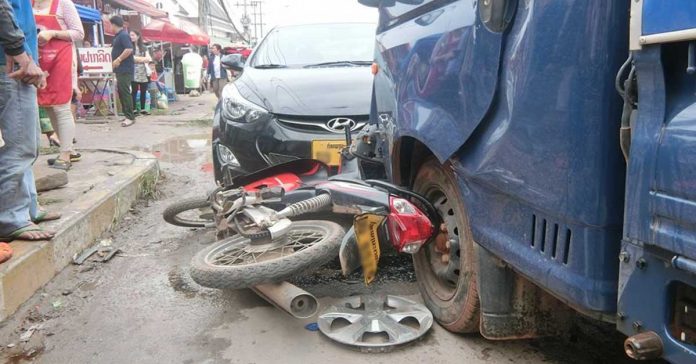
Road accidents continue to plague Vientiane Capital, with the latest figures for the year so far reaching a staggering 525 cases, according to a recent announcement by police.

Lieutenant Colonel Phengsavanh Thammaboun, Head of the Vientiane Capital Traffic Police Department, stated in an interview with the Vientiane Mai that in the first six months of this year, 525 road accidents had occurred within Vientiane.

These figures include 89 deaths.

The district in which the most road accidents occurred was Xaythany District, which saw 148 accidents so far this year, costing the economy LAK 6.3 billion.

Although the number of road accidents remains high, the capital city has at least seen fewer incidents than in previous years, with nine fewer accidents than in 2018, and 17 fewer deaths.

According to reports from the police, almost all road accidents have occurred due to reckless driving or ignorance of traffic regulations. A general lack of awareness or respect for traffic regulations still prevails among drivers in Laos, with many cases of speeding giving rise to accidents.

A large number of vehicles are unroadworthy, causing traffic problems, while drunk driving remains a common occurrence as well.

The Vientiane Capital Road Traffic Department urges all motorists to take extra precautions when driving, ensure that they respect traffic regulations, and exercise better manners when driving – giving way when necessary and respecting the rights of other drivers.

Photo: Vientiane Rescue

Lao Airlines Renews Global Safety Standard Certification

Lao Airlines Renews Global Safety Standard Certification

National flag carrier Lao Airlines has passed an audit and renewed registration from the IATA International Air Transport Association Operational Safety Audit (IOSA).

The IOSA program is an internationally recognized and accepted evaluation system designed to assess the operational management and control systems of an airline.

Six auditors worked with Lao Airlines from June 24 and 28 to evaluate the airline’s services in various fields, including safety, quality of security, flight operations, reporting culture, preventive action, and safety management system.

Lao Airlines first achieved IOSA certification in 2015, and since then, it has undergone a safety inspection every two years by the IATA to ensure the required standards are maintained. The company renewed its certification in 2017.

This marks the latest efforts by the airliner to bolster its safety standards.

Lao Airlines has also signed a strategic partnership agreement with Avia Nautics. Under the partnership, Avia Nautics acts as a consultant for Lao Airlines in extending the Enhanced IOSA.