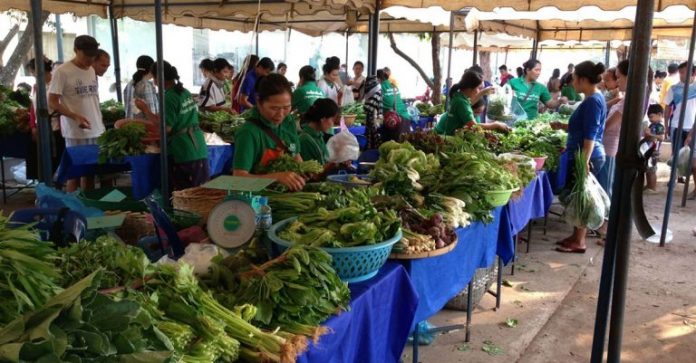
Vientiane Organic Farmers Group (photo credit: memoriesare.blogspot.com)
Vientiane Capital authorities are to establish a permanent location for an organic farmer’s market in Nonghai Village, Hadxaifong District.
The Vientiane organic agriculture group first began selling produce at temporary stalls twice a week at the That Luang esplanade in 2006. The market was then moved to Fa Ngum Park where goods were sold twice per week, with stalls eventually moving to Vientiane Center and ITECC exhibition center.
While the consumer response to organic markets has been extremely positive, the changing location has caused confusion among shoppers.
According to the Vientiane Times, Minister of Agriculture and Forestry Dr Lien Thikeo told the media that a permanent market would reduce the problems faced by farmers who currently have to showcase their products at a number of different locations. This has made sales more difficult, as consumers were not always sure of where the organic market may be set up.
The new market will provide farmers with more space and a permanent location for consumers to visit.
Better management of organic farming will ensure higher standards, and a higher quality product, while the new market will allow the government to more closely monitor prices.
Vientiane Times reports that the capital city is home to 17 organic farmers’ groups that work over 175 hectares of land. Over 1,000 tonnes of organic produce is grown and sold per year.
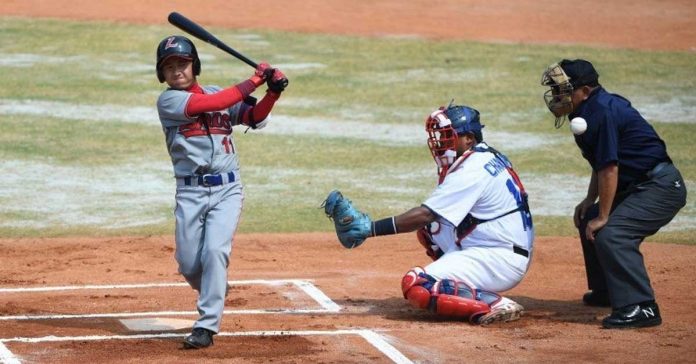
Laos saw its first baseball team formed in 2013 when just ten people began with practice sessions at a car park in the capital city of Vientiane. Now, the sport is rapidly developing, with Laos already recognized as the rising star of Asian baseball.
Despite its short history, Lao baseball has made remarkable progress. More than 100 Lao people now enjoy the previously non-existent sport.
The country dispatched a national team to the 2018 Asian Games, the first time that the country participated in an international match and has successfully hosted its first domestic league.
All sounds positive and promising, but what does this actually mean to Laos? What benefit could the growth of the baseball industry bring to the country?
Global baseball leagues
Baseball leagues are one of the most profitable sports leagues in the world.
In 2018, the Major Baseball League (MLB) in the United States ranked as the second most profitable sports leagues in the world at USD 10.7 billion.
In particular, MLB’s growth is remarkable. The league surpassed the USD 10 billion revenue mark in 2017 after seeing steep growth.
MLB’s industry revenues that account for expenses and other investments came in at USD 9.7 billion for 2019, up from USD 9.4 billion in the previous year. MLB player payrolls and benefits for the year came in at USD 4.7 billion.
Baseball is one of the official sports for the Olympics, and one of the most popular global competitions; World Baseball Classic (WBC) now welcomes participants from 15 countries across the world.
Baseball in Laos
An example from the Dominican Republic
As figures above show, the U.S. is still the center of the baseball universe, but interestingly, about a quarter of MLB players are from outside the U.S., with 102 players hailing from the Dominican Republic.
This means that more than 10 percent of players in the world’s most profitable baseball league come from the small Caribbean country with a population of only 10.7 million.
It’s estimated that Dominicans earn more than USD 400 million annually in the MLB, while players in minor leagues earn another USD 200 million. A lot of this money makes its way back to the home country.
Baseball has also contributed significantly to the Dominican Republic’s domestic economy, with the baseball industry estimated to generate about USD 1 billion each year.
This figure includes revenues from training and recruitment facilities in the country that draw in thousands of aspiring baseball players. As players from the Dominican Republic perform well in big leagues, including MLB, the country has also become a training ground for neighboring nations, including Venezuela, Panama, Mexico and Cuba.
Considering that the country has a GDP of USD 76 billion, it’s clear that baseball has a big impact.
In addition, baseball players contribute to society in many ways. Most of these MLB players take the lead in community service by participating in baseball leagues in the Dominican Republic and spending their post-retirement lives there.
Some become celebrities and entrepreneurs and in some cases even government officials, and serve as social role models.
How can Laos benefit?
Laos could follow in the Dominican Republic’s footsteps, especially operating as an incubator for competitive players, and eventually a training ground for neighboring nations in Southeast Asia.
Baseball is already active in many Southeast Asian nations, including the Philippines, Thailand, and Indonesia.
While some are more advanced than others, Southeast Asia is not ready to compete on the global stage, as the region has yet to send a team to compete in the WBC.
Although Laos is a late starter, Lao baseball has great potential, and with support from countries like South Korea, it could eventually overtake its peers and become the leading nation in Southeast Asian baseball.
Lee Man-soo, a former South Korean baseball player and the coach for professional baseball team SK Wyverns, said during his latest press interview that the Lao national baseball team shows a skill level on par with the third grade of elite middle school players in South Korea, adding that the team is growing and improving at a fast pace.
This is high praise indeed, as middle and high school baseball players in South Korea are often a popular target for MLB scouts. The South Korean national team that consists of 18-year-olds and below took second place in the latest U-18 Baseball World Cup held in 2017.
With a government-backed baseball federation newly formed to support the industry in Laos, and the country’s first baseball stadium about to open, it may not be long before scouts from MLB or other advanced baseball leagues visit Laos in search of outstanding players.
“I may have been the first, but I certainly won’t be the last,” says Dr. Anoulak optimistically.
According to Dr. Anoulak, working for the UN at the famous matchbox headquarters in New York City was a dream come true. He recalls that the members of the cohort with whom he entered were not only the best and brightest but also idealists.
“My colleagues wanted to use their wits and intelligence to save the world from conflict and poverty. Everywhere we went as UN staff from NY, we were respected and taken seriously.”
The highlight of his time was leading the preparation for the UNSG’s official visit of the Pacific Islands countries and participation in the Pacific Islands Forum’s Leaders Meeting in 2010, where he remembers stressful hours, tight deadlines, and multiple parties and factors to consider. But in the end, he got to travel with UN Secretary-General Ban Ki-Moon as a member of his caravan.
Given the contributions made by Laos to the UN, there should normally be at least six or seven Lao nationals employed at the UN Headquarters in New York, says Dr. Anoulak. But somehow he is still the only Lao national to have worked at the UN Secretariat, between 2010 and 2014.
Dr. Anoulak suggests that those who hope to go abroad for work or be a part of international organizations need to be more proactive, and try their best to have a wider perspective along with a global viewpoint.
The first step to achieve this is to improve foreign language skills, especially English, said Dr. Anoulak, adding that while receiving a foreign education could be a great help, it is not as necessary these days.
More importantly, he stressed the need to develop good foundations in skills, including soft skills such as critical thinking, writing, and speaking precisely and clearly.
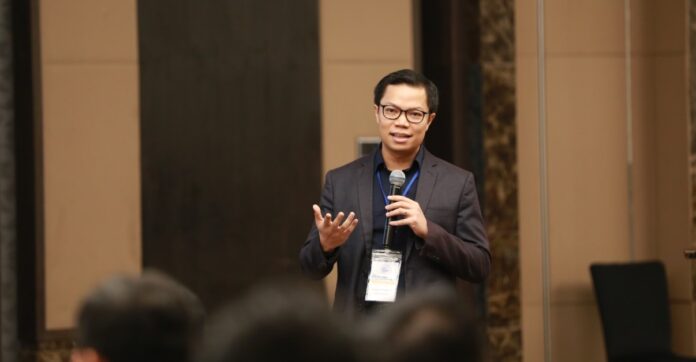
Dr. Anoulak Kittikhoun in his official capacity as Chief Strategy and Partnership Officer at the Mekong River Commission
“This is because these are the foundations to acquire more knowledge, make friends and networks, and reflect on your successes and failures,” he said.
Recalling the year 1988 when he first left Laos for the United States, Dr. Anoulak said the environment and infrastructure for education in Laos have dramatically improved.
In particular, he cited easier access to online resources.
“YouTube did not exist when I was young,” Dr. Anoulak said with a grin on his face. “Resources are out there. The important thing is to have a more proactive attitude and be ready to utilize them.”
It is often pointed out that “brain drain” is an issue for developing countries like Laos when too many students wish to study or work overseas, but it appears that Dr. Anoulak has a different approach to the subject.
This is because one of the main motivations for him to work for the UN was his desire to contribute to his home country by being a part of an international organization as a Lao citizen. A similar motivation played an important role when he decided to join the MRC in 2012.
Dr. Anoulak has spent almost eight years with the MRC, and during his tenure, the MRC has become an essential agency in the region, to which the international community pays close attention.
“I feel like the MRC and I have evolved together,” he said cheerfully. Dr. Anoulak sees himself being able to grow professionally within the MRC, and his face lights up when sharing his outlook with the organization and how he wants to and can contribute.
It was not difficult to tell that he was fully ready as ever to pave the way for a new path yet again.
With a new book entitled River Basin Organizations in Water Diplomacy coming out in November this year, Dr. Anoulak is contributing to the theory and practice of international rivers management and the critical role of river basin organizations such as the MRC.
River Basin Organizations in Water Diplomacy, Edited by Dr. Anoulak Kittikhoun and Suzanne Schmeier
“Although I’m in quite a good position with lots of great responsibilities at the moment, I want to see myself taking up a more important role within the organization in a few years, which would naturally help me contribute more to Laos, the Mekong, and the world,” said Dr. Anoulak.
No cases of the new coronavirus have been confirmed in Laos, according to Lao Minister of Health, Professor Bounkong Sihavong who spoke at a press conference yesterday.
The minister responded to rumors spreading on social media regarding a patient under treatment in Vientiane as simply untrue.
“There has so far been no confirmation of any patients infected with the new coronavirus in Laos,” said Minister Bounkong. “Suspected cases have all proved negative.”
Although a sick Chinese national and her child arrived in Laos on January 20 from Wuhan, in Hubei Province, China, her illness tested negative for the new virus originating in Wuhan. The mother and child remain under observation.
Lao social media has been inundated with fake news in recent days after claims were made that a patent was undergoing treatment for the new Coronavirus at Vientiane’s “150 Bed” Mittaphab Hospital.
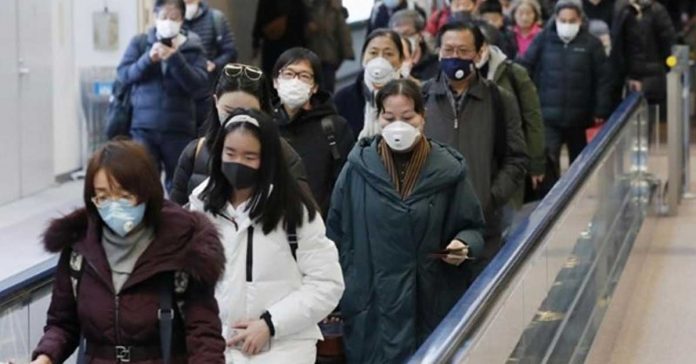
The government of Laos has tightened screening and quarantine measures at all its borders, with entry to Bokeo’s Golden Triangle region temporarily closing its borders to citizens of China and Myanmar.
Minister Bounkong did say that screening was difficult, as the equipment used to monitor the temperatures of foreign visitors upon arrival would not detect anyone in the early stages of the virus who would likely not show symptoms.
According to the World Health Organization (WHO), indicators of coronavirus infection may include respiratory symptoms, fever, cough, shortness of breath and breathing difficulties. In more severe cases, the infection can cause pneumonia, severe acute respiratory syndrome, kidney failure, or death.
The WHO recommends frequent handwashing, covering the mouth and nose when sneezing or coughing, and thoroughly cooking meat or poultry products.
The Lao government has set up a hotline, 166, for those wanting information about the virus, as the government attempts to stop the spread of fake news.
Thailand has confirmed eight cases over the virus, while Vietnam has detected two cases, and Cambodia has reported its first case overnight.
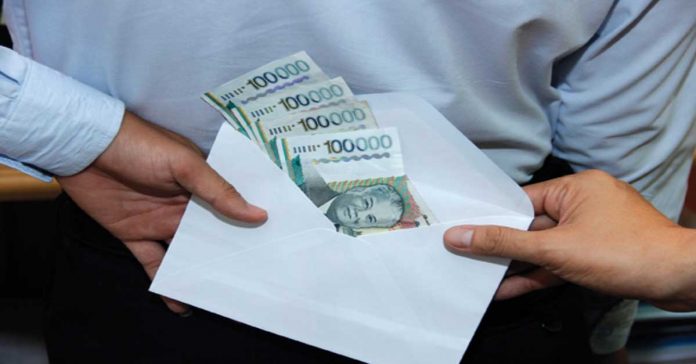
Laos has been ranked 130th on the 2019 Corruption Perceptions Index (CPI,) two places above last year, becoming one of a few countries in Southeast Asia to see less corruption.
CPI, released by Transparency International, ranks 180 countries and territories by their perceived levels of public sector corruption, according to experts and businesspeople.
Laos has gradually climbed the index over the past few years. Its ranking rose from 135 in 2017 to 132 in 2018 and 130 in 2019. It is one of very few countries in Southeast Asia to climb the ranking.
In contrast, some of its close neighbors have slipped further down. Thailand, for instance, ranked 96th in 2017 but it slipped to 99 in 2018 and 101 in 2019.
Laos signed the United Nations Convention against Corruption in 2003 and ratified it in 2009, with 186 State Parties.
The Lao government has been focusing on anti-corruption awareness-raising among civil servants and students to increase transparency in the country.
In an attempt to crack down on corruption, the government is pursuing capacity building in the development of human resources and improved legislation such as the Law on Anti-Corruption.
In addition, the Government Inspection Authority issued an instruction in February last year to law enforcement agencies to create conditions that enable people from all walks of life to participate in the fight against corruption.
“The instruction appeared to be the first-ever reference to detailed ways that members of the public can participate in the fight against misconduct and corruption,” Vientiane Times said at that time.
The number of Lao visitors to Japan’s city of Kumamoto is expected to grow four times bigger in the next ten years after the new airline routes between the Lao capital Vientiane and the Japanese city are launched, according to the latest estimation.
Such estimation was made at a forum, which was held in Kumamoto on January 20, to discuss the possible economic impact of the new routes, which will be launched on March 18 and operated by Lao Airlines.
Norihiro Izuno, a professor at Kumamoto Gakuen University and a forum participant, said South Korea has seen the number of visitors from Laos increasing sixfold after opening direct routes between Laos and South Korea eight years ago.
Japan could enjoy the same benefit with the new routes, and the number of Lao visitors is expected to increase to about 160,000 in the next ten years, about four times bigger than the current number, he said.
In addition, experts who participated in the forum said that the exports and imports of light and small electronic equipment and other high-value-added goods are expected to increase between the two countries, while there would be more business opportunities for Japanese firms that are interested in not only in Laos but also in Southeast Asia.
In November last year, soon after the news of the new routes came out, the Kumamoto city said it will increase its promotional efforts for the routes amid a drop in the number of passengers who use the city’s airport.
During an interview with local press, an unnamed city official stressed the importance of the new routes to Laos, adding that the city would try its best to attract more visitors to and from Laos.
A total of 7,161 people used the city airport in September, a 41.7 percent drop from the same month last year.
At that time, the official cited the stalled relationship between Japan and South Korea and the ongoing protest in Hong Kong as the main reasons that might have contributed to the decrease.
The World Bank has classified Laos as a lower-middle-income economy in its latest classification for the 2020 fiscal year.
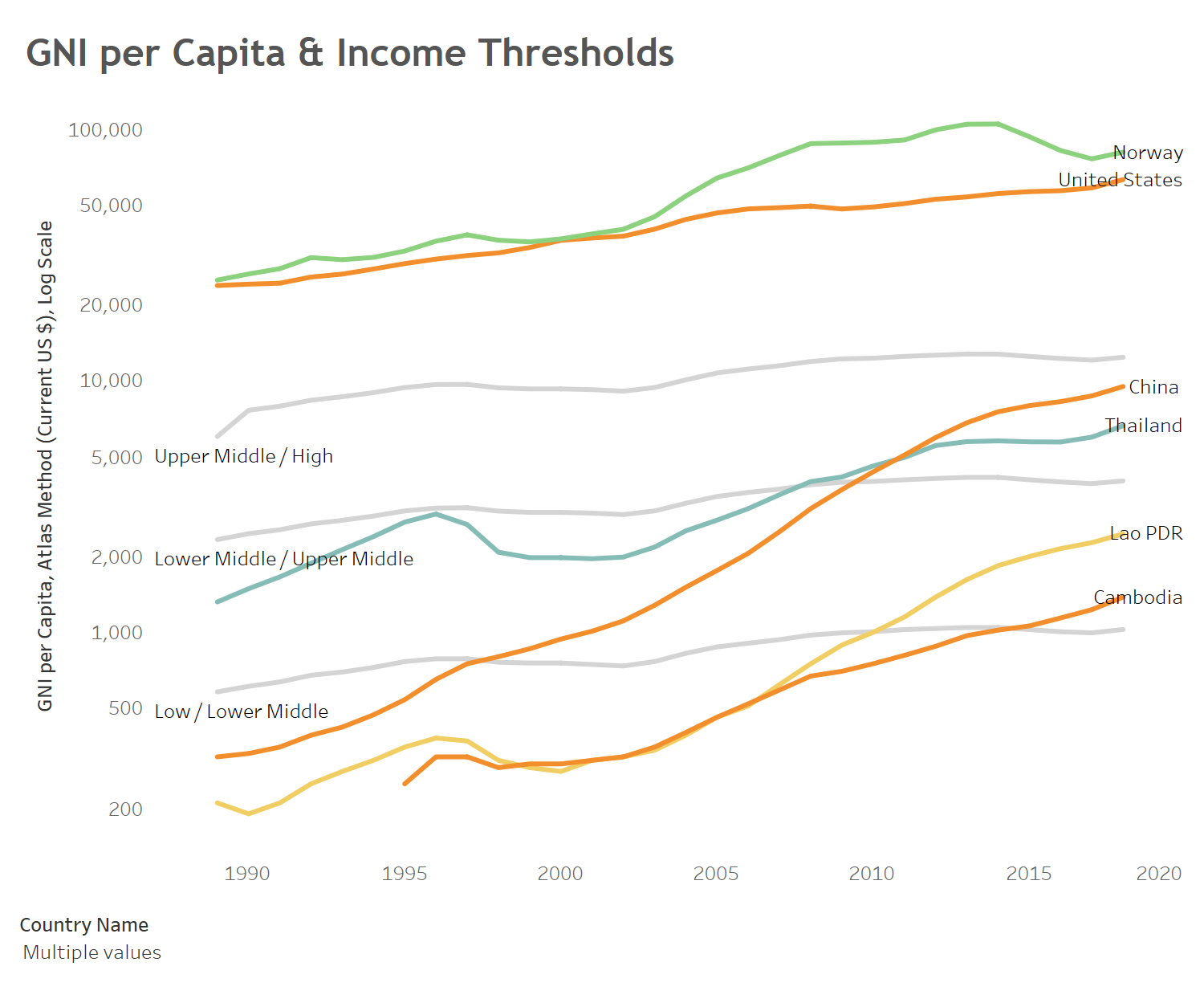
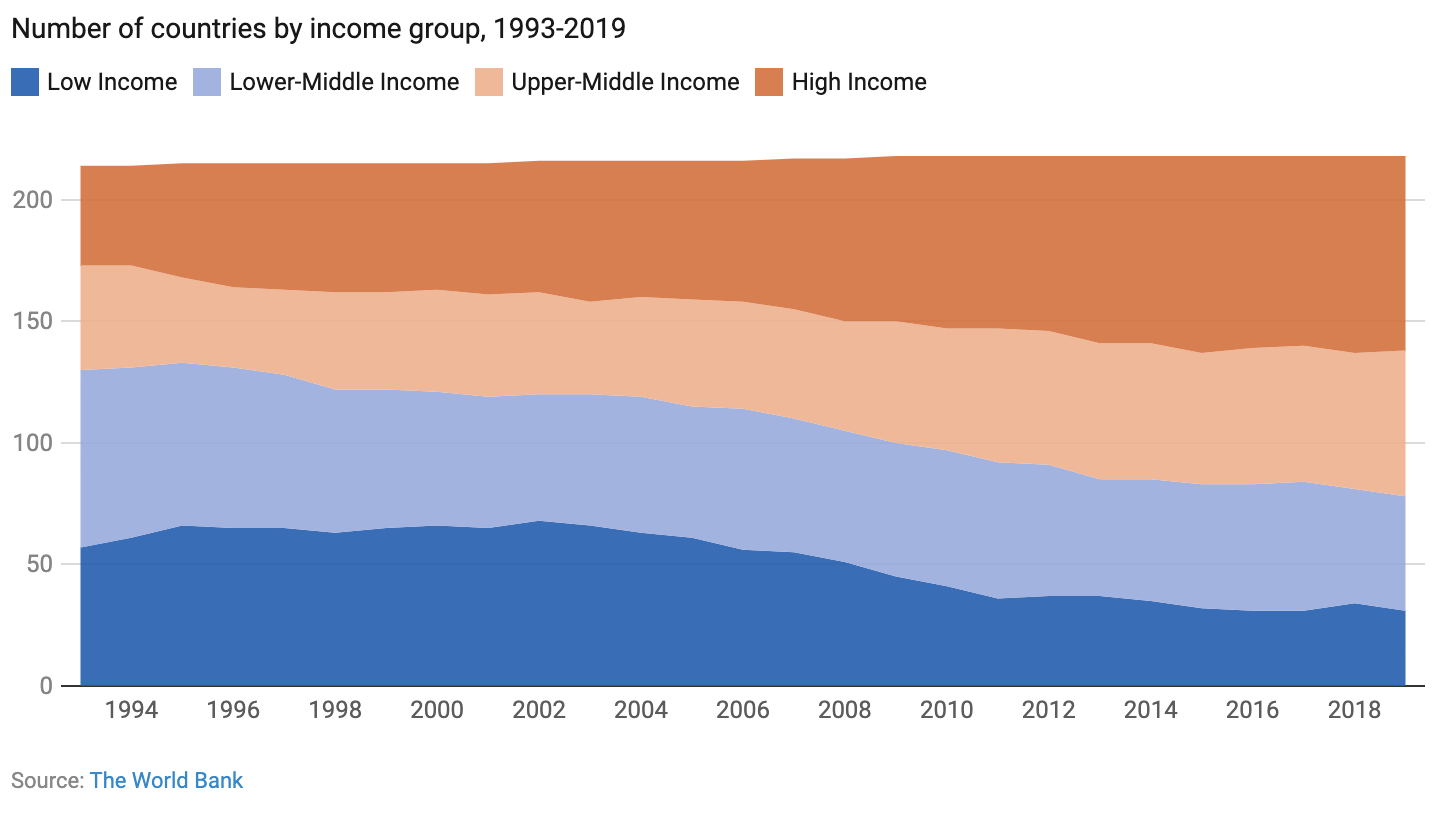
The bank classifies the world’s economies into four income groups, namely high, upper-middle, lower-middle, and low, based on Gross National Income (GNI) per capita in U.S. dollars.
Lower middle-income economies are those with a GNI per capita between USD 1,026 and USD 3,995.
The World Bank decides such classifications by two factors: a country’s GNI per capita and classification threshold.
GNI Capita & Income Thresholds (US, Finland, China, Thailand, Laos, and Cambodia)
A country’s GNI per capita can change with economic growth, inflation, exchange rates, and population, while the thresholds are adjusted for inflation annually using the SDR deflator, which is determined by summing the values in U.S. dollars, based on market exchange rates, of a basket of major currencies, the U.S. dollar, Euro, and Japanese yen.
The threshold for the upper-middle-income classification is USD 3,996 and USD 12,375, while that for the high-income classification is more than USD 12,375.
The number of high income countries has increased and the number of low income economies has decreased since 1993 (source: World Bank)
The classification tables include all World Bank members, plus all other economies with populations of more than 30,000, according to the bank.
The term country is used interchangeably with economy and does not imply political independence but refers to any territory for which authorities report separate social or economic statistics, it added.