

Home Blog Page 6456

Or-Laam: A Dish Fit For A King

Or-Laam

It wasn’t an easy job, being a Lao king. Imagine the discomfort of having to dress in the finest silk and adorned in the purest gold in an air-condition-less era in one of the most humid places in the world. Imagine the burden of wandering around the royal gardens anticipating the next invasion from warring neighbouring armies, monitoring the tributes that vassal princedoms had to pay, balancing the complex power-hungry factions of the court, and last but not least having to select a politically agreeable husband for your daughter.

But even with the weight of the kingdom on his shoulders, a king still has to eat. We do not often think about that vital and much-anticipated interruption – the queen calling him in for an elaborate supper. One that took many hours to make, and, in Laos, almost certainly featured Or Laam.

Like many traditional Lao dishes, Or Laam is made from simple ingredients that have been available to local people for as long as anyone can remember. And, like many Lao dishes, the secret to Or Laam’s distinctive flavour and texture is mired in the country’s long history.

But the famous Luang Prabang delicacy differs from many other much-loved Lao foods in that it is, quite literally, a dish prepared for a king.
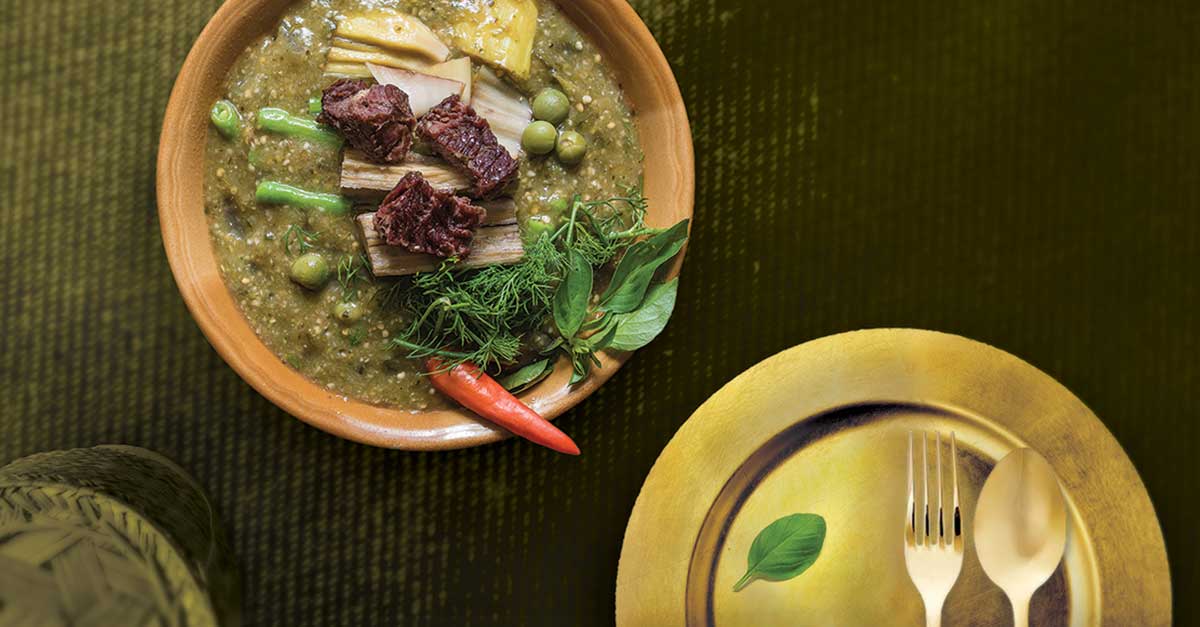
Or-Laam

Centuries ago, and even as recently as the 1940s and 50s, rural populations in northern and central Laos often ate what has become known as Or – small amounts of meat stewed in large amounts of vegetables. The meat was usually whatever had been caught that day which also had to be bulked up – for nutrition as much as meat scarcity – with as many vegetables that came to hand, with the dish varying in ingredients from village to village, province to province.

But when it came to cooking for the royal family, no expense could be spared, both in terms of time, and the quality of the ingredients. The country’s finest chefs discovered that meat that was already cooked – grilled or sun-dried – was far more fragrant and flavourful when it was boiled than fresh meat, preferably for at least two to three hours at a time. And it was only after years of culinary trial and error did the chefs come to the realisation that when added to the stew, another ingredient, pepperwood (known in Lao as sakkhan), created another wonderfully magical aroma that gives Or Laam its title as the dish of kings.

If planning Or Laam for the King’s supper, the kitchen staff would usually begin preparing the elaborate dish around noon – selecting the dried or grilled meat, and boiling it with vegetables including eggplants, yardlong beans, black-ear mushrooms, lemongrass, chilli and pepperwood. It is a dish that, for centuries, was synonymous with luxury, requiring the means to source the very best ingredients and plenty of time in which to prepare it.

It is, in other words, a dish fit for a king, although today, many traditional Lao restaurants serve it. The Champa Meuanglao Editor’s choice is the version served up by the Vientiane institution Kualao Restaurant, a much-loved restaurant housed in a beautifully restored, yellow-walled French villa in the city centre, close to the equally iconic That Dam stupa.
Champa Meuanglao

Written by: Francis Savanhkham
Originally Published in: Champa Meuanglao,  official Lao Airlines in-flight magazine, 2017 May-June Edition

Naked Espresso: Bringing Café Cool to Vientiane

Naked Espresso CML

When he arrived in Sydney as a student in 2001, Ariya Khamvongsa spent his first days sightseeing.

But as he took in the famous Darling Harbour and the iconic bridge, it wasn’t the world-famous landmarks that caught his eye – it was a queue outside a harbourfront café.

With no idea why he was lining up, he gamely joined the queue, and was baffled when he reached the end and discovered what everyone was waiting for – a coffee.

“I said, it’s gotta be something good! So I lined up with them, and then realised, oh, you’re waiting for a coffee?” he says.

“Australians and their coffee is just manic – they drink a lot! It’s all about their coffee. That particular place, Jamaican Blue Cafe, did up to 1000 cups a day.”

Until then, Ariya, known back in his home country of Laos as “Pop”, had never liked coffee, at least not the bitter black brew with sweetened condensed milk everyone drank in Vientiane. But on this day, he tried a latte – with two sugars.

The next day, he went back and asked for a job, becoming a dishwasher and later, a sandwich-maker, in the hours around his studies. By the time he’d graduated to waiter and, finally, a fully trained barista, he had weaned himself off the lattes, one sugar at a time, and hasn’t drunk anything but espresso since.

That was a long time ago, when he was just 18. Today, 16 years later, he’s the proud owner of Naked Espresso a growing empire of hip, buzzing coffee shops. They are distinctly urban-Australian, with industrial-style décor, “latte art” infographics on the wall and energetic young staff in yellow shirts, all bearing the café’s logo.

But outside, the tropical heat and narrow streets couldn’t be more difficult than an Australian city. Naked is Vientiane’s very own slice of Australia – or four and a half slices, to be precise.

[ngg_images source=”galleries” container_ids=”21″ display_type=”photocrati-nextgen_basic_thumbnails” order_by=”sortorder” order_direction=”ASC” returns=”included” override_thumbnail_settings=”1″ thumbnail_width=”100″ thumbnail_height=”75″ thumbnail_crop=”1″ images_per_page=”20″ number_of_columns=”0″ ajax_pagination=”0″ show_all_in_lightbox=”0″ use_imagebrowser_effect=”0″ show_slideshow_link=”0″ slideshow_link_text=”[Show slideshow]” template=”/home4/laotiantimes/public_html/wp-content/plugins/nextgen-gallery/products/photocrati_nextgen/modules/ngglegacy/view/gallery.php” maximum_entity_count=”500″]

Speaking in his flagship café in a street off the riverfront in Vientiane’s bustling town centre, Pop says he knew, right from the start, that he would probably run a coffee shop someday, switching his studies from accounting to international hospitality and hotel management – a decision he says his parents found difficult to understand at the time.

But it wasn’t until a visit to Vientiane in 2010 that he realised he could do it here, and that his real inspiration was closer to home.

He remembers sitting with his wife at Khop Chai Der restaurant in the town centre, and observing streams of foreigners coming in and out of Joma Bakery Café across the street.

“It’s very inspiring to see the amount of people walk in – they’re the Starbucks of South East Asia,” he says of the Canadian-run local chain.

“There’re three in Vietnam, four in Cambodia. It’s very consistent, very systematic – they’re just spot-on.”

The two decided to return to Vientiane to start a family and set up their own café – a long journey that brought them eventually to their first venue on Dongpalane Road.

The atmospheric Naked is named after the type of filter Pop uses in his machines – harder to master and known technically as “bottomless porta-filters”.  

“That was harder to say and a bit long and boring, so we went with Naked,” he says.

The first Naked Espresso branch – Sydney-style with modern art and vintage bicycles on the walls – opened in 2012, on his 28th birthday. At first, he says, his clientele was mainly foreigners looking for an authentic coffee fix that was closer to what they were used to. But steadily over the intervening five years, he has noticed more and more Lao people embracing café culture.

“When I first opened my first shop, there were only four or five cafes, and now there’re about 50 cafes [in Vientiane],” he says.

He says both locals and foreigners love to work over coffee on their laptops, have meetings or catch up with friends – just like in Australia.

“That’s our plan, to bring Australian coffee culture to Laos,” he says.

“We’re celebrating 65 years [of diplomatic relations] between Australia and Laos and I think Australia has given me a lot.”

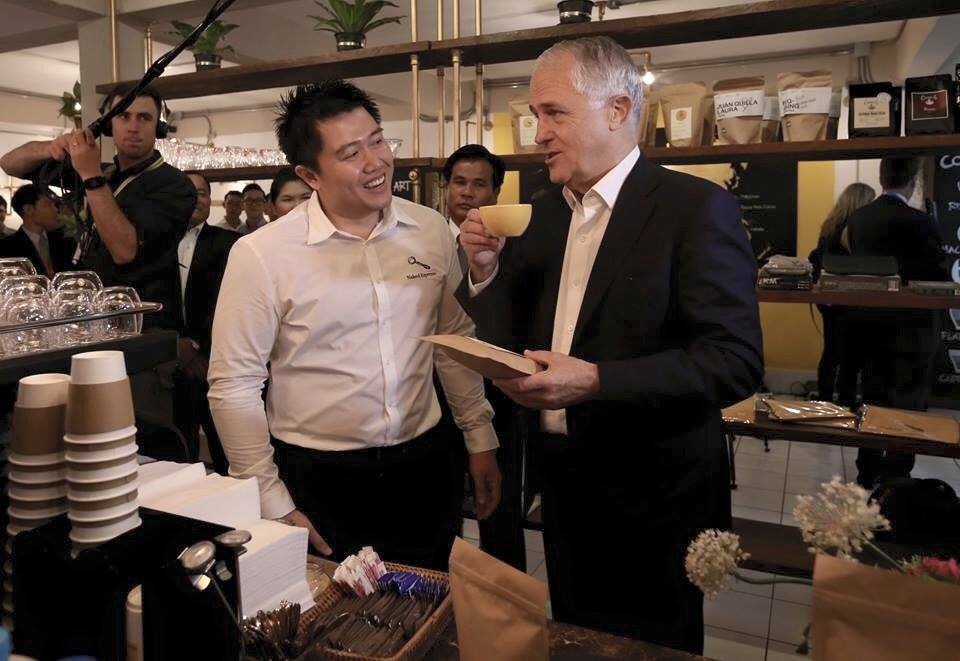
Prime Minister Malcolm Turnbull at Naked Espresso

And he even got the chance to tell this to the Australian Prime Minister, Malcolm Turnbull, in person when he was in Vientiane for the ASEAN Summit in September, 2016.

The Australian Embassy, wanting to give Mr Turnbull a memorable experience while in Laos, selected the Naked Espresso riverside branch as a venue for a special reception.  

“It just was a dream come true – he’s a guy that I look up to,” Pop says.

“We even created a Prime Minister’s blend, very limited.”

Today, two of the four Naked Espresso branches are franchised, with one to open shortly in Vientiane’s up-and-coming cafe and shopping district on Khouvieng Road, and another slated for Luang Prabang. He’s planning a roasting house and barista training courses, and is focusing more and more on using single blend coffees from Laos and overseas.

We tried to set up a new standard that I think eventually people will want to explore, what the international world is like.  

“We also do events, pop-ups, boat racing and That Luang. We’re trying to bring Lao people in. Now it’s picking up the Lao younger generation.” 

“We try to be a supporter to other cafes as well. My aim is to step back and do wholesales now,” he says.

“We’ve got this theme that we’ve tried to build values – that hospitality is a good job. Laos needs it because it’s a small country. People were quite embarrassed to be working as a waiter in Lao culture, but now it seems like people are enjoying it.”

He’s not the first to say it, but of course, happy staff leads to happy customers – not a problem for the Naked Espresso franchise in Vientiane’s coffee renaissance.


Champa Meuanglao
Written by:
Sally Pryor
Originally Published in: Champa Meuanglao,  official Lao Airlines in-flight magazine, 2017 May-June Edition
Ministry Focused on Wiping Out Malaria

Malaria Laos

With the theme being ‘End Malaria for Good,’ for World Malaria Day 2017, the Ministry of Public Health has set forth an ambitious goal to reduce the number of malaria infections and deaths in the upcoming years.

At the 60th session of the World Health Assembly in 2017, a meeting sponsored by the World Health Organization (WHO), a proposal was put forth to change ‘Africa Malaria Day’ to ‘World Malaria Day’ in an effort to shed light on the existence of malaria in countries worldwide, and to create awareness on the global fight against the preventable disease.

Minister of Public Health, Mr Bounkong Sihavong, stated that in recent years people have been getting sick and dying of malaria and that has caused a negative impact on the socio-economic development in many countries around the world.

According to the WHO, an excess of over 200 million people were infected with malaria and 429,000 were killed by the disease in 2015 worldwide. There was a 21 percent decrease in the number of people infected, while deaths from the disease decreased by 29 percent as compared to 2010.

In Laos, over 16,000 people were reportedly infected with malaria last year, with 1 life being claimed. That’s 44 percent lower than the figures reported in 2015, when more than 36,000 people were infected with malaria.

“Until 2000, Malaria had been a significant health problem. However, our ministry has an ambitious plan to reduce the number of people infected with malaria and eliminate the disease by 2020,” stated the Minister of Public Health.

Cash Will No Longer Be Accepted for Tax Payments in Laos

Cash Tax Economic Growth

According to the Minister of Finance, Mr Somdy Douangdy, several new systems have been installed to ensure tax payments can be processed through banking systems and digital technologies, allowing government tax officers to relinquish receiving tax payments in cash directly from taxpayers.

Addressing questions raised by people’s representatives, Mr Somdy gave a briefing on the methods and measures in managing revenue collection, that have been devised and implemented by the ministry to prevent revenue leakage and maintain that applicable regulations are obeyed.

As of 2016, the Ministry of Finance has developed custom and tax payment instruments to ensure entrepreneurs can pay customs and taxes conveniently.

These include Smart tax, Smart VAT, which can be used to settle tax payment when passing border checkpoints, and other bank-based tax payment systems.

The ministry is currently working on expanding several technologies to make it more convenient to pay taxes and fees through ATMs and smartphones, preventing tax officers from directly receiving taxes in cash.

The ministry is increasing revenue sources,  suggesting entrepreneurs to inspect bookkeeping, installing tax devices, promoting cash registration at hotels, restaurants, shopping centres, and establishing a revenue management database.

These revenue source expansion endeavors are funded with a soft loan from the Republic of Korea and will take around two years to complete.

Officials Require Progress on Land Concessions

Land Concessions

The government will begin to firmly regulate concession projects by withdrawing land if no advancement is made on the proposed project, urging authorities to participate in the process.

Speaking on behalf of the government, Prime Minister Thongloun Sisoulith, set forth the new regulation in response to the National Assembly’s (NA) concerns regarding land concessions.

The PM stated, “if an investor who has been given a concession is found not to proceed with the stated project in the timeframe agreed, I ask local authorities to actively investigate and report their findings to the government.”

Officials acknowledge that several concession projects have been granted, but investors seldom fulfil their end of the bargain, neglecting the contract and relevant laws. In most cases, people applying for these concessions acquire the land for the purpose of transferring it to other investors, thereby making a profit.

Relevant ministries are requested to urgently take action when they receive a report indicating possible misconduct.

NA members also touched on the issue of investors refusing to obey the requests of local authorities. Prime Minister Thongloun explained that local authorities would be required to sign off on all concession deals and other development project agreements made at the central or local level.

The Prime Minister also addressed the subject of encroachment onto state land by investors with, “in this case, local authorities have the right to use measures directly to prevent encroachment at the first stage before it continues any further. The authorities should not wait for orders from the government. If local authorities are unable to influence the situation, please inform the related sector or ministry so they can deal with the matter.”

Acquiring land without further advancing it, not only delays the country’s development but denies other developers the opportunity to use the land effectively.

Clarifying that the government would not allow a monopoly in investment, but supported competition he added, “Effective investment and the implementation of development projects that follow the law will help to strengthen the economy.”

According the Prime Minister, the government is revising its policies before submitting them to the Politburo, which is expected to propose a resolution by the Party Central Committee in order to appropriately address the issues regarding land use.

Ministry Emphasizes Importance on Copyright Protection

copyright-dvds-laos

The issue of copyright protection, or lack thereof, has persisted throughout Laos for a number of years. Director General of the Department of Intellectual Property, Dr Khanlasy Keobounphanh, explained that most people in the country do not have an adequate understanding of the concept of a copyright.  

The director stated that after so many copyright violations, the owners of copyright have pleaded with the department to address the issue.

There have been a multitude of copyright violations indicated by the sale of certain goods in markets and various shops. However, since they have not been registered with the Department of Intellectual Property, the Ministry of Science and Technology are powerless.

The protection of intellectual property applies to industrial designs, the layout of integrated circuits, trademarks, geographical indications, new plant varieties, copyright and related rights and traditional knowledge- just to name a few.

The purpose of registering is to protect intellectual property rights, create justice in society and contribute to a sustainable socio-economic and cultural development.

All commodities produced in Laos will include copyright protection under the Property Law, after it was discovered that continuous products have been copied and sold due to not being registered.

The ministry will not only protect goods that have been registered for copyright, but will protect all commodities and all Lao products for the benefit and well-being of the Lao people.

According to Dr Khanlasy, resolving the problem of copyright violation is important in the development of Laos as a civilised country, about 80 percent of people who are violating copyright laws in Vientiane are unaware of the rules governing intellectual property.

“I think it is obvious that nowadays cultural content is rapidly and globally distributed via the internet. The protection and use of copyright and related rights is a common concern not only to copyright holders but to ordinary people throughout the world,” she added.

Copyright protection enables innovator’s creativities to further the development of society, promote research and pass on technical knowledge to the public.

The ministry hopes to create awareness of copyright and related rights and promote a clear understanding of the role of copyright in enhancing cultural and economic development and encouraging creativity.

According to the ministry, in recent years 38,000 trademarks have been registered, 400 patents applied for, 400 industry design applications filed, 448 copyright information items recorded, and 92 cases of intellectual property disputes have been resolved.

Put on Your Stretchy Pants; 6th Annual European Food Festival on May 6th

european food festival

With more than 30 European food vendors and restaurants scheduled to partake at the European Food Festival this year, festival goers in the capital won’t be asking each other ‘what should we eat?’ on Saturday, May 6th.

Celebrating the 67th Anniversary of the European Union Foundation Day, the 6th European Food Festival will be held in the parking area of the National Cultural Hall in Vientiane Capital.

The European Union Delegation, the European Chamber of Commerce and Annam Fine Food will be jointly organizing the culinary extravaganza and will aim to showcase the diverse, flavorful and well-esteemed cuisine of various European countries.

EU Ambassador to Laos, Mr Leo Faber, praised that the 6th European Food Festival is anticipated to be a  continuation of success, with more than 2000 people attending last year, the response from the public has been excellent.

The festival will continue to promote cultural cooperation and tourism, and will highlight the multitude of European cuisines that can be found right here in Vientiane. The event will include various activities, with select food stalls designed to mirror each country’s most notable characteristics.

Organized children’s activities and entertainment will also be available, and European wines and beverages will be available for adult consumers to purchase. Not to mention, visitors will have a chance to win prizes in a lucky draw.

The 1st European Food Festival was launched in 2012 with the objective to observe Europe Day. It is the anniversary of the European Union Foundation and is celebrated each year all over the world.

Laos to Raise Standards with First National Food Safety Laboratory

Laos Food Safety Lab

As of this week, Laos has launched its first official National Food Safety Laboratory in Vientiane. The much needed two-storey building boasts 25 laboratories equipped with sophisticated testing platforms, and will serve as a  reference centre for the control of food quality across the nation.

The US$1.5 million project began construction in 2015, receiving 1,200 m2 through grant assistance provided by the French not-for-profit Fondation Merieux (Merieux Nutri Sciences), as part of the organization’s commitment to protecting the global population from food-borne diseases.

Minister of Health, Associate Prof. Dr Bounkong conveyed that the laboratory was extremely important to food quality control system development in Laos, and that the spread of infectious disease by tainted food is still very much present due to the lack of a food quality control system.

According to the World Health Organisation, foodborne diseases still remains a global public health threat. In SouthEast Asia, foodborne diseases  have caused 175,000 deaths annually. The region contributes to one third of global deaths due to diarrhea in children under five years of age.

A senior official from the Ministry of Health explained that the aim of the laboratory is to shield local populations against food borne diseases by analyzing and certifying the quality of imported, exported and domestic food supplies.

Food-borne illnesses are primarily caused by contamination of harmful bacteria, viruses, parasites, toxins or chemicals. Certain risks may also emerge during processing, transportation or improper food storage and production processes through poor handling.

Microbial and chemical risks can be introduced as early as the farm stage, by being exposed to industrial waste or poultry farm waste contaminating the irrigation of crops.

Merieux Foundation delivers a vast range of testing and consulting services for food safety and nutrition, agrochemical, environmental, pharmaceutical and cosmetics industries worldwide.

In past years, the food security control for Laos has heavily relied on health systems of its neighboring countries.
